
Andrei Codrescu
Author of The Blood Countess
About the Author
Romanian-born poet and essayist Andrei Codrescu, who also utilizes the pen names Betty Laredo and Maria Parfeni, emigrated to the United States in 1966. Codrescu earned a B.A. at the University of Bucharest, and has taught at numerous academic institutions including Johns Hopkins, the University of show more Baltimore, and Louisiana State University. Codrescu worked for National Public Radio as a commentator and has been featured on ABC News' Nightline. Some of Codrescu's short stories and novels include his first poetry collection, License to Carry a Gun and a memoir entitled In America's Shoe. Throughout the years, Codrescu has been awarded many honors including the Big Table Poetry Award, General Electric Foundation Poetry Prize, and National Endowment for the Arts Fellowships for poetry, editing, and radio. His titles include The Posthuman Dada Guide: Tzara and Lenin Play Chess, The Poetry Lesson, and Whatever Gets You through the Night: A Story of Sheherezade and the Arabian Entertainments. (Bowker Author Biography) show less
Image credit: "Andrei Codrescu (author) and Rochelle Hartman (librarian), January 1999." (Rochelle Hartman)
Series
Works by Andrei Codrescu
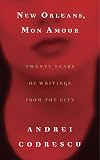
New Orleans, Mon Amour: Twenty Years of Writings from the City (2006) — Author — 254 copies, 6 reviews
The Muse Is Always Half-Dressed in New Orleans: and Other Essays (1993) — Author — 141 copies, 4 reviews
The Dog with the Chip in His Neck: Essays from NPR and Elsewhere (1996) — Author — 88 copies, 2 reviews
The Hole in the Flag: A Romanian Exile's Story of Return and Revolution (1991) — Author — 68 copies, 1 review
Whatever Gets You through the Night: A Story of Sheherezade and the Arabian Entertainments (2011) 47 copies
Thus Spake the Corpse: An Exquisite Corpse Reader, 1988-1998: Volume 2 - Fictions, Travels & Translations (1999) 45 copies
Thus Spake the Corpse : An Exquisite Corpse Reader 1988-1998 : Volume 1, Poetry & Essays (1999) 44 copies, 1 review
Reframing America: Alexander Alland, Otto Hagel & Hansel Mieth, John Gutmann, Lisette Model, Marion Palfi, Robert Frank (1995) 25 copies
Exquisite Corpse Vol. 1, No. 5 2 copies
For the Love of a Coat 1 copy
& Grammar & Money 1 copy
Exquisite Corpse 59 1 copy
Exquisite Corpse 1 copy
Associated Works
Acid Dreams: The Complete Social History of LSD: The CIA, the Sixties, and Beyond (1985) — Introduction, some editions — 649 copies, 6 reviews
Minutes of the Lead Pencil Club: Second Thoughts on the Electronic Revolution (1996) — Contributor — 88 copies, 1 review
Rediscoveries II: Important Writers Select Their Favorite Works of Neglected Fiction (1988) — Contributor — 31 copies, 1 review
Unmuzzled Ox 13 — Contributor — 7 copies
Tree 4: Winter 1974 — Contributor — 2 copies
Damn the Caesars, Vol II — Contributor — 1 copy
Funny Times: A Monthly Newspaper of Humor, Politics & Fun, Volume 16, Issue 3 (2001) — Contributor — 1 copy
Telephone 16 — Contributor — 1 copy
Talisman: A Journal of Contemporary Poetry and Poetics, Number 1, The Alice Notley Issue — Contributor — 1 copy
Famous, The Fred Lynn Issue — Contributor — 1 copy
Telephone 13 — Contributor — 1 copy
Strange Faeces 15 — Contributor — 1 copy
Personal Injury Magazine, no. 1 — Contributor — 1 copy
Passion: Men on Men {audio} — Contributor — 1 copy
Tagged
Common Knowledge
- Other names
- Perlmutter, Andrei (born)
- Birthdate
- 1946-12-20
- Gender
- male
- Occupations
- professor
NPR commentator on All Things Considered (since 1983)
poet
editor - Awards and honors
- ACLU Freedom of Speech Award
National Endowment for the Arts Fellowship (poetry ∙ editing ∙ and radio)
Ovid Prize (2006) - Nationality
- Romania (birth)
USA (passport) - Places of residence
- Sibiu, Transylvania, Romania (birthplace)
Baton Rouge, Louisiana, USA
New Orleans, Louisiana, USA - Associated Place (for map)
- Louisiana, USA
Members
Reviews
"New Orleans is different, I think, if only because the locals have had a long time to elaborate a style of living and a modus viviendi that couldn't be mistaken for anything else. Everybody in New Orleans loves the food, the music, and our sense of time (slow time) that's peculiar to us and to us only. There is a velvety sensuality here at the mouth of the Mississippi that you won't find anywhere else. Tell me what the air feels like 3 a.m. on a Thursday night in late August in Shaker show more Heights and I bet you won't be able to say because nobody stays up that late. But in New Orleans, I tell you, it's ink and honey passed through silver moonlight. Accuse me of poetry, go ahead. But prove that it isn't so. You can't, because New Orleans is made of a tissue of poetries that wove each other together over time."
From 1985 to 2005 (and then an afterword post-Katrina), Codrescu shares some of his writing from New Orleans. It's beautiful and sometimes gritty, reflecting both the light and dark of the city of dreams. He writes a few times of the parallels between New Orleans and Venice, which I had not previously considered, but having visited both, I get it. Venice had a similar effect on me- like walking into a magical city, out of real life and into a fantasy. Lovely. show less
From 1985 to 2005 (and then an afterword post-Katrina), Codrescu shares some of his writing from New Orleans. It's beautiful and sometimes gritty, reflecting both the light and dark of the city of dreams. He writes a few times of the parallels between New Orleans and Venice, which I had not previously considered, but having visited both, I get it. Venice had a similar effect on me- like walking into a magical city, out of real life and into a fantasy. Lovely. show less
I've been a fan of Codrescu for years through his spoken word bits he's done on National Public Radio (NPR). This is a collection of essays that he's written over a twenty year period about his adopted city of New Orleans, and it is a marvelous read. Codrescu's humor and insight are always sharp, and ordering this collection in this way allows the reader to follow his love affair with the city as it evolves from an initial infatuation to a deep and abiding love (the good and the bad), with show more the dark, unhappy moments that come with the package. Codrescu sees more from a coffee shop window than most of us can see in a year of observing our own neighborhood. Knowing about hurricane Katrina and post-Katrina New Orleans only serves to make many of his early observations even more relevant and powerful. Codrescu's essays reveal an ever-present awareness, likely shared by his neighbors, that the City was living on the edge of disaster.
I normally recommend reading collections like this in bits and pieces, and, certainly, one could do that, but the coherency of this anthology is so striking that I'd suggest taking it all in as you would a memoir or biography - a memoir is what this anthology turns out to be. show less
I normally recommend reading collections like this in bits and pieces, and, certainly, one could do that, but the coherency of this anthology is so striking that I'd suggest taking it all in as you would a memoir or biography - a memoir is what this anthology turns out to be. show less

One of the weirdest books I have ever read. I picked this up because of the author. Full of gratuitous sex and violence, no really. Is it a horror novel or historical fiction? It can't seem to decide. I was reviled and fascinated at the same time. I like it's prurient sado-erotic aspects more than the actual novel but in the end it was too much of a mess to rate it very high.
I thought Codrescu could write better than this, but I guess he should stick to short pieces.
I thought Codrescu could write better than this, but I guess he should stick to short pieces.

In 1947 Louis Armstrong posited the musical question, “Do you know what it means to miss New Orleans?” Sixty years later, this chestnut has taken on a whole new meaning, and (if you have any kind of heart at all) has a tendency to stick in the throat. This collection of mostly short musings in, around, and about the Crescent City finds Transylvanian transplant Andrei Codrescu in his cups and in his element and shows us exactly what it should mean.
You might think that the Deep South would show more be an odd choice of pot for a former Eastern Bloc no-goodnik to replant himself in, but with further contemplation, it does make sense. First of all, there is the vampire connection, a Bohemian sense of empire gone to dangerous seed, and a certain resigned patience that someone familiar with Soviet-style can-do attitude might recognize and respond to (eventually) in the low-gear stifling heat.
Arriving in town in 1985, Codrescu wasted no time in surrounding himself with like-minded writers, artists, and miscreants which all make for an entertaining read as they play out their fantastical roles on a rotting, vibrantly-colored stage. There is a bracingly abrupt pause between Codrescu’s description of a burgeoning art scene and the arrival of Hurricane Katrina. Most of this book is concerned with the years between 1985 and 2005, but there is an epilogue chillingly entitled, poetry will not end with the world.
“It’s heartbreaking watching my city sink,” Codrescu writes. “New Orleans will be rebuilt, but it will never again be the city I know and love.” After an entire book taken up showing us what we were missing, Codrescu unwittingly showed the world exactly what it should miss. show less
You might think that the Deep South would show more be an odd choice of pot for a former Eastern Bloc no-goodnik to replant himself in, but with further contemplation, it does make sense. First of all, there is the vampire connection, a Bohemian sense of empire gone to dangerous seed, and a certain resigned patience that someone familiar with Soviet-style can-do attitude might recognize and respond to (eventually) in the low-gear stifling heat.
Arriving in town in 1985, Codrescu wasted no time in surrounding himself with like-minded writers, artists, and miscreants which all make for an entertaining read as they play out their fantastical roles on a rotting, vibrantly-colored stage. There is a bracingly abrupt pause between Codrescu’s description of a burgeoning art scene and the arrival of Hurricane Katrina. Most of this book is concerned with the years between 1985 and 2005, but there is an epilogue chillingly entitled, poetry will not end with the world.
“It’s heartbreaking watching my city sink,” Codrescu writes. “New Orleans will be rebuilt, but it will never again be the city I know and love.” After an entire book taken up showing us what we were missing, Codrescu unwittingly showed the world exactly what it should miss. show less
Lists
Awards

You May Also Like


Associated Authors
Statistics
- Works
- 77
- Also by
- 22
- Members
- 3,352
- Popularity
- #7,616
- Rating
- 3.6
- Reviews
- 48
- ISBNs
- 142
- Languages
- 6
- Favorited
- 6