
Joan Didion (1934–2021)
Author of The Year of Magical Thinking
About the Author
Born in Sacramento, California, on December 5, 1934, Joan Didion received a B.A. from the University of California, Berkeley in 1956. She wrote for Vogue from 1956 to 1963, and was visiting regent's lecturer in English at the University of California, Berkeley in 1976. Didion also published novels, show more short stories, social commentary, and essays. Her work often comments on social disorder. Didion wrote for years on her native California; from there her perspective broadened and turned to the countries of Central America and Southeast Asia. Her novels include Democracy (1984) and The Last Thing He Wanted (1996). Well known nonfiction titles include Slouching Towards Bethlehem (1968), The White Album (1979), The Year of Magical Thinking (2005) and Blue Nights (2011). In 1971 Joan Didion was nominated for the National Book Award in fiction for Play It As It Lays. In 1981 she received the American Book Award in nonfiction, and was nominated for a National Book Critics Circle Prize in nonfiction for The White Album. Didion has received a great deal of recognition for The Year of Magical Thinking, which was awarded the National Book Award for Nonfiction in 2005. In 2007, Didion received the National Book Foundation's annual Medal for Distinguished Contribution to American Letters. In 2009, Didion was awarded an honorary Doctor of Letters degree by Harvard University. On July 3, 2013 the White House announced Didion was one of the recipients of the National Medals of Arts and Humanities presented by President Barack Obama. (Bowker Author Biography) show less
Image credit: Joan Didion, Malibu, California, October 1972
Works by Joan Didion
I Write to Find Out What I Am Thinking: Collected Nonfiction (Everyman's Library Contemporary Classics Series) (2025) 25 copies
Telling Stories (Series of Keepsakes Issued by the Friends of Bancroft Library, No. 26) (1978) 11 copies, 2 reviews
Goodbye to All That 9 copies
After Henry {essay} 7 copies
On Self-Respect 5 copies
The Women's Movement 3 copies
On Going Home 2 copies
Didion, Joan Archive 2 copies
After life 1 copy
“Quiet Days in Malibu” 1 copy
California Notes 1 copy
Associated Works
Boom! Voices of the Sixties: Personal Reflections on the '60s and Today (2007) — Contributor — 990 copies, 21 reviews
The Art of Fact: A Historical Anthology of Literary Journalism (1997) — Contributor — 225 copies, 1 review
The Writer on Her Work, Volume I: Contemporary Women Writers Reflect on their Art and Situation (1980) — Contributor — 199 copies, 1 review
Writing Women's Lives: An Anthology of Autobiographical Narratives by Twentieth-Century American Women Writers (1994) — Contributor — 128 copies, 3 reviews
The Glorious American Essay: One Hundred Essays from Colonial Times to the Present (2020) — Contributor — 119 copies
Writing New York: A Literary Anthology (Expanded 10th-Anniversary Edition) (2008) — Contributor — 101 copies, 1 review
Women's Magazines, 1940-1960: Gender Roles and the Popular Press (1998) — Contributor — 95 copies, 1 review
About Women: An Anthology of Contemporary Fiction, Poetry, and Essays (1973) — Contributor — 25 copies
Sylvia Plath's Tomato Soup Cake: A Compendium of Classic Authors' Favourite Recipes (2024) — Contributor — 6 copies
Works in Progress Number 7: Selections from the Best in Books to be Published in Coming Months (1972) — Contributor — 3 copies
Eight Modern Essayists (First Edition) — Contributor — 1 copy
Tagged
Common Knowledge
- Canonical name
- Didion, Joan
- Birthdate
- 1934-12-05
- Date of death
- 2021-12-23
- Gender
- female
- Education
- University of California, Berkeley (BA|1956 - English)
- Occupations
- novelist
essayist
screenwriter
editor - Organizations
- Vogue
- Awards and honors
- National Humanities Medal (2012)
PEN Center USA Lifetime Achievement Award (2013)
National Book Foundation Medal of Distinguished Contribution to American Letters (2007)
Evelyn F. Burkey Award (2007)
Prix Medicis Essais (2007)
American Philosophical Society (2006) (show all 13)
American Academy of Achievement's Golden Plate Award (2006)
American Academy of Arts and Letters (Gold Medal, 2005)
Robert Kirsch Award (2005)
Western Literature Association's Distinguished Achievement Award (2005)
St Louis Literary Award (2002)
Edward MacDowell Medal (1996)
American Academy of Arts and Letters (Literature, 1981) - Agent
- Lynn Nesbit (Janklow and Nesbit)
Henry Robbins - Relationships
- Dunne, John Gregory (husband)
Dunne, Dominick (brother-in-law)
Dunne, Dominique (niece)
Dunne, Griffin (nephew) - Cause of death
- Parkinson's disease
- Nationality
- USA
- Birthplace
- Sacramento, California, USA
- Places of residence
- Malibu, California, USA
Brentwood Park, California, USA
Los Angeles, California, USA
Manhattan, New York, New York, USA - Place of death
- Manhattan, New York, New York, USA
- Associated Place (for map)
- California, USA
Members
Discussions
Joan Didion? in Legacy Libraries (November 2022)
Which Joan Didion book should I read first? in Book talk (November 2019)
Reviews

this is really beautiful, and not in the way that i generally find books beautiful. her writing is great but it's not particularly lyrical, it's just so, so good. the way she writes this experience, the way her memories weave between the mundane and the extraordinary awfulness of grief is expertly done. i thought this was such a hard and important book and one that i'm going to save to return to when it's my turn for grief to come to me. i imagine it will feel like being seen and understood show more in such a crucial way.
"Grief turns out to be a place none of us know until we reach it. We anticipate (we know) that someone close to us could die, but we do not look beyond the few days or weeks that immediately follow such an imagined death. We misconstrue the nature of even those few days or weeks. We might expect if the death is sudden to feel shock. We do not expect this shock to be obliterative, dislocating to both body and mind. We might expect that we will be prostrate, inconsolable, crazy with loss. We do not expect to be literally crazy, cool customers who believe that their husband is about to return and need his shoes. In the version of grief we imagine, the model will be 'healing.' A certain forward movement will prevail. The worst days will be the earliest days. We imagine that the moment to most severely test us will be the funeral, after which this hypothetical healing will take place. When we anticipate the funeral we wonder about failing to 'get through it,' rise to the occasion, exhibit the 'strength' that invariably gets mentioned as the correct response to death. We anticipate needing to steel ourselves for the moment: will I be able to greet people, will I be able to leave the scene, will I be able even to get dressed that day? We have no way of knowing that this will not be the issue. We have no way of knowing that the funeral itself will be anodyne, a kind of narcotic regression in which we are wrapped in the care of others and the gravity and meaning of the occasion. Nor can we know ahead of the fact that (and here lies the heart of the difference between grief as we imagine it and grief as it is) the unending absence that follows, the void, the very opposite of meaning, the relentless succession of moments during which we will confront the experience of meaningless itself." show less
"Grief turns out to be a place none of us know until we reach it. We anticipate (we know) that someone close to us could die, but we do not look beyond the few days or weeks that immediately follow such an imagined death. We misconstrue the nature of even those few days or weeks. We might expect if the death is sudden to feel shock. We do not expect this shock to be obliterative, dislocating to both body and mind. We might expect that we will be prostrate, inconsolable, crazy with loss. We do not expect to be literally crazy, cool customers who believe that their husband is about to return and need his shoes. In the version of grief we imagine, the model will be 'healing.' A certain forward movement will prevail. The worst days will be the earliest days. We imagine that the moment to most severely test us will be the funeral, after which this hypothetical healing will take place. When we anticipate the funeral we wonder about failing to 'get through it,' rise to the occasion, exhibit the 'strength' that invariably gets mentioned as the correct response to death. We anticipate needing to steel ourselves for the moment: will I be able to greet people, will I be able to leave the scene, will I be able even to get dressed that day? We have no way of knowing that this will not be the issue. We have no way of knowing that the funeral itself will be anodyne, a kind of narcotic regression in which we are wrapped in the care of others and the gravity and meaning of the occasion. Nor can we know ahead of the fact that (and here lies the heart of the difference between grief as we imagine it and grief as it is) the unending absence that follows, the void, the very opposite of meaning, the relentless succession of moments during which we will confront the experience of meaningless itself." show less

I will try to be Joan Didion's witness regarding A Book of Common Prayer (1977). It is a great, ambitious novel. It is not common. Even despite its title, none of its characters have a prayer. A not uncommon trait afflicting the characters of Joan Didion's novels. That's just Joan being Joan. Cynical and ironic. Master of irony. Cynic's mistress. Joan Didion. Making me ruefully laugh calling her third novel A Book of Common Prayer. Amen.
A trait uncommon, I should amend, in the three novels show more I've so far read of the five novels of Joan Didion. The other novel's by Joan Didion I've read being A Book of Common Prayer's predecessor, Play It As It Lays (1970), and Prayer's follow-up, Democracy (1984). Perhaps they are common traits in the two novels by Joan Didion I've not yet read; her debut, Run River (1963) and most recent, though published nearly two decades ago around the time Clinton began his second term, The Last Thing He Wanted (1996). Maybe the characters inhabiting those novels have prayers. But I doubt it. Knowing Joan Didion as I do from what I've read by her, I know she plays it dark. Dims the lights on hopes. Draws the blinds on dreams. Embodies delusions.
Or wait. I'm being unfair to Joan Didion. Joan Didion's characters, I should clarify, by their choices, have ruined their hopes and dreams, remained true to their delusions, and not Joan Didion. I need to make that distinction clear. I do not want to make the same mistake as Charlotte Douglas, waning starlet and society girl who is A Book of Common's Prayer's star. Or more precisely, A Book of Common's Prayer's black hole. The black hole whom, according to the narrator of the novel, Grace Strasser Mendana, "did not make enough distinctions in her life". Grace Strasser Mendana would know. She is a scientist, but also "a student of delusion" investigating its very DNA. A Book of Common Prayer is essentially Grace's case study of Charlotte Douglas' puzzling DNA and demise. But it's also a study of guilt. Grace's guilt, not Charlotte's. But that is the subject perhaps of another novel by Joan Didion, maybe of Democracy, or maybe not.
We know Charlotte is already dead on page one.
We know that Grace will soon be dead a few pages later, after learning that Charlotte is dead and that the narrative is a remembrance. A liturgy paying homage to delusion, to Charlotte's in particular, "who dreamed her life" away. Who believed even as machine guns got her in their sights, that everything in the country of Boca Grande would turn out all right.
We know, as I already said, though it bears repeating, that no one has a prayer in A Book of Common Prayer. Pardon my redundancy, but Joan Didion says the same words and phrases twice, thrice, four times. Sometimes, Joan Didion says the same words and phrases twice, thrice, four times in italics. When Joan Didion says the same words and phrases twice, thrice, four times in italics, she is not merely doing so for emphasis. But to characterize the longing or the loss in memory. Or for social or political commentary. Or to set a mood. To evoke gravitas in her prose. For effect, powerful effect, her poignant motifs. Much has been made of Joan Didion's much-emulated style. Ask Bret Easton Ellis, Joan Didion's copycat in style. Or don't. He might not like being reminded that the style he's made famous was never his to begin with. But Joan's. Read Joan Didion yourself and see. Be her witness.
We know that even those who do not die in A Book of Common Prayer will not survive. I like that paradox. It is a representative paradox of the kind Joan Didion might write in order to imply something weightier than words. The power in Joan Didion's prose is evident beyond her singular style and terse technique. How she craftily imbues her prose with implication upon implication makes her svelte novels feel heavy in your hands like doorstopper tomes. One ruminates on, as much as reads, Joan Didion.
We know that Charlotte and her first husband, Warren Bogart, have an estranged daughter, Marin, raised by Charlotte and her second husband, Leonard Douglas, wanted by the F.B.I. for her terrorism. She's nineteen in most of Grace Strasser Mendana's remembrance of Charlotte Douglas. Nineteen, the same age as the youngest of the two Boston Marathon bombers. But Marin didn't blow up the Boston Marathon. Marin blew up the Transamerica building in San Francisco. Left behind a tape explaining why. The way a rebel parrot might explain why.
"All class enemies must suffer exemplary punishment. When the fascist police think we are near we will be far away. When the fascist police think we are far away we will be near ... We shall reply to repression with liberation. We shall reply to the terrorism of the dictatorship with the terrorism of the revolutions," Marin intoned, and with a lisp we are told by Charlotte, from the tape.
We know that Marin caught the pungent whiff of revolucion when her parents lived in the fictitious, Central American nation of Boca Grande and let the house staff tend to her rearing. Not to mention her reading. Citizens of Boca Grande raising a norte americana child. Countries of constant rot and impending riot.
We know Marin's parents, Charlotte and Leonard, were probably arms dealers disguised as U.S. diplomats. Except Charlotte, being Charlotte, wasn't cognizant of the fairly obvious fact that her second husband, Leonard, was involved in shady back room dealings with the power brokers of Boca Grande, supplying weapons and obfuscation under the watchful auspices of the U.S. government attempting to install by dubious means another regime in Central America. Read Salvador sometime, Didion's later take on real life moral rot and political riot in Central America.
We know that Marin had gotten herself permanently high on the anti-imperialist propaganda that festered down there in Boca Grande. Propaganda that was fueled in part by Marin's stepfather, a veritable tentacle of the U.S. military, that man, Leonard. Idealistic Marin, looking for a just cause to believe in but finding none in her parents, adopted new parents -- an ideology -- and chose the local subversive screeds of "the Brazilian guerilla theorist named Marighela" as her textbooks and personal guides. In lieu of higher institutional learning, Marin began (covertly herself -- like stepfather, like stepdaughter) a crash course in guerilla tactics, taught behind the scenes and between the lines of A Book of Common Prayer, a philosophy taught by Grace Strasser Mendana's warring brother and son, men on opposing political sides in Boca Grande; men that Marin's mother, Charlotte, shacked up with -- both of them -- in the days leading to her death, when civil war erupted yet again in Earth's anus, Boca Grande. Leonard and Grace tried to convince Charlotte to get the hell out of Boca Grande before the latest coup began, but Charlotte had a dinner to attend at the hotel restaurant that evening. Hosted by herself for herself. Which was Charlotte's last supper, so to speak, the grand finale of freedom before Boca Grande's airport was shut down by rebel factions for good.
"Charlotte made not enough distinctions. She took people's words at face value."
Yet Marin made her distinctions. Made her judgments. And saw the worthlessness of her parent's face values; the worthlessness of their wealth.
We know Marin's end will be life in prison or in violent death. But where is she in the interim?
"A man who described himself as a disillusioned Scientologist called Charlotte to say that Marin was under the influence of a Clear in Shasta Lake. A masseuse at Elizabeth Arden called Charlotte to say that she had received definite word from Edgar Cayce via Mass Mind that Marin was with the Hunzas in the Himalayas. The partially decomposed body of a young woman was found in a shallow grave on the Bonneville Salt Flats but the young woman's dental work differed conclusively from Marin's." At least these peculiar strangers seemed to care about Marin's whereabouts.
"Fuck Marin".
Hard to believe Charlotte uttered those words before being fatally shot in the crossfire of Boca Grande. Was Charlotte wrong for launching such a callous invective against her only daughter? Warren Bogart, Marin's biological father, said Charlotte was wrong about many things, but not about Marin, having been the first to say what Charlotte said about her.
The first to say, "Fuck Marin".
We know that soon after saying what Warren said about the daughter he rejected for her violent crimes, he died alone in a motel room. So fuck Warren Bogart. Good riddance was the general consensus regarding his death. Readers of A Book of Common Prayer, therefore, need not anticipate a tender Douglas family reunion or reconciliation with tears. Tear gas maybe, but not tears.
We know that the only player in Didion's grim novel, Grace Strasser Mendana, who met Marin, after her parents were dead and she was still hiding out from the F.B.I. in a cockroach-dive in Buffalo, would discover something tender, something transcendent, albeit discovered too late, upon meeting Marin. Then Grace Strasser Mendana (named Grace for good reason), after what she learned about Marin and, more significantly, about herself, would also die. From cancer. And we grieve. But we already knew this, didn't we, from the first few pages of A Book of Common Prayer? Grace's fate. Yet still we're sad.
Knowing Grace was doomed.
Knowing Charlotte was doomed.
Knowing Charlotte's second husband, Leonard, never gave a shit.
Knowing Warren, Charlotte's first husband, always was a shit.
Knowing Marin had no chance in Hell or Boca Grande at a real childhood.
Knowing no one had a prayer is what's so sad.
Knowing all that, from the get-go, is sadder.
But knowing that bad endings begat bad beginnings in the bassackwards world of Boca Grande is barely half the sad story of A Book of Common Prayer. Because Joan Didion is that good. Relaying the bad news first and the bad news last, and whacking you repeatedly upside the head with all the bad news in between, yet keeping you guessing, still reading, still caring, thanks to Grace's dignified manner of eulogizing her misguided subjects, makes Joan's Didion's achievement as profound as the mystery of common prayer. show less
A trait uncommon, I should amend, in the three novels show more I've so far read of the five novels of Joan Didion. The other novel's by Joan Didion I've read being A Book of Common Prayer's predecessor, Play It As It Lays (1970), and Prayer's follow-up, Democracy (1984). Perhaps they are common traits in the two novels by Joan Didion I've not yet read; her debut, Run River (1963) and most recent, though published nearly two decades ago around the time Clinton began his second term, The Last Thing He Wanted (1996). Maybe the characters inhabiting those novels have prayers. But I doubt it. Knowing Joan Didion as I do from what I've read by her, I know she plays it dark. Dims the lights on hopes. Draws the blinds on dreams. Embodies delusions.
Or wait. I'm being unfair to Joan Didion. Joan Didion's characters, I should clarify, by their choices, have ruined their hopes and dreams, remained true to their delusions, and not Joan Didion. I need to make that distinction clear. I do not want to make the same mistake as Charlotte Douglas, waning starlet and society girl who is A Book of Common's Prayer's star. Or more precisely, A Book of Common's Prayer's black hole. The black hole whom, according to the narrator of the novel, Grace Strasser Mendana, "did not make enough distinctions in her life". Grace Strasser Mendana would know. She is a scientist, but also "a student of delusion" investigating its very DNA. A Book of Common Prayer is essentially Grace's case study of Charlotte Douglas' puzzling DNA and demise. But it's also a study of guilt. Grace's guilt, not Charlotte's. But that is the subject perhaps of another novel by Joan Didion, maybe of Democracy, or maybe not.
We know Charlotte is already dead on page one.
We know that Grace will soon be dead a few pages later, after learning that Charlotte is dead and that the narrative is a remembrance. A liturgy paying homage to delusion, to Charlotte's in particular, "who dreamed her life" away. Who believed even as machine guns got her in their sights, that everything in the country of Boca Grande would turn out all right.
We know, as I already said, though it bears repeating, that no one has a prayer in A Book of Common Prayer. Pardon my redundancy, but Joan Didion says the same words and phrases twice, thrice, four times. Sometimes, Joan Didion says the same words and phrases twice, thrice, four times in italics. When Joan Didion says the same words and phrases twice, thrice, four times in italics, she is not merely doing so for emphasis. But to characterize the longing or the loss in memory. Or for social or political commentary. Or to set a mood. To evoke gravitas in her prose. For effect, powerful effect, her poignant motifs. Much has been made of Joan Didion's much-emulated style. Ask Bret Easton Ellis, Joan Didion's copycat in style. Or don't. He might not like being reminded that the style he's made famous was never his to begin with. But Joan's. Read Joan Didion yourself and see. Be her witness.
We know that even those who do not die in A Book of Common Prayer will not survive. I like that paradox. It is a representative paradox of the kind Joan Didion might write in order to imply something weightier than words. The power in Joan Didion's prose is evident beyond her singular style and terse technique. How she craftily imbues her prose with implication upon implication makes her svelte novels feel heavy in your hands like doorstopper tomes. One ruminates on, as much as reads, Joan Didion.
We know that Charlotte and her first husband, Warren Bogart, have an estranged daughter, Marin, raised by Charlotte and her second husband, Leonard Douglas, wanted by the F.B.I. for her terrorism. She's nineteen in most of Grace Strasser Mendana's remembrance of Charlotte Douglas. Nineteen, the same age as the youngest of the two Boston Marathon bombers. But Marin didn't blow up the Boston Marathon. Marin blew up the Transamerica building in San Francisco. Left behind a tape explaining why. The way a rebel parrot might explain why.
"All class enemies must suffer exemplary punishment. When the fascist police think we are near we will be far away. When the fascist police think we are far away we will be near ... We shall reply to repression with liberation. We shall reply to the terrorism of the dictatorship with the terrorism of the revolutions," Marin intoned, and with a lisp we are told by Charlotte, from the tape.
We know that Marin caught the pungent whiff of revolucion when her parents lived in the fictitious, Central American nation of Boca Grande and let the house staff tend to her rearing. Not to mention her reading. Citizens of Boca Grande raising a norte americana child. Countries of constant rot and impending riot.
We know Marin's parents, Charlotte and Leonard, were probably arms dealers disguised as U.S. diplomats. Except Charlotte, being Charlotte, wasn't cognizant of the fairly obvious fact that her second husband, Leonard, was involved in shady back room dealings with the power brokers of Boca Grande, supplying weapons and obfuscation under the watchful auspices of the U.S. government attempting to install by dubious means another regime in Central America. Read Salvador sometime, Didion's later take on real life moral rot and political riot in Central America.
We know that Marin had gotten herself permanently high on the anti-imperialist propaganda that festered down there in Boca Grande. Propaganda that was fueled in part by Marin's stepfather, a veritable tentacle of the U.S. military, that man, Leonard. Idealistic Marin, looking for a just cause to believe in but finding none in her parents, adopted new parents -- an ideology -- and chose the local subversive screeds of "the Brazilian guerilla theorist named Marighela" as her textbooks and personal guides. In lieu of higher institutional learning, Marin began (covertly herself -- like stepfather, like stepdaughter) a crash course in guerilla tactics, taught behind the scenes and between the lines of A Book of Common Prayer, a philosophy taught by Grace Strasser Mendana's warring brother and son, men on opposing political sides in Boca Grande; men that Marin's mother, Charlotte, shacked up with -- both of them -- in the days leading to her death, when civil war erupted yet again in Earth's anus, Boca Grande. Leonard and Grace tried to convince Charlotte to get the hell out of Boca Grande before the latest coup began, but Charlotte had a dinner to attend at the hotel restaurant that evening. Hosted by herself for herself. Which was Charlotte's last supper, so to speak, the grand finale of freedom before Boca Grande's airport was shut down by rebel factions for good.
"Charlotte made not enough distinctions. She took people's words at face value."
Yet Marin made her distinctions. Made her judgments. And saw the worthlessness of her parent's face values; the worthlessness of their wealth.
We know Marin's end will be life in prison or in violent death. But where is she in the interim?
"A man who described himself as a disillusioned Scientologist called Charlotte to say that Marin was under the influence of a Clear in Shasta Lake. A masseuse at Elizabeth Arden called Charlotte to say that she had received definite word from Edgar Cayce via Mass Mind that Marin was with the Hunzas in the Himalayas. The partially decomposed body of a young woman was found in a shallow grave on the Bonneville Salt Flats but the young woman's dental work differed conclusively from Marin's." At least these peculiar strangers seemed to care about Marin's whereabouts.
"Fuck Marin".
Hard to believe Charlotte uttered those words before being fatally shot in the crossfire of Boca Grande. Was Charlotte wrong for launching such a callous invective against her only daughter? Warren Bogart, Marin's biological father, said Charlotte was wrong about many things, but not about Marin, having been the first to say what Charlotte said about her.
The first to say, "Fuck Marin".
We know that soon after saying what Warren said about the daughter he rejected for her violent crimes, he died alone in a motel room. So fuck Warren Bogart. Good riddance was the general consensus regarding his death. Readers of A Book of Common Prayer, therefore, need not anticipate a tender Douglas family reunion or reconciliation with tears. Tear gas maybe, but not tears.
We know that the only player in Didion's grim novel, Grace Strasser Mendana, who met Marin, after her parents were dead and she was still hiding out from the F.B.I. in a cockroach-dive in Buffalo, would discover something tender, something transcendent, albeit discovered too late, upon meeting Marin. Then Grace Strasser Mendana (named Grace for good reason), after what she learned about Marin and, more significantly, about herself, would also die. From cancer. And we grieve. But we already knew this, didn't we, from the first few pages of A Book of Common Prayer? Grace's fate. Yet still we're sad.
Knowing Grace was doomed.
Knowing Charlotte was doomed.
Knowing Charlotte's second husband, Leonard, never gave a shit.
Knowing Warren, Charlotte's first husband, always was a shit.
Knowing Marin had no chance in Hell or Boca Grande at a real childhood.
Knowing no one had a prayer is what's so sad.
Knowing all that, from the get-go, is sadder.
But knowing that bad endings begat bad beginnings in the bassackwards world of Boca Grande is barely half the sad story of A Book of Common Prayer. Because Joan Didion is that good. Relaying the bad news first and the bad news last, and whacking you repeatedly upside the head with all the bad news in between, yet keeping you guessing, still reading, still caring, thanks to Grace's dignified manner of eulogizing her misguided subjects, makes Joan's Didion's achievement as profound as the mystery of common prayer. show less
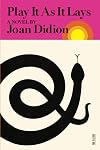
Joan Didion's Play It As It Lays is a quick read but it burdens like an anvil with its infectious existential despair after. Maria, an actress, finds herself swimming in worn out Hollywood memories whilst lying in a hospital bed, what's left of its magnetising spark and glamour, and hedonism which are only a temporary reprieve from its monstrosity: the transient fame, the disillusioned promises of films and acting, a rocky and adulterous marriage, a sick daughter, the fake friends, and the show more ultimate expiration date brought by age and trend. Maria's life is dramatic and tragic like the movies. With the lack of creative control and voice both at home and work they snake their way to Maria's life. She eventually lacks control in any part of it. She is looking for purpose, for meaning, anything to make life worth clinging to yet it's devoid of anything. What she has is a series of sexual and superficial encounters as she tethers herself into anything and anyone that alleviates any part of her that aches. Soon, we learn more, the how's, the cries, the tries but not really the why's.
Play It As It Lays is a sad charade of living. Its people have the luxury for everything yet they have nothing. They take anything as a panacea to plaster the malady of emptiness and longing underneath a critical yet debauch society. Along the lights and sounds of Las Vegas hides a bellow for help whilst the thirst of wanting floods the dry Mojave Desert.
Didion writes with high precision and lucidity; its relevance scarily familiar in the present still. The struggles of being a woman, a mother, and an actress embrace its rough pages. She performs an accurate autopsy of our society dead enough not to care about its nauseating norms and impossible expectations. It is an utterly devastating story of surviving day by day with eyes closed whilst hoping for a better tomorrow. Please prepare yourself for the anvil. show less
Play It As It Lays is a sad charade of living. Its people have the luxury for everything yet they have nothing. They take anything as a panacea to plaster the malady of emptiness and longing underneath a critical yet debauch society. Along the lights and sounds of Las Vegas hides a bellow for help whilst the thirst of wanting floods the dry Mojave Desert.
Didion writes with high precision and lucidity; its relevance scarily familiar in the present still. The struggles of being a woman, a mother, and an actress embrace its rough pages. She performs an accurate autopsy of our society dead enough not to care about its nauseating norms and impossible expectations. It is an utterly devastating story of surviving day by day with eyes closed whilst hoping for a better tomorrow. Please prepare yourself for the anvil. show less

I am honestly shocked by the rhapsodizing I've heard concerning her over the years. But I guess I shouldn't be. This smug sophisticate is precisely placed to give the establishment what it wants. It's very sly the way Didion guilelessly slouches through each scene, pulling out rugs, trying to spotlight ironies. She's the high-society poet of ennui, the vanquisher of unstylish rebels.
Viewed through the lens of her privileged bubble, challengers of the establishment, those rabble-rousing show more political types, are simple grotesques, naive child harbingers of chaos. This is because the ravages of inequality, injustice, state violence are faraway abstractions for her, unpleasantries to ruin a cocktail party (where she might show up just to look waifish, hide and judge people). Her heroes are figureheads of the capitalist fantasy machine like swaggering John "The Duke" Wayne and mega-rich playboy Hughes.
I finally had to stop after her nauseating ode to those 'self-loving' pioneers of the American frontier. You know the ones who swarmed the continent like locusts so we can have shopping malls instead of forests. Genocide can be wholesome fun as long as the victims are brown. Whoop-dee-doo for self-love. Her only previous mention of anyone of color is her painfully awkward and derisive depiction of a few faceless "negroes" in a crowd.
Does Didion deliver an insight or clever bon mot here or there? Hell, she spends every moment of her (stilted/shoe-gazing/chain-smoking/coke-swilling) life racing to jot down her every thought. She's bound to kick over a shiny pebble or two. But always she holds herself at a safe distance from life, never fathoming it in its essence. show less
Viewed through the lens of her privileged bubble, challengers of the establishment, those rabble-rousing show more political types, are simple grotesques, naive child harbingers of chaos. This is because the ravages of inequality, injustice, state violence are faraway abstractions for her, unpleasantries to ruin a cocktail party (where she might show up just to look waifish, hide and judge people). Her heroes are figureheads of the capitalist fantasy machine like swaggering John "The Duke" Wayne and mega-rich playboy Hughes.
I finally had to stop after her nauseating ode to those 'self-loving' pioneers of the American frontier. You know the ones who swarmed the continent like locusts so we can have shopping malls instead of forests. Genocide can be wholesome fun as long as the victims are brown. Whoop-dee-doo for self-love. Her only previous mention of anyone of color is her painfully awkward and derisive depiction of a few faceless "negroes" in a crowd.
Does Didion deliver an insight or clever bon mot here or there? Hell, she spends every moment of her (stilted/shoe-gazing/chain-smoking/coke-swilling) life racing to jot down her every thought. She's bound to kick over a shiny pebble or two. But always she holds herself at a safe distance from life, never fathoming it in its essence. show less
Lists
Favourite Books (4)
. (1)
Unread books (1)
Female Author (1)
Deathreads (1)
Cooper (1)
Phoebe Bridgers (1)
100 New Classics (1)
Film (1)
Overdue Podcast (1)
Allie's Wishlist (1)
. (1)
Central America (1)
First Novels (1)
2000s decade (1)
On the pile (1)
Read These Too (2)
el (2)
sad girl books (2)
1960s (1)
sad girl books (2)
My TBR (2)
1970 Club (1)
1970s (1)
Career (1)
Carole's List (1)
Awards


You May Also Like


Associated Authors
Statistics
- Works
- 56
- Also by
- 36
- Members
- 36,430
- Popularity
- #507
- Rating
- 3.9
- Reviews
- 785
- ISBNs
- 499
- Languages
- 18
- Favorited
- 142


