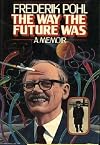
The Way the Future Was
by Frederik Pohl
On This Page
Description
The award-winning author and editor Pohl traces his lifelong involvement with science fiction.Tags
Recommendations

























Member Reviews
I enjoyed it a lot.
It's the story of a life heavily influenced by his love for science fiction. As a kid, a copy of one of the very early pulp magazines (Hugo Gernsback's Wonder Stories, IIRC) got into his hands, and his mind was blown away. From then on, he was hopelessly hooked. We see him as a young fan in the 30's getting involved in the first attempts of fandom to establish contact and organize itself (remember, no internet then!). Fans actually first got in contact with each other through mail thanks to Hugo's magazine, since it printed a letter section that included the writers' addresses, and later it was Hugo Gernsback who, in an attempt to consolidate his audience, got the idea to encourage and organize fans through his show more magazine to form science fiction clubs (what he called the Science Fiction League). Young Fred Pohl took to that like a fish takes to water, and soon he became heavily involved in New York's nascent fandom.
Eventually, he and some other like-minded youngsters created their own club, the Futurians, many of whom became well-known SF writers and editors. It's all a rather fascinating look at how fandom started, and Pohl was usually at the best place to experience it all.
Still very young, he got a job as editor of a minor SF pulp magazine, and we get to see how that world worked too. Then he served in the army in WWII (by the time he was sent to Europe the war was finishing, so he didn't see combat). Later he became an agent for many of the most famous SF writers, and managed to get broke. Then he became a big-shot editor, editing for example the prestigious SF magazines Galaxy and If... All the time he was also writing when he could, and occasionally having some other jobs to pay the bills, and socializing with numerous famous people in science fiction.
Unfortunately, the book was published right before what probably was his most successful time as a writer, when he published big classics like Man Plus and Gateway. Nevertheless, it's a fascinating opportunity for anyone with an interest in the history of science fiction to hear from someone who was heavily involved and made many contributions. Pohl is not as funny when he tells anecdotes as Asimov, but he has his own gruff, self-deprecating humor and tells things in an entertaining manner. show less
It's the story of a life heavily influenced by his love for science fiction. As a kid, a copy of one of the very early pulp magazines (Hugo Gernsback's Wonder Stories, IIRC) got into his hands, and his mind was blown away. From then on, he was hopelessly hooked. We see him as a young fan in the 30's getting involved in the first attempts of fandom to establish contact and organize itself (remember, no internet then!). Fans actually first got in contact with each other through mail thanks to Hugo's magazine, since it printed a letter section that included the writers' addresses, and later it was Hugo Gernsback who, in an attempt to consolidate his audience, got the idea to encourage and organize fans through his show more magazine to form science fiction clubs (what he called the Science Fiction League). Young Fred Pohl took to that like a fish takes to water, and soon he became heavily involved in New York's nascent fandom.
Eventually, he and some other like-minded youngsters created their own club, the Futurians, many of whom became well-known SF writers and editors. It's all a rather fascinating look at how fandom started, and Pohl was usually at the best place to experience it all.
Still very young, he got a job as editor of a minor SF pulp magazine, and we get to see how that world worked too. Then he served in the army in WWII (by the time he was sent to Europe the war was finishing, so he didn't see combat). Later he became an agent for many of the most famous SF writers, and managed to get broke. Then he became a big-shot editor, editing for example the prestigious SF magazines Galaxy and If... All the time he was also writing when he could, and occasionally having some other jobs to pay the bills, and socializing with numerous famous people in science fiction.
Unfortunately, the book was published right before what probably was his most successful time as a writer, when he published big classics like Man Plus and Gateway. Nevertheless, it's a fascinating opportunity for anyone with an interest in the history of science fiction to hear from someone who was heavily involved and made many contributions. Pohl is not as funny when he tells anecdotes as Asimov, but he has his own gruff, self-deprecating humor and tells things in an entertaining manner. show less
Frederik Pohl (1919-2013) fell in love with science fiction as a child during the Depression. He found friends who shared his passion and went on to have a long, influential career as a literary agent, writer, and editor. The Way the Future Was, his 1978 memoir, is not a warts-and-all tell-all, but he is forthright in assessing his own character. Married five times, he admits that many of the breakups were his own fault.
He doesn’t let his friends entirely off the hook. He calls the young Futurians, his 1930s fan group whose membership included such Golden Age stars as Isaac Asimov, James Blish, Damon Knight, and Donald A. Wolheim, “a fairly snotty lot.” He chastises Hugo Gernsback for not paying his writers, and he knew John show more Campbell “swallowed whole such magnolious nonsense as dianetics, the Hieronymous machine, and the John Birch Society.”
Still, he admired Campbell’s eye for talent and his instincts as an editor. Campbell warned him against writerly flourishes: “I hate a story that begins with atmosphere. Get right into the story, never mind the atmosphere.” He also offered this helpful advice in the 1930s: “I want the kind of story that could be printed in a magazine of the year two thousand A.D. as a contemporary adventure story. No gee-whiz, just take the technology for granted.” I don’t know many writers today who can write adventures that would sound contemporary six or seven decades in the future. Pohl could. show less
He doesn’t let his friends entirely off the hook. He calls the young Futurians, his 1930s fan group whose membership included such Golden Age stars as Isaac Asimov, James Blish, Damon Knight, and Donald A. Wolheim, “a fairly snotty lot.” He chastises Hugo Gernsback for not paying his writers, and he knew John show more Campbell “swallowed whole such magnolious nonsense as dianetics, the Hieronymous machine, and the John Birch Society.”
Still, he admired Campbell’s eye for talent and his instincts as an editor. Campbell warned him against writerly flourishes: “I hate a story that begins with atmosphere. Get right into the story, never mind the atmosphere.” He also offered this helpful advice in the 1930s: “I want the kind of story that could be printed in a magazine of the year two thousand A.D. as a contemporary adventure story. No gee-whiz, just take the technology for granted.” I don’t know many writers today who can write adventures that would sound contemporary six or seven decades in the future. Pohl could. show less
This is a memoir by Fred Pohl, one of the guiding influences of 20th century science fiction, published in 1979. Although he had success with his writing, his chief influence, certainly from this book, is in his editing of various magazines and his role in helping to promote a large number of the famous names of SF.
The first chapters deal with his childhood, discovery of science fiction at a young age and involvement in what eventually became science fiction fandom. The author writes about the Depression, the various editors and how he became an editor himself, for little money, at the age of nineteen. There are also anecdotes about John W Campbell, the famous editor of Astounding Science Fiction (and also the fantasy magazine, show more Unknown, although strangely that isn't mentioned at all from my recollection).
Interestingly, he also tells of how he was drawn into an organisation of young Communists. Eventually he parted company from them in disgust at how they changed from being anti-fascist to supporting Nazi Germany just because Stalin had signed a pact with Hitler. I fully expected him to later describe how he was hauled in front of the Un-American Activities Committee in the 1950s but he actually says very little on the subject. Perhaps they were only interested in film writers?
Pohl joined the army in 1943 during WWII. While still in basic training in the States, he had requested his mother to send his portable typewriter to him. Shortly after being posted to a weather unit in Italy, he learned that she was ill. She had for all intents and purposes been a single parent, since his father was always off working somewhere but often on get-rich-quick schemes which would have worked out if he hadn't been tempted to invest in yet one more and subsequently lost everything. So I would have expected he and his mother to be close. He tried to find the Red Cross man for permission to send a telegram and maybe even get compassionate leave back to the States but then heard that his mother had died. He is curiously unemotional about this. He just found a quiet place to work on his typewriter and started a novel about life in New York.
Back in civvy street, he became an advertising copywriter while continuing to write SF short stories on the side. He also began helping his childhood friend, Dirk Wylie, who had set up a literary agency since he couldn't manage more strenuous work. Dirk had received a life threatening back injury in the war, from which he eventually died. Pohl carried on helping Dirk's widow run the agency and eventually took it over. By this time, book publishers were beginning to publish science fiction, creating a market for both reprints of serialised novels and novels written especially for book publication. One of the best of these was Ian Ballantine, founder of Ballantine Books, who Pohl worked with closely. Eventually, Pohl resigned his copywriting job to become a full-time agent. He represented many of the top writers of the period but after seven years somehow ended up going bust with thirty thousand dollars of debt which he eventually paid off over a number of years.
One of the interests of this book for me were all the cameo appearance of 'Golden Age' writers whose work I had come across in anthology reprints years ago, such as Fletcher Pratt, Henry Kuttner, Pohl's close friend Cyril Kornbluth, L Sprague de Camp and others. The more famous writers such as Isaac Asimov and Robert Heinlein also make cameo appearances.
There are interesting insights into the world of magazines both before WWII and afterwards, including the attitudes of those who owned them and the lengths editors had to go to in order to try to keep them afloat and to pay the writers a half-decent amount. The editors themselves were low paid. A lot of the stories were poor, mainly due to the poor pay rates. WWII paper shortages, plus the collapse of a major distributor which a speculator acquired cheaply to wind them up and sell off their large holding of property, put a lot of magazines out of business in the 50s. He had long been selling stories to Galaxy, one of the leaders of the field which managed to survive the collapse, but as the editor Horace Gold became ill, Pohl was drafted in to cover for him temporarily and ended up staying on as editor for nine years.
A main thread later in the book is the various marriages and relationships he and others in the SF community formed, a feature being that people divorced and then married someone else's other half. Even by WWII he had already been married twice, both marriages ending amicably after a couple of years. But his third marriage was to Judith Merrill, who I knew of chiefly as an editor of science fiction, but not about their marriage. Their breakup was not amicable, due to a custody battle over their daughter. Soon afterwards, he married again and by the end of the book was already heading towards yet another divorce.
Some out-of-date attitudes are on show. At one point, he mentions he has been 'liberated' and is aware of women's equality etc, yet later on refers to the average writer's spouse having issues with 'his' behaviour. ("Writing is the only job I know that your wife will nag you out of.... and more in the same vein, though he had favourable things to say about particular women writers.) There are a few references to gay men which come across as disapproving though possibly weren't meant as such; one reference early on to a "predatory" homosexual (the context being one which today's writers and readers would clearly differentiate as nothing to do with being gay but being the behaviour of a paedophile). There's also a mention of someone in the then-all-male fandom making an approach to someone and being 'greeted with such revulsion and horror that he cravenly crept back into line' though the author is quick to say he wasn't present. And there is one section where words unacceptable now are used, although it is in the context of saying how he was born a WASP and therefore not disadvantaged in the way these various groups were.
The book becomes a bit meandering towards the end. From discussion of his involvement on a long running radio chat show, he moves on to ESP and UFOs and how he looked into the bona fides of both. There's a discussion of the history of the Milford SF writing workshop, the illness suffered by his and Carol's (wife number 3) daughter, and the death of his friend Cyril Kornbluth, again of WWII complications. The book ends on a down-note, with various friends dying, relationships severed and his marriage becoming adrift. He was turning fifty and a trip to Japan was a high point, but he then became depressed as they moved on to Hawaii and then Los Angeles. Only science fiction had remained the constant love of his life.
An interesting book on the whole but a bit disjointed in places. Sometimes he shot ahead to later developments, then went back only to deal with the subject again later on. This made things a bit confusing, for example, a reference to the Hydra Club before reaching the part of the memoir where that was explained. As mentioned above, the ending is a bit of a damp squib. But there was enough interest to make this a 3 star rating for me. show less
The first chapters deal with his childhood, discovery of science fiction at a young age and involvement in what eventually became science fiction fandom. The author writes about the Depression, the various editors and how he became an editor himself, for little money, at the age of nineteen. There are also anecdotes about John W Campbell, the famous editor of Astounding Science Fiction (and also the fantasy magazine, show more Unknown, although strangely that isn't mentioned at all from my recollection).
Interestingly, he also tells of how he was drawn into an organisation of young Communists. Eventually he parted company from them in disgust at how they changed from being anti-fascist to supporting Nazi Germany just because Stalin had signed a pact with Hitler. I fully expected him to later describe how he was hauled in front of the Un-American Activities Committee in the 1950s but he actually says very little on the subject. Perhaps they were only interested in film writers?
Pohl joined the army in 1943 during WWII. While still in basic training in the States, he had requested his mother to send his portable typewriter to him. Shortly after being posted to a weather unit in Italy, he learned that she was ill. She had for all intents and purposes been a single parent, since his father was always off working somewhere but often on get-rich-quick schemes which would have worked out if he hadn't been tempted to invest in yet one more and subsequently lost everything. So I would have expected he and his mother to be close. He tried to find the Red Cross man for permission to send a telegram and maybe even get compassionate leave back to the States but then heard that his mother had died. He is curiously unemotional about this. He just found a quiet place to work on his typewriter and started a novel about life in New York.
Back in civvy street, he became an advertising copywriter while continuing to write SF short stories on the side. He also began helping his childhood friend, Dirk Wylie, who had set up a literary agency since he couldn't manage more strenuous work. Dirk had received a life threatening back injury in the war, from which he eventually died. Pohl carried on helping Dirk's widow run the agency and eventually took it over. By this time, book publishers were beginning to publish science fiction, creating a market for both reprints of serialised novels and novels written especially for book publication. One of the best of these was Ian Ballantine, founder of Ballantine Books, who Pohl worked with closely. Eventually, Pohl resigned his copywriting job to become a full-time agent. He represented many of the top writers of the period but after seven years somehow ended up going bust with thirty thousand dollars of debt which he eventually paid off over a number of years.
One of the interests of this book for me were all the cameo appearance of 'Golden Age' writers whose work I had come across in anthology reprints years ago, such as Fletcher Pratt, Henry Kuttner, Pohl's close friend Cyril Kornbluth, L Sprague de Camp and others. The more famous writers such as Isaac Asimov and Robert Heinlein also make cameo appearances.
There are interesting insights into the world of magazines both before WWII and afterwards, including the attitudes of those who owned them and the lengths editors had to go to in order to try to keep them afloat and to pay the writers a half-decent amount. The editors themselves were low paid. A lot of the stories were poor, mainly due to the poor pay rates. WWII paper shortages, plus the collapse of a major distributor which a speculator acquired cheaply to wind them up and sell off their large holding of property, put a lot of magazines out of business in the 50s. He had long been selling stories to Galaxy, one of the leaders of the field which managed to survive the collapse, but as the editor Horace Gold became ill, Pohl was drafted in to cover for him temporarily and ended up staying on as editor for nine years.
A main thread later in the book is the various marriages and relationships he and others in the SF community formed, a feature being that people divorced and then married someone else's other half. Even by WWII he had already been married twice, both marriages ending amicably after a couple of years. But his third marriage was to Judith Merrill, who I knew of chiefly as an editor of science fiction, but not about their marriage. Their breakup was not amicable, due to a custody battle over their daughter. Soon afterwards, he married again and by the end of the book was already heading towards yet another divorce.
Some out-of-date attitudes are on show. At one point, he mentions he has been 'liberated' and is aware of women's equality etc, yet later on refers to the average writer's spouse having issues with 'his' behaviour. ("Writing is the only job I know that your wife will nag you out of.... and more in the same vein, though he had favourable things to say about particular women writers.) There are a few references to gay men which come across as disapproving though possibly weren't meant as such; one reference early on to a "predatory" homosexual (the context being one which today's writers and readers would clearly differentiate as nothing to do with being gay but being the behaviour of a paedophile). There's also a mention of someone in the then-all-male fandom making an approach to someone and being 'greeted with such revulsion and horror that he cravenly crept back into line' though the author is quick to say he wasn't present. And there is one section where words unacceptable now are used, although it is in the context of saying how he was born a WASP and therefore not disadvantaged in the way these various groups were.
The book becomes a bit meandering towards the end. From discussion of his involvement on a long running radio chat show, he moves on to ESP and UFOs and how he looked into the bona fides of both. There's a discussion of the history of the Milford SF writing workshop, the illness suffered by his and Carol's (wife number 3) daughter, and the death of his friend Cyril Kornbluth, again of WWII complications. The book ends on a down-note, with various friends dying, relationships severed and his marriage becoming adrift. He was turning fifty and a trip to Japan was a high point, but he then became depressed as they moved on to Hawaii and then Los Angeles. Only science fiction had remained the constant love of his life.
An interesting book on the whole but a bit disjointed in places. Sometimes he shot ahead to later developments, then went back only to deal with the subject again later on. This made things a bit confusing, for example, a reference to the Hydra Club before reaching the part of the memoir where that was explained. As mentioned above, the ending is a bit of a damp squib. But there was enough interest to make this a 3 star rating for me. show less
In a fractional rating system, I'd give this 4.2 stars.
This was another "grabbed randomly from the shelf" book, and when I saw it in my hand I almost put it back. It's the autobiography of classic science fiction writer and editor Fredric Pohl, as well as a history of the early days and Golden Age of science fiction.
I hadn't read it in so long that I'd forgotten if it was any good. But then I figured that it would still be better than reading nothing, so I kept it.
And you know, it's actually very good so far! I'd forgotten that Pohl was another of the Brooklyn cabal of early science fiction writers. And he's a damned good one, to boot. I never lived in Brooklyn, and I was born long after the Great Depression, but I have friends in show more Brooklyn.
I almost wish I had lived in Brooklyn in those days. Pohl makes it sound great. He doesn't pretty it up, but still, it sounds exciting and just plain fun.
This book is very much worth reading for any science fiction fan. show less
This was another "grabbed randomly from the shelf" book, and when I saw it in my hand I almost put it back. It's the autobiography of classic science fiction writer and editor Fredric Pohl, as well as a history of the early days and Golden Age of science fiction.
I hadn't read it in so long that I'd forgotten if it was any good. But then I figured that it would still be better than reading nothing, so I kept it.
And you know, it's actually very good so far! I'd forgotten that Pohl was another of the Brooklyn cabal of early science fiction writers. And he's a damned good one, to boot. I never lived in Brooklyn, and I was born long after the Great Depression, but I have friends in show more Brooklyn.
I almost wish I had lived in Brooklyn in those days. Pohl makes it sound great. He doesn't pretty it up, but still, it sounds exciting and just plain fun.
This book is very much worth reading for any science fiction fan. show less
this book will make you want to be a writer (at least it did for me). It is a great remembering of old time fandom.
Pohl is so down home humble and tells it like it was: a long slog to getting published and a long road paved with poverty after that...but told with a glint in his eye and nary any bitterness.
It was an interesting set of memories regarding some of the Sci-Fi greats in the late forties and the 1950s.
Members
- Recently Added By
Lists

Best Biographies, Autobiographies and Memoirs
464 works; 156 members

Science Fiction and Fantasy Autobiographies
38 works; 3 members
Author Information

638+ Works 42,772 Members
Frederik Pohl was born in New York City on November 26, 1919. More interested in writing than in school, he dropped out of high school in his senior year and took a job with a publishing company. After serving as a public relations officer in the United States Army from 1943 to 1945, he returned to publishing as copywriter for Popular Science, a show more literary agent for several sci-fi writers, and the editor for the magazines Galaxy and If from 1959 until 1969, with If winning three successive Hugo awards. His first published work, a poem entitled Elegy to a Dead Satellite: Luna, was printed in Amazing Stories magazine in 1937 under the pen name Elton Andrews. His first science fiction novels were published in the mid 1960's, some written in collaboration with other writers, others created alone. During his lifetime, he won over 16 major awards for his writing (much of which was published pseudonymously) including six Hugo Awards and three Nebula Awards. His works include Gateway, which won the Campbell Memorial, Hugo, Locus SF, and Nebula Awards, Beyond the Blue Event Horizon, and Jem, which won the National Book Award in 1979. He also embraced blogging in his later years, using his online journal as an ongoing sequel to his autobiography, The Way the Future Was. He died on September 2, 2013 at the age 93. (Bowker Author Biography) show less
Some Editions
Awards and Honors
Awards
Series
Belongs to Publisher Series
Science Fiction Book Club (1650)
Common Knowledge
- Original publication date
- 1978-08
- People/Characters
- Frederik Pohl
- Dedication
- For Carol, who shared so much of it, and made it so much nicer.
- First words
- When I first encountered science fiction, Herbert Hoover was the President of the United States, a plump, perplexed man who never quite figured out what had gone wrong.
- Last words
- (Click to show. Warning: May contain spoilers.)But I loved her on sight, giftless, and it looks as if I'll go on doing it as long as I live.
- Blurbers
- Asimov, Isaac; Bova, Ben; Farmer, Philip Jose; Herbert, Frank; Simak, Clifford; Williamson, Jack
Classifications
- Genres
- Biography & Memoir, Literature Studies and Criticism
- DDC/MDS
- 016.099 — Computer science, information & general works Bibliographies (books containing lists of books) Bibliographies of works on specific subjects Information Manuscripts and rare books
- LCC
- PS3566 .O36 .Z47 — Language and Literature American literature American literature Individual authors 1961-
Statistics
- Members
- 360
- Popularity
- 87,129
- Reviews
- 11
- Rating
- (4.05)
- Languages
- English
- Media
- Paper
- ISBNs
- 5
- ASINs
- 9