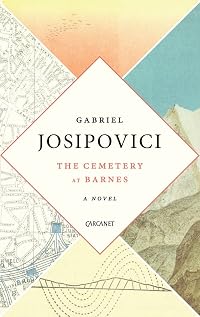
The Cemetery in Barnes
by Gabriel Josipovici
On This Page
Description
Longlisted for the Republic of Consciousness Prize 2019. Shortlisted for The Goldsmiths Prize 2018. Gabriel Josipovici's The Cemetery in Barnes is a short, intense novel that opens in elegiac mode, advances quietly towards something dark and disturbing, before ending with an eerie calm. Its three plots, relationships and time-scales are tightly woven into a single story; three voices--as in an opera by Monteverdi--provide the soundtrack, enhanced by a chorus of friends and acquaintances. The show more main voice is that of a translator who moves from London to Paris and then to Wales, the setting for an unexpected conflagration. The ending at once confirms and suspends the reader's darkest intuitions. The Cemetery in Barnes reaffirms Josipovici's status as "one of the very best writers now at work in the English language, and a man whose writing, both in fiction and in critical studies, displays a unity of sensibility and intelligence and deep feeling difficult to overvalue at any time," (Guardian). show lessTags
Recommendations







Member Reviews
This short book tells a story without a plot, and yet it entices. Josipovici’s storytelling style is not spectacular; he uses an almost careless, gently rippling tone, and many repetitive elements, but offering a richness that arises from an ingenious play of appearance and reality.
The unnamed narrator is a professional translator, a seemingly phlegmatic man with no remarkable personality, but one obsessed with the tragic verses of Monteverdi's Orfeo and the languorous poetry of Joachim du Bellay. He has settled into a sluggish bourgeois existence, with a lot of attention for the good things in life, but clearly also on the verge of depression or even over it. He is still obsessed with his late first wife, who was everything to him, show more but who he constantly shadowed when she returned from work and who he did not try to save when she fell into the Thames. And the marriage to his second wife seems perfectly harmonious, but their seemingly polite bickering reveals a yawning chasm between the two.
In other words, Josipovici presents an intriguing game of contradictions, in which he regularly casts doubt on the truthfulness of the above-mentioned elements and refers to the possibility of imaginary lives. He reinforces this by constantly jumping through time and place. Almost imperceptibly, we pass from the protagonist's life with his second wife in a farmhouse in Wales, to his first marriage and residence in London, to his lonely existence in Paris after the death of his first wife. This play with time and place constantly unbalances the reader. On top of that the author regularly repeats the same events and actions, but each time with small variations and an occasional sinister accent, in which death constantly comes into play. Also the male protagonist himself, almost carelessly, introduces these small variations in his story, by regularly repeating the original texts of Monteverdi and du Bellay, but each time translating them slightly differently, shifting the meaning of the verses. In this way, Josipovici seems to ingeniously link modernism and postmodernism, confusing his reader, while at the same time addressing a very rich palette of existential themes. It was my first acquaintance with this author, but it certainly won't be my last. show less
The unnamed narrator is a professional translator, a seemingly phlegmatic man with no remarkable personality, but one obsessed with the tragic verses of Monteverdi's Orfeo and the languorous poetry of Joachim du Bellay. He has settled into a sluggish bourgeois existence, with a lot of attention for the good things in life, but clearly also on the verge of depression or even over it. He is still obsessed with his late first wife, who was everything to him, show more but who he constantly shadowed when she returned from work and who he did not try to save when she fell into the Thames. And the marriage to his second wife seems perfectly harmonious, but their seemingly polite bickering reveals a yawning chasm between the two.
In other words, Josipovici presents an intriguing game of contradictions, in which he regularly casts doubt on the truthfulness of the above-mentioned elements and refers to the possibility of imaginary lives. He reinforces this by constantly jumping through time and place. Almost imperceptibly, we pass from the protagonist's life with his second wife in a farmhouse in Wales, to his first marriage and residence in London, to his lonely existence in Paris after the death of his first wife. This play with time and place constantly unbalances the reader. On top of that the author regularly repeats the same events and actions, but each time with small variations and an occasional sinister accent, in which death constantly comes into play. Also the male protagonist himself, almost carelessly, introduces these small variations in his story, by regularly repeating the original texts of Monteverdi and du Bellay, but each time translating them slightly differently, shifting the meaning of the verses. In this way, Josipovici seems to ingeniously link modernism and postmodernism, confusing his reader, while at the same time addressing a very rich palette of existential themes. It was my first acquaintance with this author, but it certainly won't be my last. show less
Extraordinary. Bewitching. Bemusing. Intense.
This novella has the beauty of the sonnets and opera it quotes but has subtly sinister undercurrents as well. The effect is beguiling: the threads are disorientingly dissolved and then crystallised from the rippling waters.
Watery words
The narrative swishes almost imperceptibly between three timelines of the main, unnamed, character's life. It’s like watching waves crash on a beach, then sink back a fair way, before being overtaken by another wave, or of ripples merging, distorting, reforming.
Image: Ripples rippling ripples (Source.)
It opens in Paris, detailing the daily routine of a music-loving widowed literary translator, in the third person. Then, at the bottom of the third show more page:
Sometimes you also went to concerts, his wife - his second wife - would interrupt him.
A sudden, seamless jump in time, place, and point of view, without even quotation marks.
Thus it continues: his Putney days with his first wife, his solitary time in Paris, and living in Wales with his wife - his second wife. A paragraph about his male neighbour in Wales is followed by one where he refers to the translator in Paris.
Rinse and repeat - but tweak
Recurring phrases in both the narrative and between the translator and his wife - his second wife - are like the chorus of a hymn and lend a liturgical, ritualistic reverence, like a repetition of their marriage vows, but also like a performance. Guests at their converted farmhouse high up in the Black Mountains above Abergavenny… were sometimes tempted to clap at a particularly pithy exchange.
Image: Transverse and longitudinal waves, fluctuating in prominence like the time periods of the story (Source.)
Amid the apparent beauty, truth and imagination interleave and blur, as shadow gather and darken.
Everyone has fantasies. In the one life there are many lives. Alternative lives. Some are lived and others are imagined.
When whole scenes are repeated, they change in each telling, like the variations of musical themes in an orchestral work. Where lies the truth? Which life is the one lived?
One sprouts so many lives… One is a murderer. One an incendiary. One a suicide. One lives in London. One in Paris. One in New York.
Tardis?
Josipovici is a literary magician who clearly loves language as much as the central character. In under 100, generously-spaced, very readable pages that include excerpts of poems and libretto and a magical-realist or dream episode (bartender and silver token), he weaves a story that explores sociability and solitude, clarity and opacity, fire and water, words and music, a scar of unclear significance, friends who barely know each other, truth and lies, life and death.
It is bigger on the inside. The reader has to find the story, the true story, becoming the translator – the second translator - along the way.
I wondered about a central, dramatic, event that is described as happening in several different ways, and decided the mystery was not meant to be confidently solvable. That was later confirmed in a comment on Paul's review, where he said:
"It was fascinating to ask the author in person if he knew what happened and to be told 'no, if I knew that I wouldn’t have written the book'."
Quotes
• It was the combination of surprising detail and general reflection he found so satisfying in du Bellay…
The combination of quiet precision… and profound despair that never failed to move him. (I felt the same.)
• They never called each other by name… Friends of theirs wondered if they used the same formula when they were alone, but no one really knew them well enough to ask.
• Turning the words over in his mouth as though to suck the last ounce of sweetness from them. (On rereading beloved and familiar erotic epyllia by Shakespeare.)
• Nothing comes to an end. You never leave anything behind. It always catches up with you. (Like the waves of the story washing over the reader.)
• The formal gardens and general air of symmetry which made parts of the city so elegant and so depressing at the same time. (Paris)
• Thinking frequently and long enough about something makes it seem at first possible, then even probably, and, finally, necessary.
Links
Read this novella once to be immersed. Then brush up on some of the many cultural references that are tightly sewn to its canvas, and read it again to understand it more deeply. Rinse and repeat.
• Monteverdi’s opera, L'Orfeo, is the classical Greek myth of Orpheus descending to the underworld to bring back his beloved Euridice, a story where music is integral. While writing this review, I listened to a performance from Gran Teatre del Liceu, Barcelona, 2002: here.
Image: Orpheus (with lyre) among the Thracians c440 BC (Source.)
• Emily Dickinson’s poem, A Narrow Fellow in the Grass, refers to a snake, which links back to the story of Euridice.
• French poet Joachim du Bellay published The Regrets: sonnets about his travels in Italy in the 1550s. You can read some of them with French and English adjacent, here.
• Shakespeare’s early works include erotic epyllia like Venus and Adonis, which is mentioned, including the lovely line, ‘The sea hath bounds, but deep desire hath none’.
• The (old) Barnes Cemetery in London has the grave of poet William Palgrave.
• The Père Lachaise Cemetery in Paris is the only cemetery I‘ve visited for its architecture and atmosphere.
• The Black Mountains, near Abergavenny in Wales, are beautiful.
• It’s also worth polishing your French and Italian pronunciation! Many of the poems and lyrics are immediately followed by their English translation, but to appreciate the translator’s job, you need to hear the difference, to feel the loss of rhyme and wordplay between ‘Infelice Euridice’ and ‘Unhappy Eurydice’, for example. show less
This novella has the beauty of the sonnets and opera it quotes but has subtly sinister undercurrents as well. The effect is beguiling: the threads are disorientingly dissolved and then crystallised from the rippling waters.
Watery words
The narrative swishes almost imperceptibly between three timelines of the main, unnamed, character's life. It’s like watching waves crash on a beach, then sink back a fair way, before being overtaken by another wave, or of ripples merging, distorting, reforming.
Image: Ripples rippling ripples (Source.)
It opens in Paris, detailing the daily routine of a music-loving widowed literary translator, in the third person. Then, at the bottom of the third show more page:
Sometimes you also went to concerts, his wife - his second wife - would interrupt him.
A sudden, seamless jump in time, place, and point of view, without even quotation marks.
Thus it continues: his Putney days with his first wife, his solitary time in Paris, and living in Wales with his wife - his second wife. A paragraph about his male neighbour in Wales is followed by one where he refers to the translator in Paris.
Rinse and repeat - but tweak
Recurring phrases in both the narrative and between the translator and his wife - his second wife - are like the chorus of a hymn and lend a liturgical, ritualistic reverence, like a repetition of their marriage vows, but also like a performance. Guests at their converted farmhouse high up in the Black Mountains above Abergavenny… were sometimes tempted to clap at a particularly pithy exchange.
Image: Transverse and longitudinal waves, fluctuating in prominence like the time periods of the story (Source.)
Amid the apparent beauty, truth and imagination interleave and blur, as shadow gather and darken.
Everyone has fantasies. In the one life there are many lives. Alternative lives. Some are lived and others are imagined.
When whole scenes are repeated, they change in each telling, like the variations of musical themes in an orchestral work. Where lies the truth? Which life is the one lived?
One sprouts so many lives… One is a murderer. One an incendiary. One a suicide. One lives in London. One in Paris. One in New York.
Tardis?
Josipovici is a literary magician who clearly loves language as much as the central character. In under 100, generously-spaced, very readable pages that include excerpts of poems and libretto and a magical-realist or dream episode (bartender and silver token), he weaves a story that explores sociability and solitude, clarity and opacity, fire and water, words and music, a scar of unclear significance, friends who barely know each other, truth and lies, life and death.
It is bigger on the inside. The reader has to find the story, the true story, becoming the translator – the second translator - along the way.
I wondered about a central, dramatic, event that is described as happening in several different ways, and decided the mystery was not meant to be confidently solvable. That was later confirmed in a comment on Paul's review, where he said:
"It was fascinating to ask the author in person if he knew what happened and to be told 'no, if I knew that I wouldn’t have written the book'."
Quotes
• It was the combination of surprising detail and general reflection he found so satisfying in du Bellay…
The combination of quiet precision… and profound despair that never failed to move him. (I felt the same.)
• They never called each other by name… Friends of theirs wondered if they used the same formula when they were alone, but no one really knew them well enough to ask.
• Turning the words over in his mouth as though to suck the last ounce of sweetness from them. (On rereading beloved and familiar erotic epyllia by Shakespeare.)
• Nothing comes to an end. You never leave anything behind. It always catches up with you. (Like the waves of the story washing over the reader.)
• The formal gardens and general air of symmetry which made parts of the city so elegant and so depressing at the same time. (Paris)
• Thinking frequently and long enough about something makes it seem at first possible, then even probably, and, finally, necessary.
Links
Read this novella once to be immersed. Then brush up on some of the many cultural references that are tightly sewn to its canvas, and read it again to understand it more deeply. Rinse and repeat.
• Monteverdi’s opera, L'Orfeo, is the classical Greek myth of Orpheus descending to the underworld to bring back his beloved Euridice, a story where music is integral. While writing this review, I listened to a performance from Gran Teatre del Liceu, Barcelona, 2002: here.
Image: Orpheus (with lyre) among the Thracians c440 BC (Source.)
• Emily Dickinson’s poem, A Narrow Fellow in the Grass, refers to a snake, which links back to the story of Euridice.
• French poet Joachim du Bellay published The Regrets: sonnets about his travels in Italy in the 1550s. You can read some of them with French and English adjacent, here.
• Shakespeare’s early works include erotic epyllia like Venus and Adonis, which is mentioned, including the lovely line, ‘The sea hath bounds, but deep desire hath none’.
• The (old) Barnes Cemetery in London has the grave of poet William Palgrave.
• The Père Lachaise Cemetery in Paris is the only cemetery I‘ve visited for its architecture and atmosphere.
• The Black Mountains, near Abergavenny in Wales, are beautiful.
• It’s also worth polishing your French and Italian pronunciation! Many of the poems and lyrics are immediately followed by their English translation, but to appreciate the translator’s job, you need to hear the difference, to feel the loss of rhyme and wordplay between ‘Infelice Euridice’ and ‘Unhappy Eurydice’, for example. show less
Shortlisted for the Goldsmiths Prize 2018
Longlisted for the Republic of Consciousness Prize 2019
I must admit that I knew nothing of Josipovici before the Goldsmiths shortlist was announced but this cryptic, allusive, reflective and slippery portrait of a translator and his secrets is a little gem.
Told in the third person, the main protagonist is never named. The narrative, which often repeats itself with subtle variations, frequently switches between the three phases of his life, first in Putney with his first wife, then alone in Paris and finally in the foothills of the Brecon Beacons with his second. Intertwined with this are reflections on the 16th Century French poet du Bellay and the impossibility of translating his work, and the show more music of Monteverdi, specifically his opera Orfeo, which parallels the main narrative.
Much of the book reads as a philosophical meditation, but darker secrets emerge occasionally, hinted at and later clarified.
I suspect that I missed quite a lot, and that this book would reward a close rereading. It would certainly make a worthy winner of the prize. show less
Longlisted for the Republic of Consciousness Prize 2019
I must admit that I knew nothing of Josipovici before the Goldsmiths shortlist was announced but this cryptic, allusive, reflective and slippery portrait of a translator and his secrets is a little gem.
Told in the third person, the main protagonist is never named. The narrative, which often repeats itself with subtle variations, frequently switches between the three phases of his life, first in Putney with his first wife, then alone in Paris and finally in the foothills of the Brecon Beacons with his second. Intertwined with this are reflections on the 16th Century French poet du Bellay and the impossibility of translating his work, and the show more music of Monteverdi, specifically his opera Orfeo, which parallels the main narrative.
Much of the book reads as a philosophical meditation, but darker secrets emerge occasionally, hinted at and later clarified.
I suspect that I missed quite a lot, and that this book would reward a close rereading. It would certainly make a worthy winner of the prize. show less
This may be the first book of fiction I have read in which translations are used as part of the story telling, to express character, a state of mind, a theme.
Our protagonist translates from French to English. He knows translation is unsatisfactory. As do we. Translation is like memory, while it brings out the story trapped in another language, it’s an elusive, never exact, version of the original.
There are three timeframes, easy enough to follow (as far as I can tell there are three anyway). In the present, the protagonist lives with his second wife in the Welsh countryside. They have friends who visit for lunches, one of which may be the person to whom this story is told and he in turn is retelling it. (I find such narrative show more mechanics deeply satisfying since they allow for a range of inconsistencies to exist in the story and also, we are in a state where we can only know what we are told: delicious for the literarily speculative among us.)
There is the time of the first wife to whom something happens, and that event, like a trauma, loss, is relived over and over.
The third time frame is the long period of isolation in a Paris apartment between first wife and second wife (or so I think it is). The protagonist talks about translating, being good at it and getting jobs done easily and quickly. This is also the time when the action focuses on the 17thC French poet Joachim Du Bellay much loved by the protagonist, particularly a series of sonnets around the theme of regret. He walks the Paris streets, he lives in an unchanging regime taking small delights from small things, and tea; routine, and the needs of the body are few and easily satisfied.
These three time frames are brought together by repetition of phrasing, which in prose is much like the repetition in music, so at times it can be mesmerizing, reminding us of some presence and returning us to an idea, a previous moment in the story.
Return is a theme: the protagonist talks about life with the first wife, lost in the river, he couldn’t help her he says; the imagery bobbing up, like someone trying not to drown or memory, popping up out of the depths. But only certain details about this life together are clear, mostly it’s a kind of blurred by tragedy.
Orpheus wants Eurydice back, but I’m not sure our unnamed protagonist does, or did. Most of the life with the first wife is hazy, incomplete, in the process of being forgotten.
But the Orpheus story is compelling in the way it, too, returns. Our protagonist sits in his Paris apartment bath listening to Claudio Monteverdi’s L’Orfeo. He plays back the libretto in his mind. This retelling of the libretto is like the retelling of the story of the first wife. In playing it over, something new is created, like music, like art, out of desperation to recall, Orpheus and our protagonist recreates.
The Orpheus story is constant. I’ve always thought the story of Orpheus was the story of recollection, remembering and returning to something lost, that cannot return. Orpheus wants Eurydice to return so much he can recreate her in his mind. His musical skill is tethered to the art of recollecting. Music is committed to memory, like the thoughts of those we loved. The moment Orpheus looks back to find Eurydice, she has started to disappear, is the moment of all memories, intangible, fleeting, lost.
Inconclusive, elusive. That is the entire story.
NOTE: I wrote this review four years ago and forgot it floating in my computer files, it bobbed up like ... um a memory? show less
Our protagonist translates from French to English. He knows translation is unsatisfactory. As do we. Translation is like memory, while it brings out the story trapped in another language, it’s an elusive, never exact, version of the original.
There are three timeframes, easy enough to follow (as far as I can tell there are three anyway). In the present, the protagonist lives with his second wife in the Welsh countryside. They have friends who visit for lunches, one of which may be the person to whom this story is told and he in turn is retelling it. (I find such narrative show more mechanics deeply satisfying since they allow for a range of inconsistencies to exist in the story and also, we are in a state where we can only know what we are told: delicious for the literarily speculative among us.)
There is the time of the first wife to whom something happens, and that event, like a trauma, loss, is relived over and over.
The third time frame is the long period of isolation in a Paris apartment between first wife and second wife (or so I think it is). The protagonist talks about translating, being good at it and getting jobs done easily and quickly. This is also the time when the action focuses on the 17thC French poet Joachim Du Bellay much loved by the protagonist, particularly a series of sonnets around the theme of regret. He walks the Paris streets, he lives in an unchanging regime taking small delights from small things, and tea; routine, and the needs of the body are few and easily satisfied.
These three time frames are brought together by repetition of phrasing, which in prose is much like the repetition in music, so at times it can be mesmerizing, reminding us of some presence and returning us to an idea, a previous moment in the story.
Return is a theme: the protagonist talks about life with the first wife, lost in the river, he couldn’t help her he says; the imagery bobbing up, like someone trying not to drown or memory, popping up out of the depths. But only certain details about this life together are clear, mostly it’s a kind of blurred by tragedy.
Orpheus wants Eurydice back, but I’m not sure our unnamed protagonist does, or did. Most of the life with the first wife is hazy, incomplete, in the process of being forgotten.
But the Orpheus story is compelling in the way it, too, returns. Our protagonist sits in his Paris apartment bath listening to Claudio Monteverdi’s L’Orfeo. He plays back the libretto in his mind. This retelling of the libretto is like the retelling of the story of the first wife. In playing it over, something new is created, like music, like art, out of desperation to recall, Orpheus and our protagonist recreates.
The Orpheus story is constant. I’ve always thought the story of Orpheus was the story of recollection, remembering and returning to something lost, that cannot return. Orpheus wants Eurydice to return so much he can recreate her in his mind. His musical skill is tethered to the art of recollecting. Music is committed to memory, like the thoughts of those we loved. The moment Orpheus looks back to find Eurydice, she has started to disappear, is the moment of all memories, intangible, fleeting, lost.
Inconclusive, elusive. That is the entire story.
NOTE: I wrote this review four years ago and forgot it floating in my computer files, it bobbed up like ... um a memory? show less
I read this in four sittings and for how small the book is, it were far too many breaks already. Initially I had such a hard time figuring if I had read a part before and forgotten or is it being repeated. I read it on a kindle, which made it impossible to go back and forth to check.
But eventually I got the drift. A book like this, you flow with it. As little as my grip on the events or facts in the book, it still had me completely engaged.
What a strange book. It is incredible of the author to pull this off. So many questions. So few answers. Yet so full of meaning.
But eventually I got the drift. A book like this, you flow with it. As little as my grip on the events or facts in the book, it still had me completely engaged.
What a strange book. It is incredible of the author to pull this off. So many questions. So few answers. Yet so full of meaning.
A mysterious book that draws on a wealth of culture to such an extent that readers like myself find themselves struggling to draw meaning out of the morass.
Ratings
Members
- Recently Added By
Lists

TLS 6011
41 works; 1 member
Author Information
62+ Works 1,268 Members
Gabriel Josipovici is Research Professor in the Graduate School of Humanities at the University of Sussex.
Awards and Honors
Awards
Common Knowledge
- Canonical title
- The Cemetery in Barnes
- Original publication date
- 2018
- Epigraph
- 'I am freezing. The sky is made of iron and I of stone.'
Holderlin to Schiller, September 1795 - Dedication
- In memory of Bernard Hoepffner
dear friend - best of translators
Classifications
Statistics
- Members
- 74
- Popularity
- 426,242
- Reviews
- 6
- Rating
- (3.83)
- Languages
- English
- Media
- Paper, Ebook
- ISBNs
- 3
- ASINs
- 2