
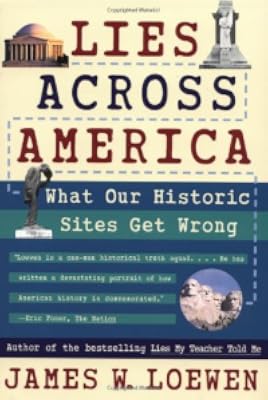
Lies Across America: What Our Historic Sites Get Wrong
by James W. Loewen
On This Page
Description
A book by the bestselling, American Book Award-winning author. In Lies Across America, James W. Loewen continues his mission, begun in the award-winning Lies My Teacher Told Me, of overturning the myths and misinformation that too often pass for American history. This is a one-of-a-kind examination of historic sites all over the country where history is literally written on the landscape, including historical markers, monuments, historic houses, forts, and ships. New changes and updates show more include: - A town in Louisiana that was the site of a major but now-forgotten slave uprising - A totally revised tour of the memory and intentional forgetting of slavery and the Civil War in Richmond, Virginia - The hideout of a gang in Delaware that made money by kidnapping free blacks and selling them into slavery Entertaining and enlightening, Lies Across America also has a serious role to play in contemporary debates about white supremacy and Confederate memorials. show lessTags
Recommendations







Member Reviews
Loewen is always a highly engaging, accessible writer. In Lies Across America, he takes what potentially could be a dull subject: historical sites, plaques and monuments, and creates a dynamic narrative of the history of the u.s. and the implications of our collective 'historic amnesia'.
by investigating the motives of a) creating the monuments to begin with and b) those who fund the monuments, loewen gives us great insight into the way that glory, memory and history is constructed in the u.s., its effects on those who are remembered as actively participating in history, and those who participated and are brushed aside.
if all tours of historic sites were as honest and engaging as loewen's research, everyone would want to visit them. i show more especially found the sections on reconstruction fascinating. as anyone who learned "american" history in united states knows, we are not always given the treat of such an insightful approach to the period of time after the liberation of slaves in the united states. show less
by investigating the motives of a) creating the monuments to begin with and b) those who fund the monuments, loewen gives us great insight into the way that glory, memory and history is constructed in the u.s., its effects on those who are remembered as actively participating in history, and those who participated and are brushed aside.
if all tours of historic sites were as honest and engaging as loewen's research, everyone would want to visit them. i show more especially found the sections on reconstruction fascinating. as anyone who learned "american" history in united states knows, we are not always given the treat of such an insightful approach to the period of time after the liberation of slaves in the united states. show less
This book does a good job of exposing disinformation on the American landscape. But on the whole I don't think it's very balanced. The section on the South is by far the largest, and a huge number of the historic sites under question relate to the Confederacy. I'm grateful to him for exposing these, although he would have done well to balance them with some lies told by the Union side. I also would have liked to see more lies regarding sites relating to American Indians, or the lack of appropriate sites.
I also agree with some critics of the book that he is sexist. For instance he actually has the gall to claim that women have historically had a higher status than men, as if men were somehow an oppressed group and women were the ruling show more class. And where he does talk about women being suppressed it's never by dominating men, but rather by "the social structure". Uh-huh. That's exactly the same sort of distancing he criticizes others of elsewhere. (I'm referring mostly to lie #6 here, which should be promptly torn from the book.) show less
I also agree with some critics of the book that he is sexist. For instance he actually has the gall to claim that women have historically had a higher status than men, as if men were somehow an oppressed group and women were the ruling show more class. And where he does talk about women being suppressed it's never by dominating men, but rather by "the social structure". Uh-huh. That's exactly the same sort of distancing he criticizes others of elsewhere. (I'm referring mostly to lie #6 here, which should be promptly torn from the book.) show less
As an avid landmark snarfer, you can imagine my excitement at finding this book on what our historical markers, memorials, and monuments get wrong - and, occasionally, right. Some of it made me very sad. After all, much of American history can be summarized as "white people ruin everything," but there were some bright spots. And some very funny ones, like the woman in Indiana who is only remembered for moving there sans a body part. It certainly opened my eyes when reading markers and visiting monuments, and gave me new questions to ask and points to ponder. I'd never even heard of the Philippines-American war, for example, and my education about Reconstruction was much less thorough (and more biased) than I'd realized. Now I have a show more whole new list of places I'd like to visit and events and people I want to learn more about. Definitely recommended for anyone interested in American history, especially if you like to visit historic sites. show less
James Loewen is best known for his breakthrough "Lies My Teacher Told Me," a scathing attack on traditional history textbooks for their superficial, nationalist, pro-imperialist views. It's fine to teach students about all the great accomplishments of the courageous people who built this country, he argues. But we're doing them, and our ancestors, a disservice if we fail to also identify how and where we went wrong.
This newer book focuses on the many historic sites (such as all those plaques that tell various historical stories at rest-stops along the Interstate) that either gloss over what really transpired at those places, or are downright dishonest. He includes at least one site in each of the 50 states.
Among this reviewer's show more favorites is Helen Keller's birthplace in Tuscumbia, Alabama. Visitors learn all about how she overcame her disabilities and became a national spokeswoman for disabled Americans. But there is no mention of Keller's radical politics. Since college, she was a radical socialist who fought hard for racial justice, women's rights, birth control, trade unions, and the First Amendment. The historical site managers' decision to omit the potentially controversial facts about Keller's life denies visitors an opportunity to think about complex isssues," Loewen writes. "It gives them an incomplete and, ultimately, inaccurate portrait of a fascinating, ambitious woman."
This book, along with "Lies my Teacher Told Me," and Howard Zinn's "A People's History of the United States," offer readers an important, and too often overlooked, alternative view of this country, warts and all. show less
This newer book focuses on the many historic sites (such as all those plaques that tell various historical stories at rest-stops along the Interstate) that either gloss over what really transpired at those places, or are downright dishonest. He includes at least one site in each of the 50 states.
Among this reviewer's show more favorites is Helen Keller's birthplace in Tuscumbia, Alabama. Visitors learn all about how she overcame her disabilities and became a national spokeswoman for disabled Americans. But there is no mention of Keller's radical politics. Since college, she was a radical socialist who fought hard for racial justice, women's rights, birth control, trade unions, and the First Amendment. The historical site managers' decision to omit the potentially controversial facts about Keller's life denies visitors an opportunity to think about complex isssues," Loewen writes. "It gives them an incomplete and, ultimately, inaccurate portrait of a fascinating, ambitious woman."
This book, along with "Lies my Teacher Told Me," and Howard Zinn's "A People's History of the United States," offer readers an important, and too often overlooked, alternative view of this country, warts and all. show less
The "Lies" are mostly lies of omission. It's more about what is left out of information on historical sights. It amused me to find out that a horse an a statue had to be male (even though the man's favorite mount was a mare) to protect the subject's dignity.
I’ll bet the United Daughters of the Confederacy didn’t love this book. I will say that I didn’t love it either – though certainly not for the same reasons. As something of a follow up to his investigation into the dismal state of public school US History textbooks, Loewen sets his sights on the questionable state of monuments, markers, and historical plaques scattered throughout the US. It’s a valiant effort, and certainly makes for a clear thesis about how misinterpretations and misinformation dominates the landscape’s “official” history.
Two primary – or oft repeated – false narratives emerge. First (and influencing Loewen’s West-to-East chapter counter-structure) there is the strong, Eurocentric (or show more WASP-centric) thinking dominates our selective story about how whites “settled” the US starting in Massachusetts and transitioned throughout the “wild” west over the ensuing centuries. This obviously ignores the millions of Native Americans already firmly settled – most were not nomadic – everywhere and even the Spaniards who had already plundered (and thus “settled”) the whole southern strip of what is now the US. Ironically the South doesn’t emerge in the official tale until after Reconstruction, when suddenly the Confederate States of America was no longer about maintaining slavery but now a valiant effort to maintain states rights and “Southern Culture” and – if the markers/memorials portray slavery at all – it wasn’t so bad as evidenced by “The Good Darky” statues and other stories about how satisfied southern blacks obviously were under such a sensible structure.
Loewen unearths other erroneous examples (a few examples from the Spanish…um…that is…The Philippines-American War) and even explores some museums and exhibits to highlight how the omission of part of a story, or some cautious wording can turn a murderous tragedy into a celebration of the murderer. I found it all very interesting but, as there were so many individual examples, it came off a bit choppy compared to his Lies My Teacher Told Me. This read more like a guide book – which, I suppose, was an intentional reader option – but it somehow felt simultaneously less diverse yet also less focused than his previous book. The two narratives dominate and other examples of incredulity show up once or get much less attention.
Whatever, I’ve never even visited a number of these states – and the individual examples are well selected – so Four Stars! But if you have time for only one Loewen book, I recommend his previous effort. show less
Two primary – or oft repeated – false narratives emerge. First (and influencing Loewen’s West-to-East chapter counter-structure) there is the strong, Eurocentric (or show more WASP-centric) thinking dominates our selective story about how whites “settled” the US starting in Massachusetts and transitioned throughout the “wild” west over the ensuing centuries. This obviously ignores the millions of Native Americans already firmly settled – most were not nomadic – everywhere and even the Spaniards who had already plundered (and thus “settled”) the whole southern strip of what is now the US. Ironically the South doesn’t emerge in the official tale until after Reconstruction, when suddenly the Confederate States of America was no longer about maintaining slavery but now a valiant effort to maintain states rights and “Southern Culture” and – if the markers/memorials portray slavery at all – it wasn’t so bad as evidenced by “The Good Darky” statues and other stories about how satisfied southern blacks obviously were under such a sensible structure.
Loewen unearths other erroneous examples (a few examples from the Spanish…um…that is…The Philippines-American War) and even explores some museums and exhibits to highlight how the omission of part of a story, or some cautious wording can turn a murderous tragedy into a celebration of the murderer. I found it all very interesting but, as there were so many individual examples, it came off a bit choppy compared to his Lies My Teacher Told Me. This read more like a guide book – which, I suppose, was an intentional reader option – but it somehow felt simultaneously less diverse yet also less focused than his previous book. The two narratives dominate and other examples of incredulity show up once or get much less attention.
Whatever, I’ve never even visited a number of these states – and the individual examples are well selected – so Four Stars! But if you have time for only one Loewen book, I recommend his previous effort. show less
Lies of omission is a more accurate title. I found this book to be a little disappointing. Perhaps it's my fault for misinterpreting the subject matter. I had assumed it dealt with information that was undeniably wrong or untrue. Presenting things inaccurate in fact rather than too concise or limited in scope.
The majority of the entries are not so much out and out "lies" as they are lies of omission or representative of events the author feels are insufficiently recognized. An example of the latter would be the "lie" of a marker that mentions a place where a woman was lynched for the crime of killing a man. Although the woman is misrepresented as having been white when she was actually Spanish the author feels the bigger "lie" is that show more it bothers to mention the woman at all while many other lynchings (throughout the history of the country not as part of the same incident) involving men as victims are not commemorated at all.
There are representations of factual inaccuracies but most entries are "lies" only to the extent that they don't tell a complete version of the story. Not so much lies as edited (sanitized) versions. Maybe I'm being too optimistic or charitable to the average American's intelligence but I believe many of them are fairly obvious in their limitations and don't necessarily require someone pointing out that they tell only one side of a story.
Initially I found the writing to be dry and somewhat hard to connect with but as I got deeper into the book that became less of an issue. Either I became more accustomed to the author's style, or more engrossed in the subject matter. Or, quite possibly, I went in with some bias and resentment from the fact that I felt (and still do) the book had been misrepresented thus my first impression was simply wrong.
As far as the overly politically correct attitude, apologist or anti-white overtones that others have referenced... one could definitely interpret it that way. It has more to do with the underlying theme of presenting a larger picture that represents the entire story in my opinion. Although there are points where it certainly felt to me as though the author was beating me over the head with his personal ideology (even though I agree with most of it). I also found the semantics over what constitutes "discovery", "wilderness" and "civilization" to be condescending, and overly simplistic.
Some of the stronger -- and more interesting in my opinion -- passages in the book are actually related to the origins of the monuments themselves and the bias of those sponsoring them. Particularly the ones that relate to the various Confederate memorials throughout the country. Once I got around the 'beating a dead horse' aspect of repeating much of the same comments on racial injustices, prejudices, etc. that had been previously stated elsewhere in the book I found them to be highly informative as to the general attitudes of the people and times in which they were created.
All in all it's not a bad book. Is it heavy handed? Oh, yes, very much so in some parts. Is it informative? Absolutely. show less
The majority of the entries are not so much out and out "lies" as they are lies of omission or representative of events the author feels are insufficiently recognized. An example of the latter would be the "lie" of a marker that mentions a place where a woman was lynched for the crime of killing a man. Although the woman is misrepresented as having been white when she was actually Spanish the author feels the bigger "lie" is that show more it bothers to mention the woman at all while many other lynchings (throughout the history of the country not as part of the same incident) involving men as victims are not commemorated at all.
There are representations of factual inaccuracies but most entries are "lies" only to the extent that they don't tell a complete version of the story. Not so much lies as edited (sanitized) versions. Maybe I'm being too optimistic or charitable to the average American's intelligence but I believe many of them are fairly obvious in their limitations and don't necessarily require someone pointing out that they tell only one side of a story.
Initially I found the writing to be dry and somewhat hard to connect with but as I got deeper into the book that became less of an issue. Either I became more accustomed to the author's style, or more engrossed in the subject matter. Or, quite possibly, I went in with some bias and resentment from the fact that I felt (and still do) the book had been misrepresented thus my first impression was simply wrong.
As far as the overly politically correct attitude, apologist or anti-white overtones that others have referenced... one could definitely interpret it that way. It has more to do with the underlying theme of presenting a larger picture that represents the entire story in my opinion. Although there are points where it certainly felt to me as though the author was beating me over the head with his personal ideology (even though I agree with most of it). I also found the semantics over what constitutes "discovery", "wilderness" and "civilization" to be condescending, and overly simplistic.
Some of the stronger -- and more interesting in my opinion -- passages in the book are actually related to the origins of the monuments themselves and the bias of those sponsoring them. Particularly the ones that relate to the various Confederate memorials throughout the country. Once I got around the 'beating a dead horse' aspect of repeating much of the same comments on racial injustices, prejudices, etc. that had been previously stated elsewhere in the book I found them to be highly informative as to the general attitudes of the people and times in which they were created.
All in all it's not a bad book. Is it heavy handed? Oh, yes, very much so in some parts. Is it informative? Absolutely. show less
Members
- Recently Added By
Lists

Dishonourable Mentions of 2013
189 works; 63 members

Books I've Read More Than Once
602 works; 48 members
Author Information

24+ Works 11,266 Members
Social scientist and professor James Loewen is an outspoken critic of "feel-good" history. In his book "Lies My Teacher Told Me: Everything Your American Textbook Got Wrong" (1996) he debunks the myths and exposes the omissions he feels are taught in the nation's high schools. Disturbed by his college students' lack of knowledge of history and show more concerned about minority misconceptions, Loewen spent two years at the Smithsonian analyzing 12 leading history texts and 11 years writing this best-selling indictment of history teaching. Loewen believes that controversy has been removed from classrooms in favor of blind patriotism. "Any history book that celebrates, rather than examines, our heritage has the by-product, intended or not, of alienating all those in the 'out group', those who have not become affluent, and denies them a tool for understanding their own group's lack of success." Loewen's other books include ""Mississippi: Conflict and Change" (1974, rev. 1980), a revisionist history of the state written with a coalition of students and faculty at Tougaloo College, Mississippi; "Mississippi Chinese: Between Black and White" (1971), a study of this minority's role in society; "Social Science in the Courtroom" (1983), based on the author's experiences as an expert witness in civil rights cases and "The Truth About Columbus: A Subversively True Poster Book For A Dubiously Celebratory Occasion" (1992). In addition, the author is a frequent contributor to professional publications, sometimes under the pseudonym James Lyons. James W. Loewen was born February 6, 1942 in Decatur, Illinois and was educated at Carleton College (B.A., 1964) and Harvard University (M.A, 1967; Ph.D., 1968). He was a sociologist and teacher specializing in race relations at Tougaloo College, Mississippi from 1968 to 1974. (Bowker Author Biography) show less
Common Knowledge
- Original publication date
- 1999
- People/Characters
- Samuel Adams; Jane Addams; John Peter Altgeld; Helen Keller
- Important places
- Alba, Texas, USA; Alcalde, New Mexico, USA; Alexandria, Virginia, USA; Almo, Idaho, USA; Amherst, Massachusetts, USA; Appomattox, Virginia, USA (show all 136); Barrington, Rhode Island, USA; Bar Harbor, Maine, USA; Baton Rouge, Louisiana, USA; Beech Island, South Carolina, USA; Benton Battlefield, North Carolina, USA; Block Island, Rhode Island, USA; Boston, Massachusetts, USA; Brookings, South Dakota, USA; Burlington, Vermont, USA; Calhoun County, Alabama, USA; Cedar Key, Florida, USA; Centralia, Washington, USA; Chicago, Illinois, USA; Colfax, Louisiana, USA; Columbia, South Carolina, USA; Concord, New Hampshire, USA; Cowlitz County, Washington, USA; Darien, Connecticut, USA; Dearborn, Michigan, USA; Delaware, Ohio, USA; Denali, Alaska, USA; Devils Lake, South Dakota, USA; Downieville, California, USA; Dublin, New Hampshire, USA; Fort Jackson, Louisiana, USA; Fort Mill, South Carolina, USA; Fort Pillow, Tennessee, USA; Fredericksburg, Texas, USA; Gainesville, Texas, USA; Galveston, Texas, USA; Gardner, Kansas, USA; Gettysburg, Pennsylvania, USA; Grant County, Arkansas, USA; Graysville, Indiana, USA; Hamptons, Maryland, USA; Hannibal, Missouri, USA; Hazlehurst, Mississippi, USA; Helena, Montana, USA; Hickison Summit, Nevada, USA; Hodgenville, Kentucky, USA; Honolulu, O'ahu, Hawai'i, USA; Indianapolis, Indiana, USA; Itta Bena, Mississippi, USA; La Grande, Oregon, USA; Lancaster, Pennsylvania, USA; Laplace, Louisiana, USA; Leadville, Colorado, USA; Lexington, Kentucky, USA; Little Rock, Arkansas, USA; Manhattan, New York, New York, USA; Muscatine, Iowa, USA; Navajo Reservation, Arizona, USA; New Orleans, Louisiana, USA; North Elba, New York, USA; Nye County, Nevada, USA; Oklahoma City, Oklahoma, USA; Pagosa Springs, Colorado, USA; Peterborough, New Hampshire, USA; Philadelphia, Pennsylvania, USA; Pittsburg, Texas, USA; Racine, Wisconsin, USA; Red Cloud, Nebraska, USA; Reliance, Delaware, USA; Richmond, Virginia, USA; Rosewood, Florida, USA; Sacramento, California, USA; St. George, Utah, USA; St. Paul, Minnesota, USA; San Francisco, California, USA; Scottsboro, Alabama, USA; South Pass City, Wyoming, USA; Stickleyville, Virginia, USA; Stone Mountain, Georgia, USA; Trenton, New Jersey, USA; Tuscumbia, Alabama, USA; Union, West Virginia, USA; Valley Forge, Pennsylvania, USA; Warren, Rhode Island, USA; Washington, D.C., USA; Woodbury, Tennessee, USA; USA; Alabama, USA; Alaska, USA; Arizona, USA; Arkansas, USA; California, USA; Colorado, USA; Connecticut, USA; Cook County, Illinois, USA; Delaware, USA; Florida, USA; Georgia, USA; Hawai'i, USA; Idaho, USA; Illinois, USA; Indiana, USA; Iowa, USA; Kansas, USA; Kentucky, USA; Louisiana, USA; Maine, USA; Maryland, USA; Massachusetts, USA; Michigan, USA; Minnesota, USA; Missouri, USA; Montana, USA; Nebraska, USA; Nevada, USA; New Hampshire, USA; New Jersey, USA; New Mexico, USA; New York, USA; North Carolina, USA; Oklahoma, USA; Oregon, USA; Pennsylvania, USA; Rhode Island, USA; South Carolina, USA; South Dakota, USA; Tennessee, USA; Texas, USA; Utah, USA; Vermont, USA; Virginia, USA; Washington, USA; West Virginia, USA; Wisconsin, USA; Wyoming, USA; Levy County, Florida, USA
- Important events
- American Civil War (1861 | 1865)
- Blurbers
- Winks, Robin W.; Kammen, Carol; Lowenthal, David; Bears, Edwin C.; Connors, Thomas; Berlin, Ira (show all 7); Zinn, Howard
- Disambiguation notice
- IBSN is for Lies Across America by James W. Loewen
Classifications
Statistics
- Members
- 1,189
- Popularity
- 20,929
- Reviews
- 14
- Rating
- (3.78)
- Languages
- English
- Media
- Paper, Audiobook, Ebook
- ISBNs
- 11
- ASINs
- 11