
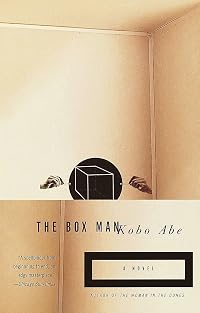
The Box Man
by Kōbō Abe
On This Page
Description
Kobo Abe, the internationally acclaimed author of Woman in the Dunes, combines wildly imaginative fantasies and naturalistic prose to create narratives reminiscent of the work of Kafka and Beckett. In this eerie and evocative masterpiece, the nameless protagonist gives up his identity and the trappings of a normal life to live in a large cardboard box he wears over his head. Wandering the streets of Tokyo and scribbling madly on the interior walls of his box, he describes the world outside show more as he sees or perhaps imagines it, a tenuous reality that seems to include a mysterious rifleman determined to shoot him, a seductive young nurse, and a doctor who wants to become a box man himself. The Box Man is a marvel of sheer originality and a bizarrely fascinating fable about the very nature of identity. Translated from the Japanese by E. Dale Saunders. show lessTags
Recommendations




















Member Reviews
A “box man”, the narrator tells us, is not someone just sleeping outdoors on sheets of cardboard as many homeless people do, or in a full cardboard box as some do. A box man lives in his box, wears it all the time, even walks around in it during the day like a hermit crab. In fact, as a box man himself he stresses that he’s not only distinct from all other street people, but is treated with contempt by them. As for the box itself, on Page 4 we’re given a detailed set of do-it-yourself instructions for making one: corrugated cardboard is preferable, the kind that has shiny waterproofing on the outside, and big enough to cover you down to the top of your legs—the sort of box a fridge, say, might be delivered to your door in. You show more cut an observation window at eye-level, with semi-opaque vinyl screens which can be opened a chink like curtains; on the inside are wire hooks for hanging your few possessions…a small shelf…a plastic board for writing…
And if all this is starting to sound a bit, well, strange, it’s much more than that.
I’ve done my best to find out whether any of it is true—did people ever really walk around in such a box; was it a phenomenon seen for a time on the streets of central Tokyo in the early 1970s? To date I’ve found no hint of it at all in real life, which leaves it as a detailed and downright peculiar piece of imagining wholly typical of Kōbō Abe (and why I like his books).
So what does he do with the idea? For a start, the format here is complicated: the main narrative (written by our box man) is interspersed with sections supposedly written by “A”, a second box man. There are what read like case notes, psychiatric ones perhaps; also a legal “affidavit”, newspaper clippings and odd, seemingly random, photographs. And if that sounds like a mess, it’s anything but—it’s meticulously put together and there are clues throughout: for instance, it turns out that before becoming a box man the narrator had been a photographer, and those weird photographs aren’t random at all.
Overall I’d summarise it this way: The Box Man is about hiding, then watching other people; it’s about voyeurism—and you could probably see it as a metaphor as well: creating a false outer persona, like a mask, from behind which we inspect other people we pass on the street. But it’s also a murder-mystery. Running through it is the question of how many box men there actually are: many, two—or just one? Was there only ever one “box man”, a lone nut who chose to live this way (which is why he’s so despised by the other local street-dwellers who know perfectly well what he’s up to)? If so, then our narrator isn’t only “unreliable” (because there are some glaring inconsistencies between the differing accounts of what happened); what we’re seeing here is a completely unhinged mind, from the inside.
Late in life Kōbō Abe was being talked about as a possible Nobel candidate, and I’m beginning to understand why. This is a deeply strange, an exceptionally peculiar, work of genius. show less
And if all this is starting to sound a bit, well, strange, it’s much more than that.
I’ve done my best to find out whether any of it is true—did people ever really walk around in such a box; was it a phenomenon seen for a time on the streets of central Tokyo in the early 1970s? To date I’ve found no hint of it at all in real life, which leaves it as a detailed and downright peculiar piece of imagining wholly typical of Kōbō Abe (and why I like his books).
So what does he do with the idea? For a start, the format here is complicated: the main narrative (written by our box man) is interspersed with sections supposedly written by “A”, a second box man. There are what read like case notes, psychiatric ones perhaps; also a legal “affidavit”, newspaper clippings and odd, seemingly random, photographs. And if that sounds like a mess, it’s anything but—it’s meticulously put together and there are clues throughout: for instance, it turns out that before becoming a box man the narrator had been a photographer, and those weird photographs aren’t random at all.
Overall I’d summarise it this way: The Box Man is about hiding, then watching other people; it’s about voyeurism—and you could probably see it as a metaphor as well: creating a false outer persona, like a mask, from behind which we inspect other people we pass on the street. But it’s also a murder-mystery. Running through it is the question of how many box men there actually are: many, two—or just one? Was there only ever one “box man”, a lone nut who chose to live this way (which is why he’s so despised by the other local street-dwellers who know perfectly well what he’s up to)? If so, then our narrator isn’t only “unreliable” (because there are some glaring inconsistencies between the differing accounts of what happened); what we’re seeing here is a completely unhinged mind, from the inside.
Late in life Kōbō Abe was being talked about as a possible Nobel candidate, and I’m beginning to understand why. This is a deeply strange, an exceptionally peculiar, work of genius. show less
This one.
This one was not an easy read.
This is the record of a box man... That is to say, at this juncture the box man is me. A box man, in his box, is recording the chronicle of a box man.
I thought I got it in the beginning. Then the middle I found befuddling. And then the last 20 pages brought the clarity I sought; or at least, the interpretation that seems most relevant to my life and my role in society.
"The nameless protagonist gives up his identity and the trappings of a normal life to live in a large cardboard box he wears over his head... he describes the world outside as he sees or perhaps imagines it, a tenuous reality that seems to include a mysterious rifleman who is determined to shoot him, a seductive young nurse given show more to disrobing, and a doctor who wants to become a box man himself." Such is the summary presented on the back of the book.
What I ended up seeing is a man who knows not how to relate to his fellow human beings, particularly women, after a certain encounter in his youth. He loses himself in the physical and the ejaculatory when it comes to the touch of a woman and cannot handle the outside world and its "moral" pressures. A touch, an emission, seem so easy to understand but becomes muddied when standards and rules and regulations try to play a part. What can he do but try to isolate himself from this outward stimulation and simplify his life to the world of a cardboard box; a box to counter the stares of his peers like a window shields its contents from the UV rays of the sun.
Unfortunately, despite your attempt at isolation, the world will still bare down on you and even worse, will try to shock you out of unsocial behavior. Thus, the roles of doctor, the rifleman and the nurse. At the end, I believe the doctor and the rifleman are one in the same with the box man, remnants of his outside-the-box character, trying to bring him back to society as he knows is "right to do". But their threatening nature makes him fear for his life knowing that death must be approaching.
The more I think about it, the more complex and amazing this book is. It really does come down to those last 20 pages. So much to say about this one.
Kudos to E. Dale Saunders for the English translation. show less
This one was not an easy read.
This is the record of a box man... That is to say, at this juncture the box man is me. A box man, in his box, is recording the chronicle of a box man.
I thought I got it in the beginning. Then the middle I found befuddling. And then the last 20 pages brought the clarity I sought; or at least, the interpretation that seems most relevant to my life and my role in society.
"The nameless protagonist gives up his identity and the trappings of a normal life to live in a large cardboard box he wears over his head... he describes the world outside as he sees or perhaps imagines it, a tenuous reality that seems to include a mysterious rifleman who is determined to shoot him, a seductive young nurse given show more to disrobing, and a doctor who wants to become a box man himself." Such is the summary presented on the back of the book.
What I ended up seeing is a man who knows not how to relate to his fellow human beings, particularly women, after a certain encounter in his youth. He loses himself in the physical and the ejaculatory when it comes to the touch of a woman and cannot handle the outside world and its "moral" pressures. A touch, an emission, seem so easy to understand but becomes muddied when standards and rules and regulations try to play a part. What can he do but try to isolate himself from this outward stimulation and simplify his life to the world of a cardboard box; a box to counter the stares of his peers like a window shields its contents from the UV rays of the sun.
Unfortunately, despite your attempt at isolation, the world will still bare down on you and even worse, will try to shock you out of unsocial behavior. Thus, the roles of doctor, the rifleman and the nurse. At the end, I believe the doctor and the rifleman are one in the same with the box man, remnants of his outside-the-box character, trying to bring him back to society as he knows is "right to do". But their threatening nature makes him fear for his life knowing that death must be approaching.
The more I think about it, the more complex and amazing this book is. It really does come down to those last 20 pages. So much to say about this one.
Kudos to E. Dale Saunders for the English translation. show less
My first reaction, after I finished this: What did I just read?
I like the books I read to make some sort of sense, even if it's only at the end that everything comes together. The Box Man felt like it was composed of pieces that would eventually form some kind of bizarre whole...except then they didn't. Or at least that's how I felt. This is the kind of book that reminds me why I so rarely venture outside of reading genre fiction.
It started off promisingly enough. The Box Man begins by writing, in excruciating detail, how one constructs a box man's box, and what it's like to start living in one. He describes the experiences of the man who shot the box man, why he began writing his notes, and the offer he received for his box, via the show more nurse's apprentice. It was all very strange stuff – just strange enough to carry me along, not so strange as to push me away. The book was ever-so-slightly unpleasant to read, and yet I couldn't not read it, propelled by a need to know where Abe was going with all of this.
At some point, I realized that I couldn't be sure what was real and what wasn't. A snippet of conversation between the doctor and the nurse's apprentice indicated that at least some of what the Box Man was experiencing was, in fact, in his head. The Box Man maybe realized this as well, leading to a convoluted shift in his conversation with the doctor, in which they discussed the reality of their current situation. Was the Box Man really there, having that conversation with the doctor, or was he in his box, writing about the meeting with the doctor that he would have in the near future as though it were his present? Or was the Box Man the creation of some third person, who was writing about the Box Man writing about his conversation with the doctor and the nurse's apprentice?
Things got even more bizarre from that point on. There may have been a murder, maybe two murders. The nurse's apprentice might have become a captive, willing or unwilling, or maybe that was all just in the Box Man's head. If I had to say what this book ended up being about, the best I could come up with would be: identity, lust, voyeurism, and an intense desire to see but not be seen.
The Box Man, whoever he was, may have started down the road to becoming a box man after a humiliating, yet sexually exciting, experience involving his first attempt at voyeurism when he was a boy. My theory is that most of what happened in the book was the hallucinations of the Box Man as he bled to death after being shot. The doctor, the nurse's apprentice, and all associated characters were figments of the Box Man's imagination, maybe fragments of his own experiences and feelings. That would, I think, explain some of the more bizarre aspects of the doctor's story, as well as the strange impression I got that the nurse's apprentice wasn't actually a human being, but rather just a collection of attractive body parts.
While I found this to be a compelling book, it wasn't an enjoyable one. I really wish the ending had been even just a little less ambiguous – I was left feeling like Abe had taken the easy way out. There are plenty of stories that are strange and unsettling, and yet don't leave the reader adrift at the end. I don't consider The Box Man to be one of those stories.
(Original review, with read-alikes, posted on A Library Girl's Familiar Diversions.) show less
I like the books I read to make some sort of sense, even if it's only at the end that everything comes together. The Box Man felt like it was composed of pieces that would eventually form some kind of bizarre whole...except then they didn't. Or at least that's how I felt. This is the kind of book that reminds me why I so rarely venture outside of reading genre fiction.
It started off promisingly enough. The Box Man begins by writing, in excruciating detail, how one constructs a box man's box, and what it's like to start living in one. He describes the experiences of the man who shot the box man, why he began writing his notes, and the offer he received for his box, via the show more nurse's apprentice. It was all very strange stuff – just strange enough to carry me along, not so strange as to push me away. The book was ever-so-slightly unpleasant to read, and yet I couldn't not read it, propelled by a need to know where Abe was going with all of this.
At some point, I realized that I couldn't be sure what was real and what wasn't. A snippet of conversation between the doctor and the nurse's apprentice indicated that at least some of what the Box Man was experiencing was, in fact, in his head. The Box Man maybe realized this as well, leading to a convoluted shift in his conversation with the doctor, in which they discussed the reality of their current situation. Was the Box Man really there, having that conversation with the doctor, or was he in his box, writing about the meeting with the doctor that he would have in the near future as though it were his present? Or was the Box Man the creation of some third person, who was writing about the Box Man writing about his conversation with the doctor and the nurse's apprentice?
Things got even more bizarre from that point on. There may have been a murder, maybe two murders. The nurse's apprentice might have become a captive, willing or unwilling, or maybe that was all just in the Box Man's head. If I had to say what this book ended up being about, the best I could come up with would be: identity, lust, voyeurism, and an intense desire to see but not be seen.
The Box Man, whoever he was, may have started down the road to becoming a box man after a humiliating, yet sexually exciting, experience involving his first attempt at voyeurism when he was a boy. My theory is that most of what happened in the book was the hallucinations of the Box Man as he bled to death after being shot. The doctor, the nurse's apprentice, and all associated characters were figments of the Box Man's imagination, maybe fragments of his own experiences and feelings. That would, I think, explain some of the more bizarre aspects of the doctor's story, as well as the strange impression I got that the nurse's apprentice wasn't actually a human being, but rather just a collection of attractive body parts.
While I found this to be a compelling book, it wasn't an enjoyable one. I really wish the ending had been even just a little less ambiguous – I was left feeling like Abe had taken the easy way out. There are plenty of stories that are strange and unsettling, and yet don't leave the reader adrift at the end. I don't consider The Box Man to be one of those stories.
(Original review, with read-alikes, posted on A Library Girl's Familiar Diversions.) show less
The idea of living in a box seems one step lower than the life of a beggar. In addition to being completely anonymous, a man in a box is also unseen. As the story opens, a city dweller feels annoyed by the presence outside of his apartment by a box man whose presence no one else wants to recognize. The apartment dweller takes careful aim with his air rifle and shoots the box man in a way so as not to permanently harm him but to make him move. The box man does move slowly, but not in an erect manner, away from the vicinity of the apartment dweller. Meanwhile, inside the box, the anonymous man is keeping a record of the man who shot him.
Abe does a bizarre psychological examination of the meaning of having no identity. He does this by show more having his anonymous man in a box that completely hides that person’s physical features. It matters not whether the box man is alone or in a crowd. The complexity of the character of an “unknown” person takes place completely within a box.
The story starts as a fascinating look into anonymity but eventually falls into kaleidoscopic plot which leaves readers stranded as to who is talking and what the author is trying to say or what the point of the book even is show less
Abe does a bizarre psychological examination of the meaning of having no identity. He does this by show more having his anonymous man in a box that completely hides that person’s physical features. It matters not whether the box man is alone or in a crowd. The complexity of the character of an “unknown” person takes place completely within a box.
The story starts as a fascinating look into anonymity but eventually falls into kaleidoscopic plot which leaves readers stranded as to who is talking and what the author is trying to say or what the point of the book even is show less
This novel messes with your head. Really.
As far as Kobo goes, I prefered Woman in the Dunes for pure entertainment, but the Box Man goes into uncharted territory (whereas Woman in the Dunes grasps at fairly traditional existentialism, albeit from a unique perspective)
Who is the Box Man? Is he one? Two? Three? Everyone? You could read this book a thousand times and still not unravel the mystery. I, of course, have my own opinion, but the beauty of this book is that you just can't stop trying to figure things out. I definitely recommend a read. I can't guarantee you'll enjoy it, but I can guarantee that you'll be either completely befuddled or completely obsessed. And befuddled.
As far as Kobo goes, I prefered Woman in the Dunes for pure entertainment, but the Box Man goes into uncharted territory (whereas Woman in the Dunes grasps at fairly traditional existentialism, albeit from a unique perspective)
Who is the Box Man? Is he one? Two? Three? Everyone? You could read this book a thousand times and still not unravel the mystery. I, of course, have my own opinion, but the beauty of this book is that you just can't stop trying to figure things out. I definitely recommend a read. I can't guarantee you'll enjoy it, but I can guarantee that you'll be either completely befuddled or completely obsessed. And befuddled.
A strange, dry, inhuman book: just the kind of thing I like. "Box men" are homeless men who walk around inside cardboard boxes. The boxes are fitted out with viewing portholes, little shelves, hooks, and supplies. Three things make this book strange, and the last two also make it bitter, misogynistic, and misanthropic.
1. I read the book because it uses photographs, and I am trying to survey 20th century books that use illustrations in fictional settings. This book has one of the oddest uses of photography I've found. There are a half-dozen grainy black and white illustrations distributed through the text. Each one has a few lines of text underneath. At first it seems those captions are excerpted from the novel itself, but it turns out show more they aren't. Even at the end of the book, a reader isn't quite sure where those text excerpts are supposed to come from. Of the half-dozen photos, only the first one connects with the narrative: it shows a figure walking away into the darkness. It fits, sort of, with a central episode in the story. In general, we're supposed to think the photographs are made by the narrator, a box man and photographer; but they aren't described in the text. It's as if they come from a separate part of the narrator's life, and their accompanying texts come from a diary the narrator doesn't mention. And that lack of reference becomes itself increasingly odd.
2. The descriptions of the box are so vivid, so precise and unexpected, that it seems they could only be the result of actually building such a box and living in it. Abe is extremely precise about what goes into the box—what the box man carries around with him—and how such a box is constructed. I would expect that from any realist or surrealist novel; but those details are inserted into unexpected places in the narrative, where they would only occur to someone who has actually spent time in such a box. The stains on the inside of the box, the uses of a small shelf under the observation window, the uses of a plastic tablet—they outdo Nabokov in their myopic realism, and they produce, for me, a creeping sense that the novelist did more than just research his subject. I haven't looked into this, but it wouldn't surprise me if there were such things as "box men" in 1970s Japan, and if Abe wasn't one himself. That's a kind of narrative unreliability that goes well beyond what a reader might infer about the author of "In Cold Blood" or "Lolita."
3. Those first two points are quizzical and memorable. This last point is unpleasant. The story turns around a "box man," another person who may want to become a "box man," and a nurse they both like. The other man is explicitly a Doppelgaenger and projection of the narrator, so in terms of men's roles, the book is about the nakedness of walking around in public without a box, the temptations of the box's security, and the odd feeling of slipping out of society and living in, and as, a box. In terms of women's roles, the book is substantially more bleak. The nurse only exists in the story to take off her clothes and pose. She is watched by the "box man," once from outside a window, and later from inside a hospital room. The narrator fantasizes about cutting her up and eating her, but that's just a passing thought. Mostly he is stricken with embarrassment about his own body, and the sum total of his idea of relations with women is watching them undress. It's an openly childish, openly masturbatory fantasy. Over the course of the book, the effect of that relentless, unreflective, supposedly natural way of representing relations is extremely unpleasant. If Abe had thought of this state of affairs ironically, or if he had tried to analyze it, or if he had presented it as a degeneration of normal relations, then it could have worked: but when he wrote this book, Abe's imaginative universe was so shriveled, so dried up and poisoned, that he could only imagine women as things that are peered at from inside cardboard boxes. I have no problem with violent, misanthropic, deranged or psychotic narratives or narrators: but this one is also unreflective, and therefore especially sour.
The narrative is quirky to the point of opacity, often uncontrolled, wandering, and shapeless. At one point the narrator admits he has made up the other "box man" entirely; several pages are devoted to a fantasy of turning into a fish and drowning; the narrative is often interrupted by notes about the color of the writer's ink or the nature of the paper he is writing on. I take all those shapeless experiments as strategies to keep writing, to get the bizarre story down on paper. I also take the entire novel as a purge: Abe has lived this way, somehow, and somehow he wants to get past it. A fascinating and very memorable book. show less
1. I read the book because it uses photographs, and I am trying to survey 20th century books that use illustrations in fictional settings. This book has one of the oddest uses of photography I've found. There are a half-dozen grainy black and white illustrations distributed through the text. Each one has a few lines of text underneath. At first it seems those captions are excerpted from the novel itself, but it turns out show more they aren't. Even at the end of the book, a reader isn't quite sure where those text excerpts are supposed to come from. Of the half-dozen photos, only the first one connects with the narrative: it shows a figure walking away into the darkness. It fits, sort of, with a central episode in the story. In general, we're supposed to think the photographs are made by the narrator, a box man and photographer; but they aren't described in the text. It's as if they come from a separate part of the narrator's life, and their accompanying texts come from a diary the narrator doesn't mention. And that lack of reference becomes itself increasingly odd.
2. The descriptions of the box are so vivid, so precise and unexpected, that it seems they could only be the result of actually building such a box and living in it. Abe is extremely precise about what goes into the box—what the box man carries around with him—and how such a box is constructed. I would expect that from any realist or surrealist novel; but those details are inserted into unexpected places in the narrative, where they would only occur to someone who has actually spent time in such a box. The stains on the inside of the box, the uses of a small shelf under the observation window, the uses of a plastic tablet—they outdo Nabokov in their myopic realism, and they produce, for me, a creeping sense that the novelist did more than just research his subject. I haven't looked into this, but it wouldn't surprise me if there were such things as "box men" in 1970s Japan, and if Abe wasn't one himself. That's a kind of narrative unreliability that goes well beyond what a reader might infer about the author of "In Cold Blood" or "Lolita."
3. Those first two points are quizzical and memorable. This last point is unpleasant. The story turns around a "box man," another person who may want to become a "box man," and a nurse they both like. The other man is explicitly a Doppelgaenger and projection of the narrator, so in terms of men's roles, the book is about the nakedness of walking around in public without a box, the temptations of the box's security, and the odd feeling of slipping out of society and living in, and as, a box. In terms of women's roles, the book is substantially more bleak. The nurse only exists in the story to take off her clothes and pose. She is watched by the "box man," once from outside a window, and later from inside a hospital room. The narrator fantasizes about cutting her up and eating her, but that's just a passing thought. Mostly he is stricken with embarrassment about his own body, and the sum total of his idea of relations with women is watching them undress. It's an openly childish, openly masturbatory fantasy. Over the course of the book, the effect of that relentless, unreflective, supposedly natural way of representing relations is extremely unpleasant. If Abe had thought of this state of affairs ironically, or if he had tried to analyze it, or if he had presented it as a degeneration of normal relations, then it could have worked: but when he wrote this book, Abe's imaginative universe was so shriveled, so dried up and poisoned, that he could only imagine women as things that are peered at from inside cardboard boxes. I have no problem with violent, misanthropic, deranged or psychotic narratives or narrators: but this one is also unreflective, and therefore especially sour.
The narrative is quirky to the point of opacity, often uncontrolled, wandering, and shapeless. At one point the narrator admits he has made up the other "box man" entirely; several pages are devoted to a fantasy of turning into a fish and drowning; the narrative is often interrupted by notes about the color of the writer's ink or the nature of the paper he is writing on. I take all those shapeless experiments as strategies to keep writing, to get the bizarre story down on paper. I also take the entire novel as a purge: Abe has lived this way, somehow, and somehow he wants to get past it. A fascinating and very memorable book. show less
Abe was probably the truest heir to Kafka. I can't even begin to describe what this novel is about because it really defies categorization. A blurb on the back calls it an "ontological thriller." In a lot of ways, it prefigures Lynch. But it's never difficult to read and is even compulsively readable. You just have to toss aside any expectation that what you're reading will "make sense." Abe also intersperes the narrative with grainy, low-res black and white photographs accompanied by prose poems, which aren't necessarily part of the narrative, but compliment it nicely.
Members
- Recently Added By
Lists

Japanese Literature
230 works; 40 members

Best Japanese Fiction
41 works; 10 members

Reading LIst
648 works; 1 member
Talk Discussions
Past Discussions
The Box Man by Kobo Abe in Author Theme Reads (May 2015)
Author Information

82+ Works 9,088 Members
Kobo Abe is the pseudonym of Kimifusa Abe, who was born in Tokyo, Japan on March 7 1924. He was brought up in Manchuria where he lived with his father, a doctor of the hosipital attached to the Imperial Medical Colledge of Manchuria. In elementary school, he was educated in the experimental way, in which a teacher trained children to debating and show more rapid reading. Abe went back to Tokyo and went to Sejo Koko High School, a famous private school. He was later admitted to the faculty of medicine of Tokyo University. In 1944, Abe heard that Japan would lose the war before long and he forged a medical certificate to get home to Manchuria. He earned his medical degree in 1948, but never practiced. After graduation he began his writing career and became a member of a literary group led by Kiyoteru Hamada. Often compared to Kafka , he treated the contemporary human predicament in a realistic yet symbolic style. In 1951 he got the Akutagawa Award by his first masterpiece, Kabe (The Walls). Among Abe's novels are Woman in the Dunes, published in 1962 and made into a film in 1964, and his best-known work, Secret Rendezvous. His plays include Friends, published in 1967. The first of his short stories to appear in English were collected in Beyond the Curve, 1944-66. Abe died in 1993. (Bowker Author Biography) show less
Some Editions
Awards and Honors
Distinctions
The Guardian Book of the Day (2020-11-17)
Series
Belongs to Publisher Series
Work Relationships
Has the adaptation
Common Knowledge
- Canonical title
- The Box Man
- Original title
- 箱男
- Alternate titles*
- L'homme-boîte
- Original publication date
- 1973 (original Japanese) (original Japanese); 1974 (English: Saunders) (English: Saunders)
- People/Characters
- The Box Man; The Nurse; The Doctor
- Important places
- Tokyo, Japan
- First words
- This is the record of a box man.
- Last words
- (Click to show. Warning: May contain spoilers.)I hear the siren of an approaching ambulance.
- Original language
- Japanese
*Some information comes from Common Knowledge in other languages. Click "Edit" for more information.
Classifications
- Genres
- General Fiction, Fiction and Literature
- DDC/MDS
- 813 — Literature & rhetoric American literature in English American fiction in English
- LCC
- PL845 .B4 .H313 — Language and Literature Languages and literatures of Eastern Asia, Africa, Oceania Languages of Eastern Asia, Africa, Oceania Japanese language and literature Japanese literature Individual authors and works
- BISAC
Statistics
- Members
- 1,146
- Popularity
- 21,915
- Reviews
- 21
- Rating
- (3.61)
- Languages
- 11 — English, French, German, Hungarian, Italian, Japanese, Lithuanian, Russian, Spanish, Swedish, Chinese, traditional
- Media
- Paper, Ebook
- ISBNs
- 21
- ASINs
- 6