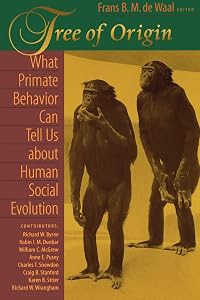
Tree of Origin: What Primate Behavior Can Tell Us about Human Social Evolution
by Frans B. M. de Waal (Editor)
On This Page
Description
How did we become the linguistic, cultured, and hugely successful apes that we are? Our closest relatives--the other mentally complex and socially skilled primates--offer tantalizing clues. In Tree of Origin nine of the world's top primate experts read these clues and compose the most extensive picture to date of what the behavior of monkeys and apes can tell us about our own evolution as a species. It has been nearly fifteen years since a single volume addressed the issue of human evolution show more from a primate perspective, and in that time we have witnessed explosive growth in research on the subject. Tree of Origin gives us the latest news about bonobos, the "make love not war" apes who behave so dramatically unlike chimpanzees. We learn about the tool traditions and social customs that set each ape community apart. We see how DNA analysis is revolutionizing our understanding of paternity, intergroup migration, and reproductive success. And we confront intriguing discoveries about primate hunting behavior, politics, cognition, diet, and the evolution of language and intelligence that challenge claims of human uniqueness in new and subtle ways. Tree of Origin provides the clearest glimpse yet of the apelike ancestor who left the forest and began the long journey toward modern humanity. show lessTags
Recommendations



















Member Reviews
This is an anthology put together by Frans de Waal as the result of a 1997 conference on Human Evolution. De Waal asked that the authors write in a speculative mode about human evolution, and that they stick to a jargon-free style. The articles here are not original research papers — they are written for a less specialized audience. And, as a non-specialist, I found it very readable and fascinating.
The study of hominid evolution is remarkably speculative, even given de Waal’s direction to the authors. There is of course evidence to draw on. Fossil evidence (fossilized remains of human ancestors, tooth marks or cut marks on fossilized bones of other animals, remains of tools, etc.) can vary from conclusive to suggestive. We never show more know, when the evidence is scant, whether we are looking at outliers or norms.
Evidence drawn from observations of our closest relatives — great apes, especially chimpanzees and bonobos — can be incredibly suggestive. But it is not always easy to distinguish traits and behaviors that are distinctive to those species’ own evolutionary track rather than shared with our own.
The speculative nature of the study invites, as here, researchers to take up a variety of perspectives from which to offer hypotheses to answer such questions as why human-sized brains evolved, how early bipedal apes or pre-humans survived, what social groupings emerged among australopithecines and others of our ancestors, . . . Researchers look at what these hominids ate, what foods their teeth were optimized for, what their skeletal features can tell us about how fast or far they could travel, etc., all as clues to answering those critical evolutionary questions.
One very interesting perspective is that of cooking. When cooking emerged among our ancestors isn’t known, but it appears to be relatively recent, maybe 250,000 years ago (for which we have evidence of earthen ovens in use). Cooking could have changed almost everything. Diets at the time were primarily vegetarian, and, for that matter, meat still comprises a small part of apes’ diets. A diet of raw plants required large jaws, teeth, and a large gut for digestion. Post-Australopithecines, our most direct ancestors, by contrast, have remarkably small guts, teeth, and jaws.
A higher ratio of energy taken in from food relative to the energy spent to digest it could have freed energy for other uses — foraging over larger areas, or cognitive activity.
Cooking also could have introduced important social changes. Food gathering, along with mating, is a strong component of social life for apes and human ancestors. Cooking would have introduced a new element — a time delay between finding and consuming food. Raw foods would be gathered for cooking, maybe in another place and at a later time. It would need to be protected from theft from other animals, and a more explicit distribution would need to be devised at the cooking site.
You can see how this one change — cooking food — could enable or set in motion many other changes, either direct changes in behaviors or more long term opportunities for adaptive, evolutionary changes.
And cooking is just one perspective the authors take up. Other discussions address the evolution of “culture” in chimpanzees and other species besides our own, the role of hunting and meat-eating, the effect of group size on intelligence and behavior, and the evolution of brain size.
Conclusions are tentative. Conclusions may always have significant uncertainties. Researchers just can’t directly access enough evidence. We don’t, for example, have a definitive fossil example of the hypothesized common ancestor to chimpanzees and humans.
But understanding where we came from and looking in the mirror at our current close relatives are both instructive about ourselves and just plain entertaining. Having read several of de Waal’s works, especially the classic Chimpanzee Politics, has given me a new eye for watching and enjoying humans like myself. show less
The study of hominid evolution is remarkably speculative, even given de Waal’s direction to the authors. There is of course evidence to draw on. Fossil evidence (fossilized remains of human ancestors, tooth marks or cut marks on fossilized bones of other animals, remains of tools, etc.) can vary from conclusive to suggestive. We never show more know, when the evidence is scant, whether we are looking at outliers or norms.
Evidence drawn from observations of our closest relatives — great apes, especially chimpanzees and bonobos — can be incredibly suggestive. But it is not always easy to distinguish traits and behaviors that are distinctive to those species’ own evolutionary track rather than shared with our own.
The speculative nature of the study invites, as here, researchers to take up a variety of perspectives from which to offer hypotheses to answer such questions as why human-sized brains evolved, how early bipedal apes or pre-humans survived, what social groupings emerged among australopithecines and others of our ancestors, . . . Researchers look at what these hominids ate, what foods their teeth were optimized for, what their skeletal features can tell us about how fast or far they could travel, etc., all as clues to answering those critical evolutionary questions.
One very interesting perspective is that of cooking. When cooking emerged among our ancestors isn’t known, but it appears to be relatively recent, maybe 250,000 years ago (for which we have evidence of earthen ovens in use). Cooking could have changed almost everything. Diets at the time were primarily vegetarian, and, for that matter, meat still comprises a small part of apes’ diets. A diet of raw plants required large jaws, teeth, and a large gut for digestion. Post-Australopithecines, our most direct ancestors, by contrast, have remarkably small guts, teeth, and jaws.
A higher ratio of energy taken in from food relative to the energy spent to digest it could have freed energy for other uses — foraging over larger areas, or cognitive activity.
Cooking also could have introduced important social changes. Food gathering, along with mating, is a strong component of social life for apes and human ancestors. Cooking would have introduced a new element — a time delay between finding and consuming food. Raw foods would be gathered for cooking, maybe in another place and at a later time. It would need to be protected from theft from other animals, and a more explicit distribution would need to be devised at the cooking site.
You can see how this one change — cooking food — could enable or set in motion many other changes, either direct changes in behaviors or more long term opportunities for adaptive, evolutionary changes.
And cooking is just one perspective the authors take up. Other discussions address the evolution of “culture” in chimpanzees and other species besides our own, the role of hunting and meat-eating, the effect of group size on intelligence and behavior, and the evolution of brain size.
Conclusions are tentative. Conclusions may always have significant uncertainties. Researchers just can’t directly access enough evidence. We don’t, for example, have a definitive fossil example of the hypothesized common ancestor to chimpanzees and humans.
But understanding where we came from and looking in the mirror at our current close relatives are both instructive about ourselves and just plain entertaining. Having read several of de Waal’s works, especially the classic Chimpanzee Politics, has given me a new eye for watching and enjoying humans like myself. show less
Ratings
Members
- Recently Added By
Author Information

Frans De Waal has been named one of Time magazine's 100 Most Influential People. The author of The Bonobo and the Atheist, among many other works, he is the C. H. Candler Professor in Emory University's Psychology Department and director of the Living Links Center at the Yerkes National Primate Research Center. He lives in Atlanta, Georgia.
All Editions
Classifications
Statistics
- Members
- 96
- Popularity
- 336,683
- Reviews
- 1
- Rating
- (4.00)
- Languages
- English, Turkish
- Media
- Paper, Ebook
- ISBNs
- 4