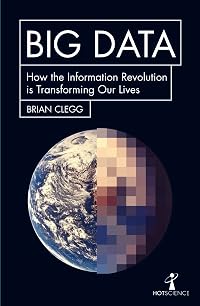
Big Data: How the Information Revolution Is Transforming Our Lives (Hot Science)
by Brian Clegg 
On This Page
Description
Is the Brexit vote successful big data politics or the end of democracy? Why do airlines overbook, and why do banks get it wrong so often? How does big data enable Netflix to forecast a hit, CERN to find the Higgs boson and medics to discover if red wine really is good for you? And how are companies using big data to benefit from smart meters, use advertising that spies on you and develop the gig economy, where workers are managed by the whim of an algorithm? The volumes of data we now show more access can give unparalleled abilities to make predictions, respond to customer demand and solve problems. But Big Brother's shadow hovers over it. Though big data can set us free and enhance our lives, it has the potential to create an underclass and a totalitarian state. With big data ever-present, you can't afford to ignore it. show lessTags
Recommendations














Member Reviews
We live in a world of big data, with government, corporations, social media, and all kinds of organizations in possession of vast amounts of quite personal data about us--most of which we've handed over ourselves.
That's just one piece big data, though. The accumulation of enormous amounts of data, and the use of modern, advanced computers to process it, has affected every area of our lives and our world. Not much over two centuries ago, medicine was still largely a matter of trial and error, and medical theories we know to be completely wrong. The 19th and 20th centuries saw considerable advances, but there were still serious limitations on the ability to test new drugs and new treatments on enough people, and a sufficiently diverse and show more balanced sample, to get truly reliable results on effectiveness, and on who they'd be effective on. Because no, humans aren't all alike, and don't all react the same way to the same treatments.
But with the late 20th and early 21st centuries, we now do have the means to gather and analyze almost unlimited data, and to keep gathering that data, making far better medical decisions possible.
On the individual level, getting the best personal results from that means handing over even more personal data. And that data is no longer sitting on paper, in locked filing cabinets in our doctors' offices. It's in computers, which generally have to be networked to get the best results out of them. I can log into one patient portal from my home computer, and access test results, upcoming appointments, and information about my prescriptions from several different specialists and the hospital I'm usually taken to when necessary. My own primary care physician isn't part of this patient portal, because he's 80 and has an attitude of deep suspicion toward the reliability of computer security that, in theory, I wholly endorse. And yet. I like having access to all this information. Oh, and a lot of the results from my primary care physician are there anyway, because my specialists have requested them in order to properly coordinate care.
I'm sure they've taken lots of care to keep all this medical data, for me and all their other patients, as secure as possible. I also believe no system is unhackable. It's a risk. It's one that on balance, I'm comfortable taking, for the benefits. But that's me. I don't have any medical conditions I consider embarrassing--and I'm autistic. I love data, and what experts can make it do. Some people have conditions they'd have a problem with random people knowing. Sometimes because certain conditions can change how other people may respond to you, and sometimes because they don't have my relatively detached attitude towards personal medical data. Both those feelings are valid, but, as I indicated above, even finding a PCP like mine who is much more conservative about sharing and accessibility of electronic data doesn't mean your information isn't going to wind up in them. Especially if you have conditions that require specialists.
There are less personally fraught uses of big data, though. CERN uses big data and the computers that process it to find, for instance, the Higgs Boson. Our space telescopes, including Hubble, Kepler, and now the James Webb, have gathered huge amounts of data, and computers have played a critical role in analyzing that data, making new discoveries about the workings of our universe possible.
I haven't even touched on the financial and economic uses of big data, and the enormous impact of that on our lives, for both good and ill. Brian Clegg does. This isn't a long book, but it's packed with information and understanding of how big data affects our lives.
Recommended.
I bought this audiobook. show less
That's just one piece big data, though. The accumulation of enormous amounts of data, and the use of modern, advanced computers to process it, has affected every area of our lives and our world. Not much over two centuries ago, medicine was still largely a matter of trial and error, and medical theories we know to be completely wrong. The 19th and 20th centuries saw considerable advances, but there were still serious limitations on the ability to test new drugs and new treatments on enough people, and a sufficiently diverse and show more balanced sample, to get truly reliable results on effectiveness, and on who they'd be effective on. Because no, humans aren't all alike, and don't all react the same way to the same treatments.
But with the late 20th and early 21st centuries, we now do have the means to gather and analyze almost unlimited data, and to keep gathering that data, making far better medical decisions possible.
On the individual level, getting the best personal results from that means handing over even more personal data. And that data is no longer sitting on paper, in locked filing cabinets in our doctors' offices. It's in computers, which generally have to be networked to get the best results out of them. I can log into one patient portal from my home computer, and access test results, upcoming appointments, and information about my prescriptions from several different specialists and the hospital I'm usually taken to when necessary. My own primary care physician isn't part of this patient portal, because he's 80 and has an attitude of deep suspicion toward the reliability of computer security that, in theory, I wholly endorse. And yet. I like having access to all this information. Oh, and a lot of the results from my primary care physician are there anyway, because my specialists have requested them in order to properly coordinate care.
I'm sure they've taken lots of care to keep all this medical data, for me and all their other patients, as secure as possible. I also believe no system is unhackable. It's a risk. It's one that on balance, I'm comfortable taking, for the benefits. But that's me. I don't have any medical conditions I consider embarrassing--and I'm autistic. I love data, and what experts can make it do. Some people have conditions they'd have a problem with random people knowing. Sometimes because certain conditions can change how other people may respond to you, and sometimes because they don't have my relatively detached attitude towards personal medical data. Both those feelings are valid, but, as I indicated above, even finding a PCP like mine who is much more conservative about sharing and accessibility of electronic data doesn't mean your information isn't going to wind up in them. Especially if you have conditions that require specialists.
There are less personally fraught uses of big data, though. CERN uses big data and the computers that process it to find, for instance, the Higgs Boson. Our space telescopes, including Hubble, Kepler, and now the James Webb, have gathered huge amounts of data, and computers have played a critical role in analyzing that data, making new discoveries about the workings of our universe possible.
I haven't even touched on the financial and economic uses of big data, and the enormous impact of that on our lives, for both good and ill. Brian Clegg does. This isn't a long book, but it's packed with information and understanding of how big data affects our lives.
Recommended.
I bought this audiobook. show less
Ratings
Members
- Recently Added By
Lists

Big Data
52 works; 2 members
Author Information

107 Works 3,561 Members
Brian Clegg was always fascinated by Isaac Asimov's classic Foundation series of books, in which the future is predicted using sophisticated mathematical modeling of human psychology and behavior.
Brian Clegg is a LibraryThing Author, an author who lists their personal library on LibraryThing.
Classifications
- Genres
- Technology, Nonfiction, Science & Nature, General Nonfiction, Business
- DDC/MDS
- 005.7 — Computer science, information & general works Computer science, knowledge & systems Artificial Intelligence/Virtual Reality Data in computer systems
- LCC
- QA76.9 .B45 — Science Mathematics Mathematics Instruments and machines Calculating machines Electronic computers. Computer science
- BISAC
Statistics
- Members
- 46
- Popularity
- 647,453
- Reviews
- 1
- Rating
- (3.90)
- Languages
- English
- Media
- Paper, Audiobook, Ebook
- ISBNs
- 7
- ASINs
- 2