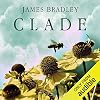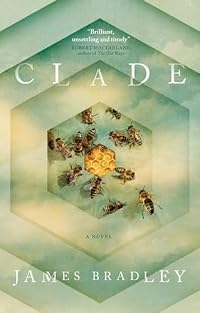
Clade
by James Bradley
On This Page
Description
On a beach in Antarctica, scientist Adam Leith marks the passage of the summer solstice. Back in Sydney his partner Elllie waits for the results of her latest round of IVF treatment. That result, when it comes, will change both their lives and propel them into a future neither could have predicted. In a collapsing England Adam will battle to survive an apocalyptic storm. Against a backdrop of growing civil unrest at home, Ellie will discover a strange affinity with beekeeping. In the show more aftermath of a pandemic, a young man finds solace in building virtual recreations of the dead. And new connections will be formed from the most unlikely beginnings. show lessTags
Recommendations








Member Reviews
I don't even know where to start, honestly. I was tempted to just review this with a 'yeah, nah.' Instead:
* Early on there are rolling summer power outages. In one instance the power goes off at midnight, and in the morning the character says 'all the food will be spoiled.' This is literally not true, and terrible research, which isn't promising for a novel based on research. How did the editor not catch this? As someone who has lived through rolling power outages, our first google search was 'how long does food last in a closed fridge during a power outage?' Hot tip, 80% of their food wasn't spoiled. The characters then repeatedly throw out their food after every outage and buy it new again. The privilege is insane.
* Cremains are not show more fine dust that feel as though they are barely heavier than air. A cursory google search confirms they are like coarse sand, and heavier than you think. This could have been a symbolic choice, but in a book of badly researched knowledge (sans climate change), it just feels like...bad research.
* Mystical 'mysterious' ex-doctor Bangladeshi beekeeper only exists to give one character hope.
* The amount of privilege depicted is genuinely incredible.
* Every woman character is detached, aloof or cut off from her emotions or only feels rage or dislike generally, and seems to be damned by her children (or lack thereof). The same can be said for Ellie, Summer and Maddie. Less so Lijuan. Whenever a man becomes detached or aloof, it's always implied or described to be the woman's fault, even though one man responds by literally *going to Antarctica* and yet...still...blaming his wife...for their distance. The latent misogyny embedded in the text is so present it's inescapable. Women are only really hopeful in momentary bursts. Men are usually the ones carrying the 'true emotions.' Whether it's Noah, or Adam, or Tom. Young girls seem to be allowed to have 'real emotions' too. For a while.But then everyone will wonder whether the girl will hurt herself because of them.
* The only overtly queer character in the novel is an underage teenager who pressures another teenage character to make out in front of a camera set up and then shames her when she doesn't, oh and also gives her drugs. Not...ideal representation at the best of times. Nothing else to balance this out.
* The ending is rushed. Suddenlythere are aliens? But wait, 15 pages later the book is over! And everyone is staring up at the Shimmer, and there's hope, for no reason! None of the characters introduced in the last section are remotely believable, engaging or likeable. They have a poor excuse at futuristic names except for Izzie. They're not compelling, and what they have to add to the story contributes nothing.
Anyway, I could go on, but basically this felt like extremely easy to read garbage. I feel like I can kind of tell what this book was trying to do, but with no interesting characters to really hook into, and the author's willingness toslowly kill off most of his cast because of the dull plodding of time , there was no real reason to hook into future characters either (I don't always mind this technique, it's been done to great effect by authors like Anne Marie MacDonald, Jeffrey Eugenides and Arundhati Roy). The majority of storylines are never resolved, and are left open-ended in a way that feels lazy rather than creative or well thought out. show less
* Early on there are rolling summer power outages. In one instance the power goes off at midnight, and in the morning the character says 'all the food will be spoiled.' This is literally not true, and terrible research, which isn't promising for a novel based on research. How did the editor not catch this? As someone who has lived through rolling power outages, our first google search was 'how long does food last in a closed fridge during a power outage?' Hot tip, 80% of their food wasn't spoiled. The characters then repeatedly throw out their food after every outage and buy it new again. The privilege is insane.
* Cremains are not show more fine dust that feel as though they are barely heavier than air. A cursory google search confirms they are like coarse sand, and heavier than you think. This could have been a symbolic choice, but in a book of badly researched knowledge (sans climate change), it just feels like...bad research.
* Mystical 'mysterious' ex-doctor Bangladeshi beekeeper only exists to give one character hope.
* The amount of privilege depicted is genuinely incredible.
* Every woman character is detached, aloof or cut off from her emotions or only feels rage or dislike generally, and seems to be damned by her children (or lack thereof). The same can be said for Ellie, Summer and Maddie. Less so Lijuan. Whenever a man becomes detached or aloof, it's always implied or described to be the woman's fault, even though one man responds by literally *going to Antarctica* and yet...still...blaming his wife...for their distance. The latent misogyny embedded in the text is so present it's inescapable. Women are only really hopeful in momentary bursts. Men are usually the ones carrying the 'true emotions.' Whether it's Noah, or Adam, or Tom. Young girls seem to be allowed to have 'real emotions' too. For a while.
* The only overtly queer character in the novel is an underage teenager who pressures another teenage character to make out in front of a camera set up and then shames her when she doesn't, oh and also gives her drugs. Not...ideal representation at the best of times. Nothing else to balance this out.
* The ending is rushed. Suddenly
Anyway, I could go on, but basically this felt like extremely easy to read garbage. I feel like I can kind of tell what this book was trying to do, but with no interesting characters to really hook into, and the author's willingness to
(Spoilers Abound. Beware!)
This was a frustrating book for me.
Climate Change is a hard issue to tackle in a novel, and most authors get it only partly right, mostly due to it being an incredibly complicated and tangled set of issues that affect every aspect of our daily lives. Authors, generally, manage to think through two or three strands really well, and then let the rest of the world go on operating mostly as-is, which makes no sense.
In Clade, extreme weather is grappled with very effectively and convincingly, and some aspects of larger impacts such as changes to daily temperatures and the disintegration of glaciers. Some parts, such as runaway genetically engineered species meant to mitigate some of climate change's harms, were a show more nice touch.
But the broader implications of how this would affect society as a whole are largely not touched on or considered at all. One gets the impression that after a set of catastrophic storms that take place over the next fifty years or so, climate change is largely over and we get back to normal. This is ridiculous. Storms are going to keep coming and getting worse for at least the next few centuries, and that's just storms.
Who is growing the food?
Who is picking it? Distributing it?
How is it being stored?
How is anything growing, in a changed climate subject to all of these storms and temperature increases?
Who the hell is spending their careers developing virtual reality technologies while society is crumbling around them?
And then who is financing these projects?
Who is mining, processing and transporting the minerals?
Are they still using fossil fuels? If so, god, WHY? If not, what are they using?
The characters are constantly flying all over the place. What in god's name are the airplane's fueling with?
What is the power source for all the technology that is constantly being referenced?
So that's one set of frustrations.
The other set is that climate change is apparently not enough of an existential threat for him.
About two-thirds of the book is about climate change. Then, having run out of steam on ice caps and monsoons, he brings in a plague, aliens, and magnetic pole reversal.
Why?
Finally, his underlying theme seems to be that human life will still be worth living (because we'll have fancy technology and great parties on newly formed beaches?), so don't worry so much.
We hardly need, as a species, to be encouraged not to fear climate change, since we're apparently so determined already not to let it bother us that in the 150 years or so we've known of the possibility and the decades in which it's been scientifically known as an existential threat we've done almost nothing. People will go on having babies, yes, and many of those babies will have wonderful lives, yes, but is that really the overall point that needs to be made at this juncture in our history? show less
This was a frustrating book for me.
Climate Change is a hard issue to tackle in a novel, and most authors get it only partly right, mostly due to it being an incredibly complicated and tangled set of issues that affect every aspect of our daily lives. Authors, generally, manage to think through two or three strands really well, and then let the rest of the world go on operating mostly as-is, which makes no sense.
In Clade, extreme weather is grappled with very effectively and convincingly, and some aspects of larger impacts such as changes to daily temperatures and the disintegration of glaciers. Some parts, such as runaway genetically engineered species meant to mitigate some of climate change's harms, were a show more nice touch.
But the broader implications of how this would affect society as a whole are largely not touched on or considered at all. One gets the impression that after a set of catastrophic storms that take place over the next fifty years or so, climate change is largely over and we get back to normal. This is ridiculous. Storms are going to keep coming and getting worse for at least the next few centuries, and that's just storms.
Who is growing the food?
Who is picking it? Distributing it?
How is it being stored?
How is anything growing, in a changed climate subject to all of these storms and temperature increases?
Who the hell is spending their careers developing virtual reality technologies while society is crumbling around them?
And then who is financing these projects?
Who is mining, processing and transporting the minerals?
Are they still using fossil fuels? If so, god, WHY? If not, what are they using?
The characters are constantly flying all over the place. What in god's name are the airplane's fueling with?
What is the power source for all the technology that is constantly being referenced?
So that's one set of frustrations.
The other set is that climate change is apparently not enough of an existential threat for him.
About two-thirds of the book is about climate change. Then, having run out of steam on ice caps and monsoons, he brings in a plague, aliens, and magnetic pole reversal.
Why?
Finally, his underlying theme seems to be that human life will still be worth living (because we'll have fancy technology and great parties on newly formed beaches?), so don't worry so much.
We hardly need, as a species, to be encouraged not to fear climate change, since we're apparently so determined already not to let it bother us that in the 150 years or so we've known of the possibility and the decades in which it's been scientifically known as an existential threat we've done almost nothing. People will go on having babies, yes, and many of those babies will have wonderful lives, yes, but is that really the overall point that needs to be made at this juncture in our history? show less
My second train read of the day exceeded expectations. I’d feared another [b:Solar|7140754|Solar|Ian McEwan|https://images.gr-assets.com/books/1320510358s/7140754.jpg|7404751] or [b:The Lamentations of Zeno|25893848|The Lamentations of Zeno|Ilija Trojanow|https://images.gr-assets.com/books/1455505402s/25893848.jpg|17780593] experience, in which a novel allegedly about climate change actually turned out to be about a middle aged man’s marital infidelity. Instead, ‘Clade’ is more of a mosaic, with an interesting range of narrators and narrative styles. They are all linked by family or friendship bonds and by climate change impacting on their lives. In the first chapter, these impacts are limited and the focus is on marital show more difficulties, then as the book goes on the climate encroaches further and further. This escalation was effectively done, although given their variety I inevitably appreciated some chapters more than others. The one about bees and environmental refugees was a particular highlight. I also liked the brief thought experiment in the penultimate chapter: ‘What if we received a message from aliens, but have already wrecked our planet and will probably be extinct by the time they receive our reply’? Definitely a chastening idea.
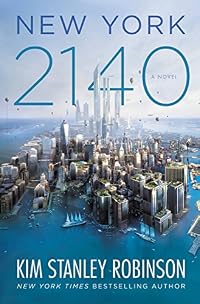
I thought the depiction of climate collapse placing strains on a family was thoughtfully done, with only minor quibbles. I wondered how Ellie made such a comfortable living as a full-time artist - universal basic income? The snippet-like format allowed a certain amount of space for reader interpretation, which I found pretty agreeable but may not suit all tastes. ‘Clade’ isn’t as powerful a climate change novel as [b:New York 2140|29570143|New York 2140|Kim Stanley Robinson|https://images.gr-assets.com/books/1471618737s/29570143.jpg|49898123], or even [b:The Carbon Diaries 2015|4935015|The Carbon Diaries 2015 (Carbon Diaries, #1)|Saci Lloyd|https://images.gr-assets.com/books/1273722854s/4935015.jpg|5000676], but it’s definitely the sort of fiction I want to see more of. It contains the confrontations between people and the environmental uncanny that Amitav Ghosh calls for in [b:The Great Derangement: Climate Change and the Unthinkable|29362082|The Great Derangement Climate Change and the Unthinkable|Amitav Ghosh|https://images.gr-assets.com/books/1462497923s/29362082.jpg|49607520] and that more literary fiction should deal with. Although slight in some ways, it’s quite profound in others. show less
I thought the depiction of climate collapse placing strains on a family was thoughtfully done, with only minor quibbles. I wondered how Ellie made such a comfortable living as a full-time artist - universal basic income? The snippet-like format allowed a certain amount of space for reader interpretation, which I found pretty agreeable but may not suit all tastes. ‘Clade’ isn’t as powerful a climate change novel as [b:New York 2140|29570143|New York 2140|Kim Stanley Robinson|https://images.gr-assets.com/books/1471618737s/29570143.jpg|49898123], or even [b:The Carbon Diaries 2015|4935015|The Carbon Diaries 2015 (Carbon Diaries, #1)|Saci Lloyd|https://images.gr-assets.com/books/1273722854s/4935015.jpg|5000676], but it’s definitely the sort of fiction I want to see more of. It contains the confrontations between people and the environmental uncanny that Amitav Ghosh calls for in [b:The Great Derangement: Climate Change and the Unthinkable|29362082|The Great Derangement Climate Change and the Unthinkable|Amitav Ghosh|https://images.gr-assets.com/books/1462497923s/29362082.jpg|49607520] and that more literary fiction should deal with. Although slight in some ways, it’s quite profound in others. show less
Reading this book in 2020, just five years after it was published feels uncanny. Climate fiction has that advantage that it talks about the possible future without much speculation. This is the case with Clade. We have been warned about what's coming, we have seen some of it happening, if we survive long enough, we will see more of it and it will get more extreme.
Clade reminded me of the British TV show Years and Years, which covers the close future of a family in all the strange familiarity of the current events mixed with some black swan type disasters nobody could have predicted. As we move along the timeline, things get more removed from the familiar, but the human connections are the thread that keeps everything together.
The show more structure of the novel was interesting. There are different characters narrating from their often limited perspectives. As the title of the novel suggests, all these characters are in some way connected to a character (predictably) called Adam. These are all done in the form of vignettes which range from deeply emotional to journalistic.
Adam is a research scientist aware that the climate change is going to transform the planet. He and his wife are going through a series of IVF treatments.The psychological portrayal of how their inability to conceive may be related to the reluctance to bring a child into this world was probably the strongest point of the novel for me. Adam learns of his wife's pregnancy while stationed in Antarctica where a large rupture in the ice sheet foreshadows the gravity of things to come.
I really enjoyed the first part of the novel, it was done really well and the story just flowed, clearly supported by Bradley's narrative craft. I found the the last one third a little lacking, as the characters had a limited perspective and were introduced abruptly so there was little emotional connection that would carry the reader through. Otherwise, this would have been a 5 star read for me.
But, overall, there is a gentle sense of optimism that never feels forced and a wonderful element of surprise towards the end. This is clearly a keeper and one of the best novels in this genre I've read. show less
Clade reminded me of the British TV show Years and Years, which covers the close future of a family in all the strange familiarity of the current events mixed with some black swan type disasters nobody could have predicted. As we move along the timeline, things get more removed from the familiar, but the human connections are the thread that keeps everything together.
The show more structure of the novel was interesting. There are different characters narrating from their often limited perspectives. As the title of the novel suggests, all these characters are in some way connected to a character (predictably) called Adam. These are all done in the form of vignettes which range from deeply emotional to journalistic.
Adam is a research scientist aware that the climate change is going to transform the planet. He and his wife are going through a series of IVF treatments.The psychological portrayal of how their inability to conceive may be related to the reluctance to bring a child into this world was probably the strongest point of the novel for me. Adam learns of his wife's pregnancy while stationed in Antarctica where a large rupture in the ice sheet foreshadows the gravity of things to come.
I really enjoyed the first part of the novel, it was done really well and the story just flowed, clearly supported by Bradley's narrative craft. I found the the last one third a little lacking, as the characters had a limited perspective and were introduced abruptly so there was little emotional connection that would carry the reader through. Otherwise, this would have been a 5 star read for me.
But, overall, there is a gentle sense of optimism that never feels forced and a wonderful element of surprise towards the end. This is clearly a keeper and one of the best novels in this genre I've read. show less
** I received a free advance copy in exchange for this unbiased review **
This book was a pleasant read. The open ends are many, including the biggest open end of all, [spoiler redacted]! But that's how life is, and I don't begrudge the author the style used here. The chapters are much like individual short stories, that just happen to all take place within the same universe, with members of the same family. There wasn't a ton in here that made me say "wow," but it was almost all fairly enjoyable--thus the three stars. Probably especially enjoyable if you're more concerned about climate change than the average person.
This book was a pleasant read. The open ends are many, including the biggest open end of all, [spoiler redacted]! But that's how life is, and I don't begrudge the author the style used here. The chapters are much like individual short stories, that just happen to all take place within the same universe, with members of the same family. There wasn't a ton in here that made me say "wow," but it was almost all fairly enjoyable--thus the three stars. Probably especially enjoyable if you're more concerned about climate change than the average person.
This is a book about how climate change will affect the future of the world. It starts out in Antarctica where Adam is studying the effects of climate change and quickly moves to Australia when his first child is born. After that it quickly moves to England where his now grown daughter and her son stay with him through an apocalyptic storm. The book jumped around a lot to the major characters but once I was able to get everyone figured out, I felt like it was a good way to keep the story moving. It was an interesting look at what could happen to the world if global warming continues.
Thanks to the author for a copy of the book to read and review. All opinions are my own.
Thanks to the author for a copy of the book to read and review. All opinions are my own.
I regret not reading Clade in time to recommend it for a Hugo.
Members
- Recently Added By
Lists

Dublin Literary Award Longlist 2017
147 works; 2 members

SFF Down Under
59 works; 3 members

2018 Hugo Eligible Novels
170 works; 16 members

International Dublin Literary Award Longlist 2017
147 works; 3 members

Climate Change
39 works; 2 members

Books Read in 2020
4,379 works; 124 members

At the Library
217 works; 1 member
Author Information

18+ Works 1,221 Members
James Bradley was born on May 15, 1967 in Adelaide, South Australia. He is a graduate of the University of Adelaide. His novels include Wrack, The Deep Field, The Resurrectionist, and Clade. He is the author of a book of poetry entitled Paper Nautilus. He edited two books, Blur: Stories by Young Australian Writers and The Penguin Book of the show more Ocean. He also writes as a critic and won the 2012 Pascall Prize for Criticism and was named Australian Critic of the Year. His other awards include The Age Fiction Book of the Year and the Kathleen Mitchell Award. (Bowker Author Biography) show less
Awards and Honors
Awards
Distinctions
Classifications
Statistics
- Members
- 236
- Popularity
- 137,168
- Reviews
- 9
- Rating
- (3.78)
- Languages
- English, German
- Media
- Paper, Audiobook, Ebook
- ISBNs
- 7
- ASINs
- 6