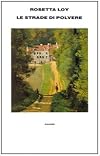
The Dust Roads of Monferrato
by Rosetta Loy
On This Page
Description
Four generations of a farming family in Piemonto, Italy, survive birth and death, triumph and tragedy, poverty and prosperity, war and peace, in a saga that spans one hundred years of eighteenth-and nineteenth-century history.Tags
Recommendations



















Member Recommendations
Member Reviews
I have had this book for ages and have avoided it for ages. It turns out that I did so for no good reason. I enjoyed it and while it is not a great work of art, it was a pleasure to read. I should note immediately that it is almost entirely description; dialogue is minimal at best. I cannot recall reading a book quite like it and yet it works well. The story follows a farming family in the Italian Piedmont, near France, through much of the 19th century. Its strong suit is the author’s romantic, often lyrical description of the lives of the family, the countryside, friends, relations, and servants. Wars, disease, weather, poverty…everything comes and goes, bringing good outcomes and bad. And everything takes places against the show more backdrop of Monferrato and its seasons. I suspect it will be slow and tedious for some, but I found its understatedness its strength and enjoyed it more than I anticipated. show less
This lovely, poetic, understated little book follows the multigenerational story, spanning the late 1790s until perhaps 1900, of a farming family in Monferrato, Italy, in the Piedmont region, near France. The strength of the book lies in Loy’s lush, almost dreamlike description of the lives and loves of the family and their friends, relations, and servants. Wars come and go, bringing cholera and high taxes; babies are conceived, birthed, and live only a few days or years, or grow into healthy young people with lives and loves of their own. Each person has a story, some subtle, some more direct – and against it all is the backdrop of Montferrato itself, and how it changes with the seasons: by turns dusty and dry, or sodden with show more spring rains and mud, or icy and snowy, or lush and green with wheat and the grapevines for the wines for which the region is known. This is a quiet, satisfying book that provides a glimpse into the lives of ordinary people two hundred years ago. show less
This family saga follows the family of The Great Masten (name lost with the town records) through the 19th century, outside of Alessandria, Piemonte. Translated from Italian with dialect left untranslated. Won the Rapallo Carige Prize in 1988.
This story fits in with the history of Piemonte, and explores its effects on one land-owning (but not noble) family. When the story begins, this area has been annexed by France. Then it is The Kingdom of Sardinia. When it ends, it is Italy. There are two wars against the Austrians. There are droughts and floods, cold, illness, hunger and bounty. Talent, dreams, and boredom. Family fortunes--not just of this family, but also of noble and mercantile families--go up and down.
I enjoyed this book, show more particularly getting to read translated historical fiction. This is not a place and time period that English fiction (US or England) set. There is very little dialogue, which felt strange at first, but it somehow works, as Loy describes the scenes--the colors, the weather, the dirt, the travels of soldiers and women visiting their families.Seeing the dialect left in place--it is generally followed by a translation--it is an odd mix of Italian and French, and similiarities to Genoese are there. The constant talk in the book of dialects is so real, as it is very real in Italy today. show less
This story fits in with the history of Piemonte, and explores its effects on one land-owning (but not noble) family. When the story begins, this area has been annexed by France. Then it is The Kingdom of Sardinia. When it ends, it is Italy. There are two wars against the Austrians. There are droughts and floods, cold, illness, hunger and bounty. Talent, dreams, and boredom. Family fortunes--not just of this family, but also of noble and mercantile families--go up and down.
I enjoyed this book, show more particularly getting to read translated historical fiction. This is not a place and time period that English fiction (US or England) set. There is very little dialogue, which felt strange at first, but it somehow works, as Loy describes the scenes--the colors, the weather, the dirt, the travels of soldiers and women visiting their families.Seeing the dialect left in place--it is generally followed by a translation--it is an odd mix of Italian and French, and similiarities to Genoese are there. The constant talk in the book of dialects is so real, as it is very real in Italy today. show less
Loy won terecht verscheidene prijzen met dit prachtig vertelde familie-epos uit Piëmonte dat zich voltrekt tussen de napoleontische oorlogen en de Italiaanse eenmaking. Maar de focus ligt minder op de grote gebeurtenissen dan wel op de kleine geschiedenissen van drie generaties beginnend bij Gran Masten op het moment dat deze een 'particulare' of landeigenaar wordt, en eindigend met de broers Gavriel en Luìs. Leven en dood wisselen elkaar af zoals de seizoenen. Veel 'condition humaine' in dit erg menselijk verhaal.
"Het was een geluid waarin de klanken van de vroegste kinderjaren te horen waren, wanneer het groen van de bomen en het voorbijtrekken van de wolken nog vloeistoffen lijken die in elkaar overgaan en de woorden en de dingen show more die nog niet door zintuiglijke waarnemingen worden onderscheiden, vormen aannemen die aan voortdurende verandering onderhevig zijn. En van verre, van de plaats waar dat monotone geluid vandaan kwam, lokte als de legendarische rattenvanger deze klaagzang de vormeloze gedaanten van de dromen met zich mee. Die zo lijken op die van de eerste levensjaren, of die misschien zelfs wel zijn." (p. 218)
De sfeer van het boek sluit mooi aan bij de neorealistische film De Klompenboom van Ermanno Olmi hoewel het harde seizoensgedreven landleven van arme dagloners in de 19e eeuwse Po-vlakte daar in zijn meer harde vorm gestalte krijgt. show less
"Het was een geluid waarin de klanken van de vroegste kinderjaren te horen waren, wanneer het groen van de bomen en het voorbijtrekken van de wolken nog vloeistoffen lijken die in elkaar overgaan en de woorden en de dingen show more die nog niet door zintuiglijke waarnemingen worden onderscheiden, vormen aannemen die aan voortdurende verandering onderhevig zijn. En van verre, van de plaats waar dat monotone geluid vandaan kwam, lokte als de legendarische rattenvanger deze klaagzang de vormeloze gedaanten van de dromen met zich mee. Die zo lijken op die van de eerste levensjaren, of die misschien zelfs wel zijn." (p. 218)
De sfeer van het boek sluit mooi aan bij de neorealistische film De Klompenboom van Ermanno Olmi hoewel het harde seizoensgedreven landleven van arme dagloners in de 19e eeuwse Po-vlakte daar in zijn meer harde vorm gestalte krijgt. show less
Apr 3, 2013Dutch
Poëtische en bijzonder mooi vertelde familiesaga die zich afspeelt in het negentiende eeuwse Piëmont.
Jan 26, 2013Dutch
Ratings
Members
- Recently Added By
Published Reviews
ThingScore 100
"Winner of Italy's Viareggio and Campiello prizes, Loy's lush and seductive novel captures the internal dramas of a 19th-century Piedmontese family and the romantic and mystical intrigues of a society innocent of Freud and industrial-age expediencies."
added by bookfitz
Lists

500 Great Books by Women
507 works; 60 members
Author Information

30+ Works 686 Members
Born in Rome in 1931, Rosetta Loy is one of Italy's leading novelists & journalists. She has written seven novels & been honored with every major Italian literary award. In 1996 she received the prestigious European Prize for literature. Her work has been translated into eleven languages. (Bowker Author Biography)
Some Editions
Awards and Honors
Series
Belongs to Publisher Series
Sammlung Luchterhand im dtv (11845)
Work Relationships
Is abridged in
Common Knowledge
- Canonical title
- The Dust Roads of Monferrato
- Original title
- Le strade di polvere
- Alternate titles*
- Wegen van stof : roman
- Original publication date
- 1987 (original Italian) (original Italian); 1990 (English translation) (English translation)
- People/Characters*
- Grand Masten; Pietro, "Pidrèn", puis "Sacarlott"; Giuseppe, "le Giaï"; Maria; Matelda, "Fantina"; Gavriel (show all 14); Louis-Charles, "Luis"; Rosetta du Fracin; Teresa des Maturlin; Antonia; Pietro-Giuseppe; Pia, "Piulott"; La Limasa; Olanda, "La Suave"
- Important places
- Piedmont, Italy
- Important events*
- Unification italienne
- First words
- It was the Great Masten who had the house built, at the end of the eighteenth century, when he became a particulare, a man who had land of his own, oxen, cows, chickens and rabbits, and so many acres that he had to hire extra... (show all) hands.
- Last words
- (Click to show. Warning: May contain spoilers.)The moon was rising in the sky, which was growing dark, and the first star, the star of shepherds, was fixed up above like a nail of light.
- Blurbers
- Gerrard, Nicol; Brandmark, Wendy; Cooke, Judy; Neuberger, Julia; Saunders, Kate
- Original language*
- Italiaans
*Some information comes from Common Knowledge in other languages. Click "Edit" for more information.
Classifications
- Genres
- Fiction and Literature, General Fiction, Historical Fiction
- DDC/MDS
- 853.914 — Literature & rhetoric Italian, Romanian & related literatures Italian fiction 1900- 20th Century 1945-1999
- LCC
- PQ4872 .O98 .S7713 — Language and Literature French, Italian, Spanish and Portuguese literatures Italian literature Individual authors, 1961-2000
Statistics
- Members
- 187
- Popularity
- 175,761
- Reviews
- 5
- Rating
- (3.98)
- Languages
- 6 — Dutch, English, French, German, Italian, Spanish
- Media
- Paper, Ebook
- ISBNs
- 22
- ASINs
- 2