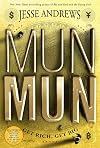
Munmun
by Jesse Andrews
On This Page
Description
In an alternate reality a lot like our world, every person's physical size is directly proportional to their wealth. The poorest of the poor are the size of rats, and billionaires are the size of skyscrapers.Warner and his sister Prayer are destitute—and tiny. Their size is not just demeaning, but dangerous: day and night they face mortal dangers that bigger richer people don't ever have to think about, from being mauled by cats to their house getting stepped on. There are no cars or show more phones built small enough for them, or schools or hospitals, for that matter—there's no point, when no one that little has any purchasing power, and when salaried doctors and teachers would never fit in buildings so small. Warner and Prayer know their only hope is to scale up, but how can two littlepoors survive in a world built against them?
A brilliant, warm, funny trip, unlike anything else out there, and a social novel for our time in the tradition of 1984 or Invisible Man. Inequality is made intensely visceral by an adventure and tragedy both hilarious and heartbreaking.
. show less
Tags
Recommendations



Member Reviews
In an alternate reality a lot like our world, every person’s physical size is directly proportional to their wealth. The poorest of the poor are the size of rats, and billionaires are the size of skyscrapers.
Warner and his sister Prayer are destitute—and tiny. Their size is not just demeaning, but dangerous: day and night they face mortal dangers that bigger richer people don’t ever have to think about, from being mauled by cats to their house getting stepped on. There are no cars or phones built small enough for them, or schools or hospitals, for that matter—there’s no point, when no one that little has any purchasing power, and when salaried doctors and teachers would never fit in buildings so small. Warner and Prayer know show more their only hope is to scale up, but how can two littlepoors survive in a world built against them?
A brilliant, warm, funny trip, unlike anything else out there, and a social novel for our time in the tradition of 1984 or Invisible Man.
Inequality is made intensely visceral by an adventure and tragedy both hilarious and heartbreaking.
Out April 2018
MY THOUGHTS:
I received this book in exchange for my honest review.
I’ve heard so much about this author and his work that I needed to get a copy of this book to review. I’m glad I did.
Andrews has managed to create something that hasn’t been done before in the YA genre. If you can get past the syntax, acronyms that are spelled out, and a whole new style of grammar, then you’ve unlocked the door to the world of “Munmun.”
Although incredibly weird and even deemed odd by many, Andrews has created an amazing world that mirrors many of the social and economic struggles of our own world. This is what makes his writing a well-written masterpiece!
I did struggle with Warner’s story being told in first-person, but that’s just me, I’m not partial to first-person narrative. However, Andrews pulls this off without deflecting from the story pace. I still remained engaged and eager to see what he’d written next. The best advice I can offer someone considering reading this book: stay open-minded and receptive to a writing form you’ve not seen before.
Some may call it juvenile, others may call it a disaster– I call it BRILLIANT!
There are surprising gems of humor found when certain characters interact which I thought to be creative tools used by the author to keep the reader engaged when plot and pace slowed slightly. These moments ushered the reader forward and back in to the action and gave the character another chink in its arc development. Truly clever!
Fiction mirrors reality during some of the more brutal and awful moments in the book, and Andrews most certainly refuses to hold your hand through them, but the voice of the author and overall ‘feel’ does manage to soften the impact somewhat, allowing the reader to digest the information presented and move forward. Another masterful technique used by the author to push the plot along.
The impact of the social and political bards are beneficial to the story in that they show a direct statement about what is often poo-poo’ed by society today. Although done in a caricature fashion where the poor are tiny, overlooked and ignore, the rich are larger than life itself and achieve everything, you can’t help but see the irony in the author’s use of said imagery.
Satirical yet brilliant! The author has taken how he sees the world and used this reflection to voice his own sardonic aptitude in a book delivering a loud message. There are far more ‘minions’ than giants and if united… one has to wonder about the outcome. Reminds me of the blockbuster children’s movie, “A Bug’s Life,” where a colony of ants were bullied in to gathering food for a nasty band of grasshoppers who were too lazy to gather their own (like the children’s nursery story too).
When the ants united and refused to allow the grasshoppers to continue bullying them, the grasshoppers didn’t stand a chance because they were out numbered, hence — united we stand??!! lol who knows.
This book is many things, some positive and some not so much, but it certainly doesn’t conform to what is considered ‘proper’ when writing fiction. Rather, it’s a dynamic, original breach of fiction normalcy worthy of becoming a classical paradox about a pariah in a fantastical world.
Because of the complexities of the main character, Andrews obviously realized he needed to keep the other characters ‘down.’ In other words, he needed to keep the developing arc of the main character the center of the story without adding distractions created by other arcs. I believe this to be an ingenious structuring ploy, and because of the writing complexities, it manages to keep the focus where it needs to be. I think if he created complex character arcs of the secondary characters, these arcs would take away from the writing. The story-line continuously develops through the driving force of the main character’s growing arc, and in doing so, drives the story forward to it’s conclusion. I don’t think the story would work if done any other way. The developing character arc is almost a living entity of its own, and in effect, takes on the job usually reserved for secondary characters–that of pushing the MC along to achieving his plot goals.
Because the whole story is laced with satire, I think if anything, it’s here where the author fell short in achieving his goals. At times, one could say the satire becomes too much or drags on, however, I didn’t really see this as a huge hindrance worthy of demoting the book. I think what the author did achieve far surpasses any huge criticism anyone may have about satire and its use.
Lots of tongue-in-cheek references that could mirror today’s political ‘giants’ are seen here and there throughout the story, and I laughed out loud at how the author had fun with these particular satirical moments, shading the inferences enough to keep things funny and not turn the reader off or feel their own political views were being slighted or attacked.
“Kick em while he’s down” is definitely how Warner is treated, an interesting paradox that also reflects how many minorities are treated in our own society. Andrews cleverly shows social viewpoints on caste systems that make the ‘whole picture’ absolutely horrifying. His mirroring world is also governed and driven by the motto, that the amount of money you own decides your value to society.
Andrews driving wit, charm and clarity along with his classic method of storytelling oozes from the pages of Munmun, and I can’t emphasize enough how important it is for all to read this book, or, you’ll miss out on something unique. show less
Warner and his sister Prayer are destitute—and tiny. Their size is not just demeaning, but dangerous: day and night they face mortal dangers that bigger richer people don’t ever have to think about, from being mauled by cats to their house getting stepped on. There are no cars or phones built small enough for them, or schools or hospitals, for that matter—there’s no point, when no one that little has any purchasing power, and when salaried doctors and teachers would never fit in buildings so small. Warner and Prayer know show more their only hope is to scale up, but how can two littlepoors survive in a world built against them?
A brilliant, warm, funny trip, unlike anything else out there, and a social novel for our time in the tradition of 1984 or Invisible Man.
Inequality is made intensely visceral by an adventure and tragedy both hilarious and heartbreaking.
Out April 2018
MY THOUGHTS:
I received this book in exchange for my honest review.
I’ve heard so much about this author and his work that I needed to get a copy of this book to review. I’m glad I did.
Andrews has managed to create something that hasn’t been done before in the YA genre. If you can get past the syntax, acronyms that are spelled out, and a whole new style of grammar, then you’ve unlocked the door to the world of “Munmun.”
Although incredibly weird and even deemed odd by many, Andrews has created an amazing world that mirrors many of the social and economic struggles of our own world. This is what makes his writing a well-written masterpiece!
I did struggle with Warner’s story being told in first-person, but that’s just me, I’m not partial to first-person narrative. However, Andrews pulls this off without deflecting from the story pace. I still remained engaged and eager to see what he’d written next. The best advice I can offer someone considering reading this book: stay open-minded and receptive to a writing form you’ve not seen before.
Some may call it juvenile, others may call it a disaster– I call it BRILLIANT!
There are surprising gems of humor found when certain characters interact which I thought to be creative tools used by the author to keep the reader engaged when plot and pace slowed slightly. These moments ushered the reader forward and back in to the action and gave the character another chink in its arc development. Truly clever!
Fiction mirrors reality during some of the more brutal and awful moments in the book, and Andrews most certainly refuses to hold your hand through them, but the voice of the author and overall ‘feel’ does manage to soften the impact somewhat, allowing the reader to digest the information presented and move forward. Another masterful technique used by the author to push the plot along.
The impact of the social and political bards are beneficial to the story in that they show a direct statement about what is often poo-poo’ed by society today. Although done in a caricature fashion where the poor are tiny, overlooked and ignore, the rich are larger than life itself and achieve everything, you can’t help but see the irony in the author’s use of said imagery.
Satirical yet brilliant! The author has taken how he sees the world and used this reflection to voice his own sardonic aptitude in a book delivering a loud message. There are far more ‘minions’ than giants and if united… one has to wonder about the outcome. Reminds me of the blockbuster children’s movie, “A Bug’s Life,” where a colony of ants were bullied in to gathering food for a nasty band of grasshoppers who were too lazy to gather their own (like the children’s nursery story too).
When the ants united and refused to allow the grasshoppers to continue bullying them, the grasshoppers didn’t stand a chance because they were out numbered, hence — united we stand??!! lol who knows.
This book is many things, some positive and some not so much, but it certainly doesn’t conform to what is considered ‘proper’ when writing fiction. Rather, it’s a dynamic, original breach of fiction normalcy worthy of becoming a classical paradox about a pariah in a fantastical world.
Because of the complexities of the main character, Andrews obviously realized he needed to keep the other characters ‘down.’ In other words, he needed to keep the developing arc of the main character the center of the story without adding distractions created by other arcs. I believe this to be an ingenious structuring ploy, and because of the writing complexities, it manages to keep the focus where it needs to be. I think if he created complex character arcs of the secondary characters, these arcs would take away from the writing. The story-line continuously develops through the driving force of the main character’s growing arc, and in doing so, drives the story forward to it’s conclusion. I don’t think the story would work if done any other way. The developing character arc is almost a living entity of its own, and in effect, takes on the job usually reserved for secondary characters–that of pushing the MC along to achieving his plot goals.
Because the whole story is laced with satire, I think if anything, it’s here where the author fell short in achieving his goals. At times, one could say the satire becomes too much or drags on, however, I didn’t really see this as a huge hindrance worthy of demoting the book. I think what the author did achieve far surpasses any huge criticism anyone may have about satire and its use.
Lots of tongue-in-cheek references that could mirror today’s political ‘giants’ are seen here and there throughout the story, and I laughed out loud at how the author had fun with these particular satirical moments, shading the inferences enough to keep things funny and not turn the reader off or feel their own political views were being slighted or attacked.
“Kick em while he’s down” is definitely how Warner is treated, an interesting paradox that also reflects how many minorities are treated in our own society. Andrews cleverly shows social viewpoints on caste systems that make the ‘whole picture’ absolutely horrifying. His mirroring world is also governed and driven by the motto, that the amount of money you own decides your value to society.
Andrews driving wit, charm and clarity along with his classic method of storytelling oozes from the pages of Munmun, and I can’t emphasize enough how important it is for all to read this book, or, you’ll miss out on something unique. show less
Think Borrowers for the 21st century, think Honey I Shrunk the Kids, think Downsizing, think Gulliver's Travels and you might get a vague flavour of this highly original novel from Jesse Andrews. You can enjoy it on a simple level as a tale of trying to succeed when the odds are stacked against you or you can delve a little deeper and see the work as a satirical and quite savage indictment of the age we live in.
Andrews has created a whole dystopian landscape with the city of Lossy Indica in the Yewess where size is proportionate to wealth, i.e. the smaller you are the poorer you are. However it is possible to scale up with the acquisition of more wealth - munmun. Warner and his sister Prayer are Littlepoors who feel their only hope of a show more safer, securer future is to scale up. But they need……munmun.
Warner is the main protagonist, a complex character and it is through him that our knowledge and understanding of the fantasy landscape is furthered. There is Dreamworld and Lifeanddeathworld. And what goes on in both is pretty mind boggling!! There are parallels with our own contemporary world though which makes the story pretty chilling at times.
Whilst the author and the setting are American and many of the references are culturally and socially applicable to that nation there are many universal observances here that can resonate with an international audience. It is an inventive and witty book. Andrews has created a unique vernacular by spelling out acronyms and fusing words together, creating verbs from nouns - US becomes Yewess, byanychance, backyarding! Genius! and I haven’t used the best ones as examples for I would consider that to be a spoiler! And then there’s the title itself! But if you love words and word play this aspect of the book will appeal.
I suspect this may be a Marmite book. I can kind of get that it will too much for some people and I’ve already seen some reviews that are calling it ‘weird’. But those who stick with it and allow themselves and their imaginations to become enveloped by this world will delight in the unusual story and the perceptive observations of our current society that are given an almost cartoon like or caricatured visual word treatment. I loved it! But then I’m weird!! show less
Andrews has created a whole dystopian landscape with the city of Lossy Indica in the Yewess where size is proportionate to wealth, i.e. the smaller you are the poorer you are. However it is possible to scale up with the acquisition of more wealth - munmun. Warner and his sister Prayer are Littlepoors who feel their only hope of a show more safer, securer future is to scale up. But they need……munmun.
Warner is the main protagonist, a complex character and it is through him that our knowledge and understanding of the fantasy landscape is furthered. There is Dreamworld and Lifeanddeathworld. And what goes on in both is pretty mind boggling!! There are parallels with our own contemporary world though which makes the story pretty chilling at times.
Whilst the author and the setting are American and many of the references are culturally and socially applicable to that nation there are many universal observances here that can resonate with an international audience. It is an inventive and witty book. Andrews has created a unique vernacular by spelling out acronyms and fusing words together, creating verbs from nouns - US becomes Yewess, byanychance, backyarding! Genius! and I haven’t used the best ones as examples for I would consider that to be a spoiler! And then there’s the title itself! But if you love words and word play this aspect of the book will appeal.
I suspect this may be a Marmite book. I can kind of get that it will too much for some people and I’ve already seen some reviews that are calling it ‘weird’. But those who stick with it and allow themselves and their imaginations to become enveloped by this world will delight in the unusual story and the perceptive observations of our current society that are given an almost cartoon like or caricatured visual word treatment. I loved it! But then I’m weird!! show less
In a similar world to ours (redolent of California) people's size reflects their wealth, or how many munmuns they have. Billionaires are the size of skyscrapers while the poor are the size of squirrels and live in fear of being eaten by cats or crushed by unwary rich people. The only way out is to become richer by getting more munmun, and then go to the bank to be scaled up.
Warner and his sister Prayer are squirrel-sized littlepoors who scrabble out a living at the bottom of this society. They live a precarious existence of constant privation and threat in lifeanddeathworld. However there is another world, dreamworld, where everybody is equal as they dream. Warner is a masterful operator in dreamworld, with the ability to insert himself show more into other's dreams, and conjure fabulous dream scenarios. But how does that help in lifeanddeathworld?
Andrews' novel is a splendid Swiftian satire, and he uses the concept of munmun to skewer a wide array of inequality in wealthy societies. The narrative voice of Warner is hugely inventive and entertaining, and he is a very appealing protagonist. This is a novel of substance, well worth being read by all readers, not just those in the Young Adult demographic. show less
Warner and his sister Prayer are squirrel-sized littlepoors who scrabble out a living at the bottom of this society. They live a precarious existence of constant privation and threat in lifeanddeathworld. However there is another world, dreamworld, where everybody is equal as they dream. Warner is a masterful operator in dreamworld, with the ability to insert himself show more into other's dreams, and conjure fabulous dream scenarios. But how does that help in lifeanddeathworld?
Andrews' novel is a splendid Swiftian satire, and he uses the concept of munmun to skewer a wide array of inequality in wealthy societies. The narrative voice of Warner is hugely inventive and entertaining, and he is a very appealing protagonist. This is a novel of substance, well worth being read by all readers, not just those in the Young Adult demographic. show less
Brilliantly-written satire that is also truly fun to read? Munmun is funny, heartbreaking, strange, and poignant. Andrews uses language to illustrate the lack of literacy of the protagonist, Warner, who is a charming narrator I enjoyed following through the surreal landscape of the Yewess, the setting of the novel, and the dreamworld that serves as a type of shared VR. Andrews lambastes socioeconomic strata and thumbs Warner's littlepoor nose at anyone who would try to pity him.
I was not totally sure what to rate this book as. When it first arrived it looked beautiful, I loved the cover and overall it was of a high quality. When I started reading 'Mun Mun' I was transported to a new world, the author put a lot of work into describing the world and the lives of the characters. The plot also kept me hooked enough to keep on coming back so as to find out what happens to Warner, Prayer, and Usher. Though for as much as enjoyed this book, I feel that it could have been more, the concept was different and I feel that this book will become very popular for that alone, but something about the writing made me cringe from the first page to the last, and unfortunatly I could not shake that feeling. It was a good book, show more but I feel that it did not live up to its potential and that the writing style will limit this book to perhaps a teen audience. show less
Inequality takes the form of size with the littlepoor being as small as rats and the bigrich as big as whales. Scaled by logarithmic amounts of munmun for each doubling of size. Warner and his sister seek to better themselves in a world were stepping on a little causes no consequence and attacking a big gets a little sentenced to a decade in a rat cage of a prison. This is a quirky dark, angry book with flashes of spiky humor. There was no good way to end the story, is the main problem - after Warner survives one semi-self-inflicted disaster after another.
Wow! It's rare to find a completely new premise. This is as original as Gulliver's Travels, Flatland and Clockwork Orange.
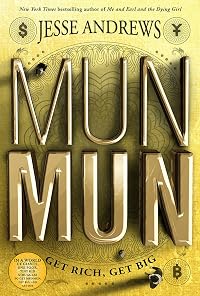
The cover may not be immediately striking or even interpretable but who cares? I wanted to understand the economics, the technology, the physiology, the ethics and the culture. Gradually, more and more of these details were covered as I read the story but you can still supply some of your own creative thinking to plug the gaps.
Munmun is also presented to the reader in a unique and unexplained style. This reminded me of the use of language in The Clockwork Orange by Anthony Burgess, where the first person narrative using an invented dialect is a continual reminder of the different world it is set in. The additional show more spaces in words were a little irritating but in general I coped just fine with the made up words, phonetic spelling and compressed phrases. Some of the characters had only fleeting appearances and so were rather sketchy but most were carefully drawn and developed sympathetically, especially the coming of age of Warner and Prayer.
Later, I updated my review to 5 stars because the story and the ideas behind it stayed in my mind for days so it's pretty powerful stuff! show less
The cover may not be immediately striking or even interpretable but who cares? I wanted to understand the economics, the technology, the physiology, the ethics and the culture. Gradually, more and more of these details were covered as I read the story but you can still supply some of your own creative thinking to plug the gaps.
Munmun is also presented to the reader in a unique and unexplained style. This reminded me of the use of language in The Clockwork Orange by Anthony Burgess, where the first person narrative using an invented dialect is a continual reminder of the different world it is set in. The additional show more spaces in words were a little irritating but in general I coped just fine with the made up words, phonetic spelling and compressed phrases. Some of the characters had only fleeting appearances and so were rather sketchy but most were carefully drawn and developed sympathetically, especially the coming of age of Warner and Prayer.
Later, I updated my review to 5 stars because the story and the ideas behind it stayed in my mind for days so it's pretty powerful stuff! show less
Members
- Recently Added By
Lists

Humorous, need I say more?
10 works; 1 member

Science Fiction
72 works; 1 member

KayStJ's to-read list
1,616 works; 11 members
Author Information

7 Works 4,191 Members
Jesse Andrews is an American author and screenwriter. He was born and raised in Pittsburgh, PA, and graduated from Schenley High School and Harvard University. His debut novel, Me and Earl and the Dying Girl, won the Cybils Award for Young Adult Fiction when it was published in 2012. Andrews wrote the feature-film adaptation of his novel, also show more entitled Me and Earl and the Dying Girl. The film premiered at the 2015 Sundance film festival, where it won both the Grand Jury Prize and the Audience Award. (Bowker Author Biography) show less
Awards and Honors
Awards
Distinctions
Notable Lists
Classifications
Statistics
- Members
- 176
- Popularity
- 186,088
- Reviews
- 14
- Rating
- (4.12)
- Languages
- English
- Media
- Paper, Audiobook, Ebook
- ISBNs
- 20
- ASINs
- 3