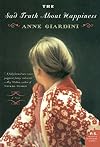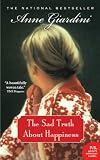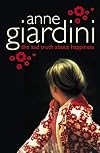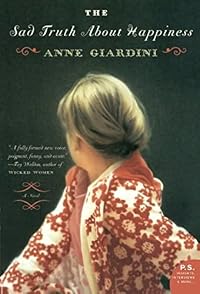
The Sad Truth About Happiness
by Anne Giardini
On This Page
Description
A beautiful and affecting novel -- bittersweet and comic -- on the elusive nature of happiness Maggie is in her early thirties, gainfully employed, between relationships, and ready for a change. But when she takes a quiz in a magazine that promises to predict the date of a person's death, she's shocked to learn she's going to die before her next birthday unless she can somehow discover contentment in life. What ensues is a quirky and satisfying journey in pursuit of true happiness, a quest show more that leads to unexpected joys and perceptions. show lessTags
Recommendations

































Member Reviews
I'm embarrassed at how long this book has languished on my bookshelf of unread books. But, despite Marie Kondo's advice to get rid of unread books, I always knew I wanted to read it. It got good reviews when it came out plus the author is Carol Shields' daughter so there's hope the writing chops are in her genetic makeup. Now that I've finally read it I can say there is a substantial difference between how mother and daughter constructed a plot but they are both descriptive and absorbing writers.
Maggie is in her 30s, has a responsible job, good friends, a loving family and, since she lives in Vancouver, is surrounded by amazing scenery. She doesn't have a romantic relationship at the moment but she's not obsessed about finding someone. show more Everything seems to be going well until she takes a quiz her roommate put together for a women's magazine that purports to tell a person how long they will live. Even though Maggie is in good shape and doesn't take part in risky activities, the quiz says she has three months to live. It all comes down to the final question which asks if she is happy? Maggie says she is not completely happy which counts as a no. If she had answered yes, the quiz would predict she would live to 96. As much as Maggie would like to discount the quiz she starts to experience insomnia and yet, her doctor can't find anything wrong with her. She tries to carry on her life and as chance would have it, three different men come into her life. Maggie may be a little gun-shy about commitment because of her sisters' experiences with love. Her one sister recently returned from living in Rome and now she is engaged and pregnant. Yet she keeps saying that she still loves the man who was her lover in Rome regardless of the fact that he is married and won't leave his wife. As the three months draw to a close, Maggie has no time to worry about whether her death is impending because her sister gives birth and shortly after her Roman lover and his wife show up to claim the baby. Maggie decides to take the baby away from Vancouver until the custody can be clarified. So she, her roommate and the baby take off to Quebec and, with the help of friends, get taken to a small francophone community where a nursing mother has lots of breast milk to spare. Eventually, they have to go back to Vancouver and face the music. At the close of the book, Maggie says that she and most of the people she knows well are happy "Happiness is more ephemeral than thought. It can't be observed without changing its nature. Its ingredients are subtle, and there is no guarantee that a formula or recipe for joy can be written out or passed on or repeated even once again. Happiness evades capture, dissolving like a melody into the air, eluding even the most delicate, careful grasp. It frustrates any systemaic search, responding better to random fossicking and oblizue approaches, and its rewards are infuriatingly arbitrary, stingy or abundant by purest chance."
The message of this book is that happiness cannot be pursued. I feel happier already. show less
Maggie is in her 30s, has a responsible job, good friends, a loving family and, since she lives in Vancouver, is surrounded by amazing scenery. She doesn't have a romantic relationship at the moment but she's not obsessed about finding someone. show more Everything seems to be going well until she takes a quiz her roommate put together for a women's magazine that purports to tell a person how long they will live. Even though Maggie is in good shape and doesn't take part in risky activities, the quiz says she has three months to live. It all comes down to the final question which asks if she is happy? Maggie says she is not completely happy which counts as a no. If she had answered yes, the quiz would predict she would live to 96. As much as Maggie would like to discount the quiz she starts to experience insomnia and yet, her doctor can't find anything wrong with her. She tries to carry on her life and as chance would have it, three different men come into her life. Maggie may be a little gun-shy about commitment because of her sisters' experiences with love. Her one sister recently returned from living in Rome and now she is engaged and pregnant. Yet she keeps saying that she still loves the man who was her lover in Rome regardless of the fact that he is married and won't leave his wife. As the three months draw to a close, Maggie has no time to worry about whether her death is impending because her sister gives birth and shortly after her Roman lover and his wife show up to claim the baby. Maggie decides to take the baby away from Vancouver until the custody can be clarified. So she, her roommate and the baby take off to Quebec and, with the help of friends, get taken to a small francophone community where a nursing mother has lots of breast milk to spare. Eventually, they have to go back to Vancouver and face the music. At the close of the book, Maggie says that she and most of the people she knows well are happy "Happiness is more ephemeral than thought. It can't be observed without changing its nature. Its ingredients are subtle, and there is no guarantee that a formula or recipe for joy can be written out or passed on or repeated even once again. Happiness evades capture, dissolving like a melody into the air, eluding even the most delicate, careful grasp. It frustrates any systemaic search, responding better to random fossicking and oblizue approaches, and its rewards are infuriatingly arbitrary, stingy or abundant by purest chance."
The message of this book is that happiness cannot be pursued. I feel happier already. show less
The Sad Truth About Happiness is the story of the seemingly happy Maggie, a woman in her thirties who works as a radiology technician, giving other women breast exams. While she is not exactly “settled down,” she has meaningful relationships with several men and stability in the form of her friend and roommate Rebecca, who creates questionnaires for women's magazines.
When Rebecca asks Maggie to test her latest quiz, which aims to predict the day a person will die, Maggie's life is suddenly thrown into turmoil. According to the quiz, Maggie will die before her next birthday. Faced with this information, Maggie begins to seriously question her life choices. Her death date, it seems, was predicated by one question – “Are you show more happy?” Maggie sets out to discover the answer to this seemingly innocuous question, surprising both herself and her friends and family.
Anne Giardini has written a lovely debut novel – wise, wry, warm, and beautiful. It would be interesting to read this novel back-to-back with Unless, by her late mother and esteemed Canadian author, Carol Shields. Each novel explores similar themes, such as love, happiness, and mother/daughter relationships – but in different ways. This is a fabulous first novel, and it is clear that Anne Giardini has earned the publication of this first book on her own merits, proving wrong the critics who would assert that it was only published because she is Carol Shields' daughter. show less
When Rebecca asks Maggie to test her latest quiz, which aims to predict the day a person will die, Maggie's life is suddenly thrown into turmoil. According to the quiz, Maggie will die before her next birthday. Faced with this information, Maggie begins to seriously question her life choices. Her death date, it seems, was predicated by one question – “Are you show more happy?” Maggie sets out to discover the answer to this seemingly innocuous question, surprising both herself and her friends and family.
Anne Giardini has written a lovely debut novel – wise, wry, warm, and beautiful. It would be interesting to read this novel back-to-back with Unless, by her late mother and esteemed Canadian author, Carol Shields. Each novel explores similar themes, such as love, happiness, and mother/daughter relationships – but in different ways. This is a fabulous first novel, and it is clear that Anne Giardini has earned the publication of this first book on her own merits, proving wrong the critics who would assert that it was only published because she is Carol Shields' daughter. show less
This book was quite readable - it did keep my attention until the end. It has some serious flaws though - did Giardini do her own editing? (Spoiler alert) There is one character who is called by the wrong name and the narrator's references to Gian Luigi's children shift - apparently he had a son who was the youngest, then the youngest was a daughter and the son was in the middle, and then he had all girls - finally it is revealed he had no children at all. Was the narrator's sister Lucy making things up about the children or did she know all along? It is never resolved or explained. There are also unlikelies (if that is a word!) - who can get 2 quick tickets for a flight from Montreal to Vancouver two days before Xmas and during a show more storm? The Quebec scenes seemed contrived - let's throw in some Canadian bi-culturalism here and see if we all understand French (I did, I grew up there). Weirdly, my copy uses American spelling, which spoiled the delicate Canadian ambiance!
Apparently Ms. Giardini has a very busy life as a mother, writer, lawyer, and head of a company. So maybe something got overlooked in the rush. But where was her editor? This book had potential but without her mother's lifelong influence and a good editor it didn't quite reach "very good" for me. show less
Apparently Ms. Giardini has a very busy life as a mother, writer, lawyer, and head of a company. So maybe something got overlooked in the rush. But where was her editor? This book had potential but without her mother's lifelong influence and a good editor it didn't quite reach "very good" for me. show less
What struck me first about this novel is how very formal the language is - reading the first few pages I thought it must be taking place in say the 30's or 40's. the writing remained very formal - gorgeously descriptive though."The woman's voice was high and very clear and had a warble in it, like cold milk pouring out into a tin cup, or a small, resonant ringing bell, and her head sat as gracefully on its upholstered chin and neck as if she were sitting for a portrait" p 135-136I loved the vivid descriptions but it did grate a little when the story perspective is from a contemporary woman in her mid thirties. For most of the book I was involved in the story, the idea and even the very odd descision she made but i lost any sympathy for show more the character as she swanned around Canada sightseeing leaving her kidnapped newborn niece in the hands of complete strangers and then finally hands the the baby straight to the father at the airport in what is somehow supposed to be a haze of confusion. This in particular snapped the cord of already stretched believability for me andI just didnt care at the end.Worth reading for the stunning description but sadly not the chracters or plot. show less
The title caught my eye and the finely-crafted prose of the first few pages hooked me. The author has a very fine eye for detail and writes it well.
The story started off strong (I could especially relate to the main character's longing for a romantic partner). However, Giardini seems to have gotten distracted by her love of description at the expense of the unifying threads that held the story together. It became uninteresting and, unfortunately, ended unsatisfyingly, even before I got to the odd bits included at the very end.
The story started off strong (I could especially relate to the main character's longing for a romantic partner). However, Giardini seems to have gotten distracted by her love of description at the expense of the unifying threads that held the story together. It became uninteresting and, unfortunately, ended unsatisfyingly, even before I got to the odd bits included at the very end.
I know that I always complain about books that are written in a colloquial style. Now I find myself complaining about the emphatically literary style of The Sad Truth About Happiness by Anne Giardini. Less than halfway through my reading, I felt as though I would be required to hand in a paper on it, say the symbolism of the chapter titles: Attic, Hall, Chimney Pots.... I am sure that as the daughter of Carol Shields, Giardini could turn in nothing less but it impeded the story which was actually quite interesting.
The second last paragraph sums up the message well:
"Life is perhaps after all simply this thing and then the next. We are all of us improvising. We find a careful balance only to discover that gravity or stasis or love or show more dismay or illness or some other force suddenly tows us in an unexpected direction. We wake up to find that we have changed abruptly in a way that is peculiar and inexplicable. We are constantly adapting, making it up, feeling our way forward, figuring out how to be and where to go next. We work it out, how to be happy, but sooner or later comes a change--sometimes something small, sometimes everything at once--and we have to start over again, feeling our way back to a provisional state of contentment." show less
The second last paragraph sums up the message well:
"Life is perhaps after all simply this thing and then the next. We are all of us improvising. We find a careful balance only to discover that gravity or stasis or love or show more dismay or illness or some other force suddenly tows us in an unexpected direction. We wake up to find that we have changed abruptly in a way that is peculiar and inexplicable. We are constantly adapting, making it up, feeling our way forward, figuring out how to be and where to go next. We work it out, how to be happy, but sooner or later comes a change--sometimes something small, sometimes everything at once--and we have to start over again, feeling our way back to a provisional state of contentment." show less
This is the story of Maggie, who takes a magazine quiz and answers "Are you happy?" with "no". I had to suspend my disbelief while reading about Maggie and her roommate who had designed the test (Rebecca) puzzling over the results: that Maggie would die in about 3 months and that changing the "no" to a "yes" would extend her life by about 60 years.
Maggie becomes involved in the custody battle between her sister Lucy and Lucy's married lover Gian Luigi. Again, some suspension of disbelief was required as Maggie found a homeless person who "babysat" the child without harming him, and also found a community of women all so willing to house and nurse three perfect strangers (Maggie, Rebecca and the child).
The more "ordinary" parts of show more Maggie's life -- dating different men, working as a radiology technician -- were more real and interesting than the main plot. And, there was throughout the book interesting insights and perspectives on the meaning of happiness.
I think Anne Giardini has potential as a writer, and I won't give up on her. But this first attempt was less than spectacular. show less
Maggie becomes involved in the custody battle between her sister Lucy and Lucy's married lover Gian Luigi. Again, some suspension of disbelief was required as Maggie found a homeless person who "babysat" the child without harming him, and also found a community of women all so willing to house and nurse three perfect strangers (Maggie, Rebecca and the child).
The more "ordinary" parts of show more Maggie's life -- dating different men, working as a radiology technician -- were more real and interesting than the main plot. And, there was throughout the book interesting insights and perspectives on the meaning of happiness.
I think Anne Giardini has potential as a writer, and I won't give up on her. But this first attempt was less than spectacular. show less
Members
- Recently Added By
Author Information

2+ Works 221 Members
Awards and Honors
Awards
Common Knowledge
- Canonical title
- The Sad Truth About Happiness
- Original publication date
- 2005
- Important places
- Vancouver, British Columbia, Canada; Québec, Canada
- Epigraph
- Home is the normal--whatever place you happen to start
from, and can return to without having to answer questions.
It's a metaphor that may seem to fit reduced expectations.
We no longer seek towers that would reach... (show all) to the heavens,
we've abandoned attempts to prove that we live in a chain of
being whose every link bears witness to the glory of God.
We merely seek assurance that we find ourselves
in a place where we know our way about
Susan Neiman, Evil in Modern Thought - Dedication
- For my mother and father
- First words
- In my family, which is middle-class, white, loving, and mildly claustrophobic, I was the child known for contentedness.
Classifications
Statistics
- Members
- 191
- Popularity
- 170,832
- Reviews
- 11
- Rating
- (2.99)
- Languages
- English
- Media
- Paper, Audiobook, Ebook
- ISBNs
- 12
- ASINs
- 4