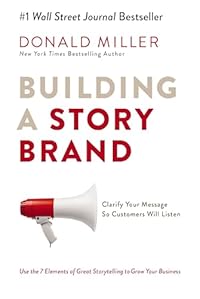
Building a StoryBrand 2.0: Clarify Your Message So Customers Will Listen
by Donald Miller
On This Page
Description
New York Times best-selling author Donald Miller uses the seven universal elements of powerful stories to teach listeners how to dramatically improve how they connect with customers and grow their businesses in this new edition of his bestselling book. Since the original publication of "Building a Storybrand", over one million business leaders have discovered Donald Miller's powerful "Storybrand Framework" and they are making millions. Now, the classic resource for connecting with customers show more has been fully revised and updated, making it even more powerful to prepare you for today's challenges. If you use the wrong words to talk about your product, nobody will buy it. Marketers and business owners struggle to effectively connect with their customers, costing them and their companies millions in lost revenue. In a world filled with constant, on-demand distractions, it has become near-impossible for business owners to effectively cut through the noise to reach their customers, something Donald Miller experienced first-hand and led him to create his proven system he first shared in Building a Storybrand to help you engage and truly influence customers. The StoryBrand process is a proven solution to the struggle business leaders face when talking about their companies. Without a clear, distinct message, customers will not understand what you can do for them and are unwilling to engage, causing you to lose potential sales, opportunities for customer engagement, and much more. In "Building a StoryBrand 2.0", Donald Miller teaches marketers and business owners to use his fully revised system of the seven universal elements of powerful stories to dramatically improve how they connect with customers and grow their businesses. His proven process has helped thousands of companies engage with their existing customers, giving them the ultimate competitive advantage. Building a StoryBrand does this by teaching you: The seven universal story points all humans respond to; - The real reason customers make purchases; - How to simplify a brand message so people understand it; and - How to create the most effective messaging for websites, brochures, and social media. Whether you are the marketing director of a multibillion-dollar company, the owner of a small business, a politician running for office, or the lead singer of a rock band, "Building a StoryBrand 2.0" will forever transform the way you talk about who you are, what you do, and the unique value you bring to your customers. show lessTags
Recommendations






Member Reviews
The analogy between business messaging and storytelling may be helpful in keeping your message concise and focused, but it's also heavily labored and not always on point.
A thesis like this one will live or die by the strength of its examples. In this case, sometimes the author's examples work; other times, they are not examples of what he says they are; still other times, he makes very sweeping pronouncements without offering any evidence at all.
The author claims to derive his authority from the time he spent as a Hollywood screenwriter, and he claims to have written a script that was produced and released nationwide. However, I was not able to find such a movie. It isn't even on the author's IMDB page. If he really did make a movie, show more then he obviously thinks his reputation will be weakened if you find out what it was — yet he still tries to parlay it into authority.
This is dishonest on the author's part; but my larger objection is that the author is a lightweight who doesn't know how to think his points through. If you choose to let this man influence the path of your business, I strongly recommend scrutinizing his claims very closely. show less
A thesis like this one will live or die by the strength of its examples. In this case, sometimes the author's examples work; other times, they are not examples of what he says they are; still other times, he makes very sweeping pronouncements without offering any evidence at all.
The author claims to derive his authority from the time he spent as a Hollywood screenwriter, and he claims to have written a script that was produced and released nationwide. However, I was not able to find such a movie. It isn't even on the author's IMDB page. If he really did make a movie, show more then he obviously thinks his reputation will be weakened if you find out what it was — yet he still tries to parlay it into authority.
This is dishonest on the author's part; but my larger objection is that the author is a lightweight who doesn't know how to think his points through. If you choose to let this man influence the path of your business, I strongly recommend scrutinizing his claims very closely. show less
One quick thing to get out of the way. This is an updated version of the author’s first book on the subject. I’ve never read the original version (I guess “1.0” would be the proper way to refer to it), so I can’t compare the changes. However, I’ll relate a story regarding 1.0.
During a video conference with a friend, I mentioned I was excited about this book I was reading. (I was about halfway through.) I showed her the 2.0 cover. She became similarly excited and said her and her husband had used the first version to help brand his company – apparently a very profitable branding.
I don’t know what was added, but a successful first version has led to a very successful second version.
I come at anything regarding the show more marketing of operations in a different way than a lot of people. I have worked in/with internal audit for over 40 years, and I believe one thing really holding the profession back is that it does not know how to market itself within the organization. I’ve done a lot of work around this and done training/presentations on the subject.
With that in mind, I approached what I read from two perspectives – as if I were marketing an internal audit department (and I worked in them for almost 30 years, so this was no stretch), and from my own training/consulting operations.
I cannot describe all the insights and new understandings I gained from reading this book. It matched many of the things I understood about how to market, but gave a new framework, approach, and understanding on the subject. In particular, the emphasis on making the customer (client) the hero of the story – remembering that is about that person, not about you – definitely resonated. I have seen too many examples in my profession of people who think the focus is on them. And if they were to make this one pivot it would result in the most important start to changing the perceptions others have of them.
So, to get a better feel for how well this all worked, I then went to the web page often referred to in the book. (See below.) While I didn’t spend as much time as would really be necessary for a department or organization, I still gave the answers some thought. Again, I did this for both an internal audit department and for my own operations.
I must say the results were very good. Any issues I had with the final framework had more to do with my not spending the time really necessary for a successful campaign. But even this quick hit provided insights I would not have thought of
One minor complaint is that this is obviously a gateway to the author’s website and business. There are constant references to setting up an account and putting the information in to help define the marketing for your operations. I will quickly note that, while there are paid versions of everything, the initial analysis is free and, as noted, interesting, thought-providing, and valuable. But a little less emphasis on the web site might be nice.
And one other thing. (And this may be a small quibble.) Miller uses a lot – a lot – of movie references to tell the story of how to tell a story. This makes perfect sense and they do an excellent job of making his points. However, one, there were almost too many of them. And, two (maybe more importantly), it is interesting how many people know so little about movies. I have recently been working with a couple of people who, I would be willing to bet, would not get a single movie reference within these pages.
Again, minor quibbles, because I cannot recommend this book enough. And I don’t care what organization, company, mom-and-pop operation, personal situation you are in. Working through these steps – understanding what they mean to you and those with whom you interact – will make you better. And it will help you better position yourself in the minds of your customers/clients/friends show less
During a video conference with a friend, I mentioned I was excited about this book I was reading. (I was about halfway through.) I showed her the 2.0 cover. She became similarly excited and said her and her husband had used the first version to help brand his company – apparently a very profitable branding.
I don’t know what was added, but a successful first version has led to a very successful second version.
I come at anything regarding the show more marketing of operations in a different way than a lot of people. I have worked in/with internal audit for over 40 years, and I believe one thing really holding the profession back is that it does not know how to market itself within the organization. I’ve done a lot of work around this and done training/presentations on the subject.
With that in mind, I approached what I read from two perspectives – as if I were marketing an internal audit department (and I worked in them for almost 30 years, so this was no stretch), and from my own training/consulting operations.
I cannot describe all the insights and new understandings I gained from reading this book. It matched many of the things I understood about how to market, but gave a new framework, approach, and understanding on the subject. In particular, the emphasis on making the customer (client) the hero of the story – remembering that is about that person, not about you – definitely resonated. I have seen too many examples in my profession of people who think the focus is on them. And if they were to make this one pivot it would result in the most important start to changing the perceptions others have of them.
So, to get a better feel for how well this all worked, I then went to the web page often referred to in the book. (See below.) While I didn’t spend as much time as would really be necessary for a department or organization, I still gave the answers some thought. Again, I did this for both an internal audit department and for my own operations.
I must say the results were very good. Any issues I had with the final framework had more to do with my not spending the time really necessary for a successful campaign. But even this quick hit provided insights I would not have thought of
One minor complaint is that this is obviously a gateway to the author’s website and business. There are constant references to setting up an account and putting the information in to help define the marketing for your operations. I will quickly note that, while there are paid versions of everything, the initial analysis is free and, as noted, interesting, thought-providing, and valuable. But a little less emphasis on the web site might be nice.
And one other thing. (And this may be a small quibble.) Miller uses a lot – a lot – of movie references to tell the story of how to tell a story. This makes perfect sense and they do an excellent job of making his points. However, one, there were almost too many of them. And, two (maybe more importantly), it is interesting how many people know so little about movies. I have recently been working with a couple of people who, I would be willing to bet, would not get a single movie reference within these pages.
Again, minor quibbles, because I cannot recommend this book enough. And I don’t care what organization, company, mom-and-pop operation, personal situation you are in. Working through these steps – understanding what they mean to you and those with whom you interact – will make you better. And it will help you better position yourself in the minds of your customers/clients/friends show less
 This review was written for LibraryThing Early Reviewers.
Solid lessons delivered in a cheesy fashion. If you can handle the repeated references to The Bourne Identity and Tommy Boy (?!), there's a lot to learn from this book.
I've been feeling overloaded with competing branding frameworks in the first year of starting a new business. This book has cleared the deck and become the system I'm now using. Donald Miller tells this story as simply as he calls the reader to do. He includes just enough real examples to convey that his method works.
This review was written for LibraryThing Early Reviewers.I struggled to read this book. Perhaps I'm less keen on marketing topics? Perhaps it's my brain acclimating to a new way of thinking about the topic? The premise is pretty simple. Seven steps are needed for a good sales pitch or a good story:
* A hero
* has a problem.
* A guide appears
* to direct the hero to a plan.
* A call to action is made.
* Failure is avoided.
* Success!
Yoda and Mary Poppins are examples who guide with empathy and competency and help their heroes solve problems. When you are selling a product or service, your customer is the hero, and you are the guide.
The book walks you through each of these steps in more detail and provides a website to help you analyze your business to find the best pitch to help you sell better. I show more love the customer-first focus of this message. I think the book could have been half as long though! Business leaders love quick reads more than long ones because they're usually pressed for time. show less
* A hero
* has a problem.
* A guide appears
* to direct the hero to a plan.
* A call to action is made.
* Failure is avoided.
* Success!
Yoda and Mary Poppins are examples who guide with empathy and competency and help their heroes solve problems. When you are selling a product or service, your customer is the hero, and you are the guide.
The book walks you through each of these steps in more detail and provides a website to help you analyze your business to find the best pitch to help you sell better. I show more love the customer-first focus of this message. I think the book could have been half as long though! Business leaders love quick reads more than long ones because they're usually pressed for time. show less
This review was written for LibraryThing Early Reviewers.Building a StoryBrand 2.0 revisits Donald Miller’s well-known messaging framework with updated examples and expanded guidance. The book focuses on helping businesses and individuals clarify what they offer by using storytelling principles that place the customer at the center. Miller walks through a structured process built around seven story elements and explains how they can be applied to branding, marketing, and communication. The tone is practical and accessible, with an emphasis on cutting through noise and simplifying messages. This revised edition will likely feel most useful to readers looking for a clear, step-by-step approach to refining their brand language rather than abstract marketing theory.
This review was written for LibraryThing Early Reviewers.This book is great for those wanting to learn about the storytelling approach to marketing. Easy to read book with a step-by-step process to tell your story and build your brand. The examples were extremely helpful. The only downside was the author’s push to make additional purchases, buy his course, or attend a consulting seminar.
This review was written for LibraryThing Early Reviewers.Members
- Recently Added By
Lists

My List
302 works; 1 member
Author Information
16 Works 1,116 Members
Donald Miller is a best-selling author and public speaker based in Nashville, Tennessee who focuses on Christian spirituality. Miller's first book, Prayer and the Art of Volkswagen Maintenance (Harvest House Publishers 2000), chronicled the cross-country road trip he took at age 21. It was printed with little fanfare, but it was republished more show more successfully in 2005 as Through Painted Deserts. Miller became a New York Times Bestselling Author when he published Blue Like Jazz in 2003. In 2004, Miller released Searching For God Knows What. In 2006, he added another book, To Own A Dragon. Don's next book, A Million Miles in a Thousand Years, was released in late 2009. His title Scary Close: Dropping the Act and Acquiring a Taste for True Intimacy became a New York Times bestseller in 2015. In 2009 Miller began production of All Things Converge, a series of DVDs for small groups that feature Miller interviewing prominent Christian writers and theologians. The first three DVDs in the series were released in the fourth quarter of 2009. (Bowker Author Biography) show less
Common Knowledge
- Canonical title
- Building a StoryBrand 2.0: Clarify Your Message So Customers Will Listen
Classifications
Statistics
- Members
- 822
- Popularity
- 33,336
- Reviews
- 21
- Rating
- (4.00)
- Languages
- English, Spanish
- Media
- Paper, Audiobook, Ebook
- ISBNs
- 13
- ASINs
- 5