
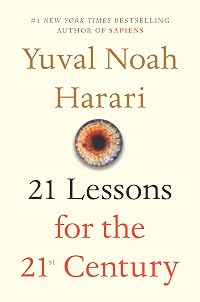
21 Lessons for the 21st Century
by Yuval Noah Harari
On This Page
Description
#1 NEW YORK TIMES BESTSELLER * In Sapiens, he explored our past. In Homo Deus, he looked to our future. Now, one of the most innovative thinkers on the planet turns to the present to make sense of today's most pressing issues. "Fascinating . . . a crucial global conversation about how to take on the problems of the twenty-first century."--Bill Gates, The New York Times Book Review NAMED ONE OF THE BEST BOOKS OF THE YEAR BY FINANCIAL TIMES AND PAMELA PAUL, KQED How do computers and show more robots change the meaning of being human? How do we deal with the epidemic of fake news? Are nations and religions still relevant? What should we teach our children? Yuval Noah Harari's 21 Lessons for the 21st Century is a probing and visionary investigation into today's most urgent issues as we move into the uncharted territory of the future. As technology advances faster than our understanding of it, hacking becomes a tactic of war, and the world feels more polarized than ever, Harari addresses the challenge of navigating life in the face of constant and disorienting change and raises the important questions we need to ask ourselves in order to survive. In twenty-one accessible chapters that are both provocative and profound, Harari builds on the ideas explored in his previous books, untangling political, technological, social, and existential issues and offering advice on how to prepare for a very different future from the world we now live in: How can we retain freedom of choice when Big Data is watching us? What will the future workforce look like, and how should we ready ourselves for it? How should we deal with the threat of terrorism? Why is liberal democracy in crisis? Harari's unique ability to make sense of where we have come from and where we are going has captured the imaginations of millions of readers. Here he invites us to consider values, meaning, and personal engagement in a world full of noise and uncertainty. When we are deluged with irrelevant information, clarity is power. Presenting complex contemporary challenges clearly and accessibly, 21 Lessons for the 21st Century is essential reading. "If there were such a thing as a required instruction manual for politicians and thought leaders, Israeli historian Yuval Noah Harari's 21 Lessons for the 21st Century would deserve serious consideration. In this collection of provocative essays, Harari . . . tackles a daunting array of issues, endeavoring to answer a persistent question: 'What is happening in the world today, and what is the deep meaning of these events?'"--BookPage (top pick) show lessTags
Recommendations












Member Reviews
Humanity faces unprecedented global challenges in the 21st century: climate change, the threat of nuclear war, growing inequality, artificial intelligence and automation, job loss and worker irrelevance, and a growing sense of disillusionment with liberalism that is driving humanity to embrace the counter-enlightenment values of nationalism and religion.
Yuval Noah Harari spends much of the book outlining these problems, placing them in historical perspective, and providing philosophical insight into their possible solutions. In this sense, 21 Lessons for the 21st Century is a brilliant primer on current affairs from a wider angle, presented by a historian that can transcend the parochialism of political debate and define the problems show more from a historically-informed and rational position. As Harari has said elsewhere, he prefers to think in centuries rather than in hours, days, or months.
Harari covers a lot of ground: climate change, immigration, technology, terrorism, war, god, religion, education, truth, meaning, and justice, and it’s worth reading the book in its entirety to get a sweeping perspective on current issues. But the main theme of the book is that the three major global problems of the 21st century (climate change, nuclear war, and technological disruption) cannot be solved locally.
Nationalism and religion in particular have no solutions for global problems. No single nation can, by itself, solve climate change, prevent nuclear war, or regulate technological innovation. Global cooperation among nations is the only chance we have at navigating these issues. The other option, I suppose, is pretending that the issues don’t exist, like when artificial intelligence and automation were never discussed during the 2016 US presidential debates and when Donald Trump called climate change a “Chinese hoax.” But ignoring the problems won’t make them go away.
Religion, Harari claims, is also largely irrelevant in terms of providing solutions, because the religious texts have almost nothing to say about contemporary problems. Additionally, religious people usually form their political conclusions first, using religion only as justification for positions they already hold. This is demonstrated by the fact that the religious occupy almost every conceivable social and political position and can find support for that position somewhere within scripture.
Another prominent theme throughout the book is humanity’s need for comforting stories, for simple and untrue myths that are required to give life meaning. This is pathological and needs to be outgrown. We need to develop intellectual integrity and the courage to admit our ignorance, confront the unknown, and forge our own meaning. The retreat to fairy tales is intellectually dishonest, and believing in something against all evidence to the contrary is, frankly, cowardly. In terms of life’s meaning, is it not enough to enjoy the companionship of others, to love, to engage in meaningful work, to help those in need, and to marvel at our access to all the world’s knowledge and cultural, artistic, and scientific output? Is all of this really meaningless if a middle-eastern carpenter from 2,000 years ago was not born of a virgin and resurrected from the dead?
For humanity to survive the challenges that lie ahead, we must transcend the old dogmas and myths and develop a new, global, cooperative philosophy based on reason, science, humanism, and progress. Whether or not this happens is up to us, but to do so we must confront and defeat the perennial conservative and reactionary forces that are constantly trying to drive us backwards.
The only downside to the book is that it repeats much of the author's previous works, and if you've read both Sapiens and Homo Deus, you'll already be familiar with much of the content and arguments, particularly his technological prognostications and his concept of imagined realities. Still, there's enough new ground and fresh insights to make this a worthwhile read. show less
Yuval Noah Harari spends much of the book outlining these problems, placing them in historical perspective, and providing philosophical insight into their possible solutions. In this sense, 21 Lessons for the 21st Century is a brilliant primer on current affairs from a wider angle, presented by a historian that can transcend the parochialism of political debate and define the problems show more from a historically-informed and rational position. As Harari has said elsewhere, he prefers to think in centuries rather than in hours, days, or months.
Harari covers a lot of ground: climate change, immigration, technology, terrorism, war, god, religion, education, truth, meaning, and justice, and it’s worth reading the book in its entirety to get a sweeping perspective on current issues. But the main theme of the book is that the three major global problems of the 21st century (climate change, nuclear war, and technological disruption) cannot be solved locally.
Nationalism and religion in particular have no solutions for global problems. No single nation can, by itself, solve climate change, prevent nuclear war, or regulate technological innovation. Global cooperation among nations is the only chance we have at navigating these issues. The other option, I suppose, is pretending that the issues don’t exist, like when artificial intelligence and automation were never discussed during the 2016 US presidential debates and when Donald Trump called climate change a “Chinese hoax.” But ignoring the problems won’t make them go away.
Religion, Harari claims, is also largely irrelevant in terms of providing solutions, because the religious texts have almost nothing to say about contemporary problems. Additionally, religious people usually form their political conclusions first, using religion only as justification for positions they already hold. This is demonstrated by the fact that the religious occupy almost every conceivable social and political position and can find support for that position somewhere within scripture.
Another prominent theme throughout the book is humanity’s need for comforting stories, for simple and untrue myths that are required to give life meaning. This is pathological and needs to be outgrown. We need to develop intellectual integrity and the courage to admit our ignorance, confront the unknown, and forge our own meaning. The retreat to fairy tales is intellectually dishonest, and believing in something against all evidence to the contrary is, frankly, cowardly. In terms of life’s meaning, is it not enough to enjoy the companionship of others, to love, to engage in meaningful work, to help those in need, and to marvel at our access to all the world’s knowledge and cultural, artistic, and scientific output? Is all of this really meaningless if a middle-eastern carpenter from 2,000 years ago was not born of a virgin and resurrected from the dead?
For humanity to survive the challenges that lie ahead, we must transcend the old dogmas and myths and develop a new, global, cooperative philosophy based on reason, science, humanism, and progress. Whether or not this happens is up to us, but to do so we must confront and defeat the perennial conservative and reactionary forces that are constantly trying to drive us backwards.
The only downside to the book is that it repeats much of the author's previous works, and if you've read both Sapiens and Homo Deus, you'll already be familiar with much of the content and arguments, particularly his technological prognostications and his concept of imagined realities. Still, there's enough new ground and fresh insights to make this a worthwhile read. show less
First of all, the reaction to this book might depend on the readership: is it a student right out of college, a person in his/her 40s, or a retiree - the mental impact might be different for each of them. "Sapiens" took me by surprise and was an eye-opener, and "21 Lessons..." doesn't fall short of that at all, another eye-opener on many levels (I am yet to read "Homo Deus" - delaying it, thinking it might be a bit "over-my-head"...).
I do agree with other reviewers that Harari doesn't have all the answers (who has?!), but he highlights and pinpoints the societal problems in such a way that definitely makes us pause and think. At first glance, Harari might seem a super skeptic, but in fact, he makes a lot of sense. I have never written show more out so many quotes from a non-fiction book (or any book for that matter) like from this one, which shows how many mind-boggling, important, radical, and, to some, sacrilegious ideas he has.
In his essay-like chapters he touches on a variety of subjects, "lessons" he calls them - and not without reason. (He lost me a bit in the chapter on science fiction - but it's not his fault). I do admit that I still struggle with the proposed idea that our "feelings are biochemical mechanisms", but I am not a scientist and cannot argue with brain research. But I especially liked how, in this book, instead of lecturing, Harari converses with the reader. Also, it has to be mentioned that, like in "Sapiens", he continues to be very consistent with his objectivity - he attacks the weak points of ALL religions/nations/philosophies, including his own (Judaism and Israel). A very welcome surprise in the last chapter - on Meditation: to think that an author who seems to be brutally critical of so many things that Homo Sapiens represent, embraces meditation so fully - it has to stand for something (both in his favor and that of meditation!). show less
I do agree with other reviewers that Harari doesn't have all the answers (who has?!), but he highlights and pinpoints the societal problems in such a way that definitely makes us pause and think. At first glance, Harari might seem a super skeptic, but in fact, he makes a lot of sense. I have never written show more out so many quotes from a non-fiction book (or any book for that matter) like from this one, which shows how many mind-boggling, important, radical, and, to some, sacrilegious ideas he has.
In his essay-like chapters he touches on a variety of subjects, "lessons" he calls them - and not without reason. (He lost me a bit in the chapter on science fiction - but it's not his fault). I do admit that I still struggle with the proposed idea that our "feelings are biochemical mechanisms", but I am not a scientist and cannot argue with brain research. But I especially liked how, in this book, instead of lecturing, Harari converses with the reader. Also, it has to be mentioned that, like in "Sapiens", he continues to be very consistent with his objectivity - he attacks the weak points of ALL religions/nations/philosophies, including his own (Judaism and Israel). A very welcome surprise in the last chapter - on Meditation: to think that an author who seems to be brutally critical of so many things that Homo Sapiens represent, embraces meditation so fully - it has to stand for something (both in his favor and that of meditation!). show less
 This review was written for LibraryThing Early Reviewers.
Society 101
Yuval Harari is well known for his books Sapiens and Homo Deus. He has decided to squander his reputation on a book called 21 Lessons for the 21st Century. The basic problem is that every chapter is the subject of whole shelves of books, and putting them all in one book cannot possibly do them justice. What we have left is a set of 21 editorials, which might inform the totally uninformed, but provide little insight and no solutions. As “lessons” they are unhelpful.
He has conveniently distilled all the threats to mankind into three: nuclear war, climate change and technological/biological disruption. But only technological/biological gets examined. You’re on your own for climate change and nuclear war, which apparently show more don’t rate high enough for “lessons”.
Despite those three most important threats, the most common theme throughout the book is criticism of religion, mostly Judaism, Christianity, and Islam, though Buddhism and Hinduism come under attack as well. Looking back from the perspective of the universe, Harari condemns all religions as pompous, pretentious, full of contradictions, and terrifically negative forces.
In his chapter on Immigration, Harari boils down the entire complex situation to three superficial “debates”:
-The receiving country must be willing
-Immigrants must be willing to adopt “at least the core norms and values” of the new country
-If immigrants assimilate, they become “us” rather than “them” and must be treated as first class citizens.
Simple, inaccurate and totally missing the real issues.
In his chapter on terrorism, Harari completely misses the point that the state has a monopoly on violence. Anyone who challenges that monopoly must be put down, no matter how many civil rights and freedoms are trampled in the process. He spends pages explaining how few people are killed by terrorists compared to traffic, war and disease. So why are we so afraid of terrorists, he asks. (Because the state wants us to be, Mr. Harari.)
In the chapter on war, he comes to the magical conclusion that we’ve pretty much done away with it. So far, the only new war we’ve seen this century is Russia taking parts of Ukraine. He says countries see too much risk in starting new wars. He completely ignores (not for the first or last time), the effects of climate change, which will result in unprecedented and massive wars as countries face unstoppable waves of immigrants seeking water and land, as countries disappear from the face of the earth, and as those that have will defend it to the death against all comers, foreign and domestic.
The final chapter is on meditation. Meditation is Harari’s solution to pretty much everything, because you can focus on what is real – what is going on in your body right then and there. He says he does this two hours a day, plus one or two months a year.
If I had to summarize 21 Lesson for the 21st Century, I would say: throw off the false faiths of institutional religions and meditate instead. Not quite what I expected, and not much help in navigating the 21st century.
David Wineberg show less
Yuval Harari is well known for his books Sapiens and Homo Deus. He has decided to squander his reputation on a book called 21 Lessons for the 21st Century. The basic problem is that every chapter is the subject of whole shelves of books, and putting them all in one book cannot possibly do them justice. What we have left is a set of 21 editorials, which might inform the totally uninformed, but provide little insight and no solutions. As “lessons” they are unhelpful.
He has conveniently distilled all the threats to mankind into three: nuclear war, climate change and technological/biological disruption. But only technological/biological gets examined. You’re on your own for climate change and nuclear war, which apparently show more don’t rate high enough for “lessons”.
Despite those three most important threats, the most common theme throughout the book is criticism of religion, mostly Judaism, Christianity, and Islam, though Buddhism and Hinduism come under attack as well. Looking back from the perspective of the universe, Harari condemns all religions as pompous, pretentious, full of contradictions, and terrifically negative forces.
In his chapter on Immigration, Harari boils down the entire complex situation to three superficial “debates”:
-The receiving country must be willing
-Immigrants must be willing to adopt “at least the core norms and values” of the new country
-If immigrants assimilate, they become “us” rather than “them” and must be treated as first class citizens.
Simple, inaccurate and totally missing the real issues.
In his chapter on terrorism, Harari completely misses the point that the state has a monopoly on violence. Anyone who challenges that monopoly must be put down, no matter how many civil rights and freedoms are trampled in the process. He spends pages explaining how few people are killed by terrorists compared to traffic, war and disease. So why are we so afraid of terrorists, he asks. (Because the state wants us to be, Mr. Harari.)
In the chapter on war, he comes to the magical conclusion that we’ve pretty much done away with it. So far, the only new war we’ve seen this century is Russia taking parts of Ukraine. He says countries see too much risk in starting new wars. He completely ignores (not for the first or last time), the effects of climate change, which will result in unprecedented and massive wars as countries face unstoppable waves of immigrants seeking water and land, as countries disappear from the face of the earth, and as those that have will defend it to the death against all comers, foreign and domestic.
The final chapter is on meditation. Meditation is Harari’s solution to pretty much everything, because you can focus on what is real – what is going on in your body right then and there. He says he does this two hours a day, plus one or two months a year.
If I had to summarize 21 Lesson for the 21st Century, I would say: throw off the false faiths of institutional religions and meditate instead. Not quite what I expected, and not much help in navigating the 21st century.
David Wineberg show less
В своей новой книге автор бестселлеров для умных Homo Sapiens и Homo Deus рассуждает уже не о том, как мы дошли до жизни такой, и не о том, что нас ждет через 100–500 лет, а о самом ближайшем будущем, которое разворачивается прямо перед глазами, но не всегда регистрируется нашим сознанием или нашими СМИ. Дает Харари и реакцию на значительную обратную связь, которую он получает со всего мира на свои будоражащие мысли. show more Главы 11-я «Война. Нельзя недооценивать человеческую глупость» и 12-я «Скромность. Вы не пуп земли» надо давать читать подрастающему поколению, даже если вам там что-то не по душе. А вот самую большую главу, 20-ю, «Смысл. Жизнь — не вымысел», венец всего труда и, наверное, квинтэссенцию всего здравого, что выработала человеческая мысль к данной минуте, советую прочесть уже всем и каждому. show less
How safe from obsolescence is the job you have now? Do you have the skills to adapt in the rapidly changing Big Data environment? How will the merger of infotech and biotech affect our collective future? How can we prevent climate change from irrevocably changing the planet? What will the next global armed conflict look like? Is the recent rise in nationalism a threat to world security? How does “post-truth” (i.e., fake news) affect our thinking? Do terrorist attacks create more fear and suffering than they should? How do the stories we tell ourselves, whether religious or secular in nature, influence our behavior?
These are all questions that are clearly of concern to each of us in the here and now. They also motivate many of the show more “lessons” discussed in 21 Lessons for the 21st Century, a volume that once again combines Yuval Noah Harari’s unique blend of history, science, philosophy, and anthropology. Unlike Sapiens, which explored mankind’s past 10,000 years, and Homo Deus, which projects humanity’s long-term future, this book purports to assess the major issues facing us in the present. Unfortunately, this exploration is neither wholly successful nor is it nearly as compelling as the author’s previous two efforts.
To be sure, there is a lot to like about what appears here. In particular, Harari’s discussion of the economic, legal, and social challenges created by the ascent of Big Data is very illuminating. Who owns the information summarizing our lives—or, perhaps more critically, who controls it—is indeed likely to be one of the major issues defining our near-term future. I also thought that the author’s interpretations of nationalism and secularism were insightful. Overall, he did a nice job of connecting several disparate themes into a cohesive bigger picture (e.g., a discussion of the importance of developing a global community is followed by an examination of nationalist sentiment which leads to a consideration of the immigration problem and then to the threat posed by terrorism).
The main problem I had with all of this is that major portions of the book were not especially original and often seemed like slightly reworked versions of arguments used in the author’s previous studies. For instance, the rise of biotech was thoroughly covered in Homo Deus and humankind’s use of rituals and ability to create useful fictions were essential parts of Sapiens. As such, there are really far fewer than 21 distinct lessons presented here, despite the volume containing 21 different chapters. Finally, the last two chapters involving the role of personal stories and the importance of meditation were woefully self-indulgent and had an off-putting pop-psychology/self-help feel to them. So, while 21 Lessons for the 21st Century is not at all a bad book, the reader might be better served by considering the author’s earlier work instead. show less
These are all questions that are clearly of concern to each of us in the here and now. They also motivate many of the show more “lessons” discussed in 21 Lessons for the 21st Century, a volume that once again combines Yuval Noah Harari’s unique blend of history, science, philosophy, and anthropology. Unlike Sapiens, which explored mankind’s past 10,000 years, and Homo Deus, which projects humanity’s long-term future, this book purports to assess the major issues facing us in the present. Unfortunately, this exploration is neither wholly successful nor is it nearly as compelling as the author’s previous two efforts.
To be sure, there is a lot to like about what appears here. In particular, Harari’s discussion of the economic, legal, and social challenges created by the ascent of Big Data is very illuminating. Who owns the information summarizing our lives—or, perhaps more critically, who controls it—is indeed likely to be one of the major issues defining our near-term future. I also thought that the author’s interpretations of nationalism and secularism were insightful. Overall, he did a nice job of connecting several disparate themes into a cohesive bigger picture (e.g., a discussion of the importance of developing a global community is followed by an examination of nationalist sentiment which leads to a consideration of the immigration problem and then to the threat posed by terrorism).
The main problem I had with all of this is that major portions of the book were not especially original and often seemed like slightly reworked versions of arguments used in the author’s previous studies. For instance, the rise of biotech was thoroughly covered in Homo Deus and humankind’s use of rituals and ability to create useful fictions were essential parts of Sapiens. As such, there are really far fewer than 21 distinct lessons presented here, despite the volume containing 21 different chapters. Finally, the last two chapters involving the role of personal stories and the importance of meditation were woefully self-indulgent and had an off-putting pop-psychology/self-help feel to them. So, while 21 Lessons for the 21st Century is not at all a bad book, the reader might be better served by considering the author’s earlier work instead. show less
This is the second book by this author which I have read. I like how he puts problems we face on a global basis rather than an individual or national basis. In order to survive in the future, we need to have a plan that will work for future generations. He talks about many subjects which will affect our lives in the future. For me, his most profound thoughts arise out of his belief that our lives consist of myths and stories which encompass such things as nationhood, religion, and other categories with which each of us self-identifies. What surprised me the most was at the end of the book where the author finds meaning and solace in meditation.
One thing I especially love about Harari’s writing is that he writes about each subject show more clearly and objectively. Whether I agree or disagree with what he writes, I understand perfectly what says. I also delight in the ways he expresses himself (i.e. “What my people lack in numbers and real influence, they more than compensate for in chutzpah.”). This author’s truths are so factual they oftentimes make me laugh in their simplicity.
Books like this one are exceptional in forcing readers to think about how objectively they see the world in terms of such things as religion, politics, and truth. I am eager to continue reading the brilliant writing of this author. show less
One thing I especially love about Harari’s writing is that he writes about each subject show more clearly and objectively. Whether I agree or disagree with what he writes, I understand perfectly what says. I also delight in the ways he expresses himself (i.e. “What my people lack in numbers and real influence, they more than compensate for in chutzpah.”). This author’s truths are so factual they oftentimes make me laugh in their simplicity.
Books like this one are exceptional in forcing readers to think about how objectively they see the world in terms of such things as religion, politics, and truth. I am eager to continue reading the brilliant writing of this author. show less
This is the 3rd book that I have read by Harari i. The first 2( Sapiens and Homo Deus) are among the best non-fiction books that I have ever read. They got me thinking about all aspects of our lives as he delves into our history as a species and the future of humans. This book is simpler and probably a good introduction to Harari for first time readers. He deals with the present and deliver 21 essays in 5 sections 1. Technological Change 2.The Political Challenge 3. Despair and Hope 4.Truth 5.Resilience . Although he deals with lofty topics he writes them in understandable ways with lots of concrete examples. One of his main themes throughout all 3 of his books is the concept of the myths that we live with. To me his number one myth is show more religion. Being a historian and scientist he looks at things through empirical evidence. Religion as an accepted myth(after all do we really have proof of God's existence) unites most of humanity. As a unifying force it has done much good in the world but also much harm. He shows that what works for small intimate groups does not solve the big problems of the world. For me the best lesson was the one on humility. The idea that the world should be looked at through the rules set down by religion shows a certain arrogance about one religion having the truth. After all what do all the rituals and rules that all religions practice have to do with the central positive message of the religion. His book addresses truth and shows how Trump and Putin distort the truth to achieve their goals. He does not necessarily have answers to our most vexing problems but this book definitely gets you to think. For me reading his 3 books has caused me to view everything through the historical perspective that he lays down in his books. There quite a few youtube videos of Harari engaging with different moderators.Check it out. This is thought provoking non-fiction at the highest level. He will challenge your deeply held beliefs about nationalism, commerce, and religion. show less
Members
- Recently Added By
Published Reviews
ThingScore 50
It’s no criticism to say that Harari hasn’t produced a satisfying answer yet. Neither has anyone else. So I hope he turns more fully to this question in the future. In the meantime, he has teed up a crucial global conversation about how to take on the problems of the 21st century.
added by Jozefus
Wittgenstein schreef dat filosofie alles zou moeten laten zoals het is: de wereld beschrijven en ordenen, zonder die uit te willen leggen of conclusies te willen trekken en daarmee de werkelijkheid geweld aandoen. Historicus Harari lijkt zich in precies zo’n spagaat te bevinden. Hij wil de geschiedenis beschrijven zoals die was, huidige wetenschappelijke en technologische ontwikkelingen show more weergeven zoals die zijn. Maar in zijn drang om conclusies te trekken en lessen aan te dragen, wordt zijn verhaal een theoretisch construct dat raakvlakken mist met de werkelijkheid. show less
added by Jozefus
[T]his book sees Harari enter that class of gurus who are assumed to be experts on everything. The 22nd lesson of this book is obvious: no single member of the tribe Homo Sapiens can know everything. If this new age needs new stories, then we have to let more people tell them.
added by Jozefus
Lists

Top Five Books of 2020
982 works; 348 members

Litsy Awards 2018
248 works; 9 members

Books That Changed Our Perspective
423 works; 168 members

2024-2025 Ezra Klein Guest Recommendations
213 works; 6 members
Author Information

37+ Works 31,566 Members
Yuval Noah Harari received a PhD in history from the University of Oxford. He lectures at the Hebrew University of Jerusalem, specializing in world history. He has written several books including Sapiens: A Brief History of Humankind which became a 2016 New York Times Bestsellers. (Bowker Author Biography)
Some Editions
Awards and Honors
Awards
Distinctions
Series
Belongs to Publisher Series
Work Relationships
Is contained in
Has as a commentary on the text
Common Knowledge
- Canonical title
- 21 Lessons for the 21st Century
- Original title
- 21 Lessons for the 21st Century
- Alternate titles*
- Eenentwintig lessen voor de eenentwintigste eeuw
- Original publication date
- 2018
- Quotations
- Russia is one of the most unequal countries in the world, with 87 percent of wealth concentrated in the hands of the richest 10 percent of people.
The U.S. armed forces need thirty people to operate every unmanned Predator or Reaper drone flying over Syria, while analyzing the resultant harvest of information occupies at least eighty people more. In 2015, the U.S. Air F... (show all)orce lacked sufficient trained humans to fill all these positions, and therefore faced an ironic crisis in manning its unmanned aircraft.
Today, the richest 1 percent own half the world's wealth. Even more alarmingly, the richest one hundred people together more than the poorest 4 billion.
Devices, such as Google Glass and games such as Pokémon Go are designed to erase the distinction between online and off-line, merging them into a single augmented reality.
Since the 1950s, superpowers avoided conflicts with one another because they all knew that war meant mutually assured destruction.
Though globalization has greatly reduced cultural differences across the planet, it has simultaneously made it far easier to encounter strangers and become upset by their oddities.
People continue to conduct a heroic struggle against traditional racism Without noticing that the battlefront has shifted. Traditional racism is waning, but the world is now full of “culturalists”.
You have the worst problem with culturist claims is that despite their statistical nature they are all too often used to prejudge individuals.
Terrorism is the weapon of a marginal and weak segment of humanity. How did it come to dominate global politics?
Terrorists calculate that when the enraged enemy uses his massive power against them, he will raise a much more violent military and political
storm than the terrorists themselves ever could create. During every storm, man... (show all)y unforeseen things happen. Mistakes are made, atrocities are committed, public opinion wavers, neutrals change their stance, and the balance of power shifts.
Above all, if we want to come back terrorism, effectively, we must realize that nothing the terrorist do can defeat us. We are the only ones who can defeat ourselves, if we overreact in a misguided way to their provocations.
This warped concept of “the three great religions” often implies in the mind of Israelis that all major, religious and ethical traditions emerged out of the womb of Judaism, which was the first religion to preach universa... (show all)l, ethical rules – – as if humans prior to the days of Abraham and Moses lived in the Hobbesian state of nature with any moral commitment, and as if all contemporary morality derive from the Ten Commandments. This is a baseless and insolent idea, which ignores many of the world's most important ethical traditions.
This suspicion is greatly strengthened by the fact that the Bible commands Jews to exterminate certain people such as the Amalekites and the Canaanites…This is one of the first recorded instances in human history when genoc... (show all)ide was presented as a binding religious duty.
The most important secular commitment is to the truth, which is based on observation and evidence rather than on mere faith…The other chief commitment of secular people is to compassion…The twin commitments to truth and c... (show all)ompassion result also in a commitment to equality…We cannot search for the truth and for the way out of suffering without the freedom to think, investigate, and experiment…Finally, secular people cherish responsibility.
Since I depend for my existence on a mind-boggling network of economic and political ties, and since global causal connections are so tangled, I find it difficult to answer even the simplest questions. Such as where my lunch ... (show all)comes from, who made the shoes I'm wearing, and what my pension fund is doing with my money.
I am aware that many people might be upset by my equating religion with fake news, but that's exactly the point. When a thousand people believe some made-up story for one month, that's fake news. When a billion people believe... (show all) it for a thousand years, that's a religion, and we are admonished not to call it “fake news” in order not to hurt the feelings of the faithful (or incite their wrath).
Adam and Eve never existed, but Chartres Cathedral is still beautiful. Much of the Bible may be fictional, but it can still bring joy to billions and can still encourage humans to be compassionate, courageous, and creative—... (show all)just like other great works of fiction, such as Don Quixote, War and Peace, and the Harry Potter books.
As a species, people prefer power to truth. We spend far more time and effort on trying to control the world than on trying to understand it—and even when we try to understand it, we usually do so in the hope that understan... (show all)ding the world will make it easier to control it.
One of the greatest fictions of all is to deny the complexity of the world and think in absolute terms: pristine purity versus satanic evil.
…if you want reliable information, pay good money for it.
To the best of our scientific understanding, none of the thousands of stories that different cultures, religions, and tribes have invented throughout history is true.
It is fascinating and terrifying to behold people spending countless hours constructing and embellishing a perfect self online, becoming attached to their own creation, and mistaking it for the truth about themselves. That's ... (show all)how a family holiday fraught with traffic jams, petty squabbles, and tense silences become a collection of beautiful panoramas, perfect dinners, and smiling faces; 99% of what we experience never becomes part of the story of the self. - Original language*
- Hebreeuws
*Some information comes from Common Knowledge in other languages. Click "Edit" for more information.
Classifications
Statistics
- Members
- 4,221
- Popularity
- 3,594
- Reviews
- 108
- Rating
- (4.01)
- Languages
- 22 — Catalan, Czech, Danish, Dutch, English, Estonian, Finnish, French, German, Greek, Hebrew, Hungarian, Italian, Polish, Portuguese, Romanian, Russian, Slovenian, Spanish, Swedish, Turkish, Chinese, traditional
- Media
- Paper, Audiobook, Ebook
- ISBNs
- 98
- ASINs
- 20
