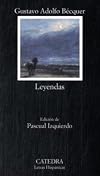
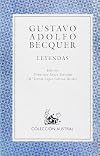
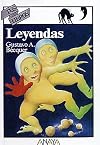
Leyendas
by Gustavo Adolfo Bécquer
On This Page
Description
A must-have for every Spanish reader's personal library. These stories represent the best of Spanish Romantic literature with allusions to history and magic. Beautifully translated.Tags
Recommendations

























Member Reviews
Bécquer será para siempre mi verano de los 15 años, cuando descubrí a maese Pérez y al arpa abandonada del salón en el ángulo oscuro. Sin ser la mejor literatura, sí marcó mi entrada a la apreciación de la poesía y el lirismo, y por ello siempre le agradeceré a Bécquer ayudarme a ver la belleza de las ideas y la palabras.
Las Leyendas son un conjunto de narraciones de carácter posromántico escritas por Gustavo Adolfo Bécquer1 y publicadas entre 1858 y 1865. Estas narraciones tienen un carácter íntimo que evoca el pasado histórico y se caracterizan por una acción verosímil con una introducción de elementos fantásticos o insólitos. Fueron publicadas en periódicos madrileños de la época como El Contemporáneo o La América.
8479690445
8479690445
8479690429
8479690429
Members
- Recently Added By
Lists

Spanische Romantik
6 works; 1 member
Author Information

175+ Works 2,980 Members
Gustavo A. Becquer was the archetypal romantic poet, devoting his life to poetry. The Rhymes, published during his lifetime in newspapers and collected by friends in a volume a year after his death, is characterized by subjectivity, musicality, and the traditional romantic themes of love, death, the idealized past, and evocative landscapes. show more Becquer uses the metaphor of yearning for an unattainable woman, first an imaginary muse and then a real woman who rejects him to describe the spiritual quest of the poet for ineffable beauty and inspiration. Becquer's poetry has been called plastic and painterly for its emphasis on color, light, and architecture. Influences on The Rhymes are said to be primarily those of Heine, Byron, Goethe, Schiller, Musset, and Lamartine. An atmosphere of magic and fantasy pervades the romantic Legends (1860-64), which are set in distant places, such as India, and remote times, primarily the Middle Ages. Damaso Alonso called Becquer's work the beginning of contemporary poetry. Becquer died at age 34 of tuberculosis and the effects of his bohemian life of poverty. (Bowker Author Biography) show less
Some Editions
Series
Belongs to Publisher Series
Work Relationships
Is contained in
Has the adaptation
Has as a student's study guide
Common Knowledge
- Canonical title*
- Leyendas
- Original title
- Leyendas
- Alternate titles
- Romantic Legends of Spain
- Original publication date
- 1868
- Original language*
- Spanish
- Disambiguation notice*
- Sammlung beinhaltet:
In der Allerseelennacht (La noche de difuntos, 1864)
Das goldene Armband (La ajorca de oro, 1861)
Meister Perez, der Organist (Maese Pérez, el organista, 1861)
Der Christus mit dem Totens... (show all)chädel (El Cristode la calavera, 1862)
Ein Kuss (El beso, 1863)
Das weiße Reh (La corza blanca, 1863)
Der Smaragdschmuck (El aderezo de las esmeraldas, 1862)
Das Verlöbnis (La promesa, 1863)
Die Weltschöpfung - Gedicht aus Indien (La creación, 1861)
Das Kreuz des Teufels (La cruz del diablo, 1860)
Glaubet an Gott! - Provencalische Legende (Creed en Dios, 1862)
Die grünen Augen (Los ojos verdes, 1861)
Der Rajah mit den roten Händen - Indische Sage (El caudillo de las manos rojas, 1858)
Die Passionsblume (La Rosa de Pasión, 1864)
Der Gnom (El gnomo, 1863)
Das Miserere (El Miserere, 1862)
Der Armenseelenberg (El monte de las ánimas, 1861)
Der Mondstrahl (El rayo de luna, 1862)
*Some information comes from Common Knowledge in other languages. Click "Edit" for more information.
Classifications
Statistics
- Members
- 488
- Popularity
- 61,795
- Reviews
- 14
- Rating
- (3.86)
- Languages
- 5 — English, German, Italian, Portuguese, Spanish
- Media
- Paper, Audiobook, Ebook
- ISBNs
- 112
- ASINs
- 15