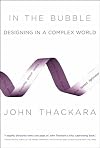
In the Bubble: Designing in a Complex World
by John Thackara
On This Page
Description
"We're filling up the world with technology and devices, but we've lost sight of an important question: What is this stuff for? What value does it add to our lives? So asks author John Thackara in his new book, In the Bubble: Designing in a Complex World." "In the Bubble is about a world based less on stuff and more on people. Thackara describes a transformation that is taking place now - not in a remote science-fiction future. We are regaining respect for what people can do that technology show more can't. In the Bubble describes services designed to help people carry out daily activities in new ways. Many of these services involve technology - ranging from body implants to wide-bodied jets. But objects and systems play a supporting role in a people-centered world. The design focus is on services, not things. And new principles - above all, lightness - inform the way these services are designed and used. At the heart of In the Bubble is a belief, informed by a wealth of real-world examples, that ethics and responsibility can inform design decisions without impeding social and technical innovation."--Jacket. show lessTags
Recommendations




















Member Reviews
Admittedly this 2006 book is dated and seems most so when it considers the (unnamed) Internet of Thing reality that is already upon. Still, it is insightful and valuable to read, especially for engineers.
Thackara tells us of ancient Greece's symposiarch who could enforce drinking or nude dancing on too-serious feasters. In this, he reminds us that humor helps keep an open mind. It does feel it still takes a very open mind to see a need for sustainability in the ecology invention and production that underpins our consumerist society. Thackara’s central thesis is: “If we can design our way into difficulty, we can design our way out.” I have the same hope and also witness the effects of poor design everywhere, including the show more “mindless” sprawl that comes from designing for swiftness, not closeness.
The zen of “design mindfulness” he promotes is exemplified by The Open Planning Project. This New York-based organization advocates for a free, distributed and open geographic information infrastructure to help citizens engage in meaningful dialogue about their places.
Thackara doesn't speak to this directly, but I was drawn to think of our automotive-based society: "bedroom communities" separated by a drive from places of work, the need for an expensive (to buy, produce and maintain) automobile for modern independence, and these vehicles that carry with them their own power plants meaning they take on their own fuel-fossil fuel. I think centuries hence there will be examinations on our decades like we look book at slavery-based economies asking "What were they thinking?" show less
Thackara tells us of ancient Greece's symposiarch who could enforce drinking or nude dancing on too-serious feasters. In this, he reminds us that humor helps keep an open mind. It does feel it still takes a very open mind to see a need for sustainability in the ecology invention and production that underpins our consumerist society. Thackara’s central thesis is: “If we can design our way into difficulty, we can design our way out.” I have the same hope and also witness the effects of poor design everywhere, including the show more “mindless” sprawl that comes from designing for swiftness, not closeness.
The zen of “design mindfulness” he promotes is exemplified by The Open Planning Project. This New York-based organization advocates for a free, distributed and open geographic information infrastructure to help citizens engage in meaningful dialogue about their places.
Thackara doesn't speak to this directly, but I was drawn to think of our automotive-based society: "bedroom communities" separated by a drive from places of work, the need for an expensive (to buy, produce and maintain) automobile for modern independence, and these vehicles that carry with them their own power plants meaning they take on their own fuel-fossil fuel. I think centuries hence there will be examinations on our decades like we look book at slavery-based economies asking "What were they thinking?" show less
A design critic writing about contemporary life and our contemporary world in a macroscopic perspective, pointing to problems such as waste of natural resources, consumerism and flawed educational systems – but always with a strongly optimistic message: We have designed ourselves into the situation we are in, we can design our way out of it again. The topics of the book are organized in themes such as speed, mobility, locality, learning and flow and in part they draw quite heavily on the successful series of Doors of Perception conferences that Thackara has been organizing. The book provides an excellent mix of big pictures, pertinent examples and interesting analyses and it should be an inspiring call to action for any designer. show more Since information technology is such an important element in contemporary society, many of the issues and positive examples Thackara raises are immediately related to interaction design in particular. show less
This book disappointed on many levels. The author organizes the book poorly, with ideas from earlier chapters being recycled through later ones. There's also contradictions, sometimes hot air, and a bit of self-promotion (I don't really care about Doors of Perception, the conference he organizes). I think I was looking for something a little more practical with respect to design in a complex world, and all I got were other people's ideas (Paul Hawken, Ivan Illich, Janine Benyus, Malcolm Gladwell), somewhat half-baked musings and details of experimental projects that may never make it into actual products or processes.
Ratings
Members
- Recently Added By
Author Information
13 Works 373 Members
Classifications
- Genres
- Nonfiction, Art & Design, Technology, General Nonfiction, Business, Science & Nature
- DDC/MDS
- 620.0042 — Applied Science & Technology Engineering Mechanical & Civil Engineering General Engineering Special Topics Design
- LCC
- TA174 .T52 — Technology Engineering Civil engineering (General). Engineering (General). Civil engineering (General) Engineering design
- BISAC
Statistics
- Members
- 246
- Popularity
- 131,531
- Reviews
- 3
- Rating
- (3.48)
- Languages
- English, French, Italian
- Media
- Paper, Ebook
- ISBNs
- 8
- ASINs
- 1