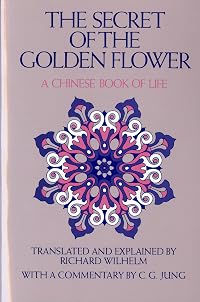
The Secret of the Golden Flower: A Chinese Book of Life
by Richard Wilhelm (Author), Dongbin Lü (Author)
On This Page
Description
The Secret of the Golden Flower is an ancient Chinese text passed on for centuries, in which Taoist mystics reveal the path to true enlightenment. The first written version was believed to have originated with Lü Dongbin, a legendary scholar, poet, and spiritual master. Lü Dongbin was the founder of the School of the Golden Elixir of Life during the Tang dynasty. In the text, symbols for light represented awareness, which is normally directed outward toward externals. The method of show more redirecting one's consciousness inward towards the self through a straightforward form of silent meditation and breathing was known as "turning the light around". Through this process of channeling energy beyond the limits of the discriminating intellect, one's psyche-indeed one's very fundamental being-can gradually open and bloom. This leads to a pure awakening of the mind and spirit. The result can be metaphorically pictured as a bright "golden flower" mandala, representing the rewarding end goal of a personal alchemy of inner transformation. This remarkable and important work, first published in the United States in 1931, is Cary F. Baynes' elegant English translation of sinologist Richard Wilhelm's 1929 German translation of the original Taoist texts. It is nothing less than a spiritual seeker's road map to discovering the secret to peace of mind. The simple method described has been called "Zen with details". This edition includes insightful philosophical commentary by psychologist Carl Jung that helps explain the metaphysical aspects of the text, providing valuable insights for Westerners. For many generations, The Secret of the Golden Flower has been an invaluable tool and guide for personal and spiritual growth. Like a practical workbook for achieving enlightenment, this clearly written meditation manual explores foundational techniques to help you experience elevated states of consciousness. show lessTags
Recommendations





Member Reviews
Jung’s marvelous commentary is balm for the writer’s psyche. He warns us against being enthralled to “… the secret objective of gaining power through words …” He explains how this ancient text guides one through disentanglement. Here is the context in which Jung makes his statement:
“It is really my purpose to push aside without mercy the metaphysical claims of all esoteric teaching; the secret objective of gaining power through words ill accords with our profound ignorance - which we should have the modesty to confess. It is my firm intention to bring things which have a metaphysical sound into the daylight of psychological understanding, and to do my best to prevent the public from believing in obscure words of power.” show more pg. 128
Read through Jung’s lens, you can see the narrator telling us, right at the beginning of his text, that it is not to be taken literally, that it is an allegory:
“Master Lu-tsu said, That which exists through itself is called the Way (Tao). Tao has neither name nor shape. It is the one essence [also translated ‘human nature’], the one primal spirit. Essence and life cannot be seen. They are contained in the light of heaven. The light of heaven cannot be seen. It is contained in the two eyes. To-day I will be your guide and will first reveal to you the secret of the Golden Flower of the great One, and starting from that, I will explain the rest in detail.
“The great One is the term given to that which has nothing above it. [great definition for “God”] The secret of the magic of life consists in using action in order to attain non-action. One must not wish to leap over everything and penetrate directly. …
“The Golden Flower is the light. What colour is the light? One uses the Golden Flower as a symbol. It is the true energy of the transcendent great One….” pg. 21
What can be taken literally is some excellent advice on how to meditate. show less
“It is really my purpose to push aside without mercy the metaphysical claims of all esoteric teaching; the secret objective of gaining power through words ill accords with our profound ignorance - which we should have the modesty to confess. It is my firm intention to bring things which have a metaphysical sound into the daylight of psychological understanding, and to do my best to prevent the public from believing in obscure words of power.” show more pg. 128
Read through Jung’s lens, you can see the narrator telling us, right at the beginning of his text, that it is not to be taken literally, that it is an allegory:
“Master Lu-tsu said, That which exists through itself is called the Way (Tao). Tao has neither name nor shape. It is the one essence [also translated ‘human nature’], the one primal spirit. Essence and life cannot be seen. They are contained in the light of heaven. The light of heaven cannot be seen. It is contained in the two eyes. To-day I will be your guide and will first reveal to you the secret of the Golden Flower of the great One, and starting from that, I will explain the rest in detail.
“The great One is the term given to that which has nothing above it. [great definition for “God”] The secret of the magic of life consists in using action in order to attain non-action. One must not wish to leap over everything and penetrate directly. …
“The Golden Flower is the light. What colour is the light? One uses the Golden Flower as a symbol. It is the true energy of the transcendent great One….” pg. 21
What can be taken literally is some excellent advice on how to meditate. show less
For all the high-faluting analysis found in this book, the original texts deal with one thing and one thing only, and this is the use of meditation to create an 'individual spirit body' free of the physical body, that will continue after the death of the physical body.
Thus, this text deals not so much with the idea of reincarnation, as the idea that the essential spirit can continue after the death of the physical body.
I think of this book as the essentials of meditation, but would not recommend it for those wishing to learn how to meditate - there are more recent works that can help the beginner whereas this book, The Secret of the Golden Flower, rewards carefully study by revealing something of the original thought that has gone into show more this ancient discipline. show less
Thus, this text deals not so much with the idea of reincarnation, as the idea that the essential spirit can continue after the death of the physical body.
I think of this book as the essentials of meditation, but would not recommend it for those wishing to learn how to meditate - there are more recent works that can help the beginner whereas this book, The Secret of the Golden Flower, rewards carefully study by revealing something of the original thought that has gone into show more this ancient discipline. show less
he didnt have to pick on my boy's watercolors like that
A classic in Jungiana with many nuances.
Translation of the T'ai Chin Hua Tsung Chih (The Secret of the Golden Flower) and part of the Chinese meditation text, The Hui Ming Ching (The Book of Consciousness and Life).
.
.
Contents
Introduction
The Secret of the Golden Flower
1. The Celestial Mind
2. The Original Spirit and the Conscious Spirit
3. Turning the Light Around and Keeping to the Center
4. Turning the Light Around and Tuning the Breathing
5. Errors in Turning the Light Around
6. Authenticating Experiences of Turning the Light Around
7. The Living Method of Turning the Light Around
8. The Secret of Freedom
9. Setting Up the Foundation in a Hundred Days
10. The Light of Essence and the Light of Consciousness
11. The Intercourse of Water and Fire
12. The Cycle
13. Song to Inspire the World
Questions and Answers Opening up the Mysteries of the Doctrine of the Golden Flower
Translation Notes
Translator's Afterword
Modern Applications of the Golden Flower show more Method
Works Cited show less
.
Contents
Introduction
The Secret of the Golden Flower
1. The Celestial Mind
2. The Original Spirit and the Conscious Spirit
3. Turning the Light Around and Keeping to the Center
4. Turning the Light Around and Tuning the Breathing
5. Errors in Turning the Light Around
6. Authenticating Experiences of Turning the Light Around
7. The Living Method of Turning the Light Around
8. The Secret of Freedom
9. Setting Up the Foundation in a Hundred Days
10. The Light of Essence and the Light of Consciousness
11. The Intercourse of Water and Fire
12. The Cycle
13. Song to Inspire the World
Questions and Answers Opening up the Mysteries of the Doctrine of the Golden Flower
Translation Notes
Translator's Afterword
Modern Applications of the Golden Flower show more Method
Works Cited show less
Members
- Recently Added By
Author Information


Some Editions
Series
Belongs to Publisher Series
Arca de Sabiduría (20)
Common Knowledge
- Canonical title*
- Kultakukan salaisuus
- Original title
- 太乙金華宗旨
- Alternate titles*
- Kultakukan salaisuus : kiinalainen ikuisen elämän kirja
- First words
- Master Lu-tsu said, That which exists through itself is called the Way (Tao).
The book comes from an esoteric circle in China. - Last words
- (Click to show. Warning: May contain spoilers.)I have made a choice of ten pictures from among an infinite variety of European mandalas, and they ought, as a whole, to illustrate clearly the parallelism between Eastern philosophy and the unconscious mental process in the West.
- Original language
- Chinese
- Canonical DDC/MDS
- 299.514
*Some information comes from Common Knowledge in other languages. Click "Edit" for more information.
Classifications
- Genres
- Religion & Spirituality, Nonfiction, Philosophy, General Nonfiction
- DDC/MDS
- 299.514 — Religion Other religions Shintoism/Taoism/Other Mythologies Of Asian Origin Religions of Chinese Origin Taoism
- LCC
- BL1900 .T25 .B3 — Philosophy, Psychology and Religion Religions. Mythology. Rationalism Religions. Mythology. Rationalism History and principles of religions Asian. Oriental By region or country China Taoism
- BISAC
Statistics
- Members
- 1,113
- Popularity
- 22,854
- Reviews
- 17
- Rating
- (3.87)
- Languages
- 11 — Chinese, Czech, Dutch, English, Finnish, French, German, Italian, Polish, Spanish, Portuguese (Brazil)
- Media
- Paper, Audiobook, Ebook
- ISBNs
- 43
- ASINs
- 24