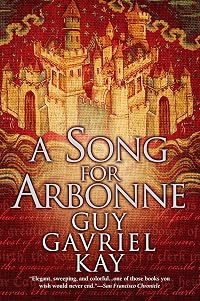
A Song for Arbonne
by Guy Gavriel Kay
On This Page
Description
Here, the lands of Arbonne and Gorhaut are on the verge of an all-consuming conflict. When a devious high priest of Gorhaut seizes the opportunity to wage a holy war against residents of Arbonne, an epic clash between the two cultures ensues.Tags
Recommendations


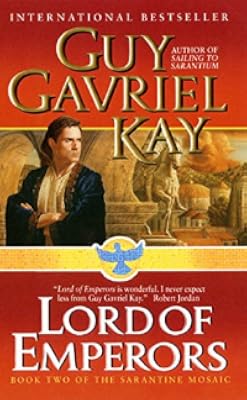






Member Recommendations
Member Reviews
The troubadours' war, the heart's true north.
I came to A Song for Arbonne after reading The Lions of Al-Rassan and Tigana, expecting more of the same: a slow, beautiful, heartbreaking meditation on love and loss set against a meticulously recreated historical backdrop. I got that. But I also got something I did not expect: a novel about the difference between courtly love and real love, between the songs men sing and the lives they actually live. And the ending, the moment when a man finally understands what he has lost- broke me in a way Kay had not broken me before.
What it is:
A world shaped like Provence in the 12th century. The land of Arbonne is a place of troubadours, courts of love, high-windowed towers, and a goddess worshipped show more openly. It is wealthy, cultured, and in the eyes of its northern neighbor, the warrior kingdom of Gorhaut- decadent and sinful. Gorhaut worships a stern sun-god named Corannos. Its ruler, King Ademar, is a cold, ambitious man who longs to conquer Arbonne and eradicate its "corrupt" worship of the female divine. But the catalyst for war is not religion alone. It is a woman. A woman who has died before the story begins.
The novel follows multiple threads: Blaise, a Gorhautian mercenary who has fled his homeland and now serves the Count of Arbonne; Bertran de Talair, the charismatic, pleasure‑loving troubadour who is Arbonne's finest warrior in secret; his sister, the fierce and intelligent Countess Aelis; and the high cleric Galbert of Gorhaut, who preaches holy war while hiding his own dark secrets. The plot moves from Provençal courts to mountain passes, from jousts to sieges, from love poems written in secret to a final, terrible battle where songs and swords meet.
Why it works (and why it stays with me):
1. The deconstruction of courtly love. Kay spends the novel showing you the ideal- troubadours singing of ladies on pedestals, of love that is pure, unattainable, and ennobling. And then he shows you the reality. Bertran de Talair is a genius with the lute and a brave commander, but he is also a man who has used women, neglected his son, and mistaken obsession for love. His arc, the slow, painful realization that he has wasted years chasing a ghost while real love stood beside him is one of the most devastating things Kay has ever written.
2. Blaise is a classic Kay protagonist: the outsider trying to find his way home. He is a Gorhautian who fights for Arbonne, haunted by his father's disgrace and his own exile. His romance with a woman who is not what she seems is tender and complicated. But the heart of his story is not romance; it is the question of where home truly lies. Is it the land of your birth, even if that land is ruled by a monster? Or is it the place where you choose to stand, even if you have no blood claim?
3. The women are not pedestal ornaments. Arbonne is a land where women inherit, rule, and command armies. Countess Aelis is a brilliant tactician. The troubadour Beatritz, long dead, haunts the novel as both muse and warning: a woman who used her beauty and wit as weapons, and who paid a price. And the young woman who becomes Blaise's lover (I will not name her, to avoid spoilers) has more agency than she initially reveals. Kay writes women who are not waiting to be rescued. They are waiting for the men to catch up.
4. The theology is nuanced. Gorhaut's god is not evil; its clerics are. The novel takes seriously the idea that faith can be corrupted by power, that holy war is almost always a mask for greed and ambition. But it also shows you the cost: ordinary people on both sides who die for beliefs they barely understand. There is a scene where a Gorhautian soldier, dying, asks for a priest of his own faith, and an Arbonnese woman brings him one. It is a small moment. It is also everything.
5. The final battle is not the ending you expect. Kay has written magnificent battle sequences before (The Lions of Al-Rassan comes to mind). Here, the battle is shorter, more brutal, and followed by a long, quiet aftermath. The real climax is not the clash of armies. It is the scene in a castle courtyard where a man finally says the words he should have said years ago; and the woman he says them to has already stopped listening. I will not spoil it. But I will say that I closed the book and sat in silence for a long time.
Where it might lose some readers (honest, even as a fan):
1. The pacing is slow in the first half. Kay spends considerable time establishing the culture of Arbonne: the troubadour competitions, the courtly rituals, the politics of love. If you are impatient for action, you may find yourself wanting to skip ahead. Do not. The slow burn makes the fire at the end fiercer.
2. The cast is large, and some characters feel underdrawn. The Gorhautian court, in particular, has several villains who are more functional than fascinating. Galbert is a compelling antagonist, a true believer who has twisted his faith into a weapon but his subordinates blur together.
3. The fantasy elements are almost invisible. There are two moons. There is a goddess whose presence is felt more than seen. There is a moment of possible supernatural intervention. But if you come from Sanderson or Rothfuss expecting magic systems, you will be disappointed. The magic here is the poetry.
Who should read this:
Lovers of historical fiction who enjoy a quarter‑turn to the fantastic.
Anyone who has ever wondered what happens after the troubadour puts down his lute.
Readers who believe that love songs are beautiful, but the truth behind them is more beautiful still.
Fans of The Lions of Al-Rassan and A Song for Arbonne is often mentioned in the same breath for good reason.
Who might skip it:
If you need fast-paced action and clear good‑vs‑evil binaries.
If you find courtly love rituals tedious.
If you prefer your fantasy heavy on magic and light on political intrigue.
Final verdict:
A Song for Arbonne is not Kay's most famous book. Tigana has the name recognition. The Lions of Al-Rassan has the critical acclaim. But this novel might be his most human. It is about the gap between the songs we sing and the lives we lead, between the love we imagine and the love we actually have. It is about a man who spent years writing poems to a dead woman, only to discover that the woman who loved him was alive, and waiting, and he had been too blind to see her.
I finished this book and immediately wanted to read it again. Not for the plot. I already knew what happened. But for the prose, the atmosphere, the quiet devastation of Kay's final chapters. He writes like a troubadour who has learned that the truest songs are not about perfect love. They are about love that is flawed, delayed, imperfect; and still, somehow, worth everything.
Five stars. For Bertran's lute. For Blaise's exile. For the road from Gorhaut to Arbonne, which is paved with lies and lit by a few stubborn truths. show less
I came to A Song for Arbonne after reading The Lions of Al-Rassan and Tigana, expecting more of the same: a slow, beautiful, heartbreaking meditation on love and loss set against a meticulously recreated historical backdrop. I got that. But I also got something I did not expect: a novel about the difference between courtly love and real love, between the songs men sing and the lives they actually live. And the ending, the moment when a man finally understands what he has lost- broke me in a way Kay had not broken me before.
What it is:
A world shaped like Provence in the 12th century. The land of Arbonne is a place of troubadours, courts of love, high-windowed towers, and a goddess worshipped show more openly. It is wealthy, cultured, and in the eyes of its northern neighbor, the warrior kingdom of Gorhaut- decadent and sinful. Gorhaut worships a stern sun-god named Corannos. Its ruler, King Ademar, is a cold, ambitious man who longs to conquer Arbonne and eradicate its "corrupt" worship of the female divine. But the catalyst for war is not religion alone. It is a woman. A woman who has died before the story begins.
The novel follows multiple threads: Blaise, a Gorhautian mercenary who has fled his homeland and now serves the Count of Arbonne; Bertran de Talair, the charismatic, pleasure‑loving troubadour who is Arbonne's finest warrior in secret; his sister, the fierce and intelligent Countess Aelis; and the high cleric Galbert of Gorhaut, who preaches holy war while hiding his own dark secrets. The plot moves from Provençal courts to mountain passes, from jousts to sieges, from love poems written in secret to a final, terrible battle where songs and swords meet.
Why it works (and why it stays with me):
1. The deconstruction of courtly love. Kay spends the novel showing you the ideal- troubadours singing of ladies on pedestals, of love that is pure, unattainable, and ennobling. And then he shows you the reality. Bertran de Talair is a genius with the lute and a brave commander, but he is also a man who has used women, neglected his son, and mistaken obsession for love. His arc, the slow, painful realization that he has wasted years chasing a ghost while real love stood beside him is one of the most devastating things Kay has ever written.
2. Blaise is a classic Kay protagonist: the outsider trying to find his way home. He is a Gorhautian who fights for Arbonne, haunted by his father's disgrace and his own exile. His romance with a woman who is not what she seems is tender and complicated. But the heart of his story is not romance; it is the question of where home truly lies. Is it the land of your birth, even if that land is ruled by a monster? Or is it the place where you choose to stand, even if you have no blood claim?
3. The women are not pedestal ornaments. Arbonne is a land where women inherit, rule, and command armies. Countess Aelis is a brilliant tactician. The troubadour Beatritz, long dead, haunts the novel as both muse and warning: a woman who used her beauty and wit as weapons, and who paid a price. And the young woman who becomes Blaise's lover (I will not name her, to avoid spoilers) has more agency than she initially reveals. Kay writes women who are not waiting to be rescued. They are waiting for the men to catch up.
4. The theology is nuanced. Gorhaut's god is not evil; its clerics are. The novel takes seriously the idea that faith can be corrupted by power, that holy war is almost always a mask for greed and ambition. But it also shows you the cost: ordinary people on both sides who die for beliefs they barely understand. There is a scene where a Gorhautian soldier, dying, asks for a priest of his own faith, and an Arbonnese woman brings him one. It is a small moment. It is also everything.
5. The final battle is not the ending you expect. Kay has written magnificent battle sequences before (The Lions of Al-Rassan comes to mind). Here, the battle is shorter, more brutal, and followed by a long, quiet aftermath. The real climax is not the clash of armies. It is the scene in a castle courtyard where a man finally says the words he should have said years ago; and the woman he says them to has already stopped listening. I will not spoil it. But I will say that I closed the book and sat in silence for a long time.
Where it might lose some readers (honest, even as a fan):
1. The pacing is slow in the first half. Kay spends considerable time establishing the culture of Arbonne: the troubadour competitions, the courtly rituals, the politics of love. If you are impatient for action, you may find yourself wanting to skip ahead. Do not. The slow burn makes the fire at the end fiercer.
2. The cast is large, and some characters feel underdrawn. The Gorhautian court, in particular, has several villains who are more functional than fascinating. Galbert is a compelling antagonist, a true believer who has twisted his faith into a weapon but his subordinates blur together.
3. The fantasy elements are almost invisible. There are two moons. There is a goddess whose presence is felt more than seen. There is a moment of possible supernatural intervention. But if you come from Sanderson or Rothfuss expecting magic systems, you will be disappointed. The magic here is the poetry.
Who should read this:
Lovers of historical fiction who enjoy a quarter‑turn to the fantastic.
Anyone who has ever wondered what happens after the troubadour puts down his lute.
Readers who believe that love songs are beautiful, but the truth behind them is more beautiful still.
Fans of The Lions of Al-Rassan and A Song for Arbonne is often mentioned in the same breath for good reason.
Who might skip it:
If you need fast-paced action and clear good‑vs‑evil binaries.
If you find courtly love rituals tedious.
If you prefer your fantasy heavy on magic and light on political intrigue.
Final verdict:
A Song for Arbonne is not Kay's most famous book. Tigana has the name recognition. The Lions of Al-Rassan has the critical acclaim. But this novel might be his most human. It is about the gap between the songs we sing and the lives we lead, between the love we imagine and the love we actually have. It is about a man who spent years writing poems to a dead woman, only to discover that the woman who loved him was alive, and waiting, and he had been too blind to see her.
I finished this book and immediately wanted to read it again. Not for the plot. I already knew what happened. But for the prose, the atmosphere, the quiet devastation of Kay's final chapters. He writes like a troubadour who has learned that the truest songs are not about perfect love. They are about love that is flawed, delayed, imperfect; and still, somehow, worth everything.
Five stars. For Bertran's lute. For Blaise's exile. For the road from Gorhaut to Arbonne, which is paved with lies and lit by a few stubborn truths. show less
I need to write this review quickly, because the more I think about A Song for Arbonne, the less I like it. I enjoyed reading it – though less than any of my other Guy Gavriel Kay experiences – and it deserves a positive spin, however belatedly. Arbonne is an interesting world, even if some of it didn't sit well with me. Kay's lyrical prose is something I enjoy, and there is a thick, layered passion to everything he writes that sweeps you along in the moment. The key phrase there is 'in the moment'. Because though Kay is capable of crafting jewels (see Tigana), A Song for Arbonne finishes as just a piece of costume jewellery.
At first, I thought the problems would be overcome; that the extremely slow start to the book (about half its show more length) was necessary world-building and characterisation for an eventual payoff. But, aside from a brief 100-page span towards the middle/end, the book does not reward perseverance. The world-building fails when it truly matters (i.e., to help make plot pivots believable) and the characterisation became increasingly deformed. The writing, though lyrical, is often melodramatic in pushing the narrative forward, and the plot is so full of holes that the book could almost be seen as a whited sepulchre. I want to mention some of these holes in the paragraph below; consider this a spoiler warning, and those who wish to avoid them should consider merely the length of the paragraph:
[spoilers] I hope, by the end of this 600+ page novel, you remember who the people were in the prologue. Because, at the end, it matters. Or, at least, it does to the characters. Because the readers will have forgotten them, and its over-egged influence on the ending is really stupid. Kay would have us believe that the Miraval/Talair rivalry is incredibly tragic and important, but the big revelation is… that Aelis died naturally in childbirth and the child also died naturally. Oh. But wait! In the finest soap opera tradition, there was a second child, who is… some random side character. And Aelis made Ariane swear an oath not to tell Bertran – the father, whom she supposedly loved – of the existence of this second, living child, for no reason I can see other than to inject some tension into the plot. This is made even more stupid when the Countess of Arbonne, Signe, intervenes to hug her long-lost grand-daughter: she wasn't told either. I guess Beatritz was irrelevant too. If it's hard to remember who's who, and who they're related to, I've not even come to Gorhaut, the invading country. I still don't know what Blaise's claim to the throne was, and his switch from exiled mercenary to noble king-apparent is abrupt, to say the least. I'm confused by the terms of the nonsensical Treaty of Iersen Bridge, and the two main antagonists, Ademar and Galbert, are cartoon villains. I've not even come to the bare-arsed cheek of the deus ex machina arrow in the final battle, or how lamely unnecessary (and dangerous, in the heat of battle) the battle plan between Urté and the Countess was. A third plot arc, concerning Lisseut the troubadour, goes literally nowhere. An overwhelming number of other small things leap out at me the more I think about the book. [end spoilers]
All told, Kay has enough craftsman's skill to lull me into a sweet sleep for the course of his novel, but after finishing it, its errors become cruelly exposed. Kay's books are all of the same character, more or less, and there are some that reward the stamina they require. A Song for Arbonne, unfortunately, does not, and should be low on the list of titles for readers wanting to see if Kay's schtick is to their tastes. He usually is to mine, but here there were too many screws shaken loose after it had moved. show less
At first, I thought the problems would be overcome; that the extremely slow start to the book (about half its show more length) was necessary world-building and characterisation for an eventual payoff. But, aside from a brief 100-page span towards the middle/end, the book does not reward perseverance. The world-building fails when it truly matters (i.e., to help make plot pivots believable) and the characterisation became increasingly deformed. The writing, though lyrical, is often melodramatic in pushing the narrative forward, and the plot is so full of holes that the book could almost be seen as a whited sepulchre. I want to mention some of these holes in the paragraph below; consider this a spoiler warning, and those who wish to avoid them should consider merely the length of the paragraph:
[spoilers] I hope, by the end of this 600+ page novel, you remember who the people were in the prologue. Because, at the end, it matters. Or, at least, it does to the characters. Because the readers will have forgotten them, and its over-egged influence on the ending is really stupid. Kay would have us believe that the Miraval/Talair rivalry is incredibly tragic and important, but the big revelation is… that Aelis died naturally in childbirth and the child also died naturally. Oh. But wait! In the finest soap opera tradition, there was a second child, who is… some random side character. And Aelis made Ariane swear an oath not to tell Bertran – the father, whom she supposedly loved – of the existence of this second, living child, for no reason I can see other than to inject some tension into the plot. This is made even more stupid when the Countess of Arbonne, Signe, intervenes to hug her long-lost grand-daughter: she wasn't told either. I guess Beatritz was irrelevant too. If it's hard to remember who's who, and who they're related to, I've not even come to Gorhaut, the invading country. I still don't know what Blaise's claim to the throne was, and his switch from exiled mercenary to noble king-apparent is abrupt, to say the least. I'm confused by the terms of the nonsensical Treaty of Iersen Bridge, and the two main antagonists, Ademar and Galbert, are cartoon villains. I've not even come to the bare-arsed cheek of the deus ex machina arrow in the final battle, or how lamely unnecessary (and dangerous, in the heat of battle) the battle plan between Urté and the Countess was. A third plot arc, concerning Lisseut the troubadour, goes literally nowhere. An overwhelming number of other small things leap out at me the more I think about the book. [end spoilers]
All told, Kay has enough craftsman's skill to lull me into a sweet sleep for the course of his novel, but after finishing it, its errors become cruelly exposed. Kay's books are all of the same character, more or less, and there are some that reward the stamina they require. A Song for Arbonne, unfortunately, does not, and should be low on the list of titles for readers wanting to see if Kay's schtick is to their tastes. He usually is to mine, but here there were too many screws shaken loose after it had moved. show less
Oh, my, how I needed this book. I’ve been so eager for an awesome fantasy read, but nothing’s held my attention in quite a while. Guy Gavriel Kay has always been one of my favorite authors. I adored his Lions of Al-Rassan - in fact, it’s my favorite book of all time. So I’m not sure why it took me so long to finally get around to reading A Song for Arbonne, but I’m so thrilled I finally did.
This book was everything I was hoping for - and more! The lyrical language, the immersive world-building, the three-dimensional characters I both loved, and loved to hate. Kay is a master of the craft, and his rich, immersive storytelling is such a pleasure to read.
The story deals with some pretty heavy themes: love, loss, cultural show more differences used as justification for war, misuse of religious power, the treatment of women as lower-class citizens and sex objects, loyalty and treason. Yet in the hands of a master storyteller, these are handled beautifully. None of these issues are glossed over, disregarded, or included for shock value or just to titillate the reader.
Blaise De Garsenc was one of my favorite characters (along with Bertran), and his character growth was fascinating to read. I adored Signe, Beatritz, Ariane, Lisseut, and Rosala as well. The way Kay weaves the full fabric of human emotion into his characters is enviable!
I’m recommending this book to every fantasy reader I know! show less
This book was everything I was hoping for - and more! The lyrical language, the immersive world-building, the three-dimensional characters I both loved, and loved to hate. Kay is a master of the craft, and his rich, immersive storytelling is such a pleasure to read.
The story deals with some pretty heavy themes: love, loss, cultural show more differences used as justification for war, misuse of religious power, the treatment of women as lower-class citizens and sex objects, loyalty and treason. Yet in the hands of a master storyteller, these are handled beautifully. None of these issues are glossed over, disregarded, or included for shock value or just to titillate the reader.
Blaise De Garsenc was one of my favorite characters (along with Bertran), and his character growth was fascinating to read. I adored Signe, Beatritz, Ariane, Lisseut, and Rosala as well. The way Kay weaves the full fabric of human emotion into his characters is enviable!
I’m recommending this book to every fantasy reader I know! show less
A Song for Arbonne - Guy Gavriel Kay
Audio performance by Euan Morton
5 stars
After a rough November, I needed some escapist fiction. This book was exactly what I needed, but as is usually true with Guy Gavriel Kay, the story had some obvious parallels to current events and resonated in my thoughts long after I finished it.
The story takes place in Arbonne, a fantasy world that resembles the middle ages troubadour culture of Provence. For all its high culture, Arbonne is a troubled land with a long standing feud dividing two of its most important barons. It is, naturally, a feud that began with the love of a lady, long dead and deeply mourned. Feuding barons weaken Arbonne’s defenses, providing opportunity for invasion by the show more neighboring, misogynistic lord of Gorhaut. It’s easy to tell who the bad guys are. This political situation is very difficult for a character like Blaise de Gorhau whose loyalties are divided between Gorhaut and Arbonne. G.G. Kay is skilled at writing the struggles and tragedies of divided loyalties. He is also amazingly good at writing a feminist, female perspective. This book is full of strong willed, intelligent, female characters.
It is not easy, at first, to keep track of the many characters, their relationships, the back stories, and the tangled snarls of political intrigue. A little difficult, but not impossible and well worth the effort. I’ve learned to trust that Kay will make all things clear, and that even seemingly trivial events will be tied to larger outcomes in the end. It does tend to make me flip back to the beginning to reread those earlier small pieces of the puzzle just to see how everything does click together. So, I had a text copy of this book, which does not have a kindle edition, and seems to be out of print. I’m hanging onto my library copy for as long as I can.
I also own Euan Morton’s excellent audio performance. Generally speaking, songs in audiobooks are disappointing at best. (Readers who cannot sing and just speak the lyrics, are better than readers who cannot sing trying to sing.) Morton is a trained singer. His renditions of Kay’s poetry are a real treat. He sings male voices as a tenor and female voices with a clear, note perfect, countertenor. The songs are all acapella, but you can almost hear the lute and extraneous tavern noises in the background. It put me in the mood for a good Renaissance Fair. show less
Audio performance by Euan Morton
5 stars
After a rough November, I needed some escapist fiction. This book was exactly what I needed, but as is usually true with Guy Gavriel Kay, the story had some obvious parallels to current events and resonated in my thoughts long after I finished it.
The story takes place in Arbonne, a fantasy world that resembles the middle ages troubadour culture of Provence. For all its high culture, Arbonne is a troubled land with a long standing feud dividing two of its most important barons. It is, naturally, a feud that began with the love of a lady, long dead and deeply mourned. Feuding barons weaken Arbonne’s defenses, providing opportunity for invasion by the show more neighboring, misogynistic lord of Gorhaut. It’s easy to tell who the bad guys are. This political situation is very difficult for a character like Blaise de Gorhau whose loyalties are divided between Gorhaut and Arbonne. G.G. Kay is skilled at writing the struggles and tragedies of divided loyalties. He is also amazingly good at writing a feminist, female perspective. This book is full of strong willed, intelligent, female characters.
It is not easy, at first, to keep track of the many characters, their relationships, the back stories, and the tangled snarls of political intrigue. A little difficult, but not impossible and well worth the effort. I’ve learned to trust that Kay will make all things clear, and that even seemingly trivial events will be tied to larger outcomes in the end. It does tend to make me flip back to the beginning to reread those earlier small pieces of the puzzle just to see how everything does click together. So, I had a text copy of this book, which does not have a kindle edition, and seems to be out of print. I’m hanging onto my library copy for as long as I can.
I also own Euan Morton’s excellent audio performance. Generally speaking, songs in audiobooks are disappointing at best. (Readers who cannot sing and just speak the lyrics, are better than readers who cannot sing trying to sing.) Morton is a trained singer. His renditions of Kay’s poetry are a real treat. He sings male voices as a tenor and female voices with a clear, note perfect, countertenor. The songs are all acapella, but you can almost hear the lute and extraneous tavern noises in the background. It put me in the mood for a good Renaissance Fair. show less
To my original review below, I would also add these words:
The language, descriptions sometimes rich, sometimes sparse, interwoven from several different points of view, are able to tell a story that is how we wish the Albigensian Crusade had gone. The importance of music at the Court of Love and those who make it is woven into the story from the very first to the very last page.
And also the heartbreak of many of the characters, starting with Bertran de Talair, are so well-described, as is the freedom to change how one views the world like Blaise de Garsenc. What Guy Gavriel Kay shows again is the destruction of those with absolute certainty that their way is the only way, and all other ways must be destroyed, embodied in the High show more Priest of Corannos, Galbert de Garsenc.
Musicians and troubadours and joglars create beauty in the southern kingdom of Arbonne. Their Queens of the Court of Love, both former and current, encourage their music, and while Signe de Barbentian has handed this title to her niece, she is no less capable than her late husband of handling affairs of state. The Priestesses of the Goddess Rian are aware of the politics in the world and what part they can play in the larger picture.
A much loved, much read favorite of any number of motifs and characters and a time that is as much medieval as fantasy.
-------------------
Such beautiful, rich language! I re-read it over the past few weeks, and all of the questions I had reading it the first time through just fell into place. The tortured love of two people that changes the dynamics in a country, the twisting of religion into a reason for invasion, all are elements that Guy Gavriel Kay masterfully brings to the printed word. show less
The language, descriptions sometimes rich, sometimes sparse, interwoven from several different points of view, are able to tell a story that is how we wish the Albigensian Crusade had gone. The importance of music at the Court of Love and those who make it is woven into the story from the very first to the very last page.
And also the heartbreak of many of the characters, starting with Bertran de Talair, are so well-described, as is the freedom to change how one views the world like Blaise de Garsenc. What Guy Gavriel Kay shows again is the destruction of those with absolute certainty that their way is the only way, and all other ways must be destroyed, embodied in the High show more Priest of Corannos, Galbert de Garsenc.
Musicians and troubadours and joglars create beauty in the southern kingdom of Arbonne. Their Queens of the Court of Love, both former and current, encourage their music, and while Signe de Barbentian has handed this title to her niece, she is no less capable than her late husband of handling affairs of state. The Priestesses of the Goddess Rian are aware of the politics in the world and what part they can play in the larger picture.
A much loved, much read favorite of any number of motifs and characters and a time that is as much medieval as fantasy.
-------------------
Such beautiful, rich language! I re-read it over the past few weeks, and all of the questions I had reading it the first time through just fell into place. The tortured love of two people that changes the dynamics in a country, the twisting of religion into a reason for invasion, all are elements that Guy Gavriel Kay masterfully brings to the printed word. show less
I took a genre fiction class with Nancy Pearl when I was in graduate school and I've remembered the name Guy Gavriel Kay ever since (it's a memorable name, so fantasy-character sounding). Nancy is a big fan and so I marked some of his books to-read, but I never read one until now -- and only because I listened to [b:Wayward Son|44017627|Wayward Son (Simon Snow, #2)|Rainbow Rowell|https://i.gr-assets.com/images/S/compressed.photo.goodreads.com/books/1552666477l/44017627._SY75_.jpg|62661027] and wanted to listen to another book with the same narrator (Euan Morton). I have nothing but respect for Nancy, but I usually find medieval fantasy too violent and misogynistic. But it's coronavirus quarantine times and I thought I wouldn't mind show more getting caught up in a fantasy world, despite any problematic stuff.
A Song for Arbonne has a lot of violence, but it's surprisingly feminist. There's hardly equality of the sexes, but there is a kingdom ruled by a woman that worships a goddess. The female characters are for the most part well-written, though some a little too noble and perfect. The main theme of this book, for me, was toxic masculinity. There's also a great semi-out gay character.
If you like Game of Thrones, you might like this one. I was really surprised by how much I liked it. I could criticize Kay's verbosity (in general I prefer an economy of words) but the plot is so well done and the characters came alive for me by the end.
The ending was just about perfect -- satisfying but with a bit of open-ended mystery. I went into this book knowing nothing about it, so afterward when I read an article about it, I realized this is much closer to alternate-reality historical fiction than fantasy. There's not very much magic in this book and there are real parallel historical events.
I will almost certainly try more GGK novels before this quarantine is over, especially if they're narrated by Euan Morton. Did I mention he has a lovely singing voice? One of my favorite parts of the audiobook. show less
A Song for Arbonne has a lot of violence, but it's surprisingly feminist. There's hardly equality of the sexes, but there is a kingdom ruled by a woman that worships a goddess. The female characters are for the most part well-written, though some a little too noble and perfect. The main theme of this book, for me, was toxic masculinity. There's also a great semi-out gay character.
If you like Game of Thrones, you might like this one. I was really surprised by how much I liked it. I could criticize Kay's verbosity (in general I prefer an economy of words) but the plot is so well done and the characters came alive for me by the end.
The ending was just about perfect -- satisfying but with a bit of open-ended mystery. I went into this book knowing nothing about it, so afterward when I read an article about it, I realized this is much closer to alternate-reality historical fiction than fantasy. There's not very much magic in this book and there are real parallel historical events.
I will almost certainly try more GGK novels before this quarantine is over, especially if they're narrated by Euan Morton. Did I mention he has a lovely singing voice? One of my favorite parts of the audiobook. show less
Now, don't get me wrong, A Song for Arbonne's a fine book. It's got strong worldbuilding of a non-fantasy fake-take on historical France, and it's got strong and enjoyable characters that will stick in my brain.... but about 2/3 of the way through A Song for Arbonne all turned to political machinations. Political machinations are just Not My Style. In fact, I am bored to tears by them. By the time I reached the last 100 pages, I was as excited to be reading more as I would be if someone was angling to play Risk with me -- namely, not at all.
Overall assessment: good book (probably a 4 star book for someone else), but just not something that fits my tastes. It's a close miss, but it's a definite miss.
Overall assessment: good book (probably a 4 star book for someone else), but just not something that fits my tastes. It's a close miss, but it's a definite miss.
Members
- Recently Added By
Published Reviews
Guy Gavriel Kay n'est pas un auteur de fantasy comme les autres, Depuis la déjà fort remarquée Tapisserie de Fionavar, qui liait aux thèmes classiques de la High Fantasy une interprétation très personnelle du fameux triangle amoureux Arthur / Lancelot / Guenièvre, il s'est signalé par une tendance croissante à substituer aux poncifs du genre des préoccupations d'ordre historique, show more politique ou stratégique. Certes, la thématique du pouvoir joue toujours un rôle assez considérable dans les romans d'heroic fantasy, comme dans toute la littérature inspirée de l'héroïsme romantique du XIXème siècle. Mais ce romantisme, chez Guy Gavriel Kay, se teinte à la fois d'un intérêt pour l'Histoire et d'un cynisme résolument contemporains, post-modernes. Ainsi, d'un roman à l'autre, son oeuvre semble s'orienter vers une forme nouvelle d'heroic fantasy qui, tout en respectant la structure, les conventions littéraires et même l'ambiance générale du genre, se débarrasse peu à peu de sa naïveté foncière, de sa croyance en l'homme ou de son obsession pour la spiritualité. Une progression tout à fait intéressante dans un genre parfois quelque peu bégayant, où les auteurs se contentent (trop ?) souvent d'appliquer des schémas préconçus — tels que ceux conseillés par David Eddings dans son Codex de Riva. A ce titre, la Chanson d'Arbonne constitue certainement le roman le plus représentatif de Guy Gavriel Kay, puisque c'est là, après la Tapisserie de Fionavar et Tigane, que la transition est la plus manifeste. show less
added by Ariane65
Lists

Best Fantasy Novels
821 works; 361 members
Favourite High Fantasy Books
113 works; 23 members

Books That Made Me Cry
199 works; 105 members

The Best of Canadian Literature
235 works; 33 members

Slipstream or Interstitial Fiction
160 works; 19 members

Nineties
43 works; 10 members

Top Five Books of 2021
604 works; 181 members

1990s
309 works; 17 members
Speculative Fiction to Read
706 works; 32 members

Books Read in 2023
5,638 works; 147 members

Books Read in 2021
5,361 works; 114 members

Recommend the 20 best books you've read in the last five years
2,168 works; 607 members

Best Audiobooks
240 works; 114 members
Books That Made Us Cry
278 works; 145 members
Book Worlds We'd Like To Visit
322 works; 158 members

Canadian Jurist-Novelists
313 works; 1 member

Survey of Fantasy Classics
111 works; 23 members
Talk Discussions
Past Discussions
Book Discussion: A Song for Arbonne ~CAUTION ~ Contains SPOILERS in The Green Dragon (July 2009)
Book Discussion: A Song for Arbonne - SPOILER FREE Thread in The Green Dragon (July 2009)
Author Information

35+ Works 38,835 Members
Guy Gavriel Kay was born on November 7, 1954 in Weyburn, Saskatchewan, Canada. He became interested in fantasy fiction while working as an assistant to Christopher Tolkien. He assisted him with the editing of J. R. R. Tolkien's The Silmarillion. After receiving a law degree from the University of Toronto, he became principal writer and associate show more producer for the CBC radio series, The Scales of Justice. He also wrote several episodes when the series moved to television. He has written social and political commentary for several publications including the National Post, The Globe and Mail, and The Guardian. His first fantasy novels were The Summer Tree, The Wandering Fire, and The Darkest Road, which make up the Fionavar Tapestry Trilogy. His other works include A Song for Arbonne, The Lions of Al-Rassan, Beyond This Dark House, The Last Light of the Sun, and Under Heaven. He has received numerous awards including and the Aurora Award for Tigana and The Wandering Fire, the 2008 World Fantasy Award for Best Novel for Ysabel, and the International Goliardos Award for his work in the fantasy field. (Bowker Author Biography) show less
Some Editions
Awards and Honors
Awards
Series
Belongs to Publisher Series
Work Relationships
Common Knowledge
- Canonical title
- A Song for Arbonne
- Original title
- A Song for Arbonne
- Alternate titles*
- Een lied voor Arbonne
- Original publication date
- 1992-08
- People/Characters
- Blaise de Garsenc; Bertran de Talair; Ariane de Carenzu; Signe de Barbentain; Rudel Correze; Lisseut de Vezét (show all 11); Urté de Miraval; Aelis de Miraval; Galbert de Garsenc; Ademar, King of Gorhaut; Ranald de Garsenc
- Important places
- Arbonne; Gorhaut
- Dedication
- This book is dedicated with love, to the memory of my father, Dr. Samuel K. Kay, whose skill and compassion as a surgeon were enhanced all his life by a love for language and literature - a love he conveyed to his sons, among... (show all) so many other gifts.
- First words
- On a morning in the springtime of the year, when the snows of the mountains were melting and the rivers swift in their running, Aelis de Miraval watched her husband ride out at dawn to hunt in the forest west of their castle,... (show all) and shortly after that she took horse herself, travelling north and east along the shores of the lake towards the begetting of her son.
- Last words
- (Click to show. Warning: May contain spoilers.)And so Luth lifted is voice without shame, feeling a deep richness, a glory in the night, as he galloped his horse down the winding, empty road to the south, past farm and castle, village and field and forest, under the risen moons and the stars above Arbonne.
- Blurbers
- de Lint, Charles
- Original language
- English
*Some information comes from Common Knowledge in other languages. Click "Edit" for more information.
Classifications
- Genres
- Fantasy, Fiction and Literature, General Fiction, Historical Fiction
- DDC/MDS
- 813.54 — Literature & rhetoric American literature in English American fiction in English 1900-1999 1945-1999
- LCC
- PR9199.3 .K39 .S6 — Language and Literature English English Literature English literature: Provincial, local, etc.
- BISAC
Statistics
- Members
- 2,939
- Popularity
- 6,118
- Reviews
- 58
- Rating
- (4.10)
- Languages
- 8 — Czech, Dutch, English, French, German, Greek, Polish, Croatian
- Media
- Paper, Audiobook, Ebook
- ISBNs
- 40
- ASINs
- 14