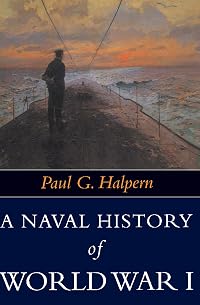
A Naval History of World War I
by Paul G. Halpern
On This Page
Description
There have been a number of studies published on the activities of British and German navies during World War I, but little on naval action in other arenas. This book offers for the first time a balanced history of the naval war as a whole, viewed from the perspective of all participants in all major theaters. The author's earlier examination The Naval War in the Mediterranean, 1914-1918, centered on submarine activities and allied efforts to counteract this new menace. With this welcome show more sequel he again takes the reader beyond those World War I operations staged on the North Sea. Halpern' show lessTags
Recommendations































Member Reviews
Traditionally studies of the naval battles of the First World War have focused primarily on the non-event of the confrontation between the British and German battle fleets in the North Sea. While relevant in the context of the tensions that led to war and important for several reasons, such predominance creates a distorted impression of the war at sea as being one that was mainly fought around the waters off Great Britain. In fact, the naval history of the First World War is one that well justifies the title of the conflict overall, as ships of the various sides fought each other in critical struggles across every part of the globe.
In this respect, Paul Halpern is the ideal person to write an overall history of the conflict at sea. A show more longtime naval historian of the era, he approaches the subject from his earlier work studying the First World War in the Mediterranean, a long-overlooked front that engaged many navies not traditionally covered in histories of the war. This equips him with a background and perspective that is perfectly suited for a broader study of the naval history of the war, one that he displays on nearly every page. Beginning with a short survey of the navies of the major powers, he goes on to discuss the exciting pursuits of the first months of the war before taking the reader on a tour of the many neglected fronts, from the Black Sea to the Danube River. To accomplish this, he draws upon his own considerable work as well as many of the often-neglected official histories and memoirs, many of which require the surmounting of numerous language barriers.
The war that emerges within these pages is not a staid affair of massive dreadnoughts glaring at each other from their respective ports, but a series of struggles of cruisers, destroyers, submarines, and river boats often characterized by dash and ingenuity. Though Halpern recounts many of these clashes, his focus is primarily strategic, as he explains how each of these battles and campaigns played a role in the broader effort by the various sides to win the war. His analysis is insightful, explaining why these oft-ignored struggles mattered in the grand scheme of conflict. Nor does he overlook the traditional subject of the stand-off between the Grand and High Sea Fleets, giving them due attention as a critical component of his topic.
All of this makes Halpern’s book a truly impressive study of the First World War at sea. Encompassing as it does issues of geography, diplomacy, and society, it is indeed not just an account of battles and campaigns but a real naval history of the conflict. Such an inclusive scope can make it easy to quibble about minor errors such as typos, or about what was left out (my personal complaint is the lack of a concluding chapter examining some of the post-war consequences of the experiences he describes), but none of this should overshadow the magnificence of Halpern’s achievement. Simply put, this is the single best history of the naval conflicts of the First World War, one that is an indispensable starting point for understanding the conflicts at sea and the role it played in the war overall. show less
In this respect, Paul Halpern is the ideal person to write an overall history of the conflict at sea. A show more longtime naval historian of the era, he approaches the subject from his earlier work studying the First World War in the Mediterranean, a long-overlooked front that engaged many navies not traditionally covered in histories of the war. This equips him with a background and perspective that is perfectly suited for a broader study of the naval history of the war, one that he displays on nearly every page. Beginning with a short survey of the navies of the major powers, he goes on to discuss the exciting pursuits of the first months of the war before taking the reader on a tour of the many neglected fronts, from the Black Sea to the Danube River. To accomplish this, he draws upon his own considerable work as well as many of the often-neglected official histories and memoirs, many of which require the surmounting of numerous language barriers.
The war that emerges within these pages is not a staid affair of massive dreadnoughts glaring at each other from their respective ports, but a series of struggles of cruisers, destroyers, submarines, and river boats often characterized by dash and ingenuity. Though Halpern recounts many of these clashes, his focus is primarily strategic, as he explains how each of these battles and campaigns played a role in the broader effort by the various sides to win the war. His analysis is insightful, explaining why these oft-ignored struggles mattered in the grand scheme of conflict. Nor does he overlook the traditional subject of the stand-off between the Grand and High Sea Fleets, giving them due attention as a critical component of his topic.
All of this makes Halpern’s book a truly impressive study of the First World War at sea. Encompassing as it does issues of geography, diplomacy, and society, it is indeed not just an account of battles and campaigns but a real naval history of the conflict. Such an inclusive scope can make it easy to quibble about minor errors such as typos, or about what was left out (my personal complaint is the lack of a concluding chapter examining some of the post-war consequences of the experiences he describes), but none of this should overshadow the magnificence of Halpern’s achievement. Simply put, this is the single best history of the naval conflicts of the First World War, one that is an indispensable starting point for understanding the conflicts at sea and the role it played in the war overall. show less
Fine work by Paul G. Halpern. Coverd the Naval aspect of WWI completely and exclusively. This book greatly expanded my knowledge of the sea war. The volume is set up geographically (The Baltic, The Adriatic, The Black Sea, etc.). However there are a few chapters dealing with other aspects. I found that structure useful. Rather then dealing with the war chronologicaly, and thereby moving around the globe, Mr. Halpern covers in full a specific area of the globe before moving on to another ocean or sea.
The book is well documented if you wish to get more specific information on a given area. I liked the notation since this allows me to uncover new sources and books.
One comment is that I had a problem understanding the maps he presents. The show more land areas, and consequently the shorelines, were merely black outlines on white pages. On many of the maps I had difficulty determining which was land and whilch was water. That may sound lame, but when you look at the appendix with the maps, I am sure you will understand that comment.
Regardless, it was very informative. Provided me with a great deal of new information. show less
The book is well documented if you wish to get more specific information on a given area. I liked the notation since this allows me to uncover new sources and books.
One comment is that I had a problem understanding the maps he presents. The show more land areas, and consequently the shorelines, were merely black outlines on white pages. On many of the maps I had difficulty determining which was land and whilch was water. That may sound lame, but when you look at the appendix with the maps, I am sure you will understand that comment.
Regardless, it was very informative. Provided me with a great deal of new information. show less
Ratings
Members
- Recently Added By
Author Information
11+ Works 267 Members
Paul G. Halpern is Professor of History at Florida State University.
Common Knowledge
- Important places
- Atlantic Ocean; North Sea; South Atlantic Ocean
- Important events
- World War I (1914 | 1918); Battle of Coronel (1914-11-01); Battle of the Falkland Islands (1914-12-08); Gallipoli Campaign; Mesopotamian Campaign; Battle of Jutland (1916-05-31 | 1916-06-01)
Classifications
Statistics
- Members
- 136
- Popularity
- 236,955
- Reviews
- 2
- Rating
- (4.43)
- Languages
- English
- Media
- Paper, Audiobook, Ebook
- ISBNs
- 6
- ASINs
- 2