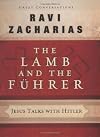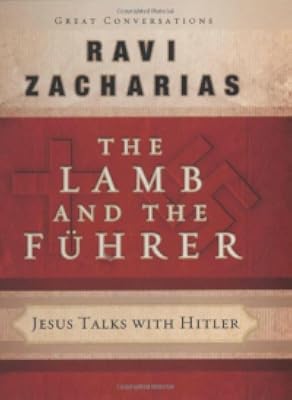
The Lamb and the Fuhrer: Jesus Talks with Hitler
by Ravi Zacharias
Great Conversations, Conversations with Jesus (3)
On This Page
Description
Adolf Hitler, Evil, hatred, pride, and destruction. Jesus Christ, Peace, love, humility, and life. What could they possibly have to talk about? In this compelling dialogue, two men of contrasting values meet face-to-face. They address fundamental issues of life and death, the evil of violence in light of the value of human life, and the timeless search for unity in diversity. Dietrich Bonhoeffer, the German pastor Hitler ordered hanged, joins in and the heat intensifies when the three begin show more to weigh the value of relationships, love, and forgiveness. You wont want to miss this imaginative discourse that will take you inside the mind of one of the most brutal tyrants of all timeand the very God who made him. show lessTags
Recommendations





























Member Reviews
What would Hitler say to Jesus—and Jesus to Hitler? In The Lamb and the Führer, Ravi Zacharias imagines their conversation a few minutes after Hitler's suicide. A bit further on, another famous man joins the dialogue, the German pastor Dietrich Bonhoeffer who was executed for a failed assassination attempt. In the interchange of ideas and arguments, each defends his point of view and explains his philosophy.
Zacharias doesn't really need to prove that Jesus's message is a better one than Hitler's; who's going to argue with that? Hitler is viewed by the majority of the world today as the embodiment of human evil. But what he does expose is that Hitler's actions are the natural result of a naturalistic (evolutionary) worldview. Darwin show more and Nietzche are mentioned as contributors to this worldview (interestingly, Hitler presented Nietzche's works to Mussolini with pride). Nazism is based on naturalism, while Christianity teaches that each human being is created in the image of God and is therefore valuable. If human life is created by a Person, it is sacred; if it is a grand biological accident, it isn't. Simple as that.
Though the atrocity of Hitler's actions is exposed in this conversation, I was also struck by his constant logical fallacies. For example, Hitler blames all the Jews for crucifying Christ but disclaims responsibility for murders carried out under his own regime, even going so far as to say he never personally walked into a concentration camp; he calls the Jews genetically inferior but claims they were able to plunder and profit from a superior race; and the list goes on and on.
Hitler's tone in the dialogue is predictably abrupt, angry, and dogmatic. It's frustrating to read his part of the conversation and observe his utter self-absorption and heartless cruelty. He simply can't and won't understand. Zacharias includes Hitler's final statement made before he committed suicide, and words can't even describe the man's depravity. And yet at the heart of the book is the point that while we aren't Hitlers, we have the same potential for darkness in our hearts and need a Savior just as much as any cruel dictator.
The exchanges between Hitler and Bonhoeffer aren't as clear-cut as those between Hitler and Christ. Zacharias handles them well, but I think there are still some open questions about the biblical justification for Bonhoeffer's actions. In the conversation, Hitler condemns Bonhoeffer's assassination attempt as immoral, but this is entirely illogical given the fact that Hitler believed human life originated through natural causes and was not sacred. To even claim that human life is sacred is to borrow from the Judeo-Christian worldview.
I've actually read this slim little volume twice, not because it's a hard read but because I really wanted to grasp the implications of the conversation. I also recently finished that wildly popular fictional story set during the Third Reich, Markus Zusak's The Book Thief, and reading these two very different books close together enriched my perception of both.
The Lamb and the Führer is a readable and intelligent discussion of the moral issues surrounding this ugly part of our history, and I recommend it. No one dissects issues of worldview like Zacharias. show less
Zacharias doesn't really need to prove that Jesus's message is a better one than Hitler's; who's going to argue with that? Hitler is viewed by the majority of the world today as the embodiment of human evil. But what he does expose is that Hitler's actions are the natural result of a naturalistic (evolutionary) worldview. Darwin show more and Nietzche are mentioned as contributors to this worldview (interestingly, Hitler presented Nietzche's works to Mussolini with pride). Nazism is based on naturalism, while Christianity teaches that each human being is created in the image of God and is therefore valuable. If human life is created by a Person, it is sacred; if it is a grand biological accident, it isn't. Simple as that.
Though the atrocity of Hitler's actions is exposed in this conversation, I was also struck by his constant logical fallacies. For example, Hitler blames all the Jews for crucifying Christ but disclaims responsibility for murders carried out under his own regime, even going so far as to say he never personally walked into a concentration camp; he calls the Jews genetically inferior but claims they were able to plunder and profit from a superior race; and the list goes on and on.
Hitler's tone in the dialogue is predictably abrupt, angry, and dogmatic. It's frustrating to read his part of the conversation and observe his utter self-absorption and heartless cruelty. He simply can't and won't understand. Zacharias includes Hitler's final statement made before he committed suicide, and words can't even describe the man's depravity. And yet at the heart of the book is the point that while we aren't Hitlers, we have the same potential for darkness in our hearts and need a Savior just as much as any cruel dictator.
The exchanges between Hitler and Bonhoeffer aren't as clear-cut as those between Hitler and Christ. Zacharias handles them well, but I think there are still some open questions about the biblical justification for Bonhoeffer's actions. In the conversation, Hitler condemns Bonhoeffer's assassination attempt as immoral, but this is entirely illogical given the fact that Hitler believed human life originated through natural causes and was not sacred. To even claim that human life is sacred is to borrow from the Judeo-Christian worldview.
I've actually read this slim little volume twice, not because it's a hard read but because I really wanted to grasp the implications of the conversation. I also recently finished that wildly popular fictional story set during the Third Reich, Markus Zusak's The Book Thief, and reading these two very different books close together enriched my perception of both.
The Lamb and the Führer is a readable and intelligent discussion of the moral issues surrounding this ugly part of our history, and I recommend it. No one dissects issues of worldview like Zacharias. show less
I actually learned some interesting facts about Hitler that I didn't know as well as getting an easy to digest philosphical investigation into the conflict between Hitler and the true teachings of Christ. Well worth the read.
Ratings
Members
- Recently Added By
Author Information

193+ Works 17,342 Members
Ravi Zacharias was born on March 26, 1946 in India. He is a Christian apologist and author of several Christian books. He won the Gold Medallion Book Award for his title Can Man Live Without God? His works include: A Shattered Visage: The Real Face of Atheism, Deliver Us from Evil, Cries of the Heart, The Broken Promise, Recapture the Wonder, Has show more Christianity Failed You? and The Prince and the Prophet: Jesus Talks with Mohammed. He is the founder and chairman of the board of Ravi Zacharias International Ministries, host of the radio programs Let My People Think and Just Thinking, and has been a visiting scholar at Ridley Hall, where he studied moralist philosophers and literature of the Romantic era. (Bowker Author Biography) show less
Series


Common Knowledge
- Canonical title
- The Lamb and the Fuhrer: Jesus Talks with Hitler
- Original publication date
- 2005
- People/Characters
- Jesus Christ; Adolf Hitler; Dietrich Bonhoeffer
Classifications
Statistics
- Members
- 216
- Popularity
- 150,810
- Reviews
- 2
- Rating
- (3.60)
- Languages
- English, Spanish
- Media
- Paper, Audiobook, Ebook
- ISBNs
- 10
- ASINs
- 7