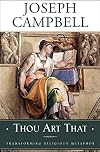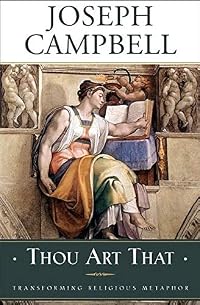
Thou Art That: Transforming Religious Metaphor
by Joseph Campbell
On This Page
Description
Thou Art That is a compilation of previously uncollected essays and lectures by Joseph Campbell that focus on the Judeo-Christian tradition. Campbell explores common religious symbols, reexamining and reinterpreting them in the context of his remarkable knowledge of world mythology.Campbell believed that society often confuses the literal and metaphorical interpretations of religious stories and symbols. In this collection, he eloquently reestablishes these symbols as a means to enhance show more spiritual understanding and mystical revelation. With characteristic verve, he ranges from rich storytelling to insightful comparative scholarship. Included is editor Eugene Kennedy's classic interview with Campbell in the New York Times Magazine, which originally brought the scholar to the attention of the public. show lessTags
Recommendations













Member Recommendations
Member Reviews
Six-word review: Mythology and spiritual symbolism interpreted metaphorically.
Extended review:
This is the first volume in a series of compilations of material from the lectures and essays of Joseph Campbell, selected, integrated, and edited by various scholars on behalf of the Joseph Campbell Foundation. As such, it can't be viewed in quite the same light as the books authored by Campbell, although the content and the words are his. It's a little more casual, a bit disjointed, a bit repetitive, and possibly--although this is my own inexpert opinion and may be groundless--a bit muddied in places by the necessity of stitching together pieces of disparate material.
It could conceivably be the case that the editor has unwittingly introduced show more errors and interpretations that don't belong to Campbell. Editing someone else's work is a worthy enterprise, but inevitably fraught with risk. The perils become many times greater when the author is no longer around to answer questions and review his own work.
I would have expected, for instance, that Campbell himself would have spoken of the precession and not the procession of the equinoxes; but one way or another, the term appears erroneously on page 44. That is not the only such lapse I noticed in the book.
With that caveat in mind, I did enjoy reading this small volume, awed, as ever, by the breadth and depth of Campbell's knowledge, his ability to assimilate vast quantities of material, and his representation of it through the lens of a single clear vision. Any exposure to Campbell's thinking always makes me feel that I have glimpsed other dimensions of being. Even when I fail to retain the perspective gained at a higher elevation, I remember that I've been there. show less
Extended review:
This is the first volume in a series of compilations of material from the lectures and essays of Joseph Campbell, selected, integrated, and edited by various scholars on behalf of the Joseph Campbell Foundation. As such, it can't be viewed in quite the same light as the books authored by Campbell, although the content and the words are his. It's a little more casual, a bit disjointed, a bit repetitive, and possibly--although this is my own inexpert opinion and may be groundless--a bit muddied in places by the necessity of stitching together pieces of disparate material.
It could conceivably be the case that the editor has unwittingly introduced show more errors and interpretations that don't belong to Campbell. Editing someone else's work is a worthy enterprise, but inevitably fraught with risk. The perils become many times greater when the author is no longer around to answer questions and review his own work.
I would have expected, for instance, that Campbell himself would have spoken of the precession and not the procession of the equinoxes; but one way or another, the term appears erroneously on page 44. That is not the only such lapse I noticed in the book.
With that caveat in mind, I did enjoy reading this small volume, awed, as ever, by the breadth and depth of Campbell's knowledge, his ability to assimilate vast quantities of material, and his representation of it through the lens of a single clear vision. Any exposure to Campbell's thinking always makes me feel that I have glimpsed other dimensions of being. Even when I fail to retain the perspective gained at a higher elevation, I remember that I've been there. show less
One of Campbell's better books, the numerology analysis in the beginning is highly speculative and some would consider it "woo" but it's interesting and still falls within the subject of comparative mythology. Do not skip the foreword by Eugene Kennedy it really sets the stage for the rest of the book.
Joseph Campbell shows in this book the closeness of myth and religion. The first chapter shows the difficulty of this in the public eye. "No, myth is not a lie. A whole mythology symbolic is an organization of symbolic images and narratives, metaphorical of the possibilities of human experience and the fulfillment of a given culture at a given time." Myths have four functions:
1. aligning waking consciousness to the mysterium tremendum of this universe, as it is.
2. interpretive, to present a consistent image of the cosmos.
3. to support a specific moral order in a society.
4. to carry individuals through various stages and crises in life.
These are essays combed from Campbell's oeuvre and combined into 7 chapters.
1. Metaphor and religious show more mystery.
2. The experience of religious mystery.
3. Our notions of God (including symbols)
4. The religious imagination and the rules of traditional theology.
5. Symbols of the Judeo-Christian tradition (Genesis and Abraham).
6. Understanding the symbols of Judeo-Christian spirituality (similarity of the Hebrew and Greek narratives).
7. Question Period (some questions that Campbell responded to at his lectures.
I found that Campbell offers a compelling narrative. show less
1. aligning waking consciousness to the mysterium tremendum of this universe, as it is.
2. interpretive, to present a consistent image of the cosmos.
3. to support a specific moral order in a society.
4. to carry individuals through various stages and crises in life.
These are essays combed from Campbell's oeuvre and combined into 7 chapters.
1. Metaphor and religious show more mystery.
2. The experience of religious mystery.
3. Our notions of God (including symbols)
4. The religious imagination and the rules of traditional theology.
5. Symbols of the Judeo-Christian tradition (Genesis and Abraham).
6. Understanding the symbols of Judeo-Christian spirituality (similarity of the Hebrew and Greek narratives).
7. Question Period (some questions that Campbell responded to at his lectures.
I found that Campbell offers a compelling narrative. show less
Interesting read. He misunderstands some theological things. Worth reading though, it will make you think and explore some symbolism.
The nature of being a number of disparate talks and essays stitched together into one work results in it being poorly structured and disjointed. It's also prone to more of Campbell's forays off into la-la-land than normal.
Collected by the Joseph Campbell Foundation (www.jcf.org) this book brings together notes that explains the ridiculous nature of PEACE> how do I mean that, well LIFE EATS LIFE. We only survive because we eat other living things, from grasses to animals. This is the nature of living. To ignore it, or to become a vegan to deny it is slave morality (see What Nietzsche Really Said)
Campbell's essays on Judeo-Christian tradition exploring common symbols of Western religions.
Members
- Recently Added By
Author Information

201+ Works 41,643 Members
Joseph Campbell was born in White Plains, New York on March 26, 1904. He received a B.A. in English literature in 1925 and an M.A. in Medieval literature in 1927 from Columbia University. He was awarded a Proudfit Traveling Fellowship to continue his studies at the University of Paris. After he had received and rejected an offer to teach at his show more high school alma mater, his Fellowship was renewed, and he traveled to Germany to resume his studies at the University of Munich. During the year he was housemaster of Canterbury School, he sold his first short story, Strictly Platonic, to Liberty magazine. In 1934, he accepted a position in the literature department at Sarah Lawrence College, a post he would retain until retiring in 1972. During his lifetime, he wrote more than 40 books including The Hero with a Thousand Faces, The Mythic Image, the four-volume The Masks of God, and The Power of Myth with Bill Moyers. During the 1940s and 1950s, he collaborated with Swami Nikhilananda on translations of the Upanishads and The Gospel of Sri Ramakrishna. He received several awards including National Institute of Arts and Letters Award for Contributions to Creative Literature and the 1985 National Arts Club Gold Medal of Honor in Literature. He died after a brief struggle with cancer on October 30, 1987. (Bowker Author Biography) show less
All Editions
Series
Belongs to Publisher Series
Common Knowledge
- Original title
- Thou are that: Transforming Religious Metaphor
- Original publication date
- 2001
- Dedication
- For Jean Erdman Campbell
- First words
- Let me begin by explaining the history of my impulse to place metaphor at the center of our exploration of Western spirituality.
- Last words
- (Click to show. Warning: May contain spoilers.)Easter and Passover, particularly, remind us that we have to let go in order to enter it.
- Blurbers
- Hillman, James; Kennedy, Eugene
- Original language
- English US
Classifications
Statistics
- Members
- 530
- Popularity
- 56,091
- Reviews
- 7
- Rating
- (4.02)
- Languages
- 6 — Dutch, English, French, German, Portuguese, Spanish
- Media
- Paper, Audiobook, Ebook
- ISBNs
- 12
- ASINs
- 4