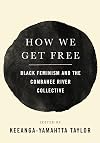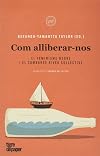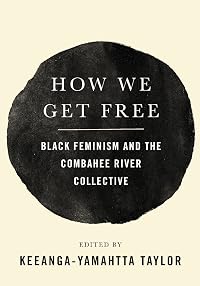
How We Get Free: Black Feminism and the Combahee River Collective
by Keeanga-Yamahtta Taylor (Editor)
On This Page
Description
Black feminists remind us "that America's destiny is inseparable from how it treats [black women] and the nation ignores this truth at its peril" (The New York Review of Books). Winner of the 2018 Lambda Literary Award for LGBTQ Nonfiction "If Black women were free, it would mean that everyone else would have to be free." -Combahee River Collective Statement The Combahee River Collective, a path-breaking group of radical black feminists, was one of the most important organizations to develop show more out of the antiracist and women's liberation movements of the 1960s and 70s. In this collection of essays and interviews edited by activist-scholar Keeanga-Yamahtta Taylor, founding members of the organization and contemporary activists reflect on the legacy of its contributions to Black feminism and its impact on today's struggles. "A striking collection that should be immediately added to the Black feminist canon." -Bitch Media "An essential book for any feminist library." -Library Journal "As white feminism has gained an increasing amount of coverage, there are still questions as to how black and brown women's needs are being addressed. This book, through a collection of interviews with prominent black feminists, provides some answers." -The Independent "For feminists of all kinds, astute scholars, or anyone with a passion for social justice, How We Get Free is an invaluable work." -Ethnic and Racial Studies Journal. show lessTags
Recommendations


Member Reviews
American's are loathe to place things into historical context, to reflect on past experience, to learn, and to move forward. Rather we burn things down and start from zero all the time. It is frustrating and infuriating, and as much as I would like to lay this behavior at the feet of the radical anarchist in the White House and his merry band of self-dealing lackeys it is something that is routinely done by the left, the center, and those at every point in between those spots on the spectrum. One movement that has been most guilty of this is feminism. Third wave feminists reject second-wave feminism out of hand as just a bunch of bitter women who want to stop them from getting laid and wearing cute shorts. This book, a collection of show more interviews by and between current black feminist socialist activists and the founders of the Combahee River Collective, contextualizes current definitions of feminism, gender and sexuality, and to a lesser extent the modern American spin on socialism. This is where intersectionality comes from, and the discussion is really satisfying.
I am an old feminist, most definitely placed squarely within the later part of the second wave. I was a Women's Studies minor in the 80's. and read some about the Combahee Collective at the time, but honestly not a ton, so much of this was revelatory. The interviews with the three founders were unending genius. Barbara Smith, Beverly Smith, and Demita Frazier are spectacularly wise. I learned so much from listening to their interviews. Though I support BLM, I am not a fan of Keeanga-Yamahtta Taylor, and my opinion of her after reading this book has not really improved much, she is sloppy as an academic, and to the extent she has a philosophy guiding her actions it is a philosophy that favors toppling over building. Tear that shit down is not reasoned or productive political discourse. Her anti-semitic rant at the end did not help. (You can support the interests of the Palestinian people without being an anti-semite, I am a person who does that -- Taylor does not.) For the most part this was amazing, and I tore through the audiobook. I recommend it absolutely,. show less
I am an old feminist, most definitely placed squarely within the later part of the second wave. I was a Women's Studies minor in the 80's. and read some about the Combahee Collective at the time, but honestly not a ton, so much of this was revelatory. The interviews with the three founders were unending genius. Barbara Smith, Beverly Smith, and Demita Frazier are spectacularly wise. I learned so much from listening to their interviews. Though I support BLM, I am not a fan of Keeanga-Yamahtta Taylor, and my opinion of her after reading this book has not really improved much, she is sloppy as an academic, and to the extent she has a philosophy guiding her actions it is a philosophy that favors toppling over building. Tear that shit down is not reasoned or productive political discourse. Her anti-semitic rant at the end did not help. (You can support the interests of the Palestinian people without being an anti-semite, I am a person who does that -- Taylor does not.) For the most part this was amazing, and I tore through the audiobook. I recommend it absolutely,. show less
This is so interesting, how a group of black, some queer, women got together in a black feminists movement. What that intersection of identity means to them, what identity politics means to them, the faults with white feminism or anti-racism that isn't also feminist. This book is largely conversational, with each member being asked the same questions and then their replies, so audio was a great way to consume this - it felt like a radio program.
This wasn't what I was expecting. This weaves the history in with the current political climate seamlessly.
Ratings
Members
- Recently Added By
Lists

The Black Archives: All Power To the People! Reading List
79 works; 10 members

BLM
210 works; 1 member
Zora Canon
100 works; 6 members

The Zora Canon
98 works; 4 members

Patriarchy and white supremacy de-programming
69 works; 1 member
Author Information

Keeanga-Yamahtta Taylor writes and speaks on Black politics, social movements, and racial inequality in the United States. She is the author of Race for Profit How Banks and the Real Estate industry Undermined Black Homeownership, which was a finalist for the 2020 Pulitzer Prize for History, and of How We Get Free: Black Feminism and the Combahee show more River Collective, which won the Lambda Literary Award for LGBTQ nonfiction in 2018. She is a professor of African American Studies at Princeton University and a contributing writer at the New Yorker. show less
All Editions
Awards and Honors
Awards
Common Knowledge
- Original publication date
- 2017
Classifications
- Genres
- Sexuality and Gender Studies, General Nonfiction, Nonfiction, History, LGBTQ+
- DDC/MDS
- 305.48 — Society, government, & culture Social sciences, sociology & anthropology Social group - Age, Gender, Ethnicity Women Specific groups of women
- LCC
- HQ1426 — Social sciences The family. Marriage, Women and Sexuality The Family. Marriage. Women Women. Feminism
- BISAC
Statistics
- Members
- 666
- Popularity
- 43,227
- Reviews
- 3
- Rating
- (4.12)
- Languages
- Catalan, English
- Media
- Paper, Audiobook, Ebook
- ISBNs
- 10
- ASINs
- 2