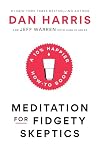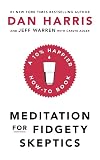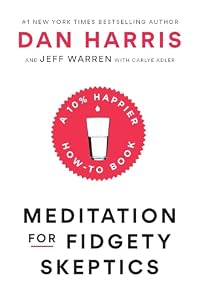
Meditation for Fidgety Skeptics: A 10% Happier How-to Book
by Dan Harris, Carlye Adler, Jeff Warren
On This Page
Description
This book will get you to meditate. Minus the pan flutes.ABC News anchor Dan Harris used to think that meditation was for people who collect crystals, play Ultimate Frisbee, and use the word “namaste” without irony. After he had a panic attack on live television, he went on a strange and circuitous journey that ultimately led him to embrace a practice he’d long considered ridiculous. Harris discovered that meditation made him more focused and less yanked around by his emotions. show more According to his wife, it also made him significantly less annoying. He wrote about his experiences in the bracingly candid and extremely funny memoir 10% Happier, which became a #1 New York Times bestseller and landed Harris in the entirely unexpected position of being one of meditation’s most vocal public proponents.
Here’s what he’s fixated on now: Science suggests that meditation can lower blood pressure, mitigate depression and anxiety, and literally rewire key parts of the brain, among numerous other benefits. And yet there are millions of people who want to meditate but aren’t actually practicing. What’s holding them back?
In Meditation for Fidgety Skeptics, Harris and his friend Jeff Warren, a masterful teacher and “Meditation MacGyver,” embark on a cross-country quest to tackle the myths, misconceptions, and self-deceptions that stop people from meditating. They rent a rock-star tour bus (whose previous occupants were Parliament Funkadelic) and travel across eighteen states, talking to scores of would-be meditators—including parents, military cadets, police officers, and even a few celebrities. They create a taxonomy of the most common issues (“I suck at this,” “I don’t have the time,” etc.) and offer up science-based life hacks to help people overcome them.
The book is filled with game-changing and deeply practical meditation instructions. You’ll also get access to the 10% Happier app, where you can listen for free to guided audio versions of all the meditations in the book. Amid it all unspools the strange and hilarious story of what happens when a congenitally sarcastic, type-A journalist and a groovy Canadian mystic embark on an epic road trip into America’s neurotic underbelly, as well as their own.
Includes two bonus guided meditations.. show less
Tags
Recommendations

Member Reviews
After twenty years of on-again/off-again commitment to meditation, I decided that, perhaps, the best way to reignite my practice was with a beginner's mind, as well as a skeptic's mind. That is, after all, a fair way to approach most things, even those that have served you well for two decades.
Life is different now than when I was in my early 30's. My 90+-year-old parents need consistent care. My children are independent, with one now in college and the other driving. I can't log onto social media or the news without my blood pressure skyrocketing. I am suddenly besieged by anxiety, insomnia, a general depressive malaise, and a slowed metabolism. Needless to say, I need meditation. I just won't go to the well often enough. I treat it show more like a cheap gym membership - I do it now and then to say I've done it, but I am not being the kind of practitioner I have been and know I can be again. So...I started over. And I agreed to take a less dogmatic approach.
Enter Dan Harris, whose "10% Happier" podcast (and first book) has inspired me greatly because he's so candid, even a bit snarky, about all the trappings of mindfulness practice. He gets it. He realizes that 21st century Americans raised on satire and pharmaceuticals aren't going to blindly embrace a practice that requires slowing down, being present, and being wholly honest with how uncomfortable it can feel to sit with the hard stuff.
This book does a fine job of taking an approach that can help everyone from longtime Buddhists (like myself) to those new to secular meditation. There's no dogma here, only practice. I will say, there is a fair amount of "adult" language in the book, which didn't bother me, but if you're expecting Thich Nhat Hanh, well...imagine if Thich Nhat Hanh and Jon Stewart were somehow cohabitating the same personage. That is to say, it's a little saucy - a nice mix of sincerity and sarcasm - and yet, Dan conveys a genuine knowledge and appreciation for meditation, offering a solid set of tools to engage a new practice. Or in my case, renew one that is struggling.
From pure mindfulness practice to compassion meditation, from the "I'm too busy" to "people will say I'm weird" excuses, Dan covers the landscape nicely, with humor and with heart. He does a fine job of reteaching this old dog some new tricks. show less
Life is different now than when I was in my early 30's. My 90+-year-old parents need consistent care. My children are independent, with one now in college and the other driving. I can't log onto social media or the news without my blood pressure skyrocketing. I am suddenly besieged by anxiety, insomnia, a general depressive malaise, and a slowed metabolism. Needless to say, I need meditation. I just won't go to the well often enough. I treat it show more like a cheap gym membership - I do it now and then to say I've done it, but I am not being the kind of practitioner I have been and know I can be again. So...I started over. And I agreed to take a less dogmatic approach.
Enter Dan Harris, whose "10% Happier" podcast (and first book) has inspired me greatly because he's so candid, even a bit snarky, about all the trappings of mindfulness practice. He gets it. He realizes that 21st century Americans raised on satire and pharmaceuticals aren't going to blindly embrace a practice that requires slowing down, being present, and being wholly honest with how uncomfortable it can feel to sit with the hard stuff.
This book does a fine job of taking an approach that can help everyone from longtime Buddhists (like myself) to those new to secular meditation. There's no dogma here, only practice. I will say, there is a fair amount of "adult" language in the book, which didn't bother me, but if you're expecting Thich Nhat Hanh, well...imagine if Thich Nhat Hanh and Jon Stewart were somehow cohabitating the same personage. That is to say, it's a little saucy - a nice mix of sincerity and sarcasm - and yet, Dan conveys a genuine knowledge and appreciation for meditation, offering a solid set of tools to engage a new practice. Or in my case, renew one that is struggling.
From pure mindfulness practice to compassion meditation, from the "I'm too busy" to "people will say I'm weird" excuses, Dan covers the landscape nicely, with humor and with heart. He does a fine job of reteaching this old dog some new tricks. show less
This is an excellent follow up to Dan Harris's "10% Happier..." book about mindfulness meditation. Here we have actual mindfulness meditation instructions by Jeff Warren, a very skillful mindfulness meditation teacher, alongside with Dan Harris's unending wit and hilarious comments (I couldn't help but burst out laughing out loud at times!). The instruction is directed to everybody - either starting on the journey of mindfulness meditation or in the process of mastering it. I found it tremendously helpful, as I listened to this audiobook. I felt like listening to some chapters again and again. I have to say that I was very impressed with how Jeff Warren expanded the notion of mindfulness meditation - he offers a variety of techniques show more for all personality types, as well as for extremely busy people. Just as the title implies - even skeptics will get on board! show less
So I took a week or so off from my normal reading routine. Why? Because I've been reading this book and putting it into practice and since mindfulness and meditation are all about focus of your intentions......I did!
Easiest book that you will ever read on meditation and its benefits. And not only does the author give clear, simple advice on the practice of meditation, he makes it incredibly fun to move through the text. Mr. Harris was so engaging that I found myself experiencing meditation (which I have only sporadically practiced) in a lighter manner; with less concern for the 'outcome' and more respect for the process. Though, I must say, as his words were the ones that kept bouncing around in my head while I practiced (very, very show more funny) it may have increased the challenge for me. The "free-range" meditations were great reminders that you can slip a little meditation in just about anywhere, at any time.
This book isn't just about meditation however. It's also a refreshingly light romp through relationship, community and self-love and learning to hear what our bodies are telling us and what we may even literally be saying out loud but missing because we aren't paying attention. I love that the writer shared his process and personal experiences....made me wish I'd been there for the journey! show less
Easiest book that you will ever read on meditation and its benefits. And not only does the author give clear, simple advice on the practice of meditation, he makes it incredibly fun to move through the text. Mr. Harris was so engaging that I found myself experiencing meditation (which I have only sporadically practiced) in a lighter manner; with less concern for the 'outcome' and more respect for the process. Though, I must say, as his words were the ones that kept bouncing around in my head while I practiced (very, very show more funny) it may have increased the challenge for me. The "free-range" meditations were great reminders that you can slip a little meditation in just about anywhere, at any time.
This book isn't just about meditation however. It's also a refreshingly light romp through relationship, community and self-love and learning to hear what our bodies are telling us and what we may even literally be saying out loud but missing because we aren't paying attention. I love that the writer shared his process and personal experiences....made me wish I'd been there for the journey! show less
There’s quite a bit of wisdom in this book, written for those who struggle to make meditation a part of their lives or doubt that they have the time or ability to “do it.” ABC News Anchor Dan Harris teams up with a team led by meditation guru Jeff Warren to give profound yet down-to-earth advice that could truly be life-changing. There were times when I wished the book hadn’t been as detailed as it was on the process involved, e.g. the 10% tour, the app, how the book was written, etc, but some of the frustrations from the real-life events from that are turned around into lessons which may make it more relatable, as is Harris’s regular joking around.
Sorry what follows is so long, but it was helpful for me to show more review/summarize/process it this way. Some of the nuggets of wisdom the book includes, in addition to its many sample meditations:
- Seeing the internal narrator in one’s head as not the same as oneself, and largely boring/negative/self-referential. Mindfulness being the ability to see thought patterns as characters (even naming them), or visualizing the mind as if from behind a waterfall, in order to respond wisely in situations instead of reacting impulsively. “When we are mindful, we watch thinking play out from the vantage point of awareness. Awareness is the wider perspective. Most people don’t realize it’s the wider perspective because thinking feels so similar to awareness. It’s perfectly camouflaged.”
- An interesting acronym related to difficult emotions that come up is RAIN: recognize, accept, investigate, and non-identification. Getting adept at recognizing the tip-offs for these things, accepting them (because “what you resist persists”), investigating why they are happening almost like a curious 3rd party detective, and then (a remarkable thought for me), not identifying oneself so directly with them, e.g. not taking your own emotions personally. “How does it change your experience to note that anger is happening, the way you might note a thunderstorm is happening?”
- “Meditation does not require you to stop thinking.” The mind wandering is normal, noting this and then returning to concentration is in itself the practice of meditation. Simply feel satisfaction at having noticed this in the first place, and continue on. One of the meditations encourages simply saying “Welcome to the party” when you’ve noticed the mind wandering or an insistent thought while meditating.
- Be kind to yourself, as much as you are to others. When stressed or overwhelmed, to not only see emotions clearly, but also “do it in a way that’s sort of more generous.” And the meditation with the simple short phrase, “May I be well.”
- In being compassionate to others, “The idea is to connect to the very reasonable desire for this person’s hurt and challenge to end. We are not looking to create an emotional response, although emotions can happen and are welcomed. Nor are we trying to fix the person or ‘the problem.’ Your compassion isn’t dependent on any kind of outcome. It’s caring for its own sake. We simply wish for the person to be well.”
- “Equanimity is the capacity to let your experience be what it is, without trying to fight it and negotiate with it. It’s like an inner smoothness or frictionlessness.” Later: “Let go of judgments. Let go of any bracing or rigidity. Let go of all the ways you may be subtly trying to control the experience.”
- Also let go of things you cannot control.
- As for desires, “Using noting here can really help: wanting, wanting, wanting. If you can stay with this feeling, a very liberating and powerful moment can sometimes happen: the wanting passes, and you realize you are actually fine. More than fine, happy. Content with how things are. And you realize how many hundreds of hours you have been – and will be again – lost in this pattern, robotically indulging your novelty-seeking, when, had you just thought to look, the urge would eventually pop like an empty soap bubble and you could relax.” And note that “desire can mask loneliness, agitation can cover fear, and sleeplessness can be a form of avoidance.”
- From Shinzen Young: “Suffering = Pain x Resistance. Pain is an inevitable part of life. Suffering (in his definition) is not. It comes from fighting or resisting some uncomfortable sensation or emotion or whatever. When we do this, there’s a snowball effect: tension spreads, and the original insult starts to reverberate through the whole mind-body tract, leading to even more discomfort, stress, and reactivity. The suffering amplifies.”
- The Buddhist parable about the “second arrow.” “A man is walking through the woods and he gets hit by an arrow. He immediately engages in a round of self-pitying thoughts: ‘Who shot me with an arrow? Why am I always the one who gets hit be an arrow? … These painful thoughts are the second arrow.” “We can have really old stories too: some arrowhead got snapped off years before, and it’s still festering in our chest, radiating out into our experience in the form of grudges and avoidances and lifelong convictions about how things are and should be. These patterns are reactions. We can live inside them without any memory or awareness of what they once reacted to.”
- Relative to worry, from Joseph Goldstein: “When for the eighty-seventh time you find yourself chewing over, say an impending deadline or your rival’s promotion, maybe ask yourself one simple question: ‘Is this useful?’”
- Relative to opinions, from Bernie Glassman: “When you go into any situation, think, don’t know.” Warren explains: “As in, don’t pretend you know what’s up or what’s really going on. Chill for a bit in the situation, watching, learning. There’s a humility here that is really helpful.”
- Relative to keep it going, “You should view failure as inevitable and even a healthy part of the process.” Moreover even 10 good breaths in any situation or mental state can be a useful meditation; it can be interspersed/integrated into daily activities. “Your breath is your best friend in life and in meditation. Breathing in and up can raise your energy when you are low, and breathing out and down can lower your energy when you are high.”
- You can age badly, and you can age well. I know affable old folks who sit in the park and watch the kids play, and they’ve got that good-natured, easygoing quality. A serious practice just makes that happen sooner in your life.”
- Finally this: “The truth is, I was born on third base, the recipient of an incalculable amount of unearned privilege.” It may not be true for all readers (or at least, as extreme), but what fantastic recognition and perspective by Dan Harris. Another is “These are the good old days.” show less
Sorry what follows is so long, but it was helpful for me to show more review/summarize/process it this way. Some of the nuggets of wisdom the book includes, in addition to its many sample meditations:
- Seeing the internal narrator in one’s head as not the same as oneself, and largely boring/negative/self-referential. Mindfulness being the ability to see thought patterns as characters (even naming them), or visualizing the mind as if from behind a waterfall, in order to respond wisely in situations instead of reacting impulsively. “When we are mindful, we watch thinking play out from the vantage point of awareness. Awareness is the wider perspective. Most people don’t realize it’s the wider perspective because thinking feels so similar to awareness. It’s perfectly camouflaged.”
- An interesting acronym related to difficult emotions that come up is RAIN: recognize, accept, investigate, and non-identification. Getting adept at recognizing the tip-offs for these things, accepting them (because “what you resist persists”), investigating why they are happening almost like a curious 3rd party detective, and then (a remarkable thought for me), not identifying oneself so directly with them, e.g. not taking your own emotions personally. “How does it change your experience to note that anger is happening, the way you might note a thunderstorm is happening?”
- “Meditation does not require you to stop thinking.” The mind wandering is normal, noting this and then returning to concentration is in itself the practice of meditation. Simply feel satisfaction at having noticed this in the first place, and continue on. One of the meditations encourages simply saying “Welcome to the party” when you’ve noticed the mind wandering or an insistent thought while meditating.
- Be kind to yourself, as much as you are to others. When stressed or overwhelmed, to not only see emotions clearly, but also “do it in a way that’s sort of more generous.” And the meditation with the simple short phrase, “May I be well.”
- In being compassionate to others, “The idea is to connect to the very reasonable desire for this person’s hurt and challenge to end. We are not looking to create an emotional response, although emotions can happen and are welcomed. Nor are we trying to fix the person or ‘the problem.’ Your compassion isn’t dependent on any kind of outcome. It’s caring for its own sake. We simply wish for the person to be well.”
- “Equanimity is the capacity to let your experience be what it is, without trying to fight it and negotiate with it. It’s like an inner smoothness or frictionlessness.” Later: “Let go of judgments. Let go of any bracing or rigidity. Let go of all the ways you may be subtly trying to control the experience.”
- Also let go of things you cannot control.
- As for desires, “Using noting here can really help: wanting, wanting, wanting. If you can stay with this feeling, a very liberating and powerful moment can sometimes happen: the wanting passes, and you realize you are actually fine. More than fine, happy. Content with how things are. And you realize how many hundreds of hours you have been – and will be again – lost in this pattern, robotically indulging your novelty-seeking, when, had you just thought to look, the urge would eventually pop like an empty soap bubble and you could relax.” And note that “desire can mask loneliness, agitation can cover fear, and sleeplessness can be a form of avoidance.”
- From Shinzen Young: “Suffering = Pain x Resistance. Pain is an inevitable part of life. Suffering (in his definition) is not. It comes from fighting or resisting some uncomfortable sensation or emotion or whatever. When we do this, there’s a snowball effect: tension spreads, and the original insult starts to reverberate through the whole mind-body tract, leading to even more discomfort, stress, and reactivity. The suffering amplifies.”
- The Buddhist parable about the “second arrow.” “A man is walking through the woods and he gets hit by an arrow. He immediately engages in a round of self-pitying thoughts: ‘Who shot me with an arrow? Why am I always the one who gets hit be an arrow? … These painful thoughts are the second arrow.” “We can have really old stories too: some arrowhead got snapped off years before, and it’s still festering in our chest, radiating out into our experience in the form of grudges and avoidances and lifelong convictions about how things are and should be. These patterns are reactions. We can live inside them without any memory or awareness of what they once reacted to.”
- Relative to worry, from Joseph Goldstein: “When for the eighty-seventh time you find yourself chewing over, say an impending deadline or your rival’s promotion, maybe ask yourself one simple question: ‘Is this useful?’”
- Relative to opinions, from Bernie Glassman: “When you go into any situation, think, don’t know.” Warren explains: “As in, don’t pretend you know what’s up or what’s really going on. Chill for a bit in the situation, watching, learning. There’s a humility here that is really helpful.”
- Relative to keep it going, “You should view failure as inevitable and even a healthy part of the process.” Moreover even 10 good breaths in any situation or mental state can be a useful meditation; it can be interspersed/integrated into daily activities. “Your breath is your best friend in life and in meditation. Breathing in and up can raise your energy when you are low, and breathing out and down can lower your energy when you are high.”
- You can age badly, and you can age well. I know affable old folks who sit in the park and watch the kids play, and they’ve got that good-natured, easygoing quality. A serious practice just makes that happen sooner in your life.”
- Finally this: “The truth is, I was born on third base, the recipient of an incalculable amount of unearned privilege.” It may not be true for all readers (or at least, as extreme), but what fantastic recognition and perspective by Dan Harris. Another is “These are the good old days.” show less
Recommended by Linda D.
Read first 95 pages and got some useful information; reading the rest felt like it might be a case of diminishing returns (though I'm aware of what it looks like to leave a book called Meditation for Fidgety Skeptics unfinished). May try 10% Happier another time.
Notes
Page 6-7:
1. Sit comfortably.
2. Bring your full attention to the feeling of your breath, in and out.
3. Notice when you are distracted, and begin again. And again. And again.
Every time you catch yourself wandering and escort your attention back to the breath, it is like a biceps curl for the brain. It is also a radical act: you're breaking a lifetime's habit of walking around in a fog of rumination and projection, and you are actually focusing on what's show more happening right now.
...the goal is not to clear your mind but to focus your mind...Getting lost and starting over is not failing at meditation, it is succeeding.
"Equanimity is the capacity to let your experience be what it is, without trying to fight it and negotiate with it. It's like an inner smoothness or frictionlessness." (Jeff Warren, 45)
"Hurt more, suffer less." In other words, while mindfulness may mean you feel your irritation or impatience more acutely, it is less likely to stick around and you are less likely to act on it - to turn it into true suffering for yourself and others. (58)
Scientists who study habit formation talk about "cue, routine, reward." You can...construct a cue-routine-reward loop that gets you to meditate.
It's helpful to approach habit formation with the same attitude we hope to employ during meditation: every time you get lost, just begin again. (73) show less
Read first 95 pages and got some useful information; reading the rest felt like it might be a case of diminishing returns (though I'm aware of what it looks like to leave a book called Meditation for Fidgety Skeptics unfinished). May try 10% Happier another time.
Notes
Page 6-7:
1. Sit comfortably.
2. Bring your full attention to the feeling of your breath, in and out.
3. Notice when you are distracted, and begin again. And again. And again.
Every time you catch yourself wandering and escort your attention back to the breath, it is like a biceps curl for the brain. It is also a radical act: you're breaking a lifetime's habit of walking around in a fog of rumination and projection, and you are actually focusing on what's show more happening right now.
...the goal is not to clear your mind but to focus your mind...Getting lost and starting over is not failing at meditation, it is succeeding.
"Equanimity is the capacity to let your experience be what it is, without trying to fight it and negotiate with it. It's like an inner smoothness or frictionlessness." (Jeff Warren, 45)
"Hurt more, suffer less." In other words, while mindfulness may mean you feel your irritation or impatience more acutely, it is less likely to stick around and you are less likely to act on it - to turn it into true suffering for yourself and others. (58)
Scientists who study habit formation talk about "cue, routine, reward." You can...construct a cue-routine-reward loop that gets you to meditate.
It's helpful to approach habit formation with the same attitude we hope to employ during meditation: every time you get lost, just begin again. (73) show less
Informative guidance for folks new to the skills of mindfulness meditation. Even better for those who have sampled the practice, but judged themselves unsuccessful. A real beginners book. Thoughtful, generous and humorous, a real antidote to one's "fallacy of uniqueness". This book clarifies many of the misconceptions people have about meditation; shows how it can be practiced by anyone.
This review is based on the Blinkist version of the book...thus a summary and my review needs to be qualified as such. Presumably the original full text has much more details and research.....but it also takes much longer to read. If I like the Blinkist version, I might seek out and read the full book. Meanwhile, here are some snippets that caught my attention:
For Harris, a big change came in 2004, when he was working as an anchorman for ABC News. While live on air, with an audience of five million viewers, the author suddenly began to stutter and slur his words–he was in the grip of a panic attack.....It was the wake-up call Harris needed to make some much-needed changes in his life. And it’s what led to him discovering the show more benefits of meditation.....after doing some research, he was surprised to find a wealth of solid, scientific evidence showing the practice to be a proven stress reducer. It’s benefits......included lowering blood pressure and helping people recover from anxiety, depression and post-traumatic stress disorder (PTSD).
Harris also found legitimate data indicating that meditation both strengthens the immune system and rewires the neurons in the brain to improve attributes like self-awareness, endurance and compassion.......Meditation is about finding inner peace by focusing on a sensation that works for you.
The first step is always the same: getting yourself comfortable.....take a few deep breaths as you straighten out your spine and your posture.....It’s good to start off easy, with a five-to ten-minute meditation.....Remember, there’s no right or wrong experience, and if you’re fidgety, as Harris was at first, it doesn’t mean meditation isn’t for you. So forget your expectations of what meditation is supposed to be and just try to stay calm and open....Meditation is about focusing your attention on a single sensation......just gently focus your attention on your in-breath and out-breath. Focus on how the air enters through your nose, moves to your lungs and how your chest or stomach expands and contracts. But it doesn’t have to be breathing. You can focus on whatever sensation works for you, whether it’s the sound of a ticking clock or the sight of a candle’s flame, the feeling of your body against your chair or your feet against the floor......Whatever you choose to focus on, keep it up for five to ten minutes.
Get started with short meditations, which can easily lead to longer ones......Contrary to what you may think, forming a daily meditation practice doesn’t have to require more than a couple minutes here and there. In fact, just 60 seconds can be enough to get your practice started.,,,,,,A lot of people find that their commute on the train or bus is the perfect time to close their eyes and meditate for a minute or more.
Here’s a helpful guide to make the most of a one-minute meditation–it’s called the ten breaths meditation, and it’s super easy. Wherever you happen to be, just silently count along as you take ten long, deep breaths in… and out…..who knows–you might be enjoying ten minutes of peace in the morning and the evening.
It’s been an uphill battle to get mainstream acceptance, but meditation has a lot going for it.
The conservative worlds of business and politics have long held out against meditation. But, even here, things are shifting.......Congressman Tim Ryan has written a book called A Mindful Nation, which promotes the benefits of meditation. Ryan praises the practice, saying that it’s not only good for individuals, but also, potentially, for the nation........He also shows parents the compelling scientific evidence of how beneficial it can be for the development of healthy brains.......Ryan also cites the long list of diverse, high-functioning, successful people who practice meditation, from tennis champion Novak Djokovic to Steve Jobs. If someone expresses doubts, it’s likely there’s a public figure they respect who’s practicing meditation,
Meditation is a great way to let yourself be lazy and connect with a companion.....Basically, a two-hour meditation is your free pass to live a life of leisure for a while.....To begin with, close your eyes, take some deep breaths and enjoy the sensation of your body gradually relaxing. Now, imagine yourself sinking into the floor, couch or bed, and feel yourself letting go of everything. You can slowly lift your arms and let them flop back down beside you to encourage this sense of letting go........Continue clearing away any worries or stress for the next two hours. If you happen to fall asleep, don’t worry. That’s not against the rules. And if your mind wanders, don’t panic. Just bring it gently back to your sensation and continue to let go. This meditation can also be done with a companion, be it a pet, a close friend or a partner.
As with any meditation, you shouldn’t be forcing any feelings. Just be open and welcoming to them.......Well, part of what makes meditation so valuable is that it gives you the tools to stop running and face your messy emotions.......by relaxing our clenched jaw or tight shoulders, we can release the emotions that tightened them up in the first place. The real trick to getting the most out of your meditation is to avoid running away or trying to control the newly freed emotions you encounter during your session........Instead, you want to act like a curious observer, identifying the feelings and tracking them back to their origins.
To do this, try employing the R.A.I.N. method, which stands for Recognize, Accept, Investigate and Non-identification.
1. The first step is to truly recognize it and become familiar with its sensations.
2. The second step is to accept that you have this emotion.
3. Now comes the investigation, where you try to deduce the origins of this feeling.
4. Finally, there’s non-identification, which is about learning that your identity is not determined by whether or not you feel certain “good” or “bad” emotions.
If you have a high-pressure job, the S.U.R.F. meditation tool can improve your performance.
.......both performance and quality of life are improved when people with dangerous jobs start meditating. This holds true for police as well as military soldiers and firefighters......One of the specific techniques used by those with dangerous jobs is called the S.U.R.F. meditation, which stands for Stop, Understand, Relax and Freedom.
So first you stop, and take a moment to pause and think before you react to the situation.The second and third steps, to understand and relax, are about recognizing the emotion or urge that’s driving you and understanding what it wants you to do–punching someone in the nose, for instance....and then doing the opposite by reacting with a calm, measured response.....The final step, freedom, is about embracing the fact that you’re in control and that you don’t have to automatically respond to provocations with anger or violence.
Stay attuned to the benefits of meditation and work toward the goal of focusing on nothing.
The challenge is keeping it up and staying consistent, even when you catch a cold or go on vacation. Because once you miss a day or two, it’s easy to miss another and, before you know it, it’s slipped away completely......So make sure you put the appropriate value on the rewards that meditation provides and take note of how enjoyable and calming and relaxing it
According to Bill Duane, a manager at Google, the company’s employees have reduced their stress levels by 19 percent thanks to meditation classes......The final tip is to eventually take your practice to the next level by trying to meditate on absolutely nothing.
Meditation isn’t only for hippy-dippy folks who smell of patchouli oil. It’s a scientifically proven method for improving your health and sharpening the skills that help professionals and people working in dangerous situations. By implementing meditation in your life, and turning it into a daily habit, you’ll soon be on your way to a happier, less stressful existence.
What’s my take on the book? Well, I’ve already been convinced that meditation can be helpful and useful but I’ve never consciously practiced it. The book is a reasonable round-up of material on meditation and how to apply it to a modern life. None of it stunningly new to me. I give it four stars. show less
For Harris, a big change came in 2004, when he was working as an anchorman for ABC News. While live on air, with an audience of five million viewers, the author suddenly began to stutter and slur his words–he was in the grip of a panic attack.....It was the wake-up call Harris needed to make some much-needed changes in his life. And it’s what led to him discovering the show more benefits of meditation.....after doing some research, he was surprised to find a wealth of solid, scientific evidence showing the practice to be a proven stress reducer. It’s benefits......included lowering blood pressure and helping people recover from anxiety, depression and post-traumatic stress disorder (PTSD).
Harris also found legitimate data indicating that meditation both strengthens the immune system and rewires the neurons in the brain to improve attributes like self-awareness, endurance and compassion.......Meditation is about finding inner peace by focusing on a sensation that works for you.
The first step is always the same: getting yourself comfortable.....take a few deep breaths as you straighten out your spine and your posture.....It’s good to start off easy, with a five-to ten-minute meditation.....Remember, there’s no right or wrong experience, and if you’re fidgety, as Harris was at first, it doesn’t mean meditation isn’t for you. So forget your expectations of what meditation is supposed to be and just try to stay calm and open....Meditation is about focusing your attention on a single sensation......just gently focus your attention on your in-breath and out-breath. Focus on how the air enters through your nose, moves to your lungs and how your chest or stomach expands and contracts. But it doesn’t have to be breathing. You can focus on whatever sensation works for you, whether it’s the sound of a ticking clock or the sight of a candle’s flame, the feeling of your body against your chair or your feet against the floor......Whatever you choose to focus on, keep it up for five to ten minutes.
Get started with short meditations, which can easily lead to longer ones......Contrary to what you may think, forming a daily meditation practice doesn’t have to require more than a couple minutes here and there. In fact, just 60 seconds can be enough to get your practice started.,,,,,,A lot of people find that their commute on the train or bus is the perfect time to close their eyes and meditate for a minute or more.
Here’s a helpful guide to make the most of a one-minute meditation–it’s called the ten breaths meditation, and it’s super easy. Wherever you happen to be, just silently count along as you take ten long, deep breaths in… and out…..who knows–you might be enjoying ten minutes of peace in the morning and the evening.
It’s been an uphill battle to get mainstream acceptance, but meditation has a lot going for it.
The conservative worlds of business and politics have long held out against meditation. But, even here, things are shifting.......Congressman Tim Ryan has written a book called A Mindful Nation, which promotes the benefits of meditation. Ryan praises the practice, saying that it’s not only good for individuals, but also, potentially, for the nation........He also shows parents the compelling scientific evidence of how beneficial it can be for the development of healthy brains.......Ryan also cites the long list of diverse, high-functioning, successful people who practice meditation, from tennis champion Novak Djokovic to Steve Jobs. If someone expresses doubts, it’s likely there’s a public figure they respect who’s practicing meditation,
Meditation is a great way to let yourself be lazy and connect with a companion.....Basically, a two-hour meditation is your free pass to live a life of leisure for a while.....To begin with, close your eyes, take some deep breaths and enjoy the sensation of your body gradually relaxing. Now, imagine yourself sinking into the floor, couch or bed, and feel yourself letting go of everything. You can slowly lift your arms and let them flop back down beside you to encourage this sense of letting go........Continue clearing away any worries or stress for the next two hours. If you happen to fall asleep, don’t worry. That’s not against the rules. And if your mind wanders, don’t panic. Just bring it gently back to your sensation and continue to let go. This meditation can also be done with a companion, be it a pet, a close friend or a partner.
As with any meditation, you shouldn’t be forcing any feelings. Just be open and welcoming to them.......Well, part of what makes meditation so valuable is that it gives you the tools to stop running and face your messy emotions.......by relaxing our clenched jaw or tight shoulders, we can release the emotions that tightened them up in the first place. The real trick to getting the most out of your meditation is to avoid running away or trying to control the newly freed emotions you encounter during your session........Instead, you want to act like a curious observer, identifying the feelings and tracking them back to their origins.
To do this, try employing the R.A.I.N. method, which stands for Recognize, Accept, Investigate and Non-identification.
1. The first step is to truly recognize it and become familiar with its sensations.
2. The second step is to accept that you have this emotion.
3. Now comes the investigation, where you try to deduce the origins of this feeling.
4. Finally, there’s non-identification, which is about learning that your identity is not determined by whether or not you feel certain “good” or “bad” emotions.
If you have a high-pressure job, the S.U.R.F. meditation tool can improve your performance.
.......both performance and quality of life are improved when people with dangerous jobs start meditating. This holds true for police as well as military soldiers and firefighters......One of the specific techniques used by those with dangerous jobs is called the S.U.R.F. meditation, which stands for Stop, Understand, Relax and Freedom.
So first you stop, and take a moment to pause and think before you react to the situation.The second and third steps, to understand and relax, are about recognizing the emotion or urge that’s driving you and understanding what it wants you to do–punching someone in the nose, for instance....and then doing the opposite by reacting with a calm, measured response.....The final step, freedom, is about embracing the fact that you’re in control and that you don’t have to automatically respond to provocations with anger or violence.
Stay attuned to the benefits of meditation and work toward the goal of focusing on nothing.
The challenge is keeping it up and staying consistent, even when you catch a cold or go on vacation. Because once you miss a day or two, it’s easy to miss another and, before you know it, it’s slipped away completely......So make sure you put the appropriate value on the rewards that meditation provides and take note of how enjoyable and calming and relaxing it
According to Bill Duane, a manager at Google, the company’s employees have reduced their stress levels by 19 percent thanks to meditation classes......The final tip is to eventually take your practice to the next level by trying to meditate on absolutely nothing.
Meditation isn’t only for hippy-dippy folks who smell of patchouli oil. It’s a scientifically proven method for improving your health and sharpening the skills that help professionals and people working in dangerous situations. By implementing meditation in your life, and turning it into a daily habit, you’ll soon be on your way to a happier, less stressful existence.
What’s my take on the book? Well, I’ve already been convinced that meditation can be helpful and useful but I’ve never consciously practiced it. The book is a reasonable round-up of material on meditation and how to apply it to a modern life. None of it stunningly new to me. I give it four stars. show less
Members
- Recently Added By
Lists

Books Read in 2019
4,052 works; 108 members

Books Read in 2018
4,360 works; 110 members
Author Information

8+ Works 2,821 Members
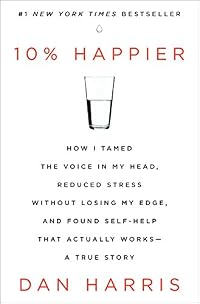
Dan Harris is a broadcast journalist. Before joining ABC News, he worked for local news outlets in Boston and Maine. He is the co-anchor of Nightline and the weekend editions of Good Morning America. He regularly reports for 20/20, World News with Diane Sawyer, and the weekday editions of Good Morning America. His first book, 10% Happier: How I show more Tamed the Voice in My Head, Reduced Stress Without Losing My Edge, and Found a Self-Help That Actually Works - A True Story, was published in 2014. In 2017, he and co-author Jeff Warren published Meditation For Fidgety Skeptics: A 10% Happier How-to Book. (Bowker Author Biography) show less
3+ Works 905 Members
5+ Works 793 Members
Work Relationships
Common Knowledge
- Original publication date
- 2017-12-26
- Epigraph
- "The untrained mind is stupid."
-- Ajahn Chah, meditation master - First words
- If you had told me as recently as a few years ago that I would someday become a traveling evangelist for meditation, I would have coughed my beer up through my nose.
- Blurbers
- Rubin, Gretchen; Epstein, Mark; Goldstein, Joseph; Salzberg, Sharon
Classifications
Statistics
- Members
- 560
- Popularity
- 52,584
- Reviews
- 12
- Rating
- (3.91)
- Languages
- English, Spanish
- Media
- Paper, Audiobook, Ebook
- ISBNs
- 14
- ASINs
- 5