Gods, Men and Ghosts
by Lord Dunsany
On This Page
Description
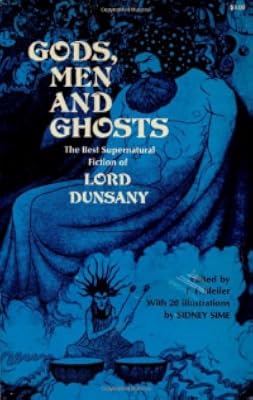
Irish writer Edward J. M. D. Plunkett, 18th Baron of Dunsany, ranks among the twentieth century's great masters of supernatural and science fiction. An outstanding dramatist whose supernatural plays anticipated the theater of the absurd, Dunsany was also a virtuoso writer of short stories and essays. This selection presents the finest of his works, gathered from long-out-of-print sources. Contents include the famous "Three Sailors' Gambit," possibly the best chess story ever written; the show more remarkable trilogy about Nuth and the Gnoles, Thangobrind the Jeweller, and the Gibbelins; exploits of the Gods, including both "The Gods of Pengana" and adventures from other books; and favorite adventures of Jorkens, prince of liars. Dunsany's spellbinding tales are complemented by the remarkable visions of Sidney H. Sime, whose delicate illustrations form an indispensable complement to the stories. show lessTags
Recommendations

















Member Reviews
When I started my new job, I was asked to answer any three of a dozen questions for an item introducing me. One was “What is your greatest fear?”. I said I’d read 1984 and enough other dystopias to beware of divulging that.
The Bureau d'échange de Maux is a short story that opens with recollections of the “wondrously evil old man” in a small, quirky building in a Parisian side street. He and it are immediately enticing and repellant; the reader is drawn into the narrator’s curiosity - and compulsion.
“You paid twenty francs… for admission to the bureau and then had the right to exchange any evil or misfortune with anyone on the premises for some evil or misfortune that he ‘could afford’.”
A capitalist spin on show more Faust, with seductive atmospherics.
Some startling exchanges are made in “the dingy ends of that low-ceilinged room”, including wisdom for folly and death for life.
The narrator is, of course, tempted to try a trade, but he’s also cautious.
“Man has never yet benefited by the marvellous and that the more miraculous his advantage appears to be the more securely and tightly do the gods or the witches catch him.”
Read the story (link below) to see how what he does relates to my opening paragraph.
Image: Still Life with a Skull and a Writing Quill, by Pieter Claes (Source)
Quotes
• “Its doorway made of three brown beams of wood, the top one overlapping the others like the Greek letter pi, all the rest painted green, a house far lower and narrower than its neighbours and infinitely stranger.”
• “A man's own evil is to him the worst thing there is or ever could be, and that an evil so unbalances all men's minds that they always seek for extremes in that small grim shop.”
See also
• My only other encounter with Lord Dunsany’s work was more than a decade ago, when I read his YA (not that it was described as such back then) novella, The King of Elfland’s Daughter. I found the purple prose a bit much and wrote that “I prefer things a little darker”: see my review HERE. This shorter story certainly delivers that, which is amusing, because I also wrote of Elfland that “the moral is perhaps ‘Be careful what you wish for’”. Well, I got what I wished for - and am glad of it - though the narrator of this story is more equivocal.
• A strict translation of “maux” is “ailments”, but here, it’s explicitly about “evil” from the start.
• This was published in 1916 and features a single, but strongly anti-Semitic analogy.
Short story club
I read this in Black Water: The Anthology of Fantastic Literature, by Alberto Manguel, from which I’m reading one story a week with The Short Story Club, starting 4 September 2023.
You can read this story HERE.
You can join the group here. show less
The Bureau d'échange de Maux is a short story that opens with recollections of the “wondrously evil old man” in a small, quirky building in a Parisian side street. He and it are immediately enticing and repellant; the reader is drawn into the narrator’s curiosity - and compulsion.
“You paid twenty francs… for admission to the bureau and then had the right to exchange any evil or misfortune with anyone on the premises for some evil or misfortune that he ‘could afford’.”
A capitalist spin on show more Faust, with seductive atmospherics.
Some startling exchanges are made in “the dingy ends of that low-ceilinged room”, including wisdom for folly and death for life.
The narrator is, of course, tempted to try a trade, but he’s also cautious.
“Man has never yet benefited by the marvellous and that the more miraculous his advantage appears to be the more securely and tightly do the gods or the witches catch him.”
Read the story (link below) to see how what he does relates to my opening paragraph.
Image: Still Life with a Skull and a Writing Quill, by Pieter Claes (Source)
Quotes
• “Its doorway made of three brown beams of wood, the top one overlapping the others like the Greek letter pi, all the rest painted green, a house far lower and narrower than its neighbours and infinitely stranger.”
• “A man's own evil is to him the worst thing there is or ever could be, and that an evil so unbalances all men's minds that they always seek for extremes in that small grim shop.”
See also
• My only other encounter with Lord Dunsany’s work was more than a decade ago, when I read his YA (not that it was described as such back then) novella, The King of Elfland’s Daughter. I found the purple prose a bit much and wrote that “I prefer things a little darker”: see my review HERE. This shorter story certainly delivers that, which is amusing, because I also wrote of Elfland that “the moral is perhaps ‘Be careful what you wish for’”. Well, I got what I wished for - and am glad of it - though the narrator of this story is more equivocal.
• A strict translation of “maux” is “ailments”, but here, it’s explicitly about “evil” from the start.
• This was published in 1916 and features a single, but strongly anti-Semitic analogy.
Short story club
I read this in Black Water: The Anthology of Fantastic Literature, by Alberto Manguel, from which I’m reading one story a week with The Short Story Club, starting 4 September 2023.
You can read this story HERE.
You can join the group here. show less
The Jorkens stories and those from the books of wonder were the best. I was let down by the final section of stories about the gods.
Ratings
Members
- Recently Added By
Author Information

391+ Works 10,071 Members
Though during his lifetime the Irish nobleman Lord Edward John Moreton Drax Plunkett, the 18th Baron Dunsany, was perhaps regarded as a minor talent, his somber short fantasies and novels had a significant impact on the development of fantasy and horror fiction. In real life, Dunsany was as interesting and versatile as anyone about whom he wrote. show more He was an African big-game hunter, a soldier in both the Boer War and World War I, and was wounded in the 1916 Irish Easter Rebellion. He was also the national chess champion of Ireland. Dunsany's first short story collection, The Gods of Pegana, was published in 1905 and was soon followed by other fantasy anthologies, including Time and the Gods (1906) and The Sword of Welleran and Other Stories (1908), among others. These stories are distinguished by their elegant, fairy tale settings and Dunsany's unique, macabre sense of humor. Dunsany's novels, such as The King of Elfland's Daughter (1924) and The Charwoman's Shadow (1926), are considered fantasy classics. Although Dunsany wrote prodigiously and with great versatility throughout his life, many regard his early, highly stylized short fiction to be his best work, and his most important. (Bowker Author Biography) show less
All Editions
Work Relationships
Is contained in
Common Knowledge
Classifications
Statistics
- Members
- 156
- Popularity
- 209,858
- Reviews
- 3
- Rating
- (4.18)
- Languages
- English, Italian
- Media
- Paper, Ebook
- ISBNs
- 4
- ASINs
- 2