On This Page
Description
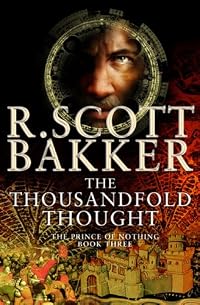
All opposition to the man once derided as the Prince of Nothing has vanished or been vanquished. Their leaders slain, the heathen Fanim have fled in disarray. One final march will bring the Holy War to the fabled city of Shimeh. But so very much has changed. Anasurimbor Kellhus, the Warrior-Prophet, now leads the Men of the Tusk. The cuckolded sorcerer Achamian serves as his tutor, betraying his school to keep safe the man he believes can prevent the Second Apocalypse. The Scylvendi show more barbarian, Cnaiur, succumbs finally to madness. The Consult, sensing the endgame of millennia of planning, work frantically to prepare for the coming of the No-God. The final reckoning is at hand. Faceless assassins will strike in the dead of night. Kings and Emperors will fall. The sorcerous Schools will be unleashed. And Anasurimbor Kellhus will at last confront his father and the dread revelation of the Thousandfold Thought.|R. Scott Bakker is a student of literature, history, philosophy, and ancient languages. His previous books include the Prince of Nothing trilogy: The Darkness that Comes Before, The Warrior Prophet, and The Thousandfold Thought. The Aspect-Emperor series is a sequel series that includes The Judging Eye, The White-Luck Warrior, The Great Ordeal, and The Unholy Consult. He lives in London, Ontario. show lessTags
Recommendations







Member Reviews
This review applies to all three volumes of Bakker's 'The Prince of Nothing' series. First off, let me say that I'm really impressed with what Bakker achieved here. I'm reminded of something Guy Kay said when asked why he wrote The Fionavar Tapestry about wanting to prove that there was still life in the old tropes of high fantasy, as designed by Tolkien, and that new things could be done with them as opposed to mere slavish imitation. I think Bakker succeeded admirably in this (whereas Guy Kay's actual creation of something really new, in Fionavar at least, is debatable).
From the explanation of the Elves' immortality, as well as a really interesting extrapolation of what that would mean for a contigent being, to the depiction of evil show more so utterly repulsive and frightening that it makes Melkor and Sauron look like Sunday school teachers this series really played with the traditional high fantasy motifs in ways I found very intriguing. Add to that a magic system based on principles from the epistomology of different schools of philosophy and a cast of characters whose flaws make them almost painfully real to the reader and you'd expect to get a smash hit on your hands. Except that doesn't really seem to have happened and I think I know why.
In a nutshell the books, and the world they present, are just so unambiguosuly dark that I think few readers have the stomach to follow Bakker where he wants to lead them. The most redeeming character of the series, the downtrodden wizard Drusus Achamian, is ultimately a loser who seems only to be a relative good-guy in that he's too feckless to be effectively out for himself. Anasûrimbor Kellhus, the character who would be the titular hero of the series as written by anyone else, is more akin to a natural force than a man and the utter vacuity of his moral centre is so frightening that it makes him both more and less human than any other character of the novel. Cnaiür urs Skiötha, another incredibly well-drawn and fascinating character, is also so driven by his broken nature that while what he is capable of is impressive, it certainly isn't anything the reader is likely to relate to. Bakker obviously has a point to make in his story about human nature, and even the nature of reality, but it certainly isn't a point that is likely to sit well with too many readers unless they like their world view leavened with a heaping portion of nihilism. One begins to wonder, as we learn more about this world and the sleeping great evil that is apparently looming on the horizon, why anyone would bother trying to save such an utterly flawed universe anyway. Despite all of this, though, the world as Bakker paints it is an incredibly vivid and interesting one. The hints of 'what has gone before' that are dropped in the story give real texture to this place and the mysteries still left unanswered are as tantalising as those for which we do receive some explanation. It is really fascinating to see how someone using similar tropes and building blocks to Tolkien could have built something so completely different, and yet still so compelling.
The story itself follows the rise of a great crusade between warring nations against the backdrop of the rise to power of an ancient force of evil which most of the world does not even believe in anymore. Behind and within this backdrop are woven the tales of the three main characters (Achaimian, Kellhus, and Cnaiur) as they each pursue their own goals and are inextricably led to one another. The climax of the series could be considered something of an anti-climax, for while each of the characters has, in some sense, found what they were seeking and begun upon a new path, the much larger movements of the story (both the crusade and the rise of sleeping evil) are left in media res for another series to pick up on. Bakker has now released two books in this continuation of the larger story, but many readers may find it frustrating that so much of what could be considered the overarching plot of the novels is left completely hanging by the end of volume three.
Overall I was torn by this series. One the one hand I think Bakker did a commendable job in building a world that did truly new things with the high fantasy genre and I was always fascinated by each new mystery he revealed; on the other hand I ended up feeling like I needed a shower after reading these books. The evil in it is presented so convincingly, and the very nature of the world he created is so bleak, that I just don't relish the thought of visiting the place again. Add to that the fact that the term "sympathetic character" doesn't seem to be in Bakker's vocabulary and you are left with a series that is definitely tailored to the tastes of the minority...but then again, maybe that's a good thing. show less
From the explanation of the Elves' immortality, as well as a really interesting extrapolation of what that would mean for a contigent being, to the depiction of evil show more so utterly repulsive and frightening that it makes Melkor and Sauron look like Sunday school teachers this series really played with the traditional high fantasy motifs in ways I found very intriguing. Add to that a magic system based on principles from the epistomology of different schools of philosophy and a cast of characters whose flaws make them almost painfully real to the reader and you'd expect to get a smash hit on your hands. Except that doesn't really seem to have happened and I think I know why.
In a nutshell the books, and the world they present, are just so unambiguosuly dark that I think few readers have the stomach to follow Bakker where he wants to lead them. The most redeeming character of the series, the downtrodden wizard Drusus Achamian, is ultimately a loser who seems only to be a relative good-guy in that he's too feckless to be effectively out for himself. Anasûrimbor Kellhus, the character who would be the titular hero of the series as written by anyone else, is more akin to a natural force than a man and the utter vacuity of his moral centre is so frightening that it makes him both more and less human than any other character of the novel. Cnaiür urs Skiötha, another incredibly well-drawn and fascinating character, is also so driven by his broken nature that while what he is capable of is impressive, it certainly isn't anything the reader is likely to relate to. Bakker obviously has a point to make in his story about human nature, and even the nature of reality, but it certainly isn't a point that is likely to sit well with too many readers unless they like their world view leavened with a heaping portion of nihilism. One begins to wonder, as we learn more about this world and the sleeping great evil that is apparently looming on the horizon, why anyone would bother trying to save such an utterly flawed universe anyway. Despite all of this, though, the world as Bakker paints it is an incredibly vivid and interesting one. The hints of 'what has gone before' that are dropped in the story give real texture to this place and the mysteries still left unanswered are as tantalising as those for which we do receive some explanation. It is really fascinating to see how someone using similar tropes and building blocks to Tolkien could have built something so completely different, and yet still so compelling.
The story itself follows the rise of a great crusade between warring nations against the backdrop of the rise to power of an ancient force of evil which most of the world does not even believe in anymore. Behind and within this backdrop are woven the tales of the three main characters (Achaimian, Kellhus, and Cnaiur) as they each pursue their own goals and are inextricably led to one another. The climax of the series could be considered something of an anti-climax, for while each of the characters has, in some sense, found what they were seeking and begun upon a new path, the much larger movements of the story (both the crusade and the rise of sleeping evil) are left in media res for another series to pick up on. Bakker has now released two books in this continuation of the larger story, but many readers may find it frustrating that so much of what could be considered the overarching plot of the novels is left completely hanging by the end of volume three.
Overall I was torn by this series. One the one hand I think Bakker did a commendable job in building a world that did truly new things with the high fantasy genre and I was always fascinated by each new mystery he revealed; on the other hand I ended up feeling like I needed a shower after reading these books. The evil in it is presented so convincingly, and the very nature of the world he created is so bleak, that I just don't relish the thought of visiting the place again. Add to that the fact that the term "sympathetic character" doesn't seem to be in Bakker's vocabulary and you are left with a series that is definitely tailored to the tastes of the minority...but then again, maybe that's a good thing. show less
In many ways this conclusion to The Prince of Nothing is stunningly good, brilliantly imaginative in a way that brings to mind Steven Erikson. Bakker's brutally compelling world that is fresh, surprising, consistent, and deep. His descriptive language is nothing less than astonishing. His ability to capture the epic pageantry of battle is superb. And he makes you feel the tormented questioning of his characters.
And yet this is military fantasy that frequently fumbles its strategy, tactics, and logistics. I found myself constantly frustrated by a sense that battles simply wouldn't be fought this way, and campaigns wouldn't be run this way, and armies couldn't be supplied this way. Which isn't to deny that these battles are beautifully show more described, and clearly take the plot where Bakker wants it to go.
By the halfway point of this third book of the series I was finding it hard to find sympathy for any of the admittedly interesting cast of characters. Kellhus' ability to read and manipulate even the best of normal men and women is both logical and organic within the story, but at times it just seemed too easy. Fortunately things picked up in the last 150 pages or so, and the book certainly finished with a sustained bang. Overall, a very impressive, if in some ways flawed, debut trilogy from Bakker. show less
And yet this is military fantasy that frequently fumbles its strategy, tactics, and logistics. I found myself constantly frustrated by a sense that battles simply wouldn't be fought this way, and campaigns wouldn't be run this way, and armies couldn't be supplied this way. Which isn't to deny that these battles are beautifully show more described, and clearly take the plot where Bakker wants it to go.
By the halfway point of this third book of the series I was finding it hard to find sympathy for any of the admittedly interesting cast of characters. Kellhus' ability to read and manipulate even the best of normal men and women is both logical and organic within the story, but at times it just seemed too easy. Fortunately things picked up in the last 150 pages or so, and the book certainly finished with a sustained bang. Overall, a very impressive, if in some ways flawed, debut trilogy from Bakker. show less
One of Bakker's many impressive talents in these books is the ability to spend page after page on the inner life of virtually any character, without it feeling like it hurts the pacing or halts the story. Somehow, the story seems always to progress, even when a character is busy having thoughts -- thoughts he or she has often had variations of dozens of times before, to boot.
The world building is also staggering, as evidenced by the 100+ page glossary in this third volume where the first two only had some small name and place registers. It includes several page long retellings of ancient wars, nations and organisations, often done with an in-world charm and sense of realism by sprinkling in things like how this event has lead to a show more common idiom, or by haughtily insisting some minor detail of common misconception is true when the reader of the novels know surely it is not. Putting this extended glossary here, when the reader has already familiarised themselves with the main cast in two thick novels and presumably no longer simply need an overview of who is who in the story, is another small stroke of genious. Though I'd recommend pausing, perhaps a third or so of the way into the actual novel, to read through the entire glossary. It contains no spoilers for the third volume as far as I can see, and the background information should be helpful, especially with giving context to Achamian's dreams and Esmenet's reading.
To get back to the actual narrative, it delivers satisfying conclusions to nearly every character's arc (well, there was one minor one that left me slightly wanting, but it worked), and sets up another, much larger conflict on the horizon without that feeling like it cheats this of a proper ending. In fact, the end scene is so magnificently Biblical in intensity and feel, I think it will stay with me as a masterpiece of iconic fantasy -- akin to Gandalf facing Durin's Bane at Moria, the faun by the lone lantern greeting a small girl in the snowy woods of Narnia, or the fate of Eddard Stark.
Be forewarned, though, this series is grim, cynical and brutal. And if you want happy endings, look elsewhere. show less
The world building is also staggering, as evidenced by the 100+ page glossary in this third volume where the first two only had some small name and place registers. It includes several page long retellings of ancient wars, nations and organisations, often done with an in-world charm and sense of realism by sprinkling in things like how this event has lead to a show more common idiom, or by haughtily insisting some minor detail of common misconception is true when the reader of the novels know surely it is not. Putting this extended glossary here, when the reader has already familiarised themselves with the main cast in two thick novels and presumably no longer simply need an overview of who is who in the story, is another small stroke of genious. Though I'd recommend pausing, perhaps a third or so of the way into the actual novel, to read through the entire glossary. It contains no spoilers for the third volume as far as I can see, and the background information should be helpful, especially with giving context to Achamian's dreams and Esmenet's reading.
To get back to the actual narrative, it delivers satisfying conclusions to nearly every character's arc (well, there was one minor one that left me slightly wanting, but it worked), and sets up another, much larger conflict on the horizon without that feeling like it cheats this of a proper ending. In fact, the end scene is so magnificently Biblical in intensity and feel, I think it will stay with me as a masterpiece of iconic fantasy -- akin to Gandalf facing Durin's Bane at Moria, the faun by the lone lantern greeting a small girl in the snowy woods of Narnia, or the fate of Eddard Stark.
Be forewarned, though, this series is grim, cynical and brutal. And if you want happy endings, look elsewhere. show less
I normally never really dislike books but this series takes the cake. It's not about it's writing or really it's plot; I absolutely hate these characters.
First off we have Kellhus or should I say Gary Sue to match all of Gary Sues. I get it, he's suppose to be inhuman in intellect and reading people. I get it after being hit over the head after every description that he's like no other man, he's so smart, he's so observant. He has intellect and skill, he talk and he can fight. More toward the third book I started to feel like "What the hell is the point of this story?" The plot comes down to a rather bloody and dramatic roadtrip where everyone just gushes over Kellhus. And I mean EVERYONE. There is absolutely NO ONE who doesn't like show more Kellhus. And the few that don't are promptly killed off, because, come on, Kellhus is just fantastic right? Xerius? Dead. Conphas? Dead. Cnaiur? Well he got sent off to die but then he came back but really....I'll get to this point later. And at the last page, Achamian finally takes the balls to stand up, for two lines. Too bad I won't read Aspect-Emperor because I'm sure it's just going to be an even longer pissing contest.
Next on our list is actually 2 people, namely Serwe and Esmenet, namely: BAKKER CANNOT WRITE FEMALES FOR SHIT. I was abhorred by how he chose to portray females as tools for fucking, getting pregnant, and getting married to. Absolutely none of the female named characters (which makes a grand totally of 3 counting Xerius' mother) have no higher a role than to fuck and breed with. So let's start of with Serwe, shall we? Her only defining trait that is every mentioned is how gosh darn good looking she is. Seriously. That's all that ever comes up. When Cnaiur meets her: Hurr she's so pretty. Let me devote my whole life to making her my wife because she's pretty. When Esmenet meets her: Aww no wonder Kellhus likes her, she's pretty. I wish I could be like her. When Achamian promptly cheats on Esmenet: Omg, sorry Esmi but she was just so gosh darn hot, what to you expect me to do? And so her role is to create conflict between Kellhus and Cnaiur. Then she gets pregnant. Then she gives birth. Then Bakker kills her off. Fantastic. What a worthless character.
Well then how about Esmenet? She's actually got a personality, right? Bakker keeps describing how intelligent she is, and how much she wants to actually mean something in a world where women are second class citizens. Great! Well great for the first book! And then the 2nd half of the 2nd book it just plummeted. Oh what's that Akka, you died? Well I guess I'll just fling myself into the arms of the guy closest to me because women have to have a man in their life or else the just fall apart, am I right guys? Oh what? Akka isn't dead? So then Esmenet's role now becomes "Let's create conflict between Achamian and Kellhus for the next book and a half" and stays that way. And what drives up the wall despite all this blatant sexism is that at the end of the 3rd book, when everything's said and done and Achamian STRAIGHT UP TELLS HER that Kellhus is not to be trusted. SHE STILLS STAYS WITH HIM because why? OMG AKKA YOU DON'T UNDERSTAND, I'M PREGNANT AND THUS I MUST STAY WITH THE MAN WHO IMPREGNATED ME BECAUSE THAT'S ALL I'M GOOD FOR IN LIFE. Are you kidding me?!
And before you feel I'm too biased because I'm female, let me just say, Bakker also does a horrible job with writing men. Seriously, the downfall of most of the male characters is because they're fucking SEX FIENDS. The only reason stopping Cnaiur from slitting Kellhus throat most times was unbearable urge to screw Serwe. He just couldn't take that Kellhus was getting some from her and not him. REALLY? Second example. Achamian cheats on the love of his life and probably skews their relationship because why? WELL SERWE WAS RIGHT THERE AND SHE WAS HOT SO YEAH.....Are you kidding me? Look I'm all for sex in books and have no qualms about it but if your plot is just riddled with sex scene after sex scene and all your females' main concern is getting raped in the next chapter (which both Serwe and Esmenet are, of fucking course.) THEN YOU HAVE A PROBLEM.
I seriously could go on, this rant last all three books but I'll spare anyone reading this anymore agony. I picked up this series because of it's multitude of good reviews, but now I'm putting it down wondering how can anyone read through this horrendous display of characterization without one moment of "What the hell are these people even doing?" show less
First off we have Kellhus or should I say Gary Sue to match all of Gary Sues. I get it, he's suppose to be inhuman in intellect and reading people. I get it after being hit over the head after every description that he's like no other man, he's so smart, he's so observant. He has intellect and skill, he talk and he can fight. More toward the third book I started to feel like "What the hell is the point of this story?" The plot comes down to a rather bloody and dramatic roadtrip where everyone just gushes over Kellhus. And I mean EVERYONE. There is absolutely NO ONE who doesn't like show more Kellhus. And the few that don't are promptly killed off, because, come on, Kellhus is just fantastic right? Xerius? Dead. Conphas? Dead. Cnaiur? Well he got sent off to die but then he came back but really....I'll get to this point later. And at the last page, Achamian finally takes the balls to stand up, for two lines. Too bad I won't read Aspect-Emperor because I'm sure it's just going to be an even longer pissing contest.
Next on our list is actually 2 people, namely Serwe and Esmenet, namely: BAKKER CANNOT WRITE FEMALES FOR SHIT. I was abhorred by how he chose to portray females as tools for fucking, getting pregnant, and getting married to. Absolutely none of the female named characters (which makes a grand totally of 3 counting Xerius' mother) have no higher a role than to fuck and breed with. So let's start of with Serwe, shall we? Her only defining trait that is every mentioned is how gosh darn good looking she is. Seriously. That's all that ever comes up. When Cnaiur meets her: Hurr she's so pretty. Let me devote my whole life to making her my wife because she's pretty. When Esmenet meets her: Aww no wonder Kellhus likes her, she's pretty. I wish I could be like her. When Achamian promptly cheats on Esmenet: Omg, sorry Esmi but she was just so gosh darn hot, what to you expect me to do? And so her role is to create conflict between Kellhus and Cnaiur. Then she gets pregnant. Then she gives birth. Then Bakker kills her off. Fantastic. What a worthless character.
Well then how about Esmenet? She's actually got a personality, right? Bakker keeps describing how intelligent she is, and how much she wants to actually mean something in a world where women are second class citizens. Great! Well great for the first book! And then the 2nd half of the 2nd book it just plummeted. Oh what's that Akka, you died? Well I guess I'll just fling myself into the arms of the guy closest to me because women have to have a man in their life or else the just fall apart, am I right guys? Oh what? Akka isn't dead? So then Esmenet's role now becomes "Let's create conflict between Achamian and Kellhus for the next book and a half" and stays that way. And what drives up the wall despite all this blatant sexism is that at the end of the 3rd book, when everything's said and done and Achamian STRAIGHT UP TELLS HER that Kellhus is not to be trusted. SHE STILLS STAYS WITH HIM because why? OMG AKKA YOU DON'T UNDERSTAND, I'M PREGNANT AND THUS I MUST STAY WITH THE MAN WHO IMPREGNATED ME BECAUSE THAT'S ALL I'M GOOD FOR IN LIFE. Are you kidding me?!
And before you feel I'm too biased because I'm female, let me just say, Bakker also does a horrible job with writing men. Seriously, the downfall of most of the male characters is because they're fucking SEX FIENDS. The only reason stopping Cnaiur from slitting Kellhus throat most times was unbearable urge to screw Serwe. He just couldn't take that Kellhus was getting some from her and not him. REALLY? Second example. Achamian cheats on the love of his life and probably skews their relationship because why? WELL SERWE WAS RIGHT THERE AND SHE WAS HOT SO YEAH.....Are you kidding me? Look I'm all for sex in books and have no qualms about it but if your plot is just riddled with sex scene after sex scene and all your females' main concern is getting raped in the next chapter (which both Serwe and Esmenet are, of fucking course.) THEN YOU HAVE A PROBLEM.
I seriously could go on, this rant last all three books but I'll spare anyone reading this anymore agony. I picked up this series because of it's multitude of good reviews, but now I'm putting it down wondering how can anyone read through this horrendous display of characterization without one moment of "What the hell are these people even doing?" show less
The Whore of Sumna, some had called her, but in tones of exaltation, not condemnation.
This is where I will cease reading R. Scott Bakker. No longer is his misogyny even moderately hidden. It is right there in the open, for all to see. This is an author who seems to take pride and joy in his own descriptions of brutal rape. An author who can't find room in an entire fantasy epic for more than two major female characters: a whore, and a slave. An author who predicates even the major story-lines of his epic on the idea that woman is responsible for the downfall of man. That woman's lust is source of all evil. That even in exaltation, a woman remains what she is: a whore.
I could go on, but I don't think its worth it. It's a shame, because show more Bakker is a good writer with a great fantasy imagination. His play on determinism and free will is unique to the fantasy world as far as I know, and it gives him a nicely filled out metaphysic - something often missing from high fantasy. But the man is a complete misogynist, and it becomes increasingly clear as I go on that I can't read this tripe without getting angry. Even though I wanted to know how this book ended, it got to the point where I had to force myself to finish it. And I did finish it, and I want to know what happens in the next trilogy... But I will not continue to buy books that put money into this guy's pockets.
For his fantasy imagination, and the story-line in this book: probably 4 stars.
For his neanderthal attitude towards women: zero.
I'll split the difference and give it 2. Women fantasy fans should spurn this asshat. Even better: everyone should. show less
This is where I will cease reading R. Scott Bakker. No longer is his misogyny even moderately hidden. It is right there in the open, for all to see. This is an author who seems to take pride and joy in his own descriptions of brutal rape. An author who can't find room in an entire fantasy epic for more than two major female characters: a whore, and a slave. An author who predicates even the major story-lines of his epic on the idea that woman is responsible for the downfall of man. That woman's lust is source of all evil. That even in exaltation, a woman remains what she is: a whore.
I could go on, but I don't think its worth it. It's a shame, because show more Bakker is a good writer with a great fantasy imagination. His play on determinism and free will is unique to the fantasy world as far as I know, and it gives him a nicely filled out metaphysic - something often missing from high fantasy. But the man is a complete misogynist, and it becomes increasingly clear as I go on that I can't read this tripe without getting angry. Even though I wanted to know how this book ended, it got to the point where I had to force myself to finish it. And I did finish it, and I want to know what happens in the next trilogy... But I will not continue to buy books that put money into this guy's pockets.
For his fantasy imagination, and the story-line in this book: probably 4 stars.
For his neanderthal attitude towards women: zero.
I'll split the difference and give it 2. Women fantasy fans should spurn this asshat. Even better: everyone should. show less
Despite a promising beginning, this series botched the characters, plot, and story structure so badly that it isn't worth reading. Whether you're looking for good writing and deeper meaning or just an entertaining fantasy story, you'll find neither here.
Let's start with story structure: despite ostensibly being a series, none of the three books here stand by themselves, instead each abruptly ends and then immediately starts up again in the next volume. Thus, The Prince of Nothing is a single book divided into three parts. Even taking this view, however, The Prince of Nothing is still an unsatisfying story because there is no resolution to speak of. Bakker proves incapable of writing a beginning, middle, and end even when given over show more 1,800 pages to do so. Instead, this whole series feels like one big prologue to whatever book set in this world he writes next.
Considering the pure tonnage of writing here you would expect the world to be fleshed out, since that's the only thing this massive tome actually seems to try to accomplish. Instead the world is strangely muddled, as Bakker chooses to hide elements of the world from the reader for no sufficiently good reason. There is, for instance, a chronicle of an event known as the First Apocalypse that is widely known in this fictional world, even by characters that can't read the chronicle itself. Thus, every character in the book knows the full saga, but instead of Bakker allowing the reader to know about these events as well, he gives a trickle of information that never edifies. When a writer keeps the reader ignorant in a way that a character is also ignorant then that can create sympathy. When a writer keeps the reader ignorant where all the characters are in-the-know, at best it's an unnecessary irritation and at worst it creates a hole in the world building. Apparently Bakker doesn't realize this. He also keeps the reader in the dark for a huge number of pages concerning the magic system on this world, though that seemingly stems as much from his own lack of understanding of the system as it does his desire to give the reader only scraps of information.
Moving on to the plot: there are machinations between characters here, but the main plot is a fantasy take on the Crusades, where a Holy War is launched by the fantasy Christians to retake the land occupied by the fantasy Muslims. Hundreds upon hundreds of pages are devoted to depictions of the battles of the Holy War and the trials and tribulations of the army. The problem is, none of the main characters of this novel care about the war at all. They use the war for their own interests, or follow it as part of an unrelated mission, and have no personal investment as to whether it succeeds or fails. The lone character who genuinely believes in the Holy War is a character named Proyas, a second-tier character who is fleshed out little. Thus, for the hundreds of pages of battles it's impossible to care if the army takes that city or fights off that cavalry charge or if troop morale is low or high. What was Bakker thinking, making every major character care about revenge, power, control, knowledge, love, every conceivable motivation except for the one motivation of faith that actually would drive a Holy War? Thus, all the battles are mere background to the different plots of the characters.
This flaw is magnified by the fact that we learn early on that this whole war between the fantasy Christians and fantasy Muslims isn't important, because the battle between good and evil is right around the corner. The passages where dreams explore the First Apocalypse are actually interesting, and have stakes, compared to the Holy War where it seems of little import who wins or who loses- the real battle is up ahead. The fact that the real battle is never reached (is never even begun) further emphasizes the prologue nature of this series.
When the final volume "explains" the Holy War, it makes very little sense (if I'm understanding it correctly the idea was that it would allow for the world to be unified against the great evil that will soon emerge. How exactly does the slaughter of hundreds of thousands of people based on religious and ethnic differences lead to unity?). The main overarching plot is a huge mistake on Bakker's part.
Finally, on to the biggest flaw of this book, the characters. Specifically one character, Kellhus. Kellhus is at first presented as preternaturally good at manipulating people. Fine, though I think it strange that Bakker identifies homeschooling as the path to extreme social competence. But then it's revealed that he's also the most amazing fighter ever, capable of beating the best warrior in the world in single combat having only suffered one blow. Later on someone mentions that the only thing he lacks is the ability to use magic. Then it's discovered that he is one of the very, very few who can use magic, and he's the best ever at it. He's also an incredibly quick learner of everything, and even designs some siege weapons that makes everyone's jaw drop, because why not? In short, Kellhus suffers from superman syndrome, being so good at everything that he's unsympathetic, there's no dramatic tension to anything he does, and in general he's not so much a character as he is a plot robot.
I don't mean to suggest that Kellhus would be a better character if he had fewer strengths, though, since as soon as Bakker granted Kellhus the ability to manipulate people this whole character was hopeless. An author has certain limitations on what characteristics he can write, and those limitations are based on the author's own characteristics. Thus, if an author isn't smart, that author won't be able to write very smart characters. He can write characters that are quicker with a comeback, or who know a lot about a topic, because for the former the author can take time writing something that he or she wouldn't be able to think of on the spur of the moment, and for the latter the author can do research and put that in the character's mouth. How smart a character is, though, is limited by how smart the author is, since if an author were able to successfully answer the question "hmm, what would someone smarter than me do?" then that author would be the smarter person. That's not a loop that happens. In this case, the relevant limitation is that an author can't believably write a character who can understand and manipulate people better than the author can. Bakker is clearly no savant at manipulating people: the chapters showcasing Kellhus's mastery over others are thoroughly unconvincing, the theoretical underpinnings of that mastery are laughable as well. Instead we have a character mentioning bland "truths" about people and then those people begin licking that character's boots. It reminded me a bit of Ayn Rand, who populated her books with selfish lazy parasites to make the characters espousing her philosophy look better by comparison. Here we have a world populated by easily manipulated idiots in order to try to convince us that Kellhus is truly a master manipulator (and thus that Bakker can convincingly write such manipulation and understanding). Because of this the character that serves as the keystone of this narrative is not written believably or interestingly. It makes the book a mess.
This book raised my hopes in the beginning, depicting a dying world filled with monumental ruins of ages past, populated by strange creatures and a few humans struggling to survive. Then it turned into generic fantasy stuff, even including the cliche of a game with unexplained rules that symbolizes whatever the author needs it to. Then it turned into below average fantasy as the character of Kellhus gained more prominence. When it became clear that this book was going to focus on a war that no one cared about, while hiding some of the only interesting parts of the world, that it would blatantly serve as a prologue and not a complete book, and that it would take 1,800 pages to do it, it was revealed as yet another crappy fantasy series. Don't let the opening chapters fool you, this book is a waste of time. show less
Let's start with story structure: despite ostensibly being a series, none of the three books here stand by themselves, instead each abruptly ends and then immediately starts up again in the next volume. Thus, The Prince of Nothing is a single book divided into three parts. Even taking this view, however, The Prince of Nothing is still an unsatisfying story because there is no resolution to speak of. Bakker proves incapable of writing a beginning, middle, and end even when given over show more 1,800 pages to do so. Instead, this whole series feels like one big prologue to whatever book set in this world he writes next.
Considering the pure tonnage of writing here you would expect the world to be fleshed out, since that's the only thing this massive tome actually seems to try to accomplish. Instead the world is strangely muddled, as Bakker chooses to hide elements of the world from the reader for no sufficiently good reason. There is, for instance, a chronicle of an event known as the First Apocalypse that is widely known in this fictional world, even by characters that can't read the chronicle itself. Thus, every character in the book knows the full saga, but instead of Bakker allowing the reader to know about these events as well, he gives a trickle of information that never edifies. When a writer keeps the reader ignorant in a way that a character is also ignorant then that can create sympathy. When a writer keeps the reader ignorant where all the characters are in-the-know, at best it's an unnecessary irritation and at worst it creates a hole in the world building. Apparently Bakker doesn't realize this. He also keeps the reader in the dark for a huge number of pages concerning the magic system on this world, though that seemingly stems as much from his own lack of understanding of the system as it does his desire to give the reader only scraps of information.
Moving on to the plot: there are machinations between characters here, but the main plot is a fantasy take on the Crusades, where a Holy War is launched by the fantasy Christians to retake the land occupied by the fantasy Muslims. Hundreds upon hundreds of pages are devoted to depictions of the battles of the Holy War and the trials and tribulations of the army. The problem is, none of the main characters of this novel care about the war at all. They use the war for their own interests, or follow it as part of an unrelated mission, and have no personal investment as to whether it succeeds or fails. The lone character who genuinely believes in the Holy War is a character named Proyas, a second-tier character who is fleshed out little. Thus, for the hundreds of pages of battles it's impossible to care if the army takes that city or fights off that cavalry charge or if troop morale is low or high. What was Bakker thinking, making every major character care about revenge, power, control, knowledge, love, every conceivable motivation except for the one motivation of faith that actually would drive a Holy War? Thus, all the battles are mere background to the different plots of the characters.
This flaw is magnified by the fact that we learn early on that this whole war between the fantasy Christians and fantasy Muslims isn't important, because the battle between good and evil is right around the corner. The passages where dreams explore the First Apocalypse are actually interesting, and have stakes, compared to the Holy War where it seems of little import who wins or who loses- the real battle is up ahead. The fact that the real battle is never reached (is never even begun) further emphasizes the prologue nature of this series.
When the final volume "explains" the Holy War, it makes very little sense (if I'm understanding it correctly the idea was that it would allow for the world to be unified against the great evil that will soon emerge. How exactly does the slaughter of hundreds of thousands of people based on religious and ethnic differences lead to unity?). The main overarching plot is a huge mistake on Bakker's part.
Finally, on to the biggest flaw of this book, the characters. Specifically one character, Kellhus. Kellhus is at first presented as preternaturally good at manipulating people. Fine, though I think it strange that Bakker identifies homeschooling as the path to extreme social competence. But then it's revealed that he's also the most amazing fighter ever, capable of beating the best warrior in the world in single combat having only suffered one blow. Later on someone mentions that the only thing he lacks is the ability to use magic. Then it's discovered that he is one of the very, very few who can use magic, and he's the best ever at it. He's also an incredibly quick learner of everything, and even designs some siege weapons that makes everyone's jaw drop, because why not? In short, Kellhus suffers from superman syndrome, being so good at everything that he's unsympathetic, there's no dramatic tension to anything he does, and in general he's not so much a character as he is a plot robot.
I don't mean to suggest that Kellhus would be a better character if he had fewer strengths, though, since as soon as Bakker granted Kellhus the ability to manipulate people this whole character was hopeless. An author has certain limitations on what characteristics he can write, and those limitations are based on the author's own characteristics. Thus, if an author isn't smart, that author won't be able to write very smart characters. He can write characters that are quicker with a comeback, or who know a lot about a topic, because for the former the author can take time writing something that he or she wouldn't be able to think of on the spur of the moment, and for the latter the author can do research and put that in the character's mouth. How smart a character is, though, is limited by how smart the author is, since if an author were able to successfully answer the question "hmm, what would someone smarter than me do?" then that author would be the smarter person. That's not a loop that happens. In this case, the relevant limitation is that an author can't believably write a character who can understand and manipulate people better than the author can. Bakker is clearly no savant at manipulating people: the chapters showcasing Kellhus's mastery over others are thoroughly unconvincing, the theoretical underpinnings of that mastery are laughable as well. Instead we have a character mentioning bland "truths" about people and then those people begin licking that character's boots. It reminded me a bit of Ayn Rand, who populated her books with selfish lazy parasites to make the characters espousing her philosophy look better by comparison. Here we have a world populated by easily manipulated idiots in order to try to convince us that Kellhus is truly a master manipulator (and thus that Bakker can convincingly write such manipulation and understanding). Because of this the character that serves as the keystone of this narrative is not written believably or interestingly. It makes the book a mess.
This book raised my hopes in the beginning, depicting a dying world filled with monumental ruins of ages past, populated by strange creatures and a few humans struggling to survive. Then it turned into generic fantasy stuff, even including the cliche of a game with unexplained rules that symbolizes whatever the author needs it to. Then it turned into below average fantasy as the character of Kellhus gained more prominence. When it became clear that this book was going to focus on a war that no one cared about, while hiding some of the only interesting parts of the world, that it would blatantly serve as a prologue and not a complete book, and that it would take 1,800 pages to do it, it was revealed as yet another crappy fantasy series. Don't let the opening chapters fool you, this book is a waste of time. show less
I mostly liked this better than the second book. We're not in Kellhus' head so often, and Esmenet gets some authority, at least easing the two biggest pain points. It also helps that the world building never lets up when there's always another bit of history about some person, faction or place to keep expanding the scenery and add more colour. I didn't feel like I had much stake in the players anymore but I still found myself following their activities with interest as the Holy War neared its close. I'm not a big sports fan with favourite teams to root for, but I do watch playoff highlights.
This novel was bearable, which is fine for reading you are forced to perform but not for pleasure. I'd hoped for an ending with more power but the show more author lacks the finesse to build and hold tension, cutting away from scenes at odd times. I'm sorry this trilogy scarcely scratches the surface of the bigger (more interesting) picture around the Consult and left so much hanging. I'm curious how it all turns out and I'll probably read plot summaries online for the follow-up volumes, but that's as close to them as I'm likely to get. show less
This novel was bearable, which is fine for reading you are forced to perform but not for pleasure. I'd hoped for an ending with more power but the show more author lacks the finesse to build and hold tension, cutting away from scenes at odd times. I'm sorry this trilogy scarcely scratches the surface of the bigger (more interesting) picture around the Consult and left so much hanging. I'm curious how it all turns out and I'll probably read plot summaries online for the follow-up volumes, but that's as close to them as I'm likely to get. show less
Members
- Recently Added By
Lists

Best Fantasy Novels
821 works; 358 members
Author Information

20+ Works 7,368 Members
R. Scott Bakker holds a B.A. in English language and literature, an M.A. in theory and criticism, and is currently completing his Ph.D. in philosophy at Vanderbilt University
Awards and Honors
Notable Lists
Series


Work Relationships
Common Knowledge
- Canonical title
- The Thousandfold Thought
- Original title
- The Thousandfold Thought
- Original publication date
- 2006-01
- Epigraph
- In pursuing yonder what they have lost, they encounter only the nothing they have. In order not to lose touch with the everyday dreariness in which, as irremediable realists, they are at home, they adapt the meaning they reve... (show all)l in to the meaninglessness they flee. The worthless magic is nothing other than the worthless existence it lights up.
--THEODOR ADORNO, MINIMA MORALIA
All progressions from a higher to a lower order are marked by ruins and mystery and a residue of nameless rage. So. Here are the dead fathers.
--CORMAC McCARTHY, BLOOD MERIDIAN - Dedication
- To Tina and Keith with love
- First words
- There had been a time, for Achamian, when the future had been a habit, something belonging to the hard rhythm of his days toiling in his father's shadow.
- Last words
- (Click to show. Warning: May contain spoilers.)Retracing his bloody footprints, the Wizard limped on.
- Original language
- English
Classifications
Statistics
- Members
- 1,326
- Popularity
- 18,016
- Reviews
- 19
- Rating
- (3.87)
- Languages
- 5 — Czech, English, French, German, Spanish
- Media
- Paper, Audiobook, Ebook
- ISBNs
- 16
- ASINs
- 12