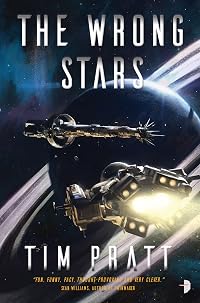
On This Page
Description
A ragtag crew of humans and posthumans discover alien technology that could change the fate of humanity . . . or awaken an ancient evil and destroy all life in the galaxy. The shady crew of the White Raven run freight and salvage at the fringes of our solar system. They discover the wreck of a centuries-old exploration vessel floating light years away from its intended destination and revive its sole occupant, who wakes with news of First Alien Contact. When the crew break it to her that show more humanity has alien allies already, she reveals that these are very different extra-terrestrials . . . and the gifts they bestowed on her could kill all humanity, or take it out to the most distant stars. show lessTags
Recommendations









Member Reviews
The Wrong Stars is the first volume in a space opera series dealing with the far future of humankind and focusing on the ragtag crew of the White Raven, whose salvage & law enforcement operations are conducted under the aegis of the Trans-Neptune Authority, one of the political entities ruling human-controlled space.
During one of their explorations, Captain Callie Machedo and her crew encounter the wreck of an ancient Earth spaceship, part of the Goldilocks fleet - slow vessels equipped with cryosleep units to allow the bridging of vast distances - sent centuries before in search of habitable planets: only one onboard cryopod is still in operation, holding Dr. Elena Oh who, once revived, warns her rescuers about the threat of a show more dangerous alien life form she and her lost crew-mates encountered. Callie and her people are mystified, since the only alien race humanity came across so far are the squid-like Liars who are certainly untrustworthy, as the name they came to be known by hints at, but quite far from a deadly menace.
As the salvage operation turns into the attempted rescue of Elena’s trapped crew-mates, new revelations bring to light the existence of another, far more ancient alien race - the Axiom - which once ruled the galaxy and might still represent a deadly threat for humans and Liars alike, so that Callie and her people find themselves enmeshed into an action-packed race to discover the truth and, if possible, avert the doom that a return of the Axiom could entail.
As with most books, The Wrong Stars stands on the double supports of plot and characterization, with the former being the strongest element. There is hardly a moment’s respite in the breathless sequence of events and plot twists that creates the backbone of the story, enhanced by a series of progressive revelations that do little to ease the burden of impending catastrophe hanging over the characters’ heads, but instead keep raising the stakes for the group of intrepid explorers. The universe in which the story is set is an intriguing one, and the author manages to give us a good picture of it without need for lengthy exposition, also conveying the notion that humanity has changed a great deal, both socially and physically - as indicated, for example, by the presence of engineer Ashok, who is a cyborg constantly on the lookout for further modifications and enhancements. Moreover, there is a vein of light humor running throughout the story, carried by the constant quips exchanged among the crew, that mitigates the seemingly endless adrenaline rush of the events, and offers a welcome respite during the tenser moments.
Unfortunately, the characters suffer from such a tight focus on the plot, and they looked to me rather like… signposts (for want of a better word) of what actual characters should be, with not enough depth for me to truly connect with any of them. As I read I kept thinking that the potential for each character was not fully explored, particularly where the already mentioned Ashok is concerned, or the weirdly inseparable duo of Janice and Drake, or again the alien Liar named Lantern who at some point joins the team: they all looked to me more paint-by-the-numbers aspects of diversity than anything else, which proved disappointing in light of the hints at trans-humanity and post-humanity inhabiting this future universe, not to mention the potentially intriguing race of the Liars.
Another source of frustration comes from the excessively carefree attitude with which the crew launches into unknown dangers - and into a situation that could lead to the total annihilation of humankind: their lives are constantly at stake, but I never perceived their acknowledgment of this fact, and was in turn surprised and annoyed at the way they faced mortal dangers as if they were embarking in one of their routine missions. This kind of portrayal failed to make me worry about their survival - both as individuals and as a group - because the way the story is told clearly implicates that they will survive anything: the fact that they always manage to overcome any danger, no matter how dire, and beat the worst odds, robs any of their endeavors of the suspense necessary to make such actions believable.
And on top of it all, there is an equally unbelievable insta-love between Captain Callie and Dr. Elena: first of all, I was somewhat creeped out by the fact that Callie feels the pangs of physical attraction for Elena when first observing her frozen body in the cryo-pod - my suspension of disbelief did not pass this stress test, which later colored my consideration of the told-but-not-shown mutual attraction between the two of them. Add the unnatural ease with which Elena accepts the fact that she’s been frozen for a few centuries and that the world she knew is no more, an ease that never takes into account the element of “future shock” one should expect in such a situation, and you will understand my problems with the characterization of this novel.
Still, the core concept of an ancient alien race poised to return and wreak havoc in the galaxy is an intriguing one, and it might be the encouragement I need to try the second book in the series - if nothing else to see if some of the problems I encountered here have been straightened out. show less
During one of their explorations, Captain Callie Machedo and her crew encounter the wreck of an ancient Earth spaceship, part of the Goldilocks fleet - slow vessels equipped with cryosleep units to allow the bridging of vast distances - sent centuries before in search of habitable planets: only one onboard cryopod is still in operation, holding Dr. Elena Oh who, once revived, warns her rescuers about the threat of a show more dangerous alien life form she and her lost crew-mates encountered. Callie and her people are mystified, since the only alien race humanity came across so far are the squid-like Liars who are certainly untrustworthy, as the name they came to be known by hints at, but quite far from a deadly menace.
As the salvage operation turns into the attempted rescue of Elena’s trapped crew-mates, new revelations bring to light the existence of another, far more ancient alien race - the Axiom - which once ruled the galaxy and might still represent a deadly threat for humans and Liars alike, so that Callie and her people find themselves enmeshed into an action-packed race to discover the truth and, if possible, avert the doom that a return of the Axiom could entail.
As with most books, The Wrong Stars stands on the double supports of plot and characterization, with the former being the strongest element. There is hardly a moment’s respite in the breathless sequence of events and plot twists that creates the backbone of the story, enhanced by a series of progressive revelations that do little to ease the burden of impending catastrophe hanging over the characters’ heads, but instead keep raising the stakes for the group of intrepid explorers. The universe in which the story is set is an intriguing one, and the author manages to give us a good picture of it without need for lengthy exposition, also conveying the notion that humanity has changed a great deal, both socially and physically - as indicated, for example, by the presence of engineer Ashok, who is a cyborg constantly on the lookout for further modifications and enhancements. Moreover, there is a vein of light humor running throughout the story, carried by the constant quips exchanged among the crew, that mitigates the seemingly endless adrenaline rush of the events, and offers a welcome respite during the tenser moments.
Unfortunately, the characters suffer from such a tight focus on the plot, and they looked to me rather like… signposts (for want of a better word) of what actual characters should be, with not enough depth for me to truly connect with any of them. As I read I kept thinking that the potential for each character was not fully explored, particularly where the already mentioned Ashok is concerned, or the weirdly inseparable duo of Janice and Drake, or again the alien Liar named Lantern who at some point joins the team: they all looked to me more paint-by-the-numbers aspects of diversity than anything else, which proved disappointing in light of the hints at trans-humanity and post-humanity inhabiting this future universe, not to mention the potentially intriguing race of the Liars.
Another source of frustration comes from the excessively carefree attitude with which the crew launches into unknown dangers - and into a situation that could lead to the total annihilation of humankind: their lives are constantly at stake, but I never perceived their acknowledgment of this fact, and was in turn surprised and annoyed at the way they faced mortal dangers as if they were embarking in one of their routine missions. This kind of portrayal failed to make me worry about their survival - both as individuals and as a group - because the way the story is told clearly implicates that they will survive anything: the fact that they always manage to overcome any danger, no matter how dire, and beat the worst odds, robs any of their endeavors of the suspense necessary to make such actions believable.
And on top of it all, there is an equally unbelievable insta-love between Captain Callie and Dr. Elena: first of all, I was somewhat creeped out by the fact that Callie feels the pangs of physical attraction for Elena when first observing her frozen body in the cryo-pod - my suspension of disbelief did not pass this stress test, which later colored my consideration of the told-but-not-shown mutual attraction between the two of them. Add the unnatural ease with which Elena accepts the fact that she’s been frozen for a few centuries and that the world she knew is no more, an ease that never takes into account the element of “future shock” one should expect in such a situation, and you will understand my problems with the characterization of this novel.
Still, the core concept of an ancient alien race poised to return and wreak havoc in the galaxy is an intriguing one, and it might be the encouragement I need to try the second book in the series - if nothing else to see if some of the problems I encountered here have been straightened out. show less
“You know I am, at heart, a pragmatist. That’s why I seek chemical assistance to have less pragmatic experiences."
This was a non-pragmatic experience, a decidedly enjoyable one that was a steady crescendo of adventure and action. I devoured it as best I could around work and sleep, being careful to not read before bedtime. I'm excited to go on to the next.
“Fair enough. I’ll go with you. I’m a little curious to find out what’s in this box myself.”
“Spiders or gold, spiders or gold,” Ashok said.
“Oh, Ashok. It’s like you never even consider the possibility of golden spiders.”
This is the story of the White Raven ("a fast cruiser just big enough for her crew of five people (or four, or maybe six, depending on how you show more defined “people”) and her crew, captained by Callie, licensed investigator for the Trans-Neptune Authority, one of the large deep space political organizations. She and the crew take odd jobs for the Authority, and are on their way back from a job when they run into an ancient space wreck. When they investigate in hopes of salvage, they discover Dr. Elena Oh in cyrosleep and are able to successfully revive her. She was a member of one of the expeditions that left a dying Earth nearly 500 years ago in hopes of finding a habitable planet, but has instead found aliens. But is Dr. Oh talking about a new alien species? Or the squid-like Liars, who were responsible for sharing technology with Earth that has allowed them to colonize further out?
“Ticking clock!” Ashok said. “Action and excitement!”
This was fast and furious space adventure, with some unpredictable elements. There's only one known alien species, the Liars, so named for their seeming inability to tell the truth about basic history or events, but who have been acceptable trade partners for technology. It's an interesting angle to interspecies communication that doesn't get the full exploration it deserves; it'd probably be interesting to read a book strictly around that concept. However, Pratt does perfectly well with it as a backstory as well. Aliens, space pirates, expedition ships, alien remnants--there's a ton of fun stuff here. There's also a romantic angle to the story that may or may not work for some.
Characters are interesting, and achieve a fair amount of individuality (depending on how you describe it) for a medium sized-cast. Callie; Stephen, the doctor; Drake and Justine, the navigator and engineer; Shall, the A.I. ship; Ashok, the enthusiastic human who is well on his way to making himself into a cyborg. They end up joined by Dr. Oh and Lantern in the course of their adventures. They are a little bit role driven, but that's okay; they each play it well. Ashok ends up being a bit of the comic relief, much like Kizzy the mechanic on "A Long Way to a Small Angry Planet."
“I like him. He must be good for morale.”
“Insofar as he gives the rest of us a single person to focus our annoyance on, he absolutely is.” Callie sighed."
It's one of those kind of books that I read a bit too fast the first time through, so I skim over some of the details. I get the feeling there's a little hand-wavy stuff about the physics, which doesn't bother me at all. Consider me your friendly neighborhood reader: all I need is semi-plausibility. This reminds me a great deal of the kind of fun I had reading the Finder series, or A Long Way..., and was actually more fun for me than most of the Expanse books. It was $1.99 on Amazon when I last checked, so I feel like I got a bargain. I'll be reading on.
“When I stormed out of my father’s house thirty-five years ago, I told him my ambition was to travel so far the sun would be invisible, not even a speck among the stars.” Stephen paused. “The young are very stupid, aren’t they?”
“They are. I’m not sure the old are any better, though." show less
This was a non-pragmatic experience, a decidedly enjoyable one that was a steady crescendo of adventure and action. I devoured it as best I could around work and sleep, being careful to not read before bedtime. I'm excited to go on to the next.
“Fair enough. I’ll go with you. I’m a little curious to find out what’s in this box myself.”
“Spiders or gold, spiders or gold,” Ashok said.
“Oh, Ashok. It’s like you never even consider the possibility of golden spiders.”
This is the story of the White Raven ("a fast cruiser just big enough for her crew of five people (or four, or maybe six, depending on how you show more defined “people”) and her crew, captained by Callie, licensed investigator for the Trans-Neptune Authority, one of the large deep space political organizations. She and the crew take odd jobs for the Authority, and are on their way back from a job when they run into an ancient space wreck. When they investigate in hopes of salvage, they discover Dr. Elena Oh in cyrosleep and are able to successfully revive her. She was a member of one of the expeditions that left a dying Earth nearly 500 years ago in hopes of finding a habitable planet, but has instead found aliens. But is Dr. Oh talking about a new alien species? Or the squid-like Liars, who were responsible for sharing technology with Earth that has allowed them to colonize further out?
“Ticking clock!” Ashok said. “Action and excitement!”
This was fast and furious space adventure, with some unpredictable elements. There's only one known alien species, the Liars, so named for their seeming inability to tell the truth about basic history or events, but who have been acceptable trade partners for technology. It's an interesting angle to interspecies communication that doesn't get the full exploration it deserves; it'd probably be interesting to read a book strictly around that concept. However, Pratt does perfectly well with it as a backstory as well. Aliens, space pirates, expedition ships, alien remnants--there's a ton of fun stuff here. There's also a romantic angle to the story that may or may not work for some.
Characters are interesting, and achieve a fair amount of individuality (depending on how you describe it) for a medium sized-cast. Callie; Stephen, the doctor; Drake and Justine, the navigator and engineer; Shall, the A.I. ship; Ashok, the enthusiastic human who is well on his way to making himself into a cyborg. They end up joined by Dr. Oh and Lantern in the course of their adventures. They are a little bit role driven, but that's okay; they each play it well. Ashok ends up being a bit of the comic relief, much like Kizzy the mechanic on "A Long Way to a Small Angry Planet."
“I like him. He must be good for morale.”
“Insofar as he gives the rest of us a single person to focus our annoyance on, he absolutely is.” Callie sighed."
It's one of those kind of books that I read a bit too fast the first time through, so I skim over some of the details. I get the feeling there's a little hand-wavy stuff about the physics, which doesn't bother me at all. Consider me your friendly neighborhood reader: all I need is semi-plausibility. This reminds me a great deal of the kind of fun I had reading the Finder series, or A Long Way..., and was actually more fun for me than most of the Expanse books. It was $1.99 on Amazon when I last checked, so I feel like I got a bargain. I'll be reading on.
“When I stormed out of my father’s house thirty-five years ago, I told him my ambition was to travel so far the sun would be invisible, not even a speck among the stars.” Stephen paused. “The young are very stupid, aren’t they?”
“They are. I’m not sure the old are any better, though." show less
I enjoyed it. Lesbian sex scene averted, blessedly, so I had no need to flee screaming. I never heard of a "demisexual" before, so my education continues.
One instance of the dreadful pollutant w-verb on p244. I damn near unswallowed on the page. But to be fair to the writer, both characters (sender and recipient) were in imminent danger of death when the heinous abuse of my eyestalks took place, so I don't doubt but what he was under some significant existential stress.
The characters, Captain Callie and Xenobiologist Elena anyway, are all as well made as one could wish. Lantern the Liar, of an alien race called "the Liars", was less three-dimensional but that's not really surprising or remediable for a character whose backstory is show more related late in the game via infodump. Lantern is positioned now to be a regular in future books, and she and her race and her religious order are fascinating to me, so patience is a must in reading this first volume.
The master aliens are creepy and xenocidal, and their tech is to die for (haw). The slave-alien Liars have been making hay off selling the said tech to humans for a good while. They've sold more than trinkets and trash to humanity, though it's all come on one Bill of Goods. The Liars have told their customers, who despite knowing the species' tendency to prevaricate whenever they feel like it, that the amazing permanent wormholes the Liars let them use to get to twenty-nine different star systems that humanity is allowed to colonize and the big dumb schmucks bought it!
The truth is, needless to say, a lot more nuanced. And a lot scarier: The tech the Liars are selling turns out to have been developed by a race that's so evil that the Liars are terrified of them returning one day. After all, the Liars are their genetically engineered slaves.
Okay, yeah, it's all very Flash Gordon versus Ming the Merciless, but it's fun and it's got humor and heart, so I'm in for one more read before I decide its fate at my readerly hands. Far from the worst I've read, not the best either, and the author's willingness to take the slow road out to a higher vantage point is in his favor. Can't *quite* get to another half-star, but it's not because the story is bad but because it's been good for the past hundred years. show less
One instance of the dreadful pollutant w-verb on p244. I damn near unswallowed on the page. But to be fair to the writer, both characters (sender and recipient) were in imminent danger of death when the heinous abuse of my eyestalks took place, so I don't doubt but what he was under some significant existential stress.
The characters, Captain Callie and Xenobiologist Elena anyway, are all as well made as one could wish. Lantern the Liar, of an alien race called "the Liars", was less three-dimensional but that's not really surprising or remediable for a character whose backstory is show more related late in the game via infodump. Lantern is positioned now to be a regular in future books, and she and her race and her religious order are fascinating to me, so patience is a must in reading this first volume.
The master aliens are creepy and xenocidal, and their tech is to die for (haw). The slave-alien Liars have been making hay off selling the said tech to humans for a good while. They've sold more than trinkets and trash to humanity, though it's all come on one Bill of Goods. The Liars have told their customers, who despite knowing the species' tendency to prevaricate whenever they feel like it, that the amazing permanent wormholes the Liars let them use to get to twenty-nine different star systems that humanity is allowed to colonize and the big dumb schmucks bought it!
The truth is, needless to say, a lot more nuanced. And a lot scarier: The tech the Liars are selling turns out to have been developed by a race that's so evil that the Liars are terrified of them returning one day. After all, the Liars are their genetically engineered slaves.
Okay, yeah, it's all very Flash Gordon versus Ming the Merciless, but it's fun and it's got humor and heart, so I'm in for one more read before I decide its fate at my readerly hands. Far from the worst I've read, not the best either, and the author's willingness to take the slow road out to a higher vantage point is in his favor. Can't *quite* get to another half-star, but it's not because the story is bad but because it's been good for the past hundred years. show less
It feels like forever since I’ve had so much fun with a book!
Callie and the rest of the crew of The White Raven exist far out on the edge of the solar system, doing salvage runs and acting as the closest thing to a police force. Then on a routine salvage mission, they find a centuries old “Goldilocks ship,” with one of the original inhabitants still in cryo-sleep. When Dr. Elena Oh wakes up, she proclaims that she’s made first contact with an alien species and that the rest of her crew is in need of rescue. Humanity’s already made contact with aliens… but is this an entirely new species? And how did Elena get back to our solar system anyway? As the questions pile up, the crew of The White Raven is set to uncover a centuries show more long conspiracy.
I love science fiction books with good aliens, and The Wrong Stars 100% delivers. The aliens humanity’s made contact with while Elena’s been gone are called the Liars. Because they lie. About everything. Every single group of Liar’s humanity’s met has spun wildly different stories about everything from the origins of their species to what day of the week it is or what their names are. They’ll never admit they’re lying, even when it’s completely obvious, but will instead say another group of Liars is lying, blame it on translation errors, or just insist that they don’t see anything wrong with the piece of technology that’s just exploded. In short, the Liars are an incredibly original alien culture that also manages to be hilarious.
It also means that it’s impossible to get any straight answers out of them. Do they know anything about what happened with Elena? Who can tell! And you definitely can’t trust any answer they give. And man, does the crew of The White Raven start wanting answers.
The pacing is quite snappy, and the narrative never drags. From the get go, there’s plenty of action and excitement to be had. On the whole, The Wrong Stars is more focused on plot shenanigans than character development, but the cast still managed to be surprisingly memorable. Callie and Elena are the clear leads, and the story switches between their POV sections. However, I think my favorite character might be the ship’s mechanic, Ashok, who’s a post-human obsessed with transforming himself into a cyborg. While the romance subplot between Callie and Elena possibly suffers from the focus on plot and the quick pacing, I never found it bothersome. All in all, I found the cast wholly enjoyable.
Also, there’s so many queer characters! Going in, I knew that there was a f/f romance subplot between Callie and Elena (this was part of why I picked it up), but I didn’t know that Callie was demisexual. There’s also a supporting character who’s ace, which made me so happy, and there’s trans and nonbinary supporting characters as well. I haven’t seen The Wrong Stars popping up on any lists for queer sci-fi, and that’s a shame. If you’re looking for a fun, well written space opera with queer characters, The Wrong Stars is right up there with A Long Way to a Small, Angry Planet.
Anyway, I enjoyed the heck out of The Wrong Stars. It’s a refreshingly fun, hard to put down book. I strongly recommend it, and I can’t wait for a sequel!
Review from The Illustrated Page. show less
Callie and the rest of the crew of The White Raven exist far out on the edge of the solar system, doing salvage runs and acting as the closest thing to a police force. Then on a routine salvage mission, they find a centuries old “Goldilocks ship,” with one of the original inhabitants still in cryo-sleep. When Dr. Elena Oh wakes up, she proclaims that she’s made first contact with an alien species and that the rest of her crew is in need of rescue. Humanity’s already made contact with aliens… but is this an entirely new species? And how did Elena get back to our solar system anyway? As the questions pile up, the crew of The White Raven is set to uncover a centuries show more long conspiracy.
I love science fiction books with good aliens, and The Wrong Stars 100% delivers. The aliens humanity’s made contact with while Elena’s been gone are called the Liars. Because they lie. About everything. Every single group of Liar’s humanity’s met has spun wildly different stories about everything from the origins of their species to what day of the week it is or what their names are. They’ll never admit they’re lying, even when it’s completely obvious, but will instead say another group of Liars is lying, blame it on translation errors, or just insist that they don’t see anything wrong with the piece of technology that’s just exploded. In short, the Liars are an incredibly original alien culture that also manages to be hilarious.
It also means that it’s impossible to get any straight answers out of them. Do they know anything about what happened with Elena? Who can tell! And you definitely can’t trust any answer they give. And man, does the crew of The White Raven start wanting answers.
The pacing is quite snappy, and the narrative never drags. From the get go, there’s plenty of action and excitement to be had. On the whole, The Wrong Stars is more focused on plot shenanigans than character development, but the cast still managed to be surprisingly memorable. Callie and Elena are the clear leads, and the story switches between their POV sections. However, I think my favorite character might be the ship’s mechanic, Ashok, who’s a post-human obsessed with transforming himself into a cyborg. While the romance subplot between Callie and Elena possibly suffers from the focus on plot and the quick pacing, I never found it bothersome. All in all, I found the cast wholly enjoyable.
Also, there’s so many queer characters! Going in, I knew that there was a f/f romance subplot between Callie and Elena (this was part of why I picked it up), but I didn’t know that Callie was demisexual. There’s also a supporting character who’s ace, which made me so happy, and there’s trans and nonbinary supporting characters as well. I haven’t seen The Wrong Stars popping up on any lists for queer sci-fi, and that’s a shame. If you’re looking for a fun, well written space opera with queer characters, The Wrong Stars is right up there with A Long Way to a Small, Angry Planet.
Anyway, I enjoyed the heck out of The Wrong Stars. It’s a refreshingly fun, hard to put down book. I strongly recommend it, and I can’t wait for a sequel!
Review from The Illustrated Page. show less
This was a fun read. Likable characters trading quips and jovial banter. There was action, but the peril didn't seem all that perilous in that the crew always seemed to have a workable solution at hand. Dare I say that it was almost too easy?
Pratt writes an all-inclusive character ensemble with regards to gender, but didn't make it the focus of the story. People just were who they were. With a monstrous evil alien race lurking about, no one gave a shit about what made their motor hum, if you catch my drift. While that works for me, if you're unsure, you'll be relieved to know that there were no details on "engine maintenance."
Having said that, the main romance in the story is a bit over the top. They were like two hormone addled show more teenagers. Actually, that might be an insult to teenagers. More like what TV execs think teenagers are like. Some of the conversations were just too cheezy. Plenty of eyeroll moments.
If you go into this looking for a beach read, you'll be fine. The science is light, and many things are handwaved away. It's best if you don't look too closely (It's about as far as you can get from Stross, Reynolds, and Watts as you can get and still be sci-fi). The point is that it's a light-hearted, fun, sci-fi adventure with a cheezy romance.
3.5 stars rounded down to 3 because things were just too easy. show less
Pratt writes an all-inclusive character ensemble with regards to gender, but didn't make it the focus of the story. People just were who they were. With a monstrous evil alien race lurking about, no one gave a shit about what made their motor hum, if you catch my drift. While that works for me, if you're unsure, you'll be relieved to know that there were no details on "engine maintenance."
Having said that, the main romance in the story is a bit over the top. They were like two hormone addled show more teenagers. Actually, that might be an insult to teenagers. More like what TV execs think teenagers are like. Some of the conversations were just too cheezy. Plenty of eyeroll moments.
If you go into this looking for a beach read, you'll be fine. The science is light, and many things are handwaved away. It's best if you don't look too closely (It's about as far as you can get from Stross, Reynolds, and Watts as you can get and still be sci-fi). The point is that it's a light-hearted, fun, sci-fi adventure with a cheezy romance.
3.5 stars rounded down to 3 because things were just too easy. show less
I saw this being recommended on Twitter by Seanan McGuire so I knew it would be good, and I wasn't disappointed. It has transgender and nonbinary and bisexual and demisexual and lesbian and cyborg characters. People use they pronouns properly (it's the future, where people behave properly around gender variance). The twist in the middle is so good, it'll make you gasp out loud. I did not see it coming at all. If you like Lois McMaster Bujold or James Tiptree Jr or Robert Sawyer, you'll love this. Epic stuff, can't wait to read the rest of the trilogy.
Marla Mason… in space!
Well, not really, but sorta. Smart, tough woman with great boots and a band of loyal crewmates in what I hope is a growing trend of “SJW” space operas. A fun read—interesting characters, some nasty situations, weird aliens, high stakes, clever banter, a bit of romance, sneaky bad guys, a mysterious conspiracy—all together making just the sort of escapist scifi I needed in the middle of 2020’s coronavirus lockdown.
If you liked Becky Chamber’s books, you’ll probably like Tim’s Axiom series.
Well, not really, but sorta. Smart, tough woman with great boots and a band of loyal crewmates in what I hope is a growing trend of “SJW” space operas. A fun read—interesting characters, some nasty situations, weird aliens, high stakes, clever banter, a bit of romance, sneaky bad guys, a mysterious conspiracy—all together making just the sort of escapist scifi I needed in the middle of 2020’s coronavirus lockdown.
If you liked Becky Chamber’s books, you’ll probably like Tim’s Axiom series.
Members
- Recently Added By
Lists

Gays in Space - Novels
43 works; 4 members

LGBTQ+ Speculative Fiction
821 works; 51 members

2018 Hugo Eligible Novels
170 works; 16 members

2017 Locus recommended reading list SciFi
28 works; 2 members

ALA The Reading List
490 works; 28 members
Author Information

223+ Works 3,222 Members
Some Editions
Awards and Honors
Awards
Series

Common Knowledge
- Original publication date
- 2017
- Dedication
- For Amanda
- First words
- Callie floated, feet hooked over a handrail in the observation deck, and looked through the viewport at the broken ship beyond.
Classifications
Statistics
- Members
- 444
- Popularity
- 69,197
- Reviews
- 23
- Rating
- (3.77)
- Languages
- English
- Media
- Paper, Audiobook, Ebook
- ISBNs
- 7
- ASINs
- 3