
On This Page
Description
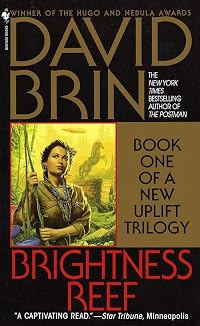
Strange visitors throw a planet of refugees into chaos in this science fiction adventure by the author of New York Times bestseller The Uplift War.Book One in the Uplift Storm Trilogy
Centuries ago, the Buyur race abandoned Jijo. Now off-limits to settlers, it’s warded by guardian machines who will protect the planet until the Institutes of the Five Galaxies declare Jijo ready—in another million years—for new civilization.
But mere laws and guardians can’t keep out the desperate. show more Clandestine bands of “sooners” have sneaked down to the lonely planet. Six intelligent races—all refugees—have bickered . . . then built a new society in the wilds of Jijo, hidden beneath forest canopies. Together they live in harmony—and in fear of the day their illegal colony will be discovered and judgment from the Five Galaxies will rain down upon them.
One day a strange starship finally does appear on Jijo. But its owners do not bring law or judgment. Only dire secrets. And they’ll do whatever it takes to keep them . . .
This ebook features a new introduction by the author.
Hugo Award Finalist
“A captivating read . . . Brightness Reef leaves you looking forward to more. It’s a worthy addition to what promises to be a great science fiction series.” —Star Tribune
“Brin is a skillful storyteller. . . . There is more than enough action to keep the book exciting, and like all good serials, the first volume ends with a bang.” —The Plain Dealer
“A universe that’s immensely appealing, leaving readers hungry for more of this exciting, epic adventure.” —Publishers Weekly
“Tremendously inventive, ambitious work.” —Kirkus Reviews
“A timely, science fictional contemplation of the refugee experience.”—Santa Fe Reporter
. show less
Tags
Recommendations





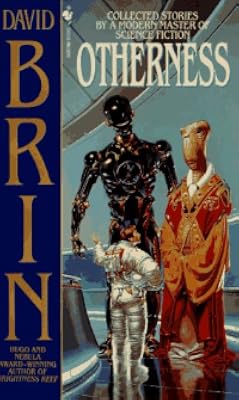
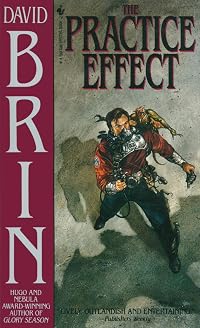

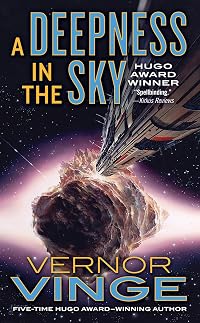
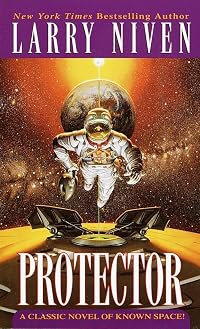



















Member Reviews
This happens to be one of those books that is both brilliant and lacking at the same time. I will explain myself.
The novel is actually quite as daunting and impressive as [b:Startide Rising|234501|Startide Rising (The Uplift Saga, #2)|David Brin|https://images.gr-assets.com/books/1476445711s/234501.jpg|251634] and [b:The Uplift War|234489|The Uplift War (The Uplift Saga, #3)|David Brin|https://images.gr-assets.com/books/1375272637s/234489.jpg|98235] in it's way, but it's mainly because Brin doesn't ever stint on world building. Ever. He goes all out and develops tons of alien races, tons of characters, and a great many implications for the amazingly complex alien culture among the 16 galaxies.
Truly, I have nothing bad to say at all show more about the quality and depth of its development. It's actually rather staggering. Brin never rests on his laurels. He finds new avenues to drill down into and I should say that there are VERY few authors who do it as deep or consistently as he does.
So what's lacking?
Well that's a very complex creature, too. My primary go-to complaint is in the basic story, but it isn't because it's too simple or too complex. Rather, it's because I was constantly wondering why I should care about some far distant fallow world where a bunch of alien refugees including humans had tossed all their technology into the drink in order to hopefully devolve genetically, culturally, and intellectually. Why would they do it? Because while they're political and cultural dissidents to the rest of the galactic society, they're also adherents to a weird quasi-religious tenant that is diametrically opposed to Uplift in general.
They want to return to innocence.
(Of course, not everyone believes. Humans are a bit more complex and have their own reasons to buck this trend with their books and their skepticism of the galactic culture that either doesn't want to be bothered to help the upstarts, but that's a sub-plot.)
I have no problem with the concept. In fact, if this was any other novel by any other author, I'd be touting it and the way it approaches the subject as honestly unique and fascinating. So what's my problem with it? I don't like book-burning. I'm in love with books. Of course, these guys take it all the way and sink their spaceships and all their tech, too, with a few human exceptions, but the core is the same.
What we've got is a novel about aliens and humans interacting in very complex ways with the ever-present fear that the galactics will find them and punish them and their entire RACE for the crimes of despoiling a fallow planet that should have remained fallow and untouched by anyone for several billion more years. That's a steep punishment for a broken law. Notice, too, that the galactic culture with its many, many, many species is an establishment that has been around for a very, very long time. Nothing stays around that long without being a very robust system. Mostly it relies on just out-waiting problems. :)
...Including dissidents who are thinking in terms of devolving themselves to pre-sentience. :)
Too bad that plan goes to seed. :)
So what's my problem? Too slow, maybe? My expectations wanted more resolution on a huge scale instead of what amounts to a tiny backwater and backward hamlet in the middle of nowhere?
Well that's my own damn problem, right? The novel is still a damn sight better than the majority of alien society novels out there by any yardstick. My problem is that I am judging it by his other brilliant Uplift novels instead of just focusing on what it does right. And it does a lot of things very right.
Of course, it's also book one of a trilogy that really needs to be read together if you want any sense of closure, too, so there's that. :)
And since I've read these before and I know that the end is practically a full 180 degrees from where we start now... I should have just kept faith from the start. :) So I will. I *was* of two minds about doing this re-read, but now that I've done this second read two decades after it was published, I'm now somewhat amazed and chastened that I should have worried. This is still a classic Brin.
I just needed to manage my expectations. :) show less
The novel is actually quite as daunting and impressive as [b:Startide Rising|234501|Startide Rising (The Uplift Saga, #2)|David Brin|https://images.gr-assets.com/books/1476445711s/234501.jpg|251634] and [b:The Uplift War|234489|The Uplift War (The Uplift Saga, #3)|David Brin|https://images.gr-assets.com/books/1375272637s/234489.jpg|98235] in it's way, but it's mainly because Brin doesn't ever stint on world building. Ever. He goes all out and develops tons of alien races, tons of characters, and a great many implications for the amazingly complex alien culture among the 16 galaxies.
Truly, I have nothing bad to say at all show more about the quality and depth of its development. It's actually rather staggering. Brin never rests on his laurels. He finds new avenues to drill down into and I should say that there are VERY few authors who do it as deep or consistently as he does.
So what's lacking?
Well that's a very complex creature, too. My primary go-to complaint is in the basic story, but it isn't because it's too simple or too complex. Rather, it's because I was constantly wondering why I should care about some far distant fallow world where a bunch of alien refugees including humans had tossed all their technology into the drink in order to hopefully devolve genetically, culturally, and intellectually. Why would they do it? Because while they're political and cultural dissidents to the rest of the galactic society, they're also adherents to a weird quasi-religious tenant that is diametrically opposed to Uplift in general.
They want to return to innocence.
(Of course, not everyone believes. Humans are a bit more complex and have their own reasons to buck this trend with their books and their skepticism of the galactic culture that either doesn't want to be bothered to help the upstarts, but that's a sub-plot.)
I have no problem with the concept. In fact, if this was any other novel by any other author, I'd be touting it and the way it approaches the subject as honestly unique and fascinating. So what's my problem with it? I don't like book-burning. I'm in love with books. Of course, these guys take it all the way and sink their spaceships and all their tech, too, with a few human exceptions, but the core is the same.
What we've got is a novel about aliens and humans interacting in very complex ways with the ever-present fear that the galactics will find them and punish them and their entire RACE for the crimes of despoiling a fallow planet that should have remained fallow and untouched by anyone for several billion more years. That's a steep punishment for a broken law. Notice, too, that the galactic culture with its many, many, many species is an establishment that has been around for a very, very long time. Nothing stays around that long without being a very robust system. Mostly it relies on just out-waiting problems. :)
...Including dissidents who are thinking in terms of devolving themselves to pre-sentience. :)
Too bad that plan goes to seed. :)
So what's my problem? Too slow, maybe? My expectations wanted more resolution on a huge scale instead of what amounts to a tiny backwater and backward hamlet in the middle of nowhere?
Well that's my own damn problem, right? The novel is still a damn sight better than the majority of alien society novels out there by any yardstick. My problem is that I am judging it by his other brilliant Uplift novels instead of just focusing on what it does right. And it does a lot of things very right.
Of course, it's also book one of a trilogy that really needs to be read together if you want any sense of closure, too, so there's that. :)
And since I've read these before and I know that the end is practically a full 180 degrees from where we start now... I should have just kept faith from the start. :) So I will. I *was* of two minds about doing this re-read, but now that I've done this second read two decades after it was published, I'm now somewhat amazed and chastened that I should have worried. This is still a classic Brin.
I just needed to manage my expectations. :) show less
This review covers all three books in the 2nd Uplift Trilogy, (Brightness Reef, Infinity's Shore, and Heaven's Reach).
At the end of the day, this rather long story, (nearly 2,000 pages over three volumes), is a good book that leaves some big openings for more adventures in the Uplift Universe. With that said, I really enjoyed the first three Uplift books, (Sundiver, Startide Rising, The Uplift War), more than I did this second trilogy. I think that is due to the stand-alone nature of the initial three volumes. I liked that each of those books told a relatively complete story that was set against a larger backdrop that stayed mostly in the background. Further, this fourth installment, (again, I'm talking about three books here), could show more have stood some editing. There is quite a bit of repetition of information - and not all of that can be attributed to getting the reader up to speed with what happened in the preceding volume. Rather, it sometimes felt as though Brin had lost some threads and was reminding himself, (and the reader), of where things stood. At times, he was (validly) revisiting a situation from the perspective of a different character - but often it felt like redundant info-dumping. Yes, we know most of the Galactics are against the upstart human 'wolflings' and their client species, the neo-chimps and neo-dolphins - please stop hitting us with that particular truncheon!
On to the good things: The overall story is really pretty great. As an unabashed and unapologetic Space Opera tale, this 2nd Uplift Trilogy does not disappoint. Throughout these Uplift books, Brin has taken a 'kitchen-sink' approach to the science, (he even says so in the afterword). He throws one big idea on top of another on top of third and a fourth. And then keeps doing it! His position as consultant for NASA is showing here in a big way - and that's a good thing because the ideas are grand and he does a good job of laying it out for us lay-people. Among all that science and big ideas, there are also a wide variety of characters to track - and there is a fair amount of head-hopping as a result - but Brin is a talented enough writer that he pulls off that aspect quite well. Helping to ease the transitions, most perspective shifts happen at logical chapter breaks. Now, with such a large cast of players, some are bound to be more interesting than others and a handful of characters do seemingly get short shrift - but I can see where Brin might re-visit some of them in order to explore their stories in greater depth. There are also other characters from the first three books that don't show up here at all, (most notably the ones left behind on Kithrup at the end of Startide Rising - which was, for me, the standout book of the entire Uplift series). I hope Brin's future plans include coming back to tie up some of those loose ends.
Having finally finished this trilogy, I feel like I have completed a marathon. Not that I've ever run a real marathon! LOL! Still, with the unrelenting onslaught of difficulties that every character seemed to be going through, always battling uphill against incredible odds. Facing implacable enemies. Managing one hair-breadth escape after another... it's nice to call this one done - at least for now.
Next up, I might have to try a nice post-apocalyptic story - just to lighten the mood! ;) show less
At the end of the day, this rather long story, (nearly 2,000 pages over three volumes), is a good book that leaves some big openings for more adventures in the Uplift Universe. With that said, I really enjoyed the first three Uplift books, (Sundiver, Startide Rising, The Uplift War), more than I did this second trilogy. I think that is due to the stand-alone nature of the initial three volumes. I liked that each of those books told a relatively complete story that was set against a larger backdrop that stayed mostly in the background. Further, this fourth installment, (again, I'm talking about three books here), could show more have stood some editing. There is quite a bit of repetition of information - and not all of that can be attributed to getting the reader up to speed with what happened in the preceding volume. Rather, it sometimes felt as though Brin had lost some threads and was reminding himself, (and the reader), of where things stood. At times, he was (validly) revisiting a situation from the perspective of a different character - but often it felt like redundant info-dumping. Yes, we know most of the Galactics are against the upstart human 'wolflings' and their client species, the neo-chimps and neo-dolphins - please stop hitting us with that particular truncheon!
On to the good things: The overall story is really pretty great. As an unabashed and unapologetic Space Opera tale, this 2nd Uplift Trilogy does not disappoint. Throughout these Uplift books, Brin has taken a 'kitchen-sink' approach to the science, (he even says so in the afterword). He throws one big idea on top of another on top of third and a fourth. And then keeps doing it! His position as consultant for NASA is showing here in a big way - and that's a good thing because the ideas are grand and he does a good job of laying it out for us lay-people. Among all that science and big ideas, there are also a wide variety of characters to track - and there is a fair amount of head-hopping as a result - but Brin is a talented enough writer that he pulls off that aspect quite well. Helping to ease the transitions, most perspective shifts happen at logical chapter breaks. Now, with such a large cast of players, some are bound to be more interesting than others and a handful of characters do seemingly get short shrift - but I can see where Brin might re-visit some of them in order to explore their stories in greater depth. There are also other characters from the first three books that don't show up here at all, (most notably the ones left behind on Kithrup at the end of Startide Rising - which was, for me, the standout book of the entire Uplift series). I hope Brin's future plans include coming back to tie up some of those loose ends.
Having finally finished this trilogy, I feel like I have completed a marathon. Not that I've ever run a real marathon! LOL! Still, with the unrelenting onslaught of difficulties that every character seemed to be going through, always battling uphill against incredible odds. Facing implacable enemies. Managing one hair-breadth escape after another... it's nice to call this one done - at least for now.
Next up, I might have to try a nice post-apocalyptic story - just to lighten the mood! ;) show less
I admit I had some difficulty getting into this. I was fascinated by the characters and the world, but that's not quite the same thing as being engaged and understanding it all. Despite this being the first book in a new Uplift series--and perhaps my problem is that I hadn't read Brin's earlier Uplift books, though I'd been told I could enter into this one instead--it really felt like I was entering into the middle of a series. The learning curve was a big one, and although I could get wrapped up in scenes and characters' stories easily enough, the larger picture was never easy to grasp. And, truth be told, I'm sure I missed quite a bit. I'd like to say that I'll go and read the earlier Uplift books and then re-read this one, but that's show more a big ask for a 700 page book which left me wishing that there'd been a bit more clarity and story included, vs. all of the incredible world-building (because world-building and character-building alone don't make books).
I am going to try to move into the next book in the series at some point, though I need a break before then. I'd recommend readers not enter into the Uplift universe through this book, though--I was told I could, but I suspect that wasn't an ideal choice. show less
I am going to try to move into the next book in the series at some point, though I need a break before then. I'd recommend readers not enter into the Uplift universe through this book, though--I was told I could, but I suspect that wasn't an ideal choice. show less
Brightness Reef is the fourth entry in Brin's Uplift series, but it is quite a departure from the other books in the series. Instead of being about humanity's integration into the wider (and far more advanced) galactic civilization, this is about life on a backwater planet where galactic politics is only a distant memory. A number of races, including humans, have made a tenuous peace on this planet, and humans even seem to have a bit of technological superiority. The main action occurs as foreign humans with possibly-nefarious plans (and much better technology) land and upset the peace. While this wildly-different setting does take some getting used to (especially as parts of the story are told by aliens), the story itself is show more interesting, though not nearly as compelling as in his previous works. My main complaint is that practically none of the major plot points is resolved by the end of the book, including how this story fits in with the larger galactic picture (and there are plenty of hints that it does). The story ends very suddenly, and with a bit of a cliffhanger. I suspect things will make a lot more sense after the next book, but I do wish that some things got wrapped up here. show less
This book takes place on an abandoned world intended to be natural and develop its own races, who would hopefully be available for uplift. A small population of each of six races, in turn, have landed small colonies on the world. Their intent is to devolve and be re-uplifted, and hopefully to avoid attention and possible punishment from the stellar community. Humans are one of the six.
These races have ancient antipathy for each other. And each brings unique skills and histories. They have overcome their differences, and their are pieces of culture of each that has worked its way into the others, yet they do maintain separate communities.
The story revolves around the arrival of a spaceship or renegade humans. Their intent is unknown, show more and seems sinister. They aren't an official envoy, so they shouldn't be here, either.
This story shows us a different side of each of the races, including the humans. It maintains its suspense on the invaders, and latent tension among the six races.
Unfortunately, this book mostly sets up the series and doesn't resolve much of anything. The story is interesting, and a must read if you're interested in the Uplift series. show less
These races have ancient antipathy for each other. And each brings unique skills and histories. They have overcome their differences, and their are pieces of culture of each that has worked its way into the others, yet they do maintain separate communities.
The story revolves around the arrival of a spaceship or renegade humans. Their intent is unknown, show more and seems sinister. They aren't an official envoy, so they shouldn't be here, either.
This story shows us a different side of each of the races, including the humans. It maintains its suspense on the invaders, and latent tension among the six races.
Unfortunately, this book mostly sets up the series and doesn't resolve much of anything. The story is interesting, and a must read if you're interested in the Uplift series. show less
The first of Brin's second Uplift trilogy has a slow start, but the complex array of characters do become quite gripping and the five or so parallel plot lines are handled well.
Set on Jijo, a reserved fallow planet, humans and other sapient species have established an understanding until a spaceship lands on the planet.
Set on Jijo, a reserved fallow planet, humans and other sapient species have established an understanding until a spaceship lands on the planet.
A confusing mess, but despite this Brin takes us into new worlds and acquaints us with all sorts of new species and so it slips into a 3-star.
Members
- Recently Added By
Lists

Best Books With Aliens
67 works; 10 members

Books Read in 2015
3,299 works; 126 members
Talk Discussions
Past Discussions
Science Fiction: Post-industrial, forest planet, retainment dam? in Name that Book (June 2009)
Author Information

153+ Works 40,380 Members
David Brin is a scientist, writer, and public speaker. He was born in Pasadena, California, on October 9, 1950. Brin attended the California Institute of Technology (Caltech) and later earned a doctorate at the University of California. He accepted a position as an engineer at Hughes Aircraft Company. Brin is a former fellow at the California show more Space Institute and serves on several government and nongovernment advisory committees dealing with issues involved with technological growth. Brin has lectured all over the world on such topics as space flight, ecology, and the search for extraterrestrial life. Brin deals with global warming, the destruction of the ozone layer, and pollution of Earth. His 1987 novel, The Uplift War, received the Hugo Award and the Locus Award. His novels have been translated into 20 languages. (Bowker Author Biography) show less

David Brin is a LibraryThing Author, an author who lists their personal library on LibraryThing.
Some Editions
Awards and Honors
Awards
Series


Belongs to Publisher Series
Work Relationships
Is contained in
Common Knowledge
- Canonical title
- Brightness Reef
- Original publication date
- 1995-09
- Dedication
- to Herbert H. Brin
Poet, journalist, and lifelong champion of justice - First words
- I must ask your permission. You, my rings, my diverse selves.
- Last words
- (Click to show. Warning: May contain spoilers.)My . . . name . . . is . . . Emerson.
- Original language
- English
- Disambiguation notice
- This was published as two books in Germany as Sternenriff and Fremder der fünf Galaxien.
This was published as two books in France as Rédemption - Le Monde de l'exil and Rédemption - Le Monde de l'oubli.
D... (show all)o not combine the German or French works with the English.
Classifications
Statistics
- Members
- 2,699
- Popularity
- 6,847
- Reviews
- 23
- Rating
- (3.72)
- Languages
- 6 — Czech, Dutch, English, Italian, Polish, Spanish
- Media
- Paper, Audiobook, Ebook
- ISBNs
- 22
- ASINs
- 14