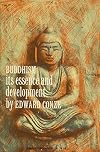
Buddhism: Its Essence and Development
by Edward Conze
On This Page
Description
This curated collection of primary texts and secondary scholarship offers an engaging and comprehensive view of Buddhism and its founder. The Wisdom of Buddha: Drawn from the sacred books of Buddhism, this collection reveals the core insights and beliefs of the world's fourth-largest religion. It covers the birth and death of the Buddha, as well as the major tenets of Buddhism, including karma and the middle doctrine. Hinduism and Buddhism: A highly original discussion of the origins and show more tenets of the great Eastern religions by a Sri Lankan theorist who introduced ancient Indian art to the West. Buddhist Texts Through the Ages: A comprehensive collection of Buddhist texts and scriptures translated from the original Pali, Sanskrit, Chinese, Tibetan, and Japanese. This edition also includes a glossary of English and foreign terms. show lessTags
Recommendations
























Member Reviews
Review From LibraryThing:
This book is a concise description of the historical development of Buddhism. The key word "essence" is correct. Dr Conze distills much into this swift, readable account. The form of American Buddhism I study is completely stripped of all supernatural trappings. It is essentially mind training, and as such has much in common with classical Stoic philosophy. Yet I have often wondered what happened to all the gods and hells of ancient Buddhism. Well, here they are. I highly recommend this as an adjunct to popular books on Buddhist practice by, say, Pema Chödrön or Thich Nhat Hanh. Little is known about very early Buddhism because, though it flourished on the Gangetic Plain, there was a reluctance to commit the show more dharma to writing. This, astonishingly to the 21st century reader, because it was believed that writing would diminish the memory skills of the monks, who, would just rely on writings as opposed to engaging in a more lively practice of Buddhism. The Pali texts were not created until about 400 years after the death of Buddha. Particularly interesting is the story of what is known about the split of Buddhism into the separate camps of the Hinayana and Mahayana. . . . And of the Mahayana how and why it was necessary to create a god-filled realm for those who could only approach the religion on the basis of faith as opposed to wisdom. Conze discusses the usefulness of mythos and how it was possible for the Mahayana to use this device for purposes of ensuring the salvation of those unable to pursue the more rigorous discipline of the monks. Thus the faith approach to nirvana and the wisdom approach, both of which bring the adherent the same ultimate enlightenment. Tantra is also explained. This was the most difficult section for me, perhaps because it seems in such opposition to the Buddhism that has been so helpful to me. Highly recommended. show less
This book is a concise description of the historical development of Buddhism. The key word "essence" is correct. Dr Conze distills much into this swift, readable account. The form of American Buddhism I study is completely stripped of all supernatural trappings. It is essentially mind training, and as such has much in common with classical Stoic philosophy. Yet I have often wondered what happened to all the gods and hells of ancient Buddhism. Well, here they are. I highly recommend this as an adjunct to popular books on Buddhist practice by, say, Pema Chödrön or Thich Nhat Hanh. Little is known about very early Buddhism because, though it flourished on the Gangetic Plain, there was a reluctance to commit the show more dharma to writing. This, astonishingly to the 21st century reader, because it was believed that writing would diminish the memory skills of the monks, who, would just rely on writings as opposed to engaging in a more lively practice of Buddhism. The Pali texts were not created until about 400 years after the death of Buddha. Particularly interesting is the story of what is known about the split of Buddhism into the separate camps of the Hinayana and Mahayana. . . . And of the Mahayana how and why it was necessary to create a god-filled realm for those who could only approach the religion on the basis of faith as opposed to wisdom. Conze discusses the usefulness of mythos and how it was possible for the Mahayana to use this device for purposes of ensuring the salvation of those unable to pursue the more rigorous discipline of the monks. Thus the faith approach to nirvana and the wisdom approach, both of which bring the adherent the same ultimate enlightenment. Tantra is also explained. This was the most difficult section for me, perhaps because it seems in such opposition to the Buddhism that has been so helpful to me. Highly recommended. show less
This book is a concise description of the historical development of Buddhism. The key word "essence" is correct. Dr Conze distills much into this swift, readable account. The form of American Buddhism I study is completely stripped of all supernatural trappings. It is essentially mind training, and as such has much in common with classical Stoic philosophy. Yet I have often wondered what happened to all the gods and hells of ancient Buddhism. Well, here they are. I highly recommend this as an adjunct to popular books on Buddhist practice by, say, Pema Chödrön or Thich Nhat Hanh. Little is known about very early Buddhism because, though it flourished on the Gangetic Plain, there was a reluctance to commit the dharma to writing. This, show more astonishingly to the 21st century reader, because it was believed that writing would diminish the memory skills of the monks, who, would just rely on writings as opposed to engaging in a more lively practice of Buddhism. The Pali texts were not created until about 400 years after the death of Buddha. Particularly interesting is the story of what is known about the split of Buddhism into the separate camps of the Hinayana and Mahayana. . . . And of the Mahayana how and why it was necessary to create a god-filled realm for those who could only approach the religion on the basis of faith as opposed to wisdom. Conze discusses the usefulness of mythos and how it was possible for the Mahayana to use this device for purposes of ensuring the salvation of those unable to pursue the more rigorous discipline of the monks. Thus the faith approach to nirvana and the wisdom approach, both of which bring the adherent the same ultimate enlightenment. Tantra is also explained. This was the most difficult section for me, perhaps because it seems in such opposition to the Buddhism that has been so helpful to me. Highly recommended. show less
CONTENTS:
Introduction: The historical context and epochs of Buddhist history
The first five hundred years: 500-0 BCE
.The peculiarities of the first period
.The monastic discipline
.The basic doctrines
.The sects and their disputes
.The laity
.Expansion
The second period: 0-500
.The mahayana in India
.Hinayana developments in India
.Nepal and Kashmir
.Ceylon
.Expansion into greater Asia
.Central Asia
.China
The third period: 500-1000
.India
.Nepal and Kashmir
.Ceylon
.Central Asia
.South-east Asia
.China and Korea
.Japan
.Tibet
The last one thousand years: 1000-1978
.India: the collapse and its causes
.Nepal and Kashmir
.Ceylon
.South-east Asia
.China and Korea
.Japan
.Tibet
.Mongolia
.The present situation
Introduction: The historical context and epochs of Buddhist history
The first five hundred years: 500-0 BCE
.The peculiarities of the first period
.The monastic discipline
.The basic doctrines
.The sects and their disputes
.The laity
.Expansion
The second period: 0-500
.The mahayana in India
.Hinayana developments in India
.Nepal and Kashmir
.Ceylon
.Expansion into greater Asia
.Central Asia
.China
The third period: 500-1000
.India
.Nepal and Kashmir
.Ceylon
.Central Asia
.South-east Asia
.China and Korea
.Japan
.Tibet
The last one thousand years: 1000-1978
.India: the collapse and its causes
.Nepal and Kashmir
.Ceylon
.South-east Asia
.China and Korea
.Japan
.Tibet
.Mongolia
.The present situation
Chapter topics include Common Ground; Monastic Buddhism; Popular Buddhism; the Old Wisdom School; the Mahayana and the New Wisdom School; Buddhism of Faith and Devotion; the Yogacarins; the Tantra, or Magical Buddhism; and Non-Indian Developments.
OPĆI BUDIZAM
Introduction aux doctrines et à l'histoire du bouddhisme passant toutes les écoles en revue. Bon ouvrage d'érudition
Feb 19, 2016 (Edited)French
> Bareau André. E. Conze. Le bouddhisme dans son essence et son développement.
In: Revue de l'histoire des religions, tome 183, n°1, 1973. pp. 88-89. … ; (en ligne),
URL : https://www.persee.fr/doc/rhr_0035-1423_1973_num_183_1_9959
> Nguyen Van Phong. Conze (Edward). — Le Bouddhisme dans son essence et son développement.
In: Archives de sociologie des religions, n°33, 1972. p. 227. … ; (en ligne),
URL : https://www.persee.fr/doc/assr_0003-9659_1972_num_33_1_1886_t1_0227_0000_3
In: Revue de l'histoire des religions, tome 183, n°1, 1973. pp. 88-89. … ; (en ligne),
URL : https://www.persee.fr/doc/rhr_0035-1423_1973_num_183_1_9959
> Nguyen Van Phong. Conze (Edward). — Le Bouddhisme dans son essence et son développement.
In: Archives de sociologie des religions, n°33, 1972. p. 227. … ; (en ligne),
URL : https://www.persee.fr/doc/assr_0003-9659_1972_num_33_1_1886_t1_0227_0000_3
Sep 14, 2019 (Edited)French
Members
- Recently Added By
Author Information

57+ Works 2,971 Members
Some Editions
Series
Belongs to Publisher Series
Common Knowledge
- Original title
- Buddhism, its essence and development. - Oxford : Cassirer
- Original publication date
- 1951
Classifications
Statistics
- Members
- 424
- Popularity
- 73,000
- Reviews
- 7
- Rating
- (3.04)
- Languages
- 7 — Dutch, English, French, German, Italian, Japanese, Spanish
- Media
- Paper, Ebook
- ISBNs
- 26
- UPCs
- 1
- ASINs
- 13