
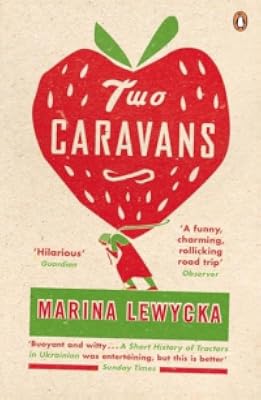
Two Caravans
by Marina Lewycka
On This Page
Description
In a Kent field and around their caravans a group of strawberry pickers celebrates a birthday. But what lies behing the buy-one-get-one-free offers at the supermarket and who picks the strawberries? The Ukrainians, the Poles, the Chinese, and although he can't pick strawberries, there's also the dog.Tags
Recommendations











Member Recommendations

Member Reviews
It is obvious that Lewycka decided to experiment with shifting formats, producing a unique blending of first and third person narration, including epistolary (Emmanuel’s narration takes the form of letters written to his sister) and the all caps grammar-deficient monologues of a stray dog. Part romance, part adventure, part social commentary, Lewycka attempts to tackle a number of serious social issues – illegal immigration, worker exploitation, environmental activism, factory farming, – from an almost tragicomic perspective. The migrant workers dreams of “freedom” and the ability to earn good money is quickly shown to be a thinly veiled illusion, which would have made for completely depressing reading except for the naïve show more innocence of some of the characters, with a focus on humour first, social commentary second.
Overall, as much as I enjoyed the growing romance between Irina and Andriy and the use of fractured English and the language barrier to produce comic moments, the manner in which Irina continues to encounter the sleazy Eastern European gangster/exploiter Vulk (in the most unlikely of places) is fanciful in the extreme. That and the fact that some of the story just comes across as rather ‘odd’. An okay read but IMO, not as good as Lewycka’s debut novel, A Short History of Tractors in Ukranian. show less
Overall, as much as I enjoyed the growing romance between Irina and Andriy and the use of fractured English and the language barrier to produce comic moments, the manner in which Irina continues to encounter the sleazy Eastern European gangster/exploiter Vulk (in the most unlikely of places) is fanciful in the extreme. That and the fact that some of the story just comes across as rather ‘odd’. An okay read but IMO, not as good as Lewycka’s debut novel, A Short History of Tractors in Ukranian. show less
Strawberry Fields, published as Two Caravans in the UK, is the rollicking, bawdy, heart-touching, and socially charged story of a group of migrant workers who meet while picking strawberries on an English farm. Chance has thrown them together in very tight quarters, and when Irina, an innocent nineteen-year-old Ukrainian girl, arrives with her sponsoring agent, a hulking “person of minimum culture”, the delicate balance existing among them is broken. With a cast of characters based loosely on those in Canterbury Tales, the story follows the travails of Irina and fellow immigrant Andriy as they try to navigate the undercurrents of illegal immigrant life.
Marina Lewycka is a quirky writer, and I can see how she may not appeal to show more everyone. I, however, laughed heartily at A Short History of Tractors in Ukraine and looked forward to reading this, her second novel. Although as humorous and unconventional as ever, Lewycka shows a darker side as she probes how agents bring illegal immigrants into a country, often confiscating their passports upon arrival, and how the bright dreams of the immigrants are dashed when reality falls far short of the easy money and social advancement they are promised. In addition, she takes a detour through a chicken processing plant guaranteed to make you think twice the next time you buy a plump breast. Nominated for the Orwell Prize, Strawberry Fields blends a fun story with social commentary and a look at the stereotypes we all have about one another.
Recommended for those looking for something a little different. show less
Marina Lewycka is a quirky writer, and I can see how she may not appeal to show more everyone. I, however, laughed heartily at A Short History of Tractors in Ukraine and looked forward to reading this, her second novel. Although as humorous and unconventional as ever, Lewycka shows a darker side as she probes how agents bring illegal immigrants into a country, often confiscating their passports upon arrival, and how the bright dreams of the immigrants are dashed when reality falls far short of the easy money and social advancement they are promised. In addition, she takes a detour through a chicken processing plant guaranteed to make you think twice the next time you buy a plump breast. Nominated for the Orwell Prize, Strawberry Fields blends a fun story with social commentary and a look at the stereotypes we all have about one another.
Recommended for those looking for something a little different. show less
This was not the book I was expecting. After reading a couple of quite heavy books, I picked this up as a light read, expecting something humorous and distracting like History of Tractors. Instead, I had my vegetarianism confirmed, my socialism confirmed and my knowledge of the lives of migrant workers expanded considerably. There is humour in the book, but there is more that saddened and angered me as I read about the trafficking of people desperate for a better life, and the processes involved in battery farming and food processing. It didn't quite leave me in despair for humanity, but it did leave me thinking that, as a species, we need help.
The balance between joy and sadness is found within this book, as is the balance between hope and lack of much to look forward to. Within these pages a story is told of those who leave their home lives and travel to another country with nothing but their dreams, only to have those dreams caught in a net that is the captivity of being a field worker. Trapped in a system of owing the people they work for, these characters find a way beyond their bondage in a somewhat unusual way, and their adventures into their various forms of freedom are quite interesting to experience. The reader's heart travels along with the characters on their various journeys, lifting up as hope comes to them and sinking down when realization hits that yet again show more things haven't been as they seemed.
I took a moment to adjust to the various perspectives within the book, as some characters stories are told in first person while some are told in third, but the adjustment didn't take long and the way that technique was used actually adds to the book in an impressive way. Reading Strawberry Fields made me glad I that mostly I choose vegetable over meat, as the section with the chicken processing plant was a point where I almost had to put the book down and walk away. I feel as if I honestly struggled along with the characters by pushing through that section and continuing on to the end of the story, reaching a depth of experience that I don't often get when reading a work of fiction. If you are a tenderhearted person picking up this book, be ready to go through some hardships, but know that this read is very much worth it. show less
I took a moment to adjust to the various perspectives within the book, as some characters stories are told in first person while some are told in third, but the adjustment didn't take long and the way that technique was used actually adds to the book in an impressive way. Reading Strawberry Fields made me glad I that mostly I choose vegetable over meat, as the section with the chicken processing plant was a point where I almost had to put the book down and walk away. I feel as if I honestly struggled along with the characters by pushing through that section and continuing on to the end of the story, reaching a depth of experience that I don't often get when reading a work of fiction. If you are a tenderhearted person picking up this book, be ready to go through some hardships, but know that this read is very much worth it. show less
Ultimamente leggo libri bellissimi quanto tristi: questo in particolare mi ha colpito molto per la leggerezza e allo stesso tempo la profondità con cui tratta un tema difficile come quello dello sfruttamento dei lavoratori stagionali.
Irina arriva in Inghilterra dall'Ucraina, dopo un viaggio infinito in pullman: il suo sogno è quello di migliorare il suo inglese scolastico e di conoscere dal vero il Paese che ha imparato ad amare sui libri. Finisce a raccogliere fragole presso un fattore viscido e sfruttatore, insieme ad altri sventurati come lei: conoscono poco la lingua e per niente i propri diritti, finendo per essere imbrogliati da chi ne sa più di loro. Ci sono Yola, la capogruppo, Marta, sua nipote, due cinesine note come Numero show more Uno e Numero Due, Tomasz dai piedi puzzoni, Vitalij l'opportunista, Emmanuel l'ingenuo, Andreij il figlio di un minatore. Ognuno è arrivato in cerca di fortuna e di un domani migliore.
In seguito a un incidente, il gruppo si ritrova in una fuga rocambolesca per l'Inghilterra, su una scassata Land Rover cui è attaccata un'altrettanto scassata roulotte: tra un lavoro e l'altro, sempre più sfruttati e mal pagati, cercando di schivare le proposte poco pulite dei cosiddetti "agenti di collocamento", scoprono ognuno la propria strada, certamente diversa da quanto avevano sperato.
Romanzo letto con trepidazione e paura di una tragedia imminente, a suo modo ha un lieto fine con lacrimoni obbligatori.
Il mio personaggio preferito è Cane, che parla tutto in maiuscolo senza punteggiatura, innocente, simpatico e sveglio più degli uomini.
"IO CANE IO FELICE IO CORRO FACCIO PIPÌ FIUTO HO I MIEI PADRONI FANNO PIPÌ NEL BOSCO (...)ANNUSO NIENTE ODORI DI CANI LASCIO IL MIO ODORE DI CANE IO CORRO IO FACCIO PIPÌ IO CANE IO CANE FELICE" show less
Irina arriva in Inghilterra dall'Ucraina, dopo un viaggio infinito in pullman: il suo sogno è quello di migliorare il suo inglese scolastico e di conoscere dal vero il Paese che ha imparato ad amare sui libri. Finisce a raccogliere fragole presso un fattore viscido e sfruttatore, insieme ad altri sventurati come lei: conoscono poco la lingua e per niente i propri diritti, finendo per essere imbrogliati da chi ne sa più di loro. Ci sono Yola, la capogruppo, Marta, sua nipote, due cinesine note come Numero show more Uno e Numero Due, Tomasz dai piedi puzzoni, Vitalij l'opportunista, Emmanuel l'ingenuo, Andreij il figlio di un minatore. Ognuno è arrivato in cerca di fortuna e di un domani migliore.
In seguito a un incidente, il gruppo si ritrova in una fuga rocambolesca per l'Inghilterra, su una scassata Land Rover cui è attaccata un'altrettanto scassata roulotte: tra un lavoro e l'altro, sempre più sfruttati e mal pagati, cercando di schivare le proposte poco pulite dei cosiddetti "agenti di collocamento", scoprono ognuno la propria strada, certamente diversa da quanto avevano sperato.
Romanzo letto con trepidazione e paura di una tragedia imminente, a suo modo ha un lieto fine con lacrimoni obbligatori.
Il mio personaggio preferito è Cane, che parla tutto in maiuscolo senza punteggiatura, innocente, simpatico e sveglio più degli uomini.
"IO CANE IO FELICE IO CORRO FACCIO PIPÌ FIUTO HO I MIEI PADRONI FANNO PIPÌ NEL BOSCO (...)ANNUSO NIENTE ODORI DI CANI LASCIO IL MIO ODORE DI CANE IO CORRO IO FACCIO PIPÌ IO CANE IO CANE FELICE" show less
What an unconventional book this was – told mainly in the third person but with two characters (one of them a dog) afforded a first-person narrative, all of this spliced in with the rest of the text, so the POV was constantly switching around. Also the way most of the characters were jettisoned along the way like contestants in a TV talent show, until just the two finalists remained. I didn’t think I was going to get on with it at first – so many characters, so many nationalities, and a sequence of events I struggled to follow. Then it all fell into place and by the end I loved it. I was finding excuses to read it when I really should have been doing something else, and when I finished it, there was that feeling of profound regret show more when you have to say goodbye to a story you have really got lost in.
It’s a story that forces the reader to confront the way immigrant workers are treated in modern Britain, a story that will contribute a few more vegetarians to the planet (I suspect) and an opportunity to make a brief re-acquaintance with the ageing Mr Mayevskyj (him of the Short History of Tractors). Characters’ voices are clear throughout, and humour is furthered by their struggles with English (I felt a bit guilty laughing at these given that I don’t speak a word of Ukrainian, Polish, Russian, Chinese.......though the balance was later redressed with the character Rock and his Yorkshire accent). And if the final section with its overtones of romance was a bit like a Ukrainian Nescafe advert, it has to be said that it was a really very impressive Nescafe advert. show less
It’s a story that forces the reader to confront the way immigrant workers are treated in modern Britain, a story that will contribute a few more vegetarians to the planet (I suspect) and an opportunity to make a brief re-acquaintance with the ageing Mr Mayevskyj (him of the Short History of Tractors). Characters’ voices are clear throughout, and humour is furthered by their struggles with English (I felt a bit guilty laughing at these given that I don’t speak a word of Ukrainian, Polish, Russian, Chinese.......though the balance was later redressed with the character Rock and his Yorkshire accent). And if the final section with its overtones of romance was a bit like a Ukrainian Nescafe advert, it has to be said that it was a really very impressive Nescafe advert. show less
When I started reading this book, I thought "Oh no, not another sad tale of exploited immigrant workers" - but I soon found out I was completely wrong. It is a tale of exploited immigrant workers, of course, and sad at times, but hilarious at others, one moment deeply moving, the next slapstick comedy, with examples of the horrors man can inflict on man (and woman!), and of the wonders of friendship and solidarity too. And Lewycka makes this improbable combination work.
I liked A History of Tractors in Oekranian, but I love this book. It might be a bit simpler in its painting of human relationships, but it sparkles with imagination, and the messages it carries stay complex, it never becomes simplistic.
I liked A History of Tractors in Oekranian, but I love this book. It might be a bit simpler in its painting of human relationships, but it sparkles with imagination, and the messages it carries stay complex, it never becomes simplistic.
Members
- Recently Added By
Lists

Llibres que he llegit el 2022
32 works; 1 member

Books Read in 2020
4,379 works; 124 members

Put a Bird On It
75 works; 12 members

living room bookshelf
150 works; 1 member
Talk Discussions
Past Discussions
Strawberry Fields, Marina Lewycka in World Reading Circle (August 2013)
Author Information

Awards and Honors
Series
Belongs to Publisher Series
dtv premium (24621)
Common Knowledge
- Original title
- Two Caravans
- Alternate titles
- Strawberry Fields
- Original publication date
- 2007
- People/Characters
- Yola; Irina Blazkho; Marta; Vulk; Andriy; Emanuel (show all 9); Tomasz; Vitaly; DOG
- Important places
- Dover, Kent, England, UK; Sheffield, South Yorkshire, England, UK; Kyiv, Ukraine; Donetsk, Ukraine
- Epigraph
- But that I praye to al this compaignye,
If that I speke after my fantasye,
As taketh not agrief of that I seye;
For myn entente is nat but for to pleye.
--Geoffrey Chaucer, Prologue to the Wife of Bath's Tale, The... (show all) Canterbury Tales - Dedication
- To the Morecambe Bay cockle-pickers
- First words
- There is a field--a broad south-sloping field siting astride a long hill that curves away into a secret leafy valley.
- Quotations
- Friendship like this is a gift from God.
It is the privilege of young people to fall in love with the wrong person... - Last words
- (Click to show. Warning: May contain spoilers.)And I pray fervedly [sic] that before long the opiate will fall from his heart and he too will become aquatinted [sic] with Love.
- Original language*
- Englisch
*Some information comes from Common Knowledge in other languages. Click "Edit" for more information.
Classifications
Statistics
- Members
- 1,475
- Popularity
- 15,758
- Reviews
- 64
- Rating
- (3.48)
- Languages
- 13 — Catalan, Dutch, English, Finnish, French, German, Hungarian, Italian, Norwegian (Bokmål), Serbian, Spanish, Swedish, Ukrainian
- Media
- Paper, Audiobook, Ebook
- ISBNs
- 51
- ASINs
- 16