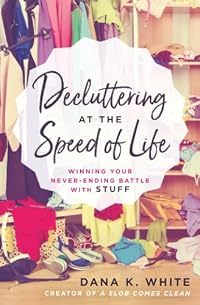
Decluttering at the Speed of Life: Winning Your Never-Ending Battle with Stuff
by Dana K. White
On This Page
Description
You don't have to live overwhelmed by stuff-you can get rid of clutter for good!While the world seems to be in love with the idea of tiny houses and minimalism, real women with real families who are constantly growing and changing simply can't purge it all and start from nothing. Yet a home with too much stuff is a home that is difficult to maintain, so where do we begin? Add in paralyzing emotional attachments and constant life challenges, and it can feel almost impossible to make real show more decluttering progress.In Decluttering at the Speed of Life, decluttering expert and author Dana White identifies the mind-sets and emotional challenges that make it difficult to declutter. Then, in her signature humorous approach, she provides workable solutions to break through these struggles and get clutter out-for good!But more than simply offering strategies, Dana dives deep into how to implement them, no matter the reader's clutter level or emotional resistance to decluttering. She helps identify procrasticlutter-the stuff that will get done eventually so it doesn't seem urgent-as well as how to make progress when there's no time to declutter.Sections of the book includeWhy You Need This Book (You Know Why)Your Unique HomeDecluttering in the Midst of Real LifeChange Your Mind, Change Your HomeBreaking Through Your Decluttering DelusionsWorking It Out Room by RoomHelping Others DeclutterReal Life Goes On (and On)As long as we're living and breathing, new clutter will appear. The good news is that decluttering can get easier, become more natural, and require significantly fewer hours, less emotional bandwidth, and little to no sweat to keep going. show lessTags
Recommendations








Member Reviews
I enjoy reading about other people’s methods with decluttering and organizing. It was really hard taking the emotion of out cleaning out my mother’s house after her passing, but it was necessary or I would have added more clutter to my house.
The book gave me the motivation to tackle my canned goods cabinet, get rid of itchy clothing, shoes that hurt, and to invest in space saving items for my drawers and closets so I can easily see what may be unnecessary to keep.
One thing mentioned in the book that I’ve learned through my frustration is that you cannot force your spouse to feel the same way about clutter and organization as you do.
The book gave me the motivation to tackle my canned goods cabinet, get rid of itchy clothing, shoes that hurt, and to invest in space saving items for my drawers and closets so I can easily see what may be unnecessary to keep.
One thing mentioned in the book that I’ve learned through my frustration is that you cannot force your spouse to feel the same way about clutter and organization as you do.
It may seem odd to give this book only four stars and yet give the older Bahn book on Ice Age art five - see http://www.goodreads.com/book/show/1122019.Images_of_the_Ice_Age - but there is a reason.
There is absolutely no doubt of the value of Lewis-Williams attempt to create a theory of cave art nor the insights that he provides into consciousness studies and what such studies may be able to tell us about the motivations and culture of palaeolithic homo sapiens.
The doubt derives from the same scepticism about what we can ever actually know that we recorded in our review of the earlier work. The data is too spread out over too great a length of time and is too represented by what can survive materially to allow any strong claims of show more knowledge.
All theory in this area tends to tell us more about our preoccupations than those of pre-historic man and woman, although one must concede that each intervention by the Academy does add something, a new angle to compare with the angles shown to us in the past.
But caution is inevitable, much as one should be deeply cautious about constructing theories of rampant matriarchalism from fat little stone ladies when textiles, wood carvings and body decoration have long since decayed, let alone social structures and micro-environments.
Yes, there are limitations on what might have been thought which arise from simple ecological truths and which do permit some analogy from current indigenous activity but modern indigenes are not ancient peoples – though, to be fair, Lewis-Williams does put in his own caveats here.
But the real warning signs that we may be jumping too far ahead in our thought processes lies in the closing words of the book.
The author quotes Julian Jaynes in his claim that we see a break in consciousness in the break between the Iliad and the Odyssey in order to make his own claim. Oh dear! What is it with academics who take textual history as human history?
Forget Jaynes. Lewis-Williams dumps text but replaces it with art, equally unwarrantably. There is no evidence of actual brain structures changing very much in thousands of years for the simple reason that brain structure is an evolved function and evolution is a slow and wasteful process.
Indeed, Lewis-Williams’ core argument depends on comparative consciousness studies that assume such long range structural similarities for them to make any sense - and yet here we have appeal to the sort of radical view of consciousness change that appeals to New Agers.
Neanderthals and Homo Sapiens will have had very different modes of consciousness because of their different speciation (meaning different brain structures) but we see no necessity for the nature of the sapient form to provide more than the fact of art rather than its precise forms.
This does not diminish the thesis that rock art forms have some derivation from altered states and that, possibly (which I find plausible), 'artists' and shamans could manipulate social conditions to their own benefit. Both those propositions are highly plausible.
I have no doubt that homo sapiens has heard ‘inner voices’ in the palaeolithic age but we are equally certain that those ‘inner voices’ are not of one kind that morphs into another kind over time but were as variant then amongst individuals as they are now.
The artistic impulse may just as likely then, as now, be much more complex in its relationship to so-called spiritual, magical and community impulses than we like to think. Lewis-Williams’ theorizing seems plausible but, I repeat, we should not be seduced into believing we know.
What we have to be careful of is assuming that the rock art we see and the social change being postulated is quite so neatly connected as the theory suggests. The truth – we do not, cannot and never will know. In some cases, they may be and, in others, not. Grand narratives are presumptuous.
Nevertheless, though perhaps a trifle intellectually confused at the end (simply pushing Jaynes back a few thousand years with no sounder evidence than Jaynes has for the claims he makes), this book is still highly recommended.
It is full of scholarly and intelligent material on a number of related issues – Western European cave art itself, consciousness studies, the history of archaeology and the rock art of Africa and the Americas. There is easily enough evidence to come to an independent view of one’s own. show less
There is absolutely no doubt of the value of Lewis-Williams attempt to create a theory of cave art nor the insights that he provides into consciousness studies and what such studies may be able to tell us about the motivations and culture of palaeolithic homo sapiens.
The doubt derives from the same scepticism about what we can ever actually know that we recorded in our review of the earlier work. The data is too spread out over too great a length of time and is too represented by what can survive materially to allow any strong claims of show more knowledge.
All theory in this area tends to tell us more about our preoccupations than those of pre-historic man and woman, although one must concede that each intervention by the Academy does add something, a new angle to compare with the angles shown to us in the past.
But caution is inevitable, much as one should be deeply cautious about constructing theories of rampant matriarchalism from fat little stone ladies when textiles, wood carvings and body decoration have long since decayed, let alone social structures and micro-environments.
Yes, there are limitations on what might have been thought which arise from simple ecological truths and which do permit some analogy from current indigenous activity but modern indigenes are not ancient peoples – though, to be fair, Lewis-Williams does put in his own caveats here.
But the real warning signs that we may be jumping too far ahead in our thought processes lies in the closing words of the book.
The author quotes Julian Jaynes in his claim that we see a break in consciousness in the break between the Iliad and the Odyssey in order to make his own claim. Oh dear! What is it with academics who take textual history as human history?
Forget Jaynes. Lewis-Williams dumps text but replaces it with art, equally unwarrantably. There is no evidence of actual brain structures changing very much in thousands of years for the simple reason that brain structure is an evolved function and evolution is a slow and wasteful process.
Indeed, Lewis-Williams’ core argument depends on comparative consciousness studies that assume such long range structural similarities for them to make any sense - and yet here we have appeal to the sort of radical view of consciousness change that appeals to New Agers.
Neanderthals and Homo Sapiens will have had very different modes of consciousness because of their different speciation (meaning different brain structures) but we see no necessity for the nature of the sapient form to provide more than the fact of art rather than its precise forms.
This does not diminish the thesis that rock art forms have some derivation from altered states and that, possibly (which I find plausible), 'artists' and shamans could manipulate social conditions to their own benefit. Both those propositions are highly plausible.
I have no doubt that homo sapiens has heard ‘inner voices’ in the palaeolithic age but we are equally certain that those ‘inner voices’ are not of one kind that morphs into another kind over time but were as variant then amongst individuals as they are now.
The artistic impulse may just as likely then, as now, be much more complex in its relationship to so-called spiritual, magical and community impulses than we like to think. Lewis-Williams’ theorizing seems plausible but, I repeat, we should not be seduced into believing we know.
What we have to be careful of is assuming that the rock art we see and the social change being postulated is quite so neatly connected as the theory suggests. The truth – we do not, cannot and never will know. In some cases, they may be and, in others, not. Grand narratives are presumptuous.
Nevertheless, though perhaps a trifle intellectually confused at the end (simply pushing Jaynes back a few thousand years with no sounder evidence than Jaynes has for the claims he makes), this book is still highly recommended.
It is full of scholarly and intelligent material on a number of related issues – Western European cave art itself, consciousness studies, the history of archaeology and the rock art of Africa and the Americas. There is easily enough evidence to come to an independent view of one’s own. show less
Super helpful, practical advice. I really appreciated White hammering on the distinction between decluttering and organizing. The thrust of the book is that decluttering is mostly about mindset, rather than process, is especially valuable to me. Not to disparage her process. The writing is clear and authentic, and the book is well organized, although she is at her best when she stops trying to be funny.
I've read numerous tidy up/declutter books but this one was completely different. The methods were so approachable. Declutter in 5 minute intervals or whatever time you have at the moment. No more making a huge mess to sort your stuff. You don't have to empty the whole room, the whole cupboard or an entire storage area.
Dana White writes with humour and has "been there" so she knows life happens. Her container theory (a shelf, a box or whatever) is an inspiring way to decide on what to throw away/donate/sell/put in the recycle cart. I loved the whole approach (and laughed lots, too). Highly recommended!
Dana White writes with humour and has "been there" so she knows life happens. Her container theory (a shelf, a box or whatever) is an inspiring way to decide on what to throw away/donate/sell/put in the recycle cart. I loved the whole approach (and laughed lots, too). Highly recommended!
I read decluttering books as brain candy.
I think White is a good motivator for the truly clutter-bound. She was once there herself & it took her years of trial & error & living in extreme clutter to finally figure out how to declutter. She's both realistic & funny. Her opinions & manner of delivery are, for the most part, ones that would appeal to those approaching hoarding levels, reducing defensiveness on the part of her intended audience.
While she advocates decluttering as finding/keeping/using the things you love (similar to Marie Kondo's "spark joy" mantra), White has a concrete way for those buried under piles to really begin to address the accumulation. She also has two unique (to decluttering books) questions to ask when show more decluttering, providing a clear, unemotional way to deal with stuff while reducing the amounts. And, after asking/answering those questions, she says your "container" (shelf, cabinet, etc.) needs to limit the amount you keep (similar to Peter Walsh). White also tells how to declutter during daily life without creating a bigger mess (often a huge stumbling block for those who are serious about decluttering). She knows her stuff & her audience.
Recommended for those with loads of accumulated things & for whom Marie Kondo's way probably won't work. show less
I think White is a good motivator for the truly clutter-bound. She was once there herself & it took her years of trial & error & living in extreme clutter to finally figure out how to declutter. She's both realistic & funny. Her opinions & manner of delivery are, for the most part, ones that would appeal to those approaching hoarding levels, reducing defensiveness on the part of her intended audience.
While she advocates decluttering as finding/keeping/using the things you love (similar to Marie Kondo's "spark joy" mantra), White has a concrete way for those buried under piles to really begin to address the accumulation. She also has two unique (to decluttering books) questions to ask when show more decluttering, providing a clear, unemotional way to deal with stuff while reducing the amounts. And, after asking/answering those questions, she says your "container" (shelf, cabinet, etc.) needs to limit the amount you keep (similar to Peter Walsh). White also tells how to declutter during daily life without creating a bigger mess (often a huge stumbling block for those who are serious about decluttering). She knows her stuff & her audience.
Recommended for those with loads of accumulated things & for whom Marie Kondo's way probably won't work. show less
I grabbed this book off of Hoopla, my libraries audio book platform. Sounded interesting and while I tend to be kind of an organization freak, I still accumulate what I consider clutter. After listening to this book I realized that I do not have a clutter problem. I already do pretty much all things that the author suggested, and I have never left empty cereal boxes sitting on my kitchen table for a month as the author claims to have done, nor have I stored a bathtub in my backyard for three years. (yikes) That being said I think this book is full of rather practical solutions for getting rid of stuff. And I did find a couple useful suggestions such as not being afraid to just donate things, rather than store them until the best time to show more sell (goodbye summer clothes that I was waiting to sell next spring) show less
This was such a refreshing book. I have read numerous books on how to declutter/tidy your home and this was a different approach. I really appreciated that the author has personally dealt with a real clutter problem and is not naturally a neat and put together person. She felt so real, as if it was your good friend giving you advice because she overcame the same issue. Plus she has a personality so no dry self improvement book here.
I have tried the Konmari method and read all of her books and I do still use her folding system but a lot of what she said was lost to me do to cultural differences. No so with this book. I have the rooms, appliances, clothes, etc. that she mentioned. Several times I smiled thinking, "yep, I am guilty of show more that".
Overall, I feel that it is a very simplistic approach that is very doable and I can't wait to put it into practice and to go pick up her other book. show less
I have tried the Konmari method and read all of her books and I do still use her folding system but a lot of what she said was lost to me do to cultural differences. No so with this book. I have the rooms, appliances, clothes, etc. that she mentioned. Several times I smiled thinking, "yep, I am guilty of show more that".
Overall, I feel that it is a very simplistic approach that is very doable and I can't wait to put it into practice and to go pick up her other book. show less
Members
- Recently Added By
Lists

Books Read in 2021
5,361 works; 113 members

Top Five Books of 2023
767 works; 317 members
Author Information

16 Works 1,093 Members
Dana K. White is a blogger, speaker, and (much to her own surprise) Decluttering Expert. In an attempt to get her home under control, Dana started blogging as Nony (short for Anonymous) at A Slob Comes Clean. Today, Dana shares realistic home management strategies and a message of hope for the hopelessly messy through her blog, weekly podcasts, show more and videos. Dana lives with her husband and three kids just outside of Dallas, Texas. show less
Common Knowledge
- Original publication date
- 2018-02-27
Classifications
Statistics
- Members
- 505
- Popularity
- 59,287
- Reviews
- 24
- Rating
- (4.04)
- Languages
- English
- Media
- Paper, Audiobook, Ebook
- ISBNs
- 7
- ASINs
- 5