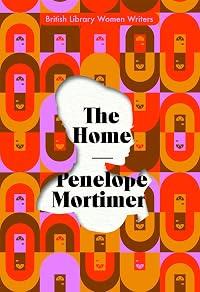
The Home
by Penelope Mortimer
On This Page
Description
"A tragi-comedy published in 1971 that looks at the experience of a woman escaping a broken marriage and trying to make a new home for grown-up children who no longer need her. Dealing with themes of abandonment, loneliness, liberation and love, Eleanor's emotional journey is often raw and dark, but at times funny and uplifting as she grapples with her newfound singledom under the critical eyes of her mother and mother-in-law, and the selfish attitudes of various suitors. Perfectly capturing show more the tone of the 70s, and the reality faced by so many women when forced to re-assess their roles as wife and mother"--Amazon website. show lessTags
Recommendations





















Member Reviews
For months, ever since she had first seen the new house, her own [spirits] had been soaring. She have rediscovered energy that she thought had long ago died; at the prospect of living by herself, in her own home, without Graham, without the load of a marriage that had become intolerable, she had felt herself flung helter-skelter without time to assess or reason, into a life of hope and good sense. She had been unable to sleep at nights, hurrying out of bed to add something more to a list, to write some reminder to herself; or else she had lain on the back, her arms behind her head, smiling at her fantasies and almost unendurably impatient. It seemed at this time incredible to her that she could have endured the last five years of her show more marriage. She did not even think about it, erasing a quarter of a century of love and passion and habit with plans for curtain rails and bookshelves and where the pictures would hang and what, above all, she would create for her children: after years of anxiety and distress there would once more be a home. She would make it alone, untrammelled, a free human being.
Just as she did in The Pumpkin Eater, the author here explores the roles of motherhood and wifehood acting as a prison on a woman's identity. Specifically she looks at what happens post-motherhood and post-wifehood, the inability as well as the reluctance to let go of an identity which has so defined and, in turn, restricted you.
I'm in awe of the way she can so deftly illustrate in just a few lines the complex history and dynamics of a family relationship, the things said and left unsaid, the years of enforced closeness which has now also armed you with the weapons required for its utter destruction. This is only my second Mortimer but definitely not my last. show less
Just as she did in The Pumpkin Eater, the author here explores the roles of motherhood and wifehood acting as a prison on a woman's identity. Specifically she looks at what happens post-motherhood and post-wifehood, the inability as well as the reluctance to let go of an identity which has so defined and, in turn, restricted you.
I'm in awe of the way she can so deftly illustrate in just a few lines the complex history and dynamics of a family relationship, the things said and left unsaid, the years of enforced closeness which has now also armed you with the weapons required for its utter destruction. This is only my second Mortimer but definitely not my last. show less
Ratings
Members
- Recently Added By
Lists

Books Read in 2024
4,727 works; 128 members

Books Read in 2025
4,128 works; 98 members
Author Information

16+ Works 1,266 Members
Some Editions
Series
Belongs to Publisher Series
Common Knowledge
- Canonical title
- The Home
- First words
- When Eleanor and her son Philip moved out they took almost everything with them, leaving Graham only the kingsize bed in which his father had died, a black leather sofa suitable for his consulting room (already lined with bla... (show all)ck leather sofas) his record player and a few odd cups and plastic plates stained with old picnics.
Classifications
Statistics
- Members
- 64
- Popularity
- 487,525
- Reviews
- 1
- Rating
- (4.00)
- Languages
- English
- Media
- Paper, Ebook
- ISBNs
- 6
- ASINs
- 3