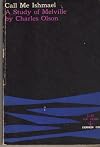
Call Me Ishmael
by Charles Olson
On This Page
Description
First published in 1947, this acknowledged classic of American literary criticism explores the influences--especially Shakespearean ones--on Melville's writing of Moby-Dick. One of the first Melvilleans to advance what has since become known as the "theory of the two Moby-Dicks," Olson argues that there were two versions of Moby-Dick, and that Melville's reading King Lear for the first time in between the first and second versions of the book had a profound impact on his conception of the show more saga: "the first book did not contain Ahab," writes Olson, and "it may not, except incidentally, have contained Moby-Dick." If literary critics and reviewers at the time responded with varying degrees of skepticism to the "theory of the two Moby-Dicks," it was the experimental style and organization of the book that generated the most controversy. show lessTags
Recommendations













Member Reviews
That is the Ahab-world, and it is wicked.
Oh sweet Rosebud of Marion Davies*, by all that is holy, why couldn't this book have been 600 pages? This is pastiche in a queerly American fashion, as epicene as overalls. My copy is a freshly printed facsimile, one that is rife with underlining and marginalia. I normally have issues with Amazon print to order but somehow it felt very appropriate here.
Throughout this nontraditional analysis there are ripples of a sidelong Melville--one from journals and letters: The infernal nature has a valor often denied to innocence. Olson looks to the inspiration for Moby Dick, the whale attack on the Essex. Cannibalism. The irony is the survivors of that disaster avoided Tahiti for fear of being eaten and show more traveled a thousand mile away looking for safety only to succumb to necessity.
As it should Hawthorn is the mentor here, much as Pushkin to Gogol, as Roger Stone to our present le Infer. This could've been a free range exposition for Olson -- Manifest Destiny for a Fallen Angel. A Morningstar for the HUAC -- or is that redundant? I think not. Melville sought pilgrimage less for his Art than for his Soul. He went to the Pacific; he went to the alleged Holy Lands. He dodged the straitjacket but instead ultimately found the oppression of oblivion. Given Olson's treatment of Gloucester in King Lear, wasn't Melville's fate a welcome transcendence?
As the strongest literary force Shakespeare caused Melville to approach tragedy in terms of drama. As the strongest social force America caused him to approach tragedy in terms of democracy.
The Bard features large here, but again more should have been explored than Timon and the Fool. Call Me Whetted.
* An Orson Welles reference appears necessary. show less
Oh sweet Rosebud of Marion Davies*, by all that is holy, why couldn't this book have been 600 pages? This is pastiche in a queerly American fashion, as epicene as overalls. My copy is a freshly printed facsimile, one that is rife with underlining and marginalia. I normally have issues with Amazon print to order but somehow it felt very appropriate here.
Throughout this nontraditional analysis there are ripples of a sidelong Melville--one from journals and letters: The infernal nature has a valor often denied to innocence. Olson looks to the inspiration for Moby Dick, the whale attack on the Essex. Cannibalism. The irony is the survivors of that disaster avoided Tahiti for fear of being eaten and show more traveled a thousand mile away looking for safety only to succumb to necessity.
As it should Hawthorn is the mentor here, much as Pushkin to Gogol, as Roger Stone to our present le Infer. This could've been a free range exposition for Olson -- Manifest Destiny for a Fallen Angel. A Morningstar for the HUAC -- or is that redundant? I think not. Melville sought pilgrimage less for his Art than for his Soul. He went to the Pacific; he went to the alleged Holy Lands. He dodged the straitjacket but instead ultimately found the oppression of oblivion. Given Olson's treatment of Gloucester in King Lear, wasn't Melville's fate a welcome transcendence?
As the strongest literary force Shakespeare caused Melville to approach tragedy in terms of drama. As the strongest social force America caused him to approach tragedy in terms of democracy.
The Bard features large here, but again more should have been explored than Timon and the Fool. Call Me Whetted.
* An Orson Welles reference appears necessary. show less
Charles Olson's Call Me Ishmael is a work of literary criticism that falls squarely into what it's hard not to think of as the American eccentric school. Think: Edward Dahlberg, Guy Davenport, D.H. Lawrence (Lawrence, of course, was English, but it was in his Studies in Classic American Literature that his critical eccentricity emerged). Since these are the kinds of critics one wants to read and reread, this is entirely a good thing.
When Olson is talking about Melville's work most explicitly as in the long chapter on Shakespeare's influence, he seems correct and scholarly. In the more speculative chapters, like the one where he blames Melville's post-Moby Dick fixation on Christ for the enervation (in Olson's view) of his later work he show more is exciting and convincing. The compression and pop of Olson's prose throughout is exemplary, and the juxtaposition of the FACT sections of the book with Olson's more essayistic chapters jars readers into thought. show less
When Olson is talking about Melville's work most explicitly as in the long chapter on Shakespeare's influence, he seems correct and scholarly. In the more speculative chapters, like the one where he blames Melville's post-Moby Dick fixation on Christ for the enervation (in Olson's view) of his later work he show more is exciting and convincing. The compression and pop of Olson's prose throughout is exemplary, and the juxtaposition of the FACT sections of the book with Olson's more essayistic chapters jars readers into thought. show less
A meditation by American poet Charles Olson written in his characteristic "fervent informal" style on Moby Dick.
Moby-Dick as Prometheus - key ideas are obscurity, multidutinous, infinite, and mythic.
To MAGNIFY is the mark of Moby-Dick. This is a poetic analysis of some of the most interesting aspects of Moby-Dick.
To MAGNIFY is the mark of Moby-Dick. This is a poetic analysis of some of the most interesting aspects of Moby-Dick.
From the concluding chapter, page 119:
Porphyry wrote that the generation of images in the mind is from water.
The three great creations of Melville and Moby-Dick are Ahab, The Pacific, and the White Whale.
The son of the father of Ocean was a prophet Proteus, of the changing shape, who, to evade philistine Aristaeus worried about bees, became first a fire, then a flood, and last a wild sea beast.
Porphyry wrote that the generation of images in the mind is from water.
The three great creations of Melville and Moby-Dick are Ahab, The Pacific, and the White Whale.
The son of the father of Ocean was a prophet Proteus, of the changing shape, who, to evade philistine Aristaeus worried about bees, became first a fire, then a flood, and last a wild sea beast.
Ratings
Members
- Recently Added By
Author Information

83+ Works 1,760 Members
The "elder statesman" of the Black Mountain school of poets, Charles Olson directly affected the work of fellow teachers Robert Duncan and Robert Creeley, as well as students including John Wieners, Jonathan Williams, Joel Oppenheimer, and Edward Dorn. In his Selected Writings (1967), Olson emphasizes "how to restore man to his "dynamic.' There is show more too much concern, he feels, with end and not enough with instant. It is not things that are important, but what happens between them. . . . He thinks of poetry as transfers of energy and he reminds us that dance is kinesis, not mimesis" (N.Y. Times). Human Universe and Other Essays is a collection of interesting pieces on subjects ranging from Homer to Yeats. Proprioception is one of Olson's seminal essays on verse and the poet's awareness. Born in Worcester, Massachusetts, Olson attended Wesleyan, Harvard, and Yale Universities. He taught at Harvard University and Clark and Black Mountain colleges. He received two Guggenheim Fellowships and a grant from the Wenner-Gren Foundation to study Mayan hieroglyphs in the Yucatan. His involvement with early Indian societies stimulated his interest in mysticism and the drug culture. (Bowker Author Biography) show less
Series
Belongs to Publisher Series
Cape Editions (02)
Common Knowledge
- People/Characters
- Herman Melville
Classifications
- Genres
- Nonfiction, Literature Studies and Criticism, Fiction and Literature
- DDC/MDS
- 813.3 — Literature & rhetoric American literature in English American fiction in English Middle 19th Century 1830-1861
- LCC
- PS2384 .M62 .O4 — Language and Literature American literature American literature Individual authors 19th century
- BISAC
Statistics
- Members
- 230
- Popularity
- 141,111
- Reviews
- 5
- Rating
- (4.21)
- Languages
- English, French
- Media
- Paper, Ebook
- ISBNs
- 8
- ASINs
- 9