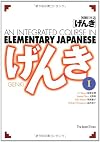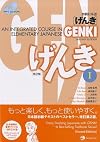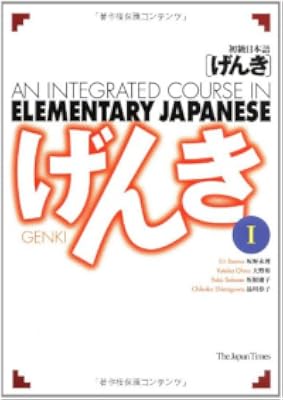
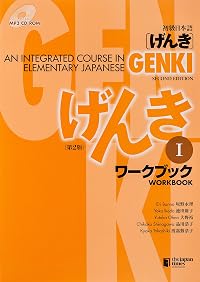
Genki 1: An Integrated Course in Elementary Japanese
by Eri Banno
Genki: An Integrated Course in Elementary Japanese (1)
On This Page
Description
Ideal for: Beginning. Published in Japan, Genki gives a beginning student of Japanese a solid grounding in all four language skills: listening, speaking, reading, and writing, throughout its 23 lessons. Packed with easy-to-understand grammar explanations, a variety of exercises full of illustrations, and scenes taken from everyday life, the lessons will have students enjoying the often tedious beginning stage of Japanese-language learning and will enable them to acquire a well-balanced show more ability to communicate in elementary Japanese. The course employs: Situations and subjects relating to daily life: The material presents the most frequently used vocabulary, expressions, and grammar, giving students the opportunity to apply what they have learned to their daily lives. Enjoyable and lively practice exercises: Both the Dialogue and Grammar and Reading and Writing sections provide a variety of stimulating exercises so that students will not lose interest in studying Japanese. Understandable and precise grammar explanations: The many examples found in the textbook are easy to read and understand. A wide variety of teaching materials: Through use of the textbook's diverse exercises, as well as a supplementary workbook and CD, students are given numerous opportunities to practice a variety of skills, including listening and writing. show lessTags
Recommendations






Member Reviews
One can never say that a language learning book has ever been 'finished', but for what it's worth, I have worked through this volume, and found it more than adequate as a first introduction to Japanese. My volume came with its colored stickers and its own CD, from amazon.co.jp, but with the abundant resources on YouTube, don't think I ever felt the need to use the CD. On the whole, I just love the layout, the clear print, the copious exercise, and the tables of 139 kanji (Chinese-based hieroglyphics) and the glossaries and verb conjugations at the back. I don't see that any other textbook is actually called for, after this one (and its Volume II, which also I have worked through). The next stage, as far as I can see, is to get going show more with the kanji (aiming at some 1000), composing paragraphs, practicing listening and speaking, and increasing one's vocabulary. show less
The grammar explanations and pace of progression are not bad. The vocabulary choice is decent, as well as the (not many) dialogues and the reading sections.
What I did not like, especially compared to language learning books of other languages, especially European (take [b:Themen Aktuell|574462|Themen Aktuell|Hartmut Aufderstraße|https://images.gr-assets.com/books/1175920847s/574462.jpg|561453] as an example, in this case for German), is that the exercise sections (both of the coursebook and the workbook) are not effective. They mainly consist of grammar drill repetition where an example is shown and all the further items just imply repeating the example with new words. There are almost no productive exercises (such as fill the blanks show more of a dialogues, decide which verb tense/vocabulary is more appropriate), as well as it totally lacks any review of and links to what happened in the past. Also the dialogues are few, and it lacks short dialogues to reinforce the communicative functions.
Still way better than equivalent Chinese learning books ([b:New Practical Chinese Reader 1 Textbook|1218932|New Practical Chinese Reader 1 Textbook|Liu Xun|https://images.gr-assets.com/books/1387700418s/1218932.jpg|1207409]), but a long distance from English and European languages courses. show less
What I did not like, especially compared to language learning books of other languages, especially European (take [b:Themen Aktuell|574462|Themen Aktuell|Hartmut Aufderstraße|https://images.gr-assets.com/books/1175920847s/574462.jpg|561453] as an example, in this case for German), is that the exercise sections (both of the coursebook and the workbook) are not effective. They mainly consist of grammar drill repetition where an example is shown and all the further items just imply repeating the example with new words. There are almost no productive exercises (such as fill the blanks show more of a dialogues, decide which verb tense/vocabulary is more appropriate), as well as it totally lacks any review of and links to what happened in the past. Also the dialogues are few, and it lacks short dialogues to reinforce the communicative functions.
Still way better than equivalent Chinese learning books ([b:New Practical Chinese Reader 1 Textbook|1218932|New Practical Chinese Reader 1 Textbook|Liu Xun|https://images.gr-assets.com/books/1387700418s/1218932.jpg|1207409]), but a long distance from English and European languages courses. show less
There was some good material in this book, but I tried to finish it 3 times, and just couldn't. I guess, for me, it would be a better material for a classroom setting, rather than trying to go through it on my own.
This is one of the best books for the serious student who wants to learn real Japanese. It enables the student to read, write, listen and speak. The book can easily be used for self-study or as part of a classroom. Its only drawback is cost, but if anyone has studied a language before knows, it is an expensive undertaking.
Very easy to learn from. I would definitely recommend this book to someone interested in learning Japanese.
Laaja oppikirja japanin kielestä. Erilaiset taulukot ja kuvat ovat mukava lisä kielioppisääntöihin. Vaikka kielenä on englanti, kirjaa on mukava lukea.
Jan 18, 2011Finnish
Ratings
Members
- Recently Added By
Author Information

45 Works 2,485 Members
Series

Common Knowledge
- Canonical title
- Genki 1: An Integrated Course in Elementary Japanese
Classifications
- Genres
- Nonfiction, General Nonfiction
- DDC/MDS
- 495 — Language Other languages Languages of east and southeast Asia
- LCC
- PL539.3 .S56 — Language and Literature Languages and literatures of Eastern Asia, Africa, Oceania Languages of Eastern Asia, Africa, Oceania Japanese language and literature Japanese language
- BISAC
Statistics
- Members
- 929
- Popularity
- 28,664
- Reviews
- 6
- Rating
- (4.32)
- Languages
- English, Japanese
- Media
- Paper, Audiobook
- ISBNs
- 6
- UPCs
- 1
- ASINs
- 1