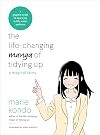
The Life-Changing Manga of Tidying Up: A Magical Story to Spark Joy in Life, Work, and Love
by Marie Kondo
On This Page
Description
"From the #1 New York Times best-selling author and lifestyle/cleaning guru Marie Kondo, this graphic novelization brings Kondo's life-changing tidying method to life with the fun, quirky story of a woman who transforms her home, work, and love life using Kondo's advice and inspiration. Marie Kondo presents the fictional story of Chiaki, a young woman in Tokyo who struggles with a cluttered apartment, messy love life, and lack of direction. After receiving a complaint from her attractive show more next-door neighbor about the sad state of her balcony, Chiaki gets Kondo to take her on as a client. Through a series of entertaining and insightful lessons, Kondo helps Chiaki get her home--and life--in order. This insightful, illustrated case study is perfect for people looking for a fun introduction to the KonMari Method of tidying up, as well as tried-and-true fans of Marie Kondo eager for a new way to think about what sparks joy. Featuring illustrations by award-winning manga artist Yuko Uramoto, this book also makes a great read for manga and graphic novel lovers of all ages"-- show lessTags
Recommendations
















Member Recommendations
Member Reviews
I haven't read Kondo's The Life-Changing Magic of Tidying Up, but I assume that this manga includes the same tips and principles as the book, just in a different format, with some edutainment aspects. Here, Marie Kondo has been hired by a new client, Chiaki, a 29-year-old sales rep in Tokyo, to learn how to clean up her fantastically messy apartment.
Kondo's method requires you to divide the contents of your home up into categories: she recommends Clothes, then Books, then Paper, then Miscellaneous Items, and finally Sentimental Things. First, though she wants you to think about the kind of life you'd like to live in your home - it's a way to focus your priorities and then start to gear your living space towards those priorities.
Rather show more than starting by helping Chiaki find new ways to store her stuff, Kondo asks her to focus on particular categories and discard things. For example, she has Chiaki collect all her clothes from her closet and wherever else they might be located, put it all in one giant pile (a good way to truly understand just how much stuff she has), and then individually consider each item. Although Chiaki is discarding things, she's supposed to focus on choosing what she wants to keep, the items that "spark joy." Everything that no longer sparks joy should be individually thanked and discarded. Kondo tells Chiaki (and readers) that this process may be more difficult and emotional than you expect - in some instances, you're essentially saying goodbye to moments in your life that are now firmly in your past.
I know a lot of folks made fun of the whole "spark joy" thing back when Kondo's book was enormously popular, but the advice in this manga actually did seem really helpful. The problem: I'm not sure I'm committed enough to cleaning up to go through Kondo's whole method. In a way, it makes me think of a less time-sensitive version of the cleanup I did when I was packing everything up to move to a new place, and even then I couldn't bring myself to individually go through all of my books.
Also, Kondo never really says how to tackle strictly utilitarian items - they're subcategories under "Miscellaneous," sure, but a plate doesn't necessarily need to spark joy in me in order to be worth keeping. Then again, I just have a little stack of plates that fits easily in my kitchen cabinets. Kondo's method seems to best apply to those things a person has so much of that they can't figure out how to deal with it all.
Even if you, like me, are too chicken to go through Kondo's whole cleaning process, this is still a motivating read, and the images of Kondo's recommendations for ways to use what you have in order to sort and store the things you plan to keep (rather than buying new storage containers) are helpful. There are also some nice diagrams explaining how to fold and hang various clothing items neatly.
(Original review posted on A Library Girl's Familiar Diversions.) show less
Kondo's method requires you to divide the contents of your home up into categories: she recommends Clothes, then Books, then Paper, then Miscellaneous Items, and finally Sentimental Things. First, though she wants you to think about the kind of life you'd like to live in your home - it's a way to focus your priorities and then start to gear your living space towards those priorities.
Rather show more than starting by helping Chiaki find new ways to store her stuff, Kondo asks her to focus on particular categories and discard things. For example, she has Chiaki collect all her clothes from her closet and wherever else they might be located, put it all in one giant pile (a good way to truly understand just how much stuff she has), and then individually consider each item. Although Chiaki is discarding things, she's supposed to focus on choosing what she wants to keep, the items that "spark joy." Everything that no longer sparks joy should be individually thanked and discarded. Kondo tells Chiaki (and readers) that this process may be more difficult and emotional than you expect - in some instances, you're essentially saying goodbye to moments in your life that are now firmly in your past.
I know a lot of folks made fun of the whole "spark joy" thing back when Kondo's book was enormously popular, but the advice in this manga actually did seem really helpful. The problem: I'm not sure I'm committed enough to cleaning up to go through Kondo's whole method. In a way, it makes me think of a less time-sensitive version of the cleanup I did when I was packing everything up to move to a new place, and even then I couldn't bring myself to individually go through all of my books.
Also, Kondo never really says how to tackle strictly utilitarian items - they're subcategories under "Miscellaneous," sure, but a plate doesn't necessarily need to spark joy in me in order to be worth keeping. Then again, I just have a little stack of plates that fits easily in my kitchen cabinets. Kondo's method seems to best apply to those things a person has so much of that they can't figure out how to deal with it all.
Even if you, like me, are too chicken to go through Kondo's whole cleaning process, this is still a motivating read, and the images of Kondo's recommendations for ways to use what you have in order to sort and store the things you plan to keep (rather than buying new storage containers) are helpful. There are also some nice diagrams explaining how to fold and hang various clothing items neatly.
(Original review posted on A Library Girl's Familiar Diversions.) show less
I read this title out of curiosity as non-fictional manga so rarely get picked up for translation. I admit to feeling more than a little let down. KonMarie comes off as a condescending guru. Her philosophy seems to be rooted in some neo-Shinto transcendental one-size-fits-all approach that feels problematic in application. Also her broken logic that feeling empowered by tidying up will somehow translate into confidence with dating is unsettling. Honestly, I admired Chiaki’s independence and KonMarie set out to debunk her lifestyle in a very conservative almost Diet-approved way. Living with only one simple outfit feels very masculine/anti-fashion and if that outfit were grey… you’d be a Buddhist monk. I thought her methodology for show more sorting was useful until we came to the chapter on books. She totally downplays reading as some kind of childish indulgence? In light of that attitude I was then really confounded by the panel where she seems to throw nutrition out the window as a joke. It’s really kind of disturbing how popular she is. show less
I consider Marie Kondo a sort of kindred spirit and had already read her four main tidying books when I saw [b:The Life-Changing Manga of Tidying Up: A Magical Story to Spark Joy in Life, Work and Love|45883110|The Life-Changing Manga of Tidying Up A Magical Story to Spark Joy in Life, Work and Love|Marie Kondō|https://i.gr-assets.com/images/S/compressed.photo.goodreads.com/books/1571646154l/45883110._SX50_.jpg|55050004] in the library. It looked so cute that I couldn't resist borrowing it. Essentially it is a graphic novel version of [b:The Life-Changing Magic of Tidying Up: The Japanese Art of Decluttering and Organizing|24430682|The Life-Changing Magic of Tidying Up The Japanese Art of Decluttering and Organizing|Marie show more Kondō|https://i.gr-assets.com/images/S/compressed.photo.goodreads.com/books/1556977597l/24430682._SX50_.jpg|41711738], in which Marie Kondo helps a woman named Chiaki tidy her extremely messy flat. And it did indeed prove to be super cute. The art is adorable yet evokes domestic chaos very realistically. I always enjoy being reminded of the Konmari method, as I find tidying calming. While my clothes, books, and komono are under control, I still have sentimental papers to sort through as I find this the most difficult category to deal with.
The only thing that I think works differently for me personally is Marie Kondo's suggestion: 'Do you have unread books that you intend to read "someday"? Believe me, "someday" never comes.' While I do sometimes get rid of unread books if I decide I don't want to read them, someday often comes when you read more than 150 books a year. I like having a buffer of unread books, around 20-25% of the total on my shelves, so there's no risk of lacking new reading matter. I was particularly glad of this policy when lockdown closed the libraries for months. However I realise that not everyone can get through their unread shelf at the pace I do. If an unread book is making you feel guilty for not reading it, or the quantity of unread books on your shelves overwhelms you, it definitely makes sense to follow Marie Kondo's suggestion. Much as I love books, I also really enjoy thanking them for the enjoyment they gave me then sending them out into the world for someone else to read. Once I've read them, nearly all my books get returned to the library, sent to friends and family, left in the community book share box, or donated to a charity shop.
[b:The Life-Changing Manga of Tidying Up: A Magical Story to Spark Joy in Life, Work and Love|45883110|The Life-Changing Manga of Tidying Up A Magical Story to Spark Joy in Life, Work and Love|Marie Kondō|https://i.gr-assets.com/images/S/compressed.photo.goodreads.com/books/1571646154l/45883110._SX50_.jpg|55050004] is a quick and fun read to introduce you to Marie Kondo if you haven't read her books before, or to remind you about her method if you have. It really made me smile. show less
The only thing that I think works differently for me personally is Marie Kondo's suggestion: 'Do you have unread books that you intend to read "someday"? Believe me, "someday" never comes.' While I do sometimes get rid of unread books if I decide I don't want to read them, someday often comes when you read more than 150 books a year. I like having a buffer of unread books, around 20-25% of the total on my shelves, so there's no risk of lacking new reading matter. I was particularly glad of this policy when lockdown closed the libraries for months. However I realise that not everyone can get through their unread shelf at the pace I do. If an unread book is making you feel guilty for not reading it, or the quantity of unread books on your shelves overwhelms you, it definitely makes sense to follow Marie Kondo's suggestion. Much as I love books, I also really enjoy thanking them for the enjoyment they gave me then sending them out into the world for someone else to read. Once I've read them, nearly all my books get returned to the library, sent to friends and family, left in the community book share box, or donated to a charity shop.
[b:The Life-Changing Manga of Tidying Up: A Magical Story to Spark Joy in Life, Work and Love|45883110|The Life-Changing Manga of Tidying Up A Magical Story to Spark Joy in Life, Work and Love|Marie Kondō|https://i.gr-assets.com/images/S/compressed.photo.goodreads.com/books/1571646154l/45883110._SX50_.jpg|55050004] is a quick and fun read to introduce you to Marie Kondo if you haven't read her books before, or to remind you about her method if you have. It really made me smile. show less
Yuko Uramoto's art lifts and clarifies the message in this manga in a charming story about self-evaluation and contemplation of the past and hopes for the future. It gets the message across that change is difficult but worth the effort. The manga is a case study of a woman who finds KonMari for help in getting her home in order, and she learns so much more in the process. The messages are simplistic but ring true. Past trauma expresses itself in how one lives, and gaining skills in dealing with life opens one up to new experiences and choices. I read the original Kondo book, and I find the manga is better at expressing Marie Kondo's message: Tidying up can actually change your life.
This review and others posted over at my blog.
I don’t normally read these type of lifestyle books and a manga edition was probably the only way I was ever going to pick up this book.
It’s a cute comic (fyi: it’s not set up in traditional manga style, you read this from front to back and left to right, or it won’t make much sense lol) and I enjoyed the art style. Marie organizes the book by category of items – the way she believes you should be organizing your own items, rather than room by room. The main categories she uses for items in your life are clothing, books, papers and sentimental books. Her first lesson is to think about your ideal lifestyle and what you want to achieve through tidying. She then tackles the best way show more to sort through items in these categories and finally ideas on how to store them. Her mantra throughout the book is to only keep what “sparks joy” in you.
I understand the general principle of this book, but the big takeaway for me was clothing organization. I am not at all like Chiaki, who lives in what I’d classify as a dump and who is someone I’d consider a slob. Sorry to any readers whose homes might be cluttered and “messy” – I’m not saying you’re a bad person, but if you leave your clothes and dishes and papers lying haphazardly all over every inch of your place, I think you’re a slob. Despite Sweetbeeps’s best efforts to create piles of clothing all over our house, I generally keep things tidy and could have people over without freaking out about the general state of our lives.
But, I do tend to hoard certain items (other than books, yes) and we don’t have as much space as I’d like so tips on organization and culling my hoards are appreciated. I had already started the project of going through all my clothes before reading this and I did get some excellent tips on how to store clothes, especially in regards to folding what I keep in drawers. My closet storage is limited and that will be a challenge when I tackle it, but I can say since reading this book I’ve reorganized my bureau and folded my shirts and tanks and leggings per Marie’s method and it has given me more space and a better view of what items I have on hand. I won’t go into crazy detail, but she stresses storing items upright and folding them into rectangles, almost like they’re in a file folder – this method puts less weight on your folded clothes, in addition to making it easier to see what you have, and I guess they’re less likely to wrinkle. I haven’t had this method in place long enough to test the less wrinkle theory though.
Okay, so enough about clothing. What I really disagreed with Marie on was her theory for keeping or discarding books. She claims you should not be reading what the book is about, but rather just touching the cover and seeing if it sparks joy within you. Sorry, but that’s not how I work. She asks, “Do you feel joy when surrounded by books that you’ve never read?” YES. She believes that you’ve missed ideal time to read a book you own (re: immediately after buying it) then “someday” never comes and you’ll never get to that book. Well, despite having a frighteningly massive TBR, I do pick up books at random, even ones I’ve owned for years. She also notes that you should donate all these unread books and they’ll come back to you if they’re meant to. I don’t believe that either! And why would I donate a book I bought and then possibly someday buy it again?
It’s not to say I never purge my collection – I do get rid of books I didn’t enjoy after reading them and I will go through my shelves randomly and pick out books I know I’m not going to read and donate them. But it would be depressing to only own books I’ve read! I like living in a library, thanks.
I do need to go through some of my more sentimental possessions and find a better way to store them, but chances are I’ll always own a lot of “stuff” because I like owning stuff and things. I also neglected to thank my clothing that I was getting rid of or to toss a pinch of salt on something to remove bad karma. These are sort of cultural/mindset ideas that don’t gel with me and I don’t feel the need to perform them when discarding my things.
I don’t necessarily think I’m the target audience for this book, but it did inspire me to get back into going through my clothing, which I appreciated. I also understand the overall message, which is, don’t let items that don’t give you joy (or are functionally necessary, I suppose) clutter up your life. I think if you’re looking for a quick, animated summary of tips for organizing your whole home, you might enjoy this more than I did.
I received this book for free from Blogging for Books in exchange for an honest review. This does not affect my opinion of the book or the content of my review. All opinions in this post are my own. show less
I don’t normally read these type of lifestyle books and a manga edition was probably the only way I was ever going to pick up this book.
It’s a cute comic (fyi: it’s not set up in traditional manga style, you read this from front to back and left to right, or it won’t make much sense lol) and I enjoyed the art style. Marie organizes the book by category of items – the way she believes you should be organizing your own items, rather than room by room. The main categories she uses for items in your life are clothing, books, papers and sentimental books. Her first lesson is to think about your ideal lifestyle and what you want to achieve through tidying. She then tackles the best way show more to sort through items in these categories and finally ideas on how to store them. Her mantra throughout the book is to only keep what “sparks joy” in you.
I understand the general principle of this book, but the big takeaway for me was clothing organization. I am not at all like Chiaki, who lives in what I’d classify as a dump and who is someone I’d consider a slob. Sorry to any readers whose homes might be cluttered and “messy” – I’m not saying you’re a bad person, but if you leave your clothes and dishes and papers lying haphazardly all over every inch of your place, I think you’re a slob. Despite Sweetbeeps’s best efforts to create piles of clothing all over our house, I generally keep things tidy and could have people over without freaking out about the general state of our lives.
But, I do tend to hoard certain items (other than books, yes) and we don’t have as much space as I’d like so tips on organization and culling my hoards are appreciated. I had already started the project of going through all my clothes before reading this and I did get some excellent tips on how to store clothes, especially in regards to folding what I keep in drawers. My closet storage is limited and that will be a challenge when I tackle it, but I can say since reading this book I’ve reorganized my bureau and folded my shirts and tanks and leggings per Marie’s method and it has given me more space and a better view of what items I have on hand. I won’t go into crazy detail, but she stresses storing items upright and folding them into rectangles, almost like they’re in a file folder – this method puts less weight on your folded clothes, in addition to making it easier to see what you have, and I guess they’re less likely to wrinkle. I haven’t had this method in place long enough to test the less wrinkle theory though.
Okay, so enough about clothing. What I really disagreed with Marie on was her theory for keeping or discarding books. She claims you should not be reading what the book is about, but rather just touching the cover and seeing if it sparks joy within you. Sorry, but that’s not how I work. She asks, “Do you feel joy when surrounded by books that you’ve never read?” YES. She believes that you’ve missed ideal time to read a book you own (re: immediately after buying it) then “someday” never comes and you’ll never get to that book. Well, despite having a frighteningly massive TBR, I do pick up books at random, even ones I’ve owned for years. She also notes that you should donate all these unread books and they’ll come back to you if they’re meant to. I don’t believe that either! And why would I donate a book I bought and then possibly someday buy it again?
It’s not to say I never purge my collection – I do get rid of books I didn’t enjoy after reading them and I will go through my shelves randomly and pick out books I know I’m not going to read and donate them. But it would be depressing to only own books I’ve read! I like living in a library, thanks.
I do need to go through some of my more sentimental possessions and find a better way to store them, but chances are I’ll always own a lot of “stuff” because I like owning stuff and things. I also neglected to thank my clothing that I was getting rid of or to toss a pinch of salt on something to remove bad karma. These are sort of cultural/mindset ideas that don’t gel with me and I don’t feel the need to perform them when discarding my things.
I don’t necessarily think I’m the target audience for this book, but it did inspire me to get back into going through my clothing, which I appreciated. I also understand the overall message, which is, don’t let items that don’t give you joy (or are functionally necessary, I suppose) clutter up your life. I think if you’re looking for a quick, animated summary of tips for organizing your whole home, you might enjoy this more than I did.
I received this book for free from Blogging for Books in exchange for an honest review. This does not affect my opinion of the book or the content of my review. All opinions in this post are my own. show less
Hmmm . . . I think I'm ready to read Kondo's first book now, and then get serious about tidying up myself. I loved the graphic novel format and personalized story she uses here, and am quite convinced of the efficacy of her methods despite having long laughed off what I'd heard about her work.
Picked up the manga on a whim, haven't read the original. Surprised with how good this was! My first exposure to Kondo was the outrage of conspicuous readers at the idea that perhaps they should discard books they will never re-read and/or don't enjoy.
I found her tips interesting, intuitive, and helpful, and plan to use them to downsize when we move later this year. A surprising amount of the book seemed to tie into RFT/ACT really well - the focus on mindfulness and the now, making room for discomfort but still doing what needs to be done, emphasis on values-based action, not being fused with the 'shoulds' and 'mights' etc. Would be fun to discuss overlaps in the exercises between the Kondo method and ACT with some RFT folks.
A few of show more the tips made me laugh at loud at first- thanking an item before discarding it, covering the eyes of photos making it easier to discard them, touching (but not opening) a book to see if it sparks joy. But I decided to test it out and by god it really does work in practice. The books that I truly love - just seeing the covers sparked joy. If I had to open it up and read a bit, it was like I was trying to convince myself that it sparked joy when it did not. With the other tips, Kondo acknowledges our tendency towards anthropomorphism and empathy.
The story illustrating the tips was incredibly saccharine but the examples and common questions/arguments were well presented. Really well presented, just with it had a touch more content. show less
I found her tips interesting, intuitive, and helpful, and plan to use them to downsize when we move later this year. A surprising amount of the book seemed to tie into RFT/ACT really well - the focus on mindfulness and the now, making room for discomfort but still doing what needs to be done, emphasis on values-based action, not being fused with the 'shoulds' and 'mights' etc. Would be fun to discuss overlaps in the exercises between the Kondo method and ACT with some RFT folks.
A few of show more the tips made me laugh at loud at first- thanking an item before discarding it, covering the eyes of photos making it easier to discard them, touching (but not opening) a book to see if it sparks joy. But I decided to test it out and by god it really does work in practice. The books that I truly love - just seeing the covers sparked joy. If I had to open it up and read a bit, it was like I was trying to convince myself that it sparked joy when it did not. With the other tips, Kondo acknowledges our tendency towards anthropomorphism and empathy.
The story illustrating the tips was incredibly saccharine but the examples and common questions/arguments were well presented. Really well presented, just with it had a touch more content. show less
Members
- Recently Added By
Lists

Books Read in 2019
4,052 works; 110 members

Books Read in 2017
4,249 works; 130 members

Books Read in 2022
5,226 works; 115 members
Author Information

47 Works 13,258 Members
Marie Kondo runs a consulting business in Tokyo helping clients transform their cluttered homes into spaces of serenity and inspiration. Her KonMari Method of decluttering and organizing has inspired a book entitled The Life-Changing Magic of Tidying Up and a television drama for Japanese television. (Bowker Author Biography)
All Editions
Work Relationships
Common Knowledge
- Canonical title
- The Life-Changing Manga of Tidying Up: A Magical Story to Spark Joy in Life, Work, and Love
- Original title
- Manga de yomu jinsei ga tokimeku katadzuke no mahō; マンガで読む人生がときめく片づけの魔法
- Original publication date
- 2017
- Disambiguation notice
- Despite having a super-similar title to The Life-Changing Magic of Tidying Up and being on the same subject, this isn't that book. It's fictionalized and was written several years later. Plus, of course, it's a manga, ... (show all)not a prose work.
Classifications
Statistics
- Members
- 642
- Popularity
- 45,310
- Reviews
- 39
- Rating
- (3.98)
- Languages
- 8 — Catalan, Dutch, English, French, German, Italian, Polish, Portuguese (Portugal)
- Media
- Paper, Ebook
- ISBNs
- 12
- ASINs
- 1