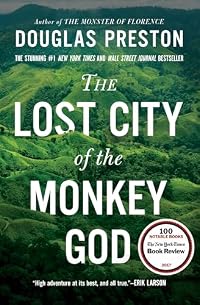
The Lost City of the Monkey God: A True Story
by Douglas Preston
On This Page
Description
Since the days of conquistador Hernán Cortés, rumors have circulated about a lost city of immense wealth hidden somewhere in the Honduran interior, called the White City or the Lost City of the Monkey God. Indigenous tribes speak of ancestors who fled there to escape the Spanish invaders, and they warn that anyone who enters this sacred city will fall ill and die. In 1940, swashbuckling journalist Theodore Morde returned from the rainforest with hundreds of artifacts and an electrifying show more story of having found the Lost City of the Monkey God - but then having committed suicide without revealing its location. Three quarters of a century later, bestselling author Doug Preston joined a team of scientists on a new quest. In 2012 he climbed aboard a rickety plane carrying the machine that would change everything: lidar, a highly advanced technology that could map the terrain under the densest rainforest canopy. In an unexplored valley ringed by steep mountains, that flight revealed the image of a sprawling metropolis, tantalizing evidence of not just an undiscovered city but an enigmatic, lost civilization. Venturing into this treacherous but breathtaking wilderness to confirm the discovery, Preston and the team battled torrential rains, quickmud, disease-carrying insects, jaguars, and deadly snakes. But it wasn't until they returned that tragedy struck: Preston and others found they had contracted in the ruins a horrifying, sometimes lethal - and incurable - disease. Suspenseful and shocking, filled with colorful history, hair-raising adventure, and dramatic twists of fortune, The Lost City of the Monkey God is the absolutely true, eyewitness account of one of the great discoveries of the twenty-first century. -- show lessTags
Recommendations






















Member Recommendations
Jungle of Stone: The Extraordinary Journey of John L. Stephens and Frederick Catherwood, and the Discovery of the Lost Civilization of the Maya by William Carlsen
rakerman Jungle of Stone tells the story of challenging explorations of Mayan sites. The Lost City of the Monkey God tells the tale of a challenging exploration of a city from an unknown but potentially Maya-related civilization.
rakerman The River of Doubt is a dangerous jungle expedition to explore a river in 1913–14. The Lost City of the Monkey God is a dangerous jungle expedition to explore a lost city in 2015. Although separated by a century, some similar challenges are encountered.
Member Reviews
I just about love lost cities, hidden artefacts and jungle adventures – whether fact or fiction – more than any other topic you could name. Like David Grann's excellent 2009 history/memoir/adventure-journalism The Lost City of Z, Douglas Preston's 2017 book The Lost City of the Monkey God relates its author's pursuit of the story of a lost city in South America, the source of such legends as La Ciudad Blanca and El Dorado. Like Grann, he combines legend, history, archaeology, anthropology and personal impressions (during his own expedition into the rainforest) into a compelling, readable crowd-pleaser.
For the layman, this is excellent. Modern archaeologists sneer at the Indiana Jones stuff, the stories of lost cities and buried show more treasure, but in truth this thirst from the public is just the most overt and populist manifestation of the natural desire to delve into a mysterious and often inaccessible past. We all desire to commune with our ancestors, to think with wonder on what the past was like, when the Americas were untapped by the West and home to the vast stone cities of the Maya, Inca and the people of Preston's titular lost city, a culture we know so little about that it hasn't even received a formal name (pp205-6). For all that we know of the conquistador period, the "pre-Columbian history" of great civilizations, with populations of tens if not hundreds of thousands, remains an enigma (pg. 288). War, disease, nature and the passage of time have conspired to such an extent that Preston can stand in Mosquitia, one of the most remote and isolated regions of the world, where humans have not set foot for hundreds of years, and discover that the stones laid there, even the very shape of the land, had been manipulated by human hands (pg. 147). Though he hardly ever waxes lyrical, preferring a functional, journalistic approach, Preston successfully evokes this wonder.
Like Grann's book, Preston commendably does not shy away from the unromantic truths of exploration, even in the modern era: the diseases, the snakes, the jungle camp floor which is "carpeted with glistening cockroaches – thousands of them, rushing in frantic activity, looking like a greasy, jittering flow" (pg. 140). Though the expedition he is a part of is high-tech, employing helicopters, drones and – groundbreakingly – LiDAR to map the jungle floor with laser beams, it does not stop the people involved from contracting leishmaniasis or coming face-to-face with deadly six-foot snakes.
Nor does it mean they can uncover the lost city's secrets. Even leaving aside the problems of understanding a past culture solely from archaeological finds, Preston relates some of the more banal roadblocks on the expedition, such as lack of funds and interest. The timeframe of the archaeological dig is determined by how long they can secure an expensive helicopter or the LiDAR equipment itself; the parameters are set by Honduran politics and, back in the States, public apathy and, infuriatingly, petty academic bickering. Even after the Herculean effort of organising and carrying out the fascinating expedition, a bunch of stay-at-home academics back on campus begin organising petitions, dismissing the archaeologists as colonialist 'treasure hunters', and accusing the participants of normalising 'hypermasculinity', 'white supremacy' and 'engaging in racist dialogue' (pp274-6). If this were a simple but misguided attempt at advocacy of native tribes – sorry, indigenous populations – it would be understandable, but still irritating; the fact that Preston raises the credible speculation that many of the pious petitioners are backers of the previous Honduran regime, or were merely peeved that they hadn't been invited themselves, makes you marvel that anything ever gets done, especially in the painstaking and poorly-funded discipline of archaeology. While it seems at times like such insufferable people are as flies on an elephant's back, we must remember that it is such flies which are carriers for catastrophic and civilization-debilitating diseases.
Speaking of which, an unexpected but thought-provoking aspect of Preston's book, which becomes much more prominent towards the end, is the role disease pandemics played in the fate of the lost city, and of the New World in general. We all know of the role of the conquistador pathogens, of course, and the smallpox-infected blankets given to the North American Indians, but Preston really communicates the frightening reality of this. He gives well-sourced estimates that the deluge of 'Old World' diseases killed off 90% of the indigenous New World population in the fifty years after Columbus' arrival, even among those (like the 'lost city' Preston's expedition uncovers) which had no direct contact with the Old World. Apply that same imagination I mentioned earlier, about our desire to learn of forgotten peoples and untouched cities of wonder, to the following scenario:
"When the city at T1 was swept by epidemics, and the people felt they had been abandoned by their gods, I wondered what ceremonies they might have performed in a desperate effort to restore the cosmic order. Whatever they did, it failed; feeling cursed and rejected by the gods, they left the city, never to return." (pg. 284)
A 90% percent mortality rate, Preston tells us, is apocalyptic; for comparison, the Black Death was between 30% to 60% in Europe at its worst, whilst the Spanish Flu killed about 5% of the world's population (pp294, 301). At time of writing, the Covid-19 pandemic has killed about a million people worldwide, and its mortality rate, which is highly-disputed and politically contentious, ranges from less than 0.1% to, even in the highest estimates, about 1%. Considering how impactful Covid-19 (or the reaction to it) has been to world civilization, one cannot even conceive of the wrecking ball of a 90% mortality rate, let alone in a society with no understanding of disease science.
I've always been interested by the immediacy of history, those links between old and new which are not always apparent but which connect us to the people of the past, whether our immediate national descendants, our primordial ancestors, or the disparate and vanished indigenous people of the far-flung Americas. Preston's book draws heavily on this sense of wonder, the thrill of discovering that the New World had "cities, temples and colossal antiquities that rivalled those of the Old World, equal to the pyramids of Egypt and the glories of ancient Rome" (pg. 14). Preston, of course, could not even know of Covid-19 when he published The Lost City of the Monkey God in 2017, but the prescience and continued relevance of his book further proves his remark that "archaeology is thick with cautionary tales that speak directly to the twenty-first century" (pg. 204). That immediacy of history we feel when we wonder, as Preston noted above, what desperate ceremonies they might have performed, returns to us in 2020. With our porous cotton masks, our proposed vaccines and our media-driven hysteria, we can think about what rituals we are performing, and will perform, to restore the cosmic order, and wonder: will they too fail? A discomforting thought, but perhaps one response is to be found in our fascination with the past: that yearning to understand and preserve can lead us to identify what elements of our own civilization would deserve to survive. show less
For the layman, this is excellent. Modern archaeologists sneer at the Indiana Jones stuff, the stories of lost cities and buried show more treasure, but in truth this thirst from the public is just the most overt and populist manifestation of the natural desire to delve into a mysterious and often inaccessible past. We all desire to commune with our ancestors, to think with wonder on what the past was like, when the Americas were untapped by the West and home to the vast stone cities of the Maya, Inca and the people of Preston's titular lost city, a culture we know so little about that it hasn't even received a formal name (pp205-6). For all that we know of the conquistador period, the "pre-Columbian history" of great civilizations, with populations of tens if not hundreds of thousands, remains an enigma (pg. 288). War, disease, nature and the passage of time have conspired to such an extent that Preston can stand in Mosquitia, one of the most remote and isolated regions of the world, where humans have not set foot for hundreds of years, and discover that the stones laid there, even the very shape of the land, had been manipulated by human hands (pg. 147). Though he hardly ever waxes lyrical, preferring a functional, journalistic approach, Preston successfully evokes this wonder.
Like Grann's book, Preston commendably does not shy away from the unromantic truths of exploration, even in the modern era: the diseases, the snakes, the jungle camp floor which is "carpeted with glistening cockroaches – thousands of them, rushing in frantic activity, looking like a greasy, jittering flow" (pg. 140). Though the expedition he is a part of is high-tech, employing helicopters, drones and – groundbreakingly – LiDAR to map the jungle floor with laser beams, it does not stop the people involved from contracting leishmaniasis or coming face-to-face with deadly six-foot snakes.
Nor does it mean they can uncover the lost city's secrets. Even leaving aside the problems of understanding a past culture solely from archaeological finds, Preston relates some of the more banal roadblocks on the expedition, such as lack of funds and interest. The timeframe of the archaeological dig is determined by how long they can secure an expensive helicopter or the LiDAR equipment itself; the parameters are set by Honduran politics and, back in the States, public apathy and, infuriatingly, petty academic bickering. Even after the Herculean effort of organising and carrying out the fascinating expedition, a bunch of stay-at-home academics back on campus begin organising petitions, dismissing the archaeologists as colonialist 'treasure hunters', and accusing the participants of normalising 'hypermasculinity', 'white supremacy' and 'engaging in racist dialogue' (pp274-6). If this were a simple but misguided attempt at advocacy of native tribes – sorry, indigenous populations – it would be understandable, but still irritating; the fact that Preston raises the credible speculation that many of the pious petitioners are backers of the previous Honduran regime, or were merely peeved that they hadn't been invited themselves, makes you marvel that anything ever gets done, especially in the painstaking and poorly-funded discipline of archaeology. While it seems at times like such insufferable people are as flies on an elephant's back, we must remember that it is such flies which are carriers for catastrophic and civilization-debilitating diseases.
Speaking of which, an unexpected but thought-provoking aspect of Preston's book, which becomes much more prominent towards the end, is the role disease pandemics played in the fate of the lost city, and of the New World in general. We all know of the role of the conquistador pathogens, of course, and the smallpox-infected blankets given to the North American Indians, but Preston really communicates the frightening reality of this. He gives well-sourced estimates that the deluge of 'Old World' diseases killed off 90% of the indigenous New World population in the fifty years after Columbus' arrival, even among those (like the 'lost city' Preston's expedition uncovers) which had no direct contact with the Old World. Apply that same imagination I mentioned earlier, about our desire to learn of forgotten peoples and untouched cities of wonder, to the following scenario:
"When the city at T1 was swept by epidemics, and the people felt they had been abandoned by their gods, I wondered what ceremonies they might have performed in a desperate effort to restore the cosmic order. Whatever they did, it failed; feeling cursed and rejected by the gods, they left the city, never to return." (pg. 284)
A 90% percent mortality rate, Preston tells us, is apocalyptic; for comparison, the Black Death was between 30% to 60% in Europe at its worst, whilst the Spanish Flu killed about 5% of the world's population (pp294, 301). At time of writing, the Covid-19 pandemic has killed about a million people worldwide, and its mortality rate, which is highly-disputed and politically contentious, ranges from less than 0.1% to, even in the highest estimates, about 1%. Considering how impactful Covid-19 (or the reaction to it) has been to world civilization, one cannot even conceive of the wrecking ball of a 90% mortality rate, let alone in a society with no understanding of disease science.
I've always been interested by the immediacy of history, those links between old and new which are not always apparent but which connect us to the people of the past, whether our immediate national descendants, our primordial ancestors, or the disparate and vanished indigenous people of the far-flung Americas. Preston's book draws heavily on this sense of wonder, the thrill of discovering that the New World had "cities, temples and colossal antiquities that rivalled those of the Old World, equal to the pyramids of Egypt and the glories of ancient Rome" (pg. 14). Preston, of course, could not even know of Covid-19 when he published The Lost City of the Monkey God in 2017, but the prescience and continued relevance of his book further proves his remark that "archaeology is thick with cautionary tales that speak directly to the twenty-first century" (pg. 204). That immediacy of history we feel when we wonder, as Preston noted above, what desperate ceremonies they might have performed, returns to us in 2020. With our porous cotton masks, our proposed vaccines and our media-driven hysteria, we can think about what rituals we are performing, and will perform, to restore the cosmic order, and wonder: will they too fail? A discomforting thought, but perhaps one response is to be found in our fascination with the past: that yearning to understand and preserve can lead us to identify what elements of our own civilization would deserve to survive. show less
This is a fascinating work bringing together history, archaeology, adventure, and science. Preston's detailing of the history of 'the White City,' and the scientific research and exploration that would eventually lead to the naming of what's now known as the City of the Jaguar, makes for an immersive and captivating journey into Honduras. The history of rumor, con men, and false promises behind this area of jungle is itself a story worth telling, but to see where all of the rumors and searches led, and the way in which different facets of science and research were brought together at various points to move forward, is really something to behold. Whether you come to the book for the adventure or the history or the science or the time in show more the jungle, I absolutely recommend it.
I'd also be remiss not to mention the NIH here. This book was written/published just about a decade ago, and a portion of it details the ways in which the National Institutes of Health were needed in order for the members of the expedition to get treatment for an illness contracted in the jungle. Without the NIH, there's no doubt that their illnesses would have been far less affordable to treat, if even treatable. And yet, in our current political climate, the NIH has been gutted by the current Administration. Reading this book should be a reminder of what an incredible resource the NIH has been and should continue to be if only we can make sure it survives these years.
But, politics aside, this is a fantastic book that takes a nuanced look at archaeology, science, and history--even where the history is difficult and/or complicated by unknowns as well as colonialism--and Preston has done incredible work in bringing all of this together.
Absolutely recommended. show less
I'd also be remiss not to mention the NIH here. This book was written/published just about a decade ago, and a portion of it details the ways in which the National Institutes of Health were needed in order for the members of the expedition to get treatment for an illness contracted in the jungle. Without the NIH, there's no doubt that their illnesses would have been far less affordable to treat, if even treatable. And yet, in our current political climate, the NIH has been gutted by the current Administration. Reading this book should be a reminder of what an incredible resource the NIH has been and should continue to be if only we can make sure it survives these years.
But, politics aside, this is a fantastic book that takes a nuanced look at archaeology, science, and history--even where the history is difficult and/or complicated by unknowns as well as colonialism--and Preston has done incredible work in bringing all of this together.
Absolutely recommended. show less
[The Lost City of the Monkey God] by Douglas Preston
Non-Fiction
4.5 Stars
From The Book:
Since the days of conquistador Hernán Cortés, rumors have circulated about a lost city of immense wealth hidden somewhere in the Honduran interior, called the White City or the Lost City of the Monkey God. Indigenous tribes speak of ancestors who fled there to escape the Spanish invaders, and they warn that anyone who enters this sacred city will fall ill and die. In 1940, swashbuckling journalist Theodore Morde returned from the rainforest with hundreds of artifacts and an electrifying story of having found the Lost City of the Monkey God-but then committed suicide without revealing its location.
Three quarters of a century later, bestselling author show more Doug Preston joined a team of scientists on a groundbreaking new quest. In 2012 he climbed aboard a rickety, single-engine plane carrying the machine that would change everything: lidar, a highly advanced, classified technology that could map the terrain under the densest rainforest canopy. In an unexplored valley ringed by steep mountains, that flight revealed the unmistakable image of a sprawling metropolis, tantalizing evidence of not just an undiscovered city but an enigmatic, lost civilization.
Venturing into this raw, treacherous, but breathtakingly beautiful wilderness to confirm the discovery, Preston and the team battled torrential rains, quickmud, disease-carrying insects, jaguars, and deadly snakes. But it wasn't until they returned that tragedy struck: Preston and others found they had contracted in the ruins a horrifying, sometimes lethal-and incurable-disease.
My Thoughts:
“There was once a great city in the mountains,” he writes, “struck down by a series of catastrophes, after which the people decided the gods were angry and left, leaving their possessions. Thereafter it was shunned as a cursed place, forbidden, visiting death on those who dared enter.”
It reads like a dark fairy tale…but in 2012, Douglas Preston was present as the expedition team attempted to use light detection and ranging technology to identify the city’s location in the uncharted wildernesses of Honduras; they shot billions of laser beams into a jungle that no human beings had entered for perhaps five hundred years....and with good reason. They succeeded in locating two large sites, apparently built by the civilization that once inhabited the Mosquiteria region. A return trip took place in 2015 to explore the sites on foot, an experience that was easier said than done but resulted in remarkable archaeological finds.
It’s not Douglas Preston's usual Agent Pendergast novel or one of his wonderful technological offerings …it’s a true adventure that the reader as well as the explorers may many times wonder if it may not have been best to just “let sleeping dogs lie.” An exceptional, entertaining, and educational read. show less
Non-Fiction
4.5 Stars
From The Book:
Since the days of conquistador Hernán Cortés, rumors have circulated about a lost city of immense wealth hidden somewhere in the Honduran interior, called the White City or the Lost City of the Monkey God. Indigenous tribes speak of ancestors who fled there to escape the Spanish invaders, and they warn that anyone who enters this sacred city will fall ill and die. In 1940, swashbuckling journalist Theodore Morde returned from the rainforest with hundreds of artifacts and an electrifying story of having found the Lost City of the Monkey God-but then committed suicide without revealing its location.
Three quarters of a century later, bestselling author show more Doug Preston joined a team of scientists on a groundbreaking new quest. In 2012 he climbed aboard a rickety, single-engine plane carrying the machine that would change everything: lidar, a highly advanced, classified technology that could map the terrain under the densest rainforest canopy. In an unexplored valley ringed by steep mountains, that flight revealed the unmistakable image of a sprawling metropolis, tantalizing evidence of not just an undiscovered city but an enigmatic, lost civilization.
Venturing into this raw, treacherous, but breathtakingly beautiful wilderness to confirm the discovery, Preston and the team battled torrential rains, quickmud, disease-carrying insects, jaguars, and deadly snakes. But it wasn't until they returned that tragedy struck: Preston and others found they had contracted in the ruins a horrifying, sometimes lethal-and incurable-disease.
My Thoughts:
“There was once a great city in the mountains,” he writes, “struck down by a series of catastrophes, after which the people decided the gods were angry and left, leaving their possessions. Thereafter it was shunned as a cursed place, forbidden, visiting death on those who dared enter.”
It reads like a dark fairy tale…but in 2012, Douglas Preston was present as the expedition team attempted to use light detection and ranging technology to identify the city’s location in the uncharted wildernesses of Honduras; they shot billions of laser beams into a jungle that no human beings had entered for perhaps five hundred years....and with good reason. They succeeded in locating two large sites, apparently built by the civilization that once inhabited the Mosquiteria region. A return trip took place in 2015 to explore the sites on foot, an experience that was easier said than done but resulted in remarkable archaeological finds.
It’s not Douglas Preston's usual Agent Pendergast novel or one of his wonderful technological offerings …it’s a true adventure that the reader as well as the explorers may many times wonder if it may not have been best to just “let sleeping dogs lie.” An exceptional, entertaining, and educational read. show less
There had been rumors about a lost city, deep in the interior of Honduras, since the time of Cortez and of course, it would be brimming with hidden treasure, but, due to it's prickly location in an impenetrable jungle, it had never been located.
In 2012, using advanced laser technology the jungle was mapped out and enough evidence was discovered to warrant sending an expedition in.
This is about that discovery and much, much more. Preston went along on the trip, so nearly everything here is told first-hand and the fact that Preston is an accomplished author, means that this is a strong, fast-paced narrative.
I love the outdoors but this locale scares the hell out of me. Snakes, jaguars, spiders and other nasty insects, are a constant show more worry, potential diseases are rampant, and since this is deep into drug cartel land, there is always a constant danger of being gunned down.
This is an exciting and very informative read, filled with adventure and startling revelations. Highly recommended. show less
In 2012, using advanced laser technology the jungle was mapped out and enough evidence was discovered to warrant sending an expedition in.
This is about that discovery and much, much more. Preston went along on the trip, so nearly everything here is told first-hand and the fact that Preston is an accomplished author, means that this is a strong, fast-paced narrative.
I love the outdoors but this locale scares the hell out of me. Snakes, jaguars, spiders and other nasty insects, are a constant show more worry, potential diseases are rampant, and since this is deep into drug cartel land, there is always a constant danger of being gunned down.
This is an exciting and very informative read, filled with adventure and startling revelations. Highly recommended. show less
Paul Simon’s riff on “the days of miracle and wonder” from his song, “The Boy in the Bubble,” comes to mind when considering Douglas Preston’s THE LOST CITY OF THE MONKEY GOD.
“These are the days of lasers in the jungle
Lasers in the jungle somewhere
Staccato signals of constant information”
Steve Elkins and Bill Benenson were funded to make a documentary film about locating the lost “White City” in the impenetrable Honduran jungle by first conducting an aerial survey, using space-age imaging technology. La Mosquitia is probably the thickest jungle on Earth, totally inscrutable without such a prior survey. Author Doug Preston, tagged along, not so much because of the attraction of discovering a lost civilization as to show more observe the use of an exciting new technology. The plan was to use NASA's LiDAR (Light Detection and Ranging) technology to map the terrain beneath the rainforest's nearly impenetrable canopy. Lasers fired between the leaves bounce back to an airborne sensor that accurately calculates distances. Computer models then can extrapolate the missing pieces covered by the canopy and thus produce accurate images of what lies beneath the trees. This technology is now in use not only to map the moon and mars but also to self-drive your Tesla. Preston notes, "We were flying above a primeval Eden looking for a lost city using advanced technology to shoot billions of laser beams into a jungle that no human beings had entered for perhaps five hundred years: a twenty-first-century assault on an ancient mystery." What they found there was truly amazing, an entirely new and sophisticated civilization distinct from the Mayas. However it required further examination on the ground to confirm this. As Berkeley archeologist, Rosemary Joyce, maintains, “LIDAR can produce images of landscapes faster than people walking the same area, and with more detail. But that is not good archaeology, because all it produces is a discovery—not knowledge… [LIDAR] may be good science—but it is bad archaeology.”
Preston’s tale of the required “ground-truthing” goes well beyond its superficial resemblance to an “Indiana Jones” adventure. He delves into the history of persistent rumors of a lost city in the Honduran jungle and its possible connection to the conquistadores or even its pre-Columbian past. He further speculates that Theodore Morde, who claimed to have found “The White City”, may have been lying to cover up the fact that he was actually prospecting for gold all the time.
Preston also describes the setting in all of its dangerous details, including poisonous snakes, jaguars, monkeys, drug runners, biting insects, mud so deep it could swallow a person, and especially the impenetrable density. It could take hours of machete hacking to travel just a few feet, all the while keeping a wary eye out for insects falling from the trees or snakes slithering through the brush. Important archeological feature were almost impossible to discern without the aid of GPS. One of the most revealing vignettes describes how British special forces guide “Woody” Wood decapitated a large poisonous fer lance (snake) that had invaded their camp. “As its head lashed back and forth, straining to sink its fangs into Woody’s fist, it expelled poison all over the back of his hand, causing his skin to bubble”
These descriptions serve to illustrate the challenges of doing archeology in remote parts of the globe. However, further dangers arise from unexpected sources. Most sites are looted long before the scientists arrive, and if the find becomes publicized, this process only accelerates. This site remains a closely guarded secret for fear of just such a catastrophe. Unfortunately, the soldiers assigned to guard it, are among the most aggressive looters. Another danger is encroachment by civilization. In this instance, jungle clearance and burning to create grazing habitat was evident just over the next ridge. If these were not challenging enough, the team received pushback from their own colleagues. A letter circulated in the academic community alleging that the expedition exaggerated the significance of its find, and failed to cite previous credible research in the location or the native peoples’ prior knowledge of the site.
An important component of the myth of “The White City” held that anyone who ventured there would meet a gruesome death. Several members of the team, including Preston, experienced this curse personally. Following their return to civilization, many discovered wounds that refused to heal. These were diagnosed as leishmaniasis, an incurable disease that can result in the face rotting away. The lesions start with the bite of sandflies carrying the parasite, whose most devastating strain attacks the mucosal surfaces of the head and neck. Preston describes his own search for a cure only to find that the best treatment is the antibiotic, amphotericin B. This drug comes with side effects so terrible that the NIH scientists who administer it have nicknamed it “amphoterrible.” As of the writing of this book, Preston had enjoyed a remission, but sores seem to be returning. Despite this, he claims he would return to the jungle site and advances the interesting speculation that mucosal leishmaniasis could account for the sudden decline of La Mosquitia civilization.
The truths Preston reveals in his narrative rival any archeological thriller that one might pick up. However, he resists the temptation to sensationalize. Instead, he treats his material with the seriousness it deserves, asking the ultimate risk-benefit questions: How can we extract the data we require without destroying one of the few remaining primitive ecosystems on the planet? How can we do that while continuing to honor the customs and livelihoods of the local people?
He concludes with a chilling reminder of our own destiny. "No civilization has survived forever. All move toward dissolution, one after the other, like waves of the sea falling upon the shore. None, including ours, is exempt from the universal fate." show less
“These are the days of lasers in the jungle
Lasers in the jungle somewhere
Staccato signals of constant information”
Steve Elkins and Bill Benenson were funded to make a documentary film about locating the lost “White City” in the impenetrable Honduran jungle by first conducting an aerial survey, using space-age imaging technology. La Mosquitia is probably the thickest jungle on Earth, totally inscrutable without such a prior survey. Author Doug Preston, tagged along, not so much because of the attraction of discovering a lost civilization as to show more observe the use of an exciting new technology. The plan was to use NASA's LiDAR (Light Detection and Ranging) technology to map the terrain beneath the rainforest's nearly impenetrable canopy. Lasers fired between the leaves bounce back to an airborne sensor that accurately calculates distances. Computer models then can extrapolate the missing pieces covered by the canopy and thus produce accurate images of what lies beneath the trees. This technology is now in use not only to map the moon and mars but also to self-drive your Tesla. Preston notes, "We were flying above a primeval Eden looking for a lost city using advanced technology to shoot billions of laser beams into a jungle that no human beings had entered for perhaps five hundred years: a twenty-first-century assault on an ancient mystery." What they found there was truly amazing, an entirely new and sophisticated civilization distinct from the Mayas. However it required further examination on the ground to confirm this. As Berkeley archeologist, Rosemary Joyce, maintains, “LIDAR can produce images of landscapes faster than people walking the same area, and with more detail. But that is not good archaeology, because all it produces is a discovery—not knowledge… [LIDAR] may be good science—but it is bad archaeology.”
Preston’s tale of the required “ground-truthing” goes well beyond its superficial resemblance to an “Indiana Jones” adventure. He delves into the history of persistent rumors of a lost city in the Honduran jungle and its possible connection to the conquistadores or even its pre-Columbian past. He further speculates that Theodore Morde, who claimed to have found “The White City”, may have been lying to cover up the fact that he was actually prospecting for gold all the time.
Preston also describes the setting in all of its dangerous details, including poisonous snakes, jaguars, monkeys, drug runners, biting insects, mud so deep it could swallow a person, and especially the impenetrable density. It could take hours of machete hacking to travel just a few feet, all the while keeping a wary eye out for insects falling from the trees or snakes slithering through the brush. Important archeological feature were almost impossible to discern without the aid of GPS. One of the most revealing vignettes describes how British special forces guide “Woody” Wood decapitated a large poisonous fer lance (snake) that had invaded their camp. “As its head lashed back and forth, straining to sink its fangs into Woody’s fist, it expelled poison all over the back of his hand, causing his skin to bubble”
These descriptions serve to illustrate the challenges of doing archeology in remote parts of the globe. However, further dangers arise from unexpected sources. Most sites are looted long before the scientists arrive, and if the find becomes publicized, this process only accelerates. This site remains a closely guarded secret for fear of just such a catastrophe. Unfortunately, the soldiers assigned to guard it, are among the most aggressive looters. Another danger is encroachment by civilization. In this instance, jungle clearance and burning to create grazing habitat was evident just over the next ridge. If these were not challenging enough, the team received pushback from their own colleagues. A letter circulated in the academic community alleging that the expedition exaggerated the significance of its find, and failed to cite previous credible research in the location or the native peoples’ prior knowledge of the site.
An important component of the myth of “The White City” held that anyone who ventured there would meet a gruesome death. Several members of the team, including Preston, experienced this curse personally. Following their return to civilization, many discovered wounds that refused to heal. These were diagnosed as leishmaniasis, an incurable disease that can result in the face rotting away. The lesions start with the bite of sandflies carrying the parasite, whose most devastating strain attacks the mucosal surfaces of the head and neck. Preston describes his own search for a cure only to find that the best treatment is the antibiotic, amphotericin B. This drug comes with side effects so terrible that the NIH scientists who administer it have nicknamed it “amphoterrible.” As of the writing of this book, Preston had enjoyed a remission, but sores seem to be returning. Despite this, he claims he would return to the jungle site and advances the interesting speculation that mucosal leishmaniasis could account for the sudden decline of La Mosquitia civilization.
The truths Preston reveals in his narrative rival any archeological thriller that one might pick up. However, he resists the temptation to sensationalize. Instead, he treats his material with the seriousness it deserves, asking the ultimate risk-benefit questions: How can we extract the data we require without destroying one of the few remaining primitive ecosystems on the planet? How can we do that while continuing to honor the customs and livelihoods of the local people?
He concludes with a chilling reminder of our own destiny. "No civilization has survived forever. All move toward dissolution, one after the other, like waves of the sea falling upon the shore. None, including ours, is exempt from the universal fate." show less
This one starts off a little sensational, relating apocryphal history regarding riches in the Honduran rain forest and the explorers that purported such stories. Seeming to tempt the reader with what material treasures could be discovered in the later pages, Preston does an about face, serving the reader a dose of reality. This turns out to be much better than any imagined narrative. The reality of exploring the jungle is a tapestry of history, politics, technology, archaeology, zoology, botany, and infectious disease. The author effectively lays all of these topics out (and then some, including criticism of the team's work), leading to an engaging book that is hard to put down.
Don't be fooled by the sensational title... this book is a show more concrete, realistic account of what an expedition into parts unknown can be like, including the prep and the aftermath. show less
Don't be fooled by the sensational title... this book is a show more concrete, realistic account of what an expedition into parts unknown can be like, including the prep and the aftermath. show less
When Douglas Preston heard about a ruin secretly being hunted for somewhere in Central America, he was excited and ended up getting himself invited to serve as the official writer for an expedition to find a mythical lost city in Honduras. A new kind of military-grade radar allowed archeologists to look at the ground structure of even heavily forested areas and the question of whether it would be able to penetrate the densest rain forest in the Americas was one that a wealthy adventurer was willing to answer, putting together a team of scientists, archaeologists, film crew, Preston and a very sketchy fixer. The answer, of course, was yes and then the challenge became that of reaching a remote area, doing the fieldwork and keeping its show more location a secret from looters, all in an unstable country.
What follows is a mishmash of Indiana Jones-style adventures (lots of snakes) with a veneer of respectable archeology, some controversy, a few photo opportunities by politicians, and Preston, always at the center of the narrative. There's a fair amount of history, politics, science and nature, but never so much on any one topic to bore the restless reader. This is a beach read for those who don't want to read a novel or delve too deeply into any single subject. Despite the cursory nature of the many subjects this book touched on, it wasn't a bad introduction to any of those topics. It's quickly paced, with a big emphasis on how actively terrifying and beautiful the rain forest is. And the final chapters, about disease, felt entirely too of the moment. show less
What follows is a mishmash of Indiana Jones-style adventures (lots of snakes) with a veneer of respectable archeology, some controversy, a few photo opportunities by politicians, and Preston, always at the center of the narrative. There's a fair amount of history, politics, science and nature, but never so much on any one topic to bore the restless reader. This is a beach read for those who don't want to read a novel or delve too deeply into any single subject. Despite the cursory nature of the many subjects this book touched on, it wasn't a bad introduction to any of those topics. It's quickly paced, with a big emphasis on how actively terrifying and beautiful the rain forest is. And the final chapters, about disease, felt entirely too of the moment. show less
Members
- Recently Added By
Lists

Top Five Books of 2020
982 works; 350 members

Non-Fiction Worth Reading
1,015 works; 260 members

Books Read in 2017
4,248 works; 129 members

To Read
617 works; 7 members

2010s
241 works; 3 members

History: Africa & Latin America
38 works; 1 member

Books Read in 2023
5,547 works; 144 members

The Edge of Survival: Tales from Beyond
12 works; 1 member

Top Five Books of 2025
950 works; 302 members
Author Information

116+ Works 85,424 Members
Douglas Jerome Preston was born on May 20, 1956 in Cambridge, Massachusetts. He received a B.A. in English literature from Pomona College in 1978. His career began at the American Museum of Natural History, where he worked as an editor and writer from 1978 to 1985. He also was a lecturer in English at Princeton University. He became a full-time show more writer of both fiction and nonfiction books in 1986. Many of his fiction works are co-written with Lincoln Child including Relic, Riptide, Thunderhead, The Wheel of Darkness, Cemetery Dance, and Gideon's Corpse. His nonfiction works include Dinosaurs in the Attic; Cities of Gold: A Journey Across the American Southwest in Pursuit of Coronado; Talking to the Ground; and The Royal Road. He has written for numerous magazines including The New Yorker; Natural History; Harper's; Smithsonian; National Geographic; and Travel and Leisure. He became a New York Times Best Selling author with his titles Two Graves and Crimson Shores which he co-wrote with Lincoln Child, and his titles White Fire, The Lost Island Blue Labyrinth and The Lost City of the Monkey God. (Bowker Author Biography) show less
Awards and Honors
Work Relationships
Common Knowledge
- Canonical title*
- La cité perdue du dieu singe
- Original title
- The Lost City of the Monkey God
- Original publication date
- 2017-01-03
- People/Characters
- Mark Adams; Christopher Begley; Bill Benenson; Laurence C. Brown; Anna Cohen; Oscar Neil Cruz (show all 31); Steve Elkins; Chris Fisher; Alicia González; Chuck Gross; Bruce Heinicke; Juan Orlando Hernández Alverado; George Gustave Heye; John Hoopes; Rosemary Joyce; Porfirio Lobo Sosa; Iain MacDonald Matheson; Theodore A. Morde; Elise O'Connell; Willy Joe Oseguera Rodas; Virgilio Paredes; Mark Plotkin; Andrew Preston; Christine Preston; Lucian Read; David Sacks; Michael Sartori; Steven James Sullivan; Tom Weinberg; Andy Wood; David Yoder
- Important places
- Honduras; Mosquitia (Nicaragua and Honduras)
- Dedication
- To my mother Dorothy McCann Preston Who Taught Me to Explore
- First words
- Deep in Honduras, in a region called La Mosquitia, lie some of the last unexplored places on earth.
- Last words
- (Click to show. Warning: May contain spoilers.)No civilization has survived forever. [. . .] None, including ours, is exempt from the universal fate.
- Publisher's editor
- Bennett, Millicent; Gold, Melody
- Blurbers
- Patterson, James; Schiff, Stacy; Grann, David; Sides, Hampton; Kurson, Robert
*Some information comes from Common Knowledge in other languages. Click "Edit" for more information.
Classifications
- Genres
- Anthropology, General Nonfiction, Nonfiction, History, Travel
- DDC/MDS
- 972.85 — History & geography History of North America Mexico, Central America, West Indies, Bermuda Central America Nicaragua
- LCC
- F1509 .M9 .P74 — Local History of the United States, Canada and Latin America Latin America. Spanish America Honduras
- BISAC
Statistics
- Members
- 2,437
- Popularity
- 7,933
- Reviews
- 111
- Rating
- (3.85)
- Languages
- 6 — English, French, German, Italian, Spanish, Portuguese (Portugal)
- Media
- Paper, Audiobook, Ebook
- ISBNs
- 29
- ASINs
- 5