The Great Wave: Gilded Age Misfits, Japanese Eccentrics, and the Opening of Old Japan
by Christopher Benfey
On This Page
Description
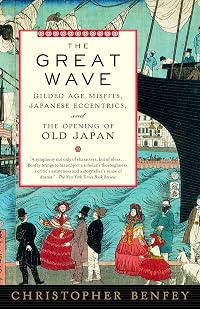
When the United States entered the Gilded Age after the Civil War the nation lost its philosophical moorings and looked eastward to "Old Japan," with its seemingly untouched indigenous culture, for balance and perspective. Japan, meanwhile, was trying to reinvent itself as a more cosmopolitan, modern state, ultimately transforming itself, in the course of twenty-five years, from a feudal backwater to an international power. This great wave of historical and cultural reciprocity between the show more two young nations, which intensified during the late 1800s, brought with it some larger-than-life personalities, as the lure of unknown foreign cultures prompted pilgrimages back and forth across the Pacific. In The great wave, Benfey tells the story of the tightly knit group of nineteenth-century travelers--connoisseurs, collectors, and scientists--who dedicated themselves to exploring and preserving Old Japan. These travelers include Herman Melville, Henry Adams, John La Farge, Lafcadio Hearn, Mabel Loomis Todd, Edward Sylvester Morse, Percival Lowell, and President Theodore Roosevelt. As well, we learn of famous Easterners come West, including Kakuzo Okakura and Shuzo Kuki. show lessTags
Recommendations















Member Recommendations
Member Reviews
Initially, I was very excited to get into this book, as I want to specialize in Meiji-era Japanese Art. Imagine my excitement at a book that for a change wasn’t written by some dreary professor from 50 years past! Alas, that excitement waned as quickly as the quality of the chapters after the first.
The first chapter is phenomenal because it introduces two people from key years of the two countries: a Japanese drifter found by American whale hunters and the famed Herman Melville himself that experienced the initial wave of Japanese-Western exchange after Commodore Perry’s… *ahem*, subtle introduction of American Imperialist strength to Japan. Both of these experiences were wonderfully interwoven to give the readers a taste of how show more the conservative Japanese populace came to see America and its Industrialism, as well as the search for morality Western cultures yearned for in time-secluded Japan. However, I was wary of this book from the start, since Western authors are quick to discount non-western perspectives. Lo and behold, my gut instinct came through yet again— it’s getting very good at determining pompous Western biases, unfortunately.
Aside from Okakura Kakuzo and Nakahama Manjiro (if you won’t read this book, please look these people up regardless!), Japanese people’s perspectives were shunted in favor of hoity rich celebrities of the late 19th century. Some, like Lafcardio Hearn, are rightfully included because they were a part of the Western-Japanese cultural exchange. Others, like Percival Lowell and Mabel Todd were included for the shock factor, I guess? Their interest in Japan was passive at best and Japan’s culture served as a means for their goals, not vice versa. It’s just so frustrating because in a cultural exchange like this, you want to hear both sides of the story, not just how the West used Japan in its superficial search for a deeper meaning in the Orient (super racist and condescending, just so you know). I wanted to learn more about how Japan adopted Western Industrialist standards in addition to their culture and while I know some of this information from my own education, I wanted to learn more about it!
The climate of Meiji era Japan is as such, condensed for simplicity: Japan experienced heavy mood whiplashes towards the West during the Meiji period (Addendum: I am speaking from and Art Historical perspective right now). In the beginning (c.1860s), the imperial state tried to absorb as much Western educational and industrial standards as it could to catch up to the imperial powers, since it had, honestly, a great change of being colonized and cut up like its great influence, China. Then, from about 1880s and 90s, an antipathy wave towards the West surged due to overwhelming nationalism experienced by the people and encouraged by the government. Suddenly, professors imported from the West and their art forms were pushed to the side as Japan promoted their own culture in extreme nationalist tones. This movement was spurred by Japan’s desires to become a great Eastern imperial power, and was equally as propagandistic as it was a response to the superiority complex emanating from the Western Imperial powers.
If this political and cultural intrigue doesn’t pique your interest, I don’t know what will!
But hey, if you’re looking for a book about the 19th century at a passing glance, I won’t bar you from reading this book. However, if you want to learn both sides of the story in this extremely interesting time period, I would suggest skipping it. Hopefully, if I find a book with the same subject material that is better, I’ll update this review! show less
The first chapter is phenomenal because it introduces two people from key years of the two countries: a Japanese drifter found by American whale hunters and the famed Herman Melville himself that experienced the initial wave of Japanese-Western exchange after Commodore Perry’s… *ahem*, subtle introduction of American Imperialist strength to Japan. Both of these experiences were wonderfully interwoven to give the readers a taste of how show more the conservative Japanese populace came to see America and its Industrialism, as well as the search for morality Western cultures yearned for in time-secluded Japan. However, I was wary of this book from the start, since Western authors are quick to discount non-western perspectives. Lo and behold, my gut instinct came through yet again— it’s getting very good at determining pompous Western biases, unfortunately.
Aside from Okakura Kakuzo and Nakahama Manjiro (if you won’t read this book, please look these people up regardless!), Japanese people’s perspectives were shunted in favor of hoity rich celebrities of the late 19th century. Some, like Lafcardio Hearn, are rightfully included because they were a part of the Western-Japanese cultural exchange. Others, like Percival Lowell and Mabel Todd were included for the shock factor, I guess? Their interest in Japan was passive at best and Japan’s culture served as a means for their goals, not vice versa. It’s just so frustrating because in a cultural exchange like this, you want to hear both sides of the story, not just how the West used Japan in its superficial search for a deeper meaning in the Orient (super racist and condescending, just so you know). I wanted to learn more about how Japan adopted Western Industrialist standards in addition to their culture and while I know some of this information from my own education, I wanted to learn more about it!
The climate of Meiji era Japan is as such, condensed for simplicity: Japan experienced heavy mood whiplashes towards the West during the Meiji period (Addendum: I am speaking from and Art Historical perspective right now). In the beginning (c.1860s), the imperial state tried to absorb as much Western educational and industrial standards as it could to catch up to the imperial powers, since it had, honestly, a great change of being colonized and cut up like its great influence, China. Then, from about 1880s and 90s, an antipathy wave towards the West surged due to overwhelming nationalism experienced by the people and encouraged by the government. Suddenly, professors imported from the West and their art forms were pushed to the side as Japan promoted their own culture in extreme nationalist tones. This movement was spurred by Japan’s desires to become a great Eastern imperial power, and was equally as propagandistic as it was a response to the superiority complex emanating from the Western Imperial powers.
If this political and cultural intrigue doesn’t pique your interest, I don’t know what will!
But hey, if you’re looking for a book about the 19th century at a passing glance, I won’t bar you from reading this book. However, if you want to learn both sides of the story in this extremely interesting time period, I would suggest skipping it. Hopefully, if I find a book with the same subject material that is better, I’ll update this review! show less
An interesting look at many of the connections that literary, artistic, political and other folks -- primarily in the Boston/New England region -- had with each other and with Japan during the late 1800s and early 1900s. Centering heavily on Boston and its art museums and benefactors, you also learn about that region's influence on Japan, and Japan's influence on it and American society in general. It does meander at times, plunging into grand (but interesting!) diversions that seem at first disconnected yet ultimately make sense related to Japan, but overall a great read. Originally written on Oct 17, 2007 at 02:08AM
The Japanese archipelago was closed to all foreigners (on penalty of death) until Admiral Perry's "kurofune" (black ships) forced open Tokyo Bay, and triggered an internal "Meji Restoration" which placed top priority on modernizing the Japanese economy and military in 1868. During the Belle Époque from 1870-World War I, Japan became a favored go-to destination for scholars, adventurers, and artists, who couldn't get enough of this new and novel, previously-unknown culture. The book follows some of the most prominent Westerners, as well as emissaries from Japan who traveled to the Occident and became minor celebrities.
The book is not overly scholarly; it's basically a period piece, showing how bits and pieces of Japanese culture were show more eagerly consumed and imitated by the West- mainly by the United States. The one thing that came as a surprise to me was how Boston was the undisputed epicenter of the early 20th century American obsession with Japan. Socialite/art collector Isabella Stewart Gardner funded numerous purchasing expeditions, and even today, the Boston Museum of Fine Arts and the Isabella Stewart Gardner Museum have the most extensive collections of Japanese classical art outside of Japan. Many of the other luminaries mentioned in this book were in Gardner's social orbit during this time: zoologist Edward Morse (Boston University has an auditorium named after him), astronomer Percival Lowell (whose discovery of trenches on Mars led to the popular belief that intelligent life must have dug these canals; thus fueling H.G. Wells to write "War of the Worlds"), and the sexually twisted astronomer/author power couple David and Mabel Todd (Mabel wrote Emily Dickenson's biography). Herman Melville is also mentioned.
To be honest, the book didn't exactly knock my socks off, but it was interesting to see how much cultural cross-pollination occurred between Japan and the US before World War I. Since the end of World War II, Japan and the US have shared an amazingly close relationship- in part because the US occupied Japan, and set up many of its modern-day institutions, modeled on our own image. This book clarified my own misconception that the two nations hadn't been particularly close before then. show less
The book is not overly scholarly; it's basically a period piece, showing how bits and pieces of Japanese culture were show more eagerly consumed and imitated by the West- mainly by the United States. The one thing that came as a surprise to me was how Boston was the undisputed epicenter of the early 20th century American obsession with Japan. Socialite/art collector Isabella Stewart Gardner funded numerous purchasing expeditions, and even today, the Boston Museum of Fine Arts and the Isabella Stewart Gardner Museum have the most extensive collections of Japanese classical art outside of Japan. Many of the other luminaries mentioned in this book were in Gardner's social orbit during this time: zoologist Edward Morse (Boston University has an auditorium named after him), astronomer Percival Lowell (whose discovery of trenches on Mars led to the popular belief that intelligent life must have dug these canals; thus fueling H.G. Wells to write "War of the Worlds"), and the sexually twisted astronomer/author power couple David and Mabel Todd (Mabel wrote Emily Dickenson's biography). Herman Melville is also mentioned.
To be honest, the book didn't exactly knock my socks off, but it was interesting to see how much cultural cross-pollination occurred between Japan and the US before World War I. Since the end of World War II, Japan and the US have shared an amazingly close relationship- in part because the US occupied Japan, and set up many of its modern-day institutions, modeled on our own image. This book clarified my own misconception that the two nations hadn't been particularly close before then. show less
An amazing look at some of the American progressives, that came to Japan after the opening up of the country, to look for a more "pure" place. Great stories and personalities. This book gives an understanding of what kind of currents were in the intellectual scene of Boston in particular. Also shows that these people, who thought they found the "authentic Japan", were all shown the same tourist attractions. Recommended!
Loved this book. For more, see here:
http://www.gordsellar.com/2011/07/21/the-great-wave-gilded-age-misfits-japanese-...
http://www.gordsellar.com/2011/07/21/the-great-wave-gilded-age-misfits-japanese-...
Ratings
Members
- Recently Added By
Author Information

15+ Works 868 Members
Christopher Benfey is Mellon Professor of English at Mount Holyoke College.
Common Knowledge
- Important places
- Japan
Classifications
Statistics
- Members
- 242
- Popularity
- 134,386
- Reviews
- 5
- Rating
- (3.90)
- Languages
- English
- Media
- Paper, Ebook
- ISBNs
- 3
- ASINs
- 4