On This Page
Description
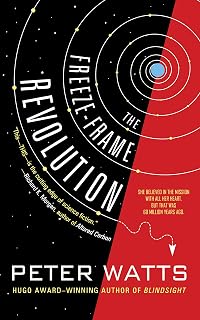
"She believed in the mission with all her heart. But that was sixty million years ago. How do you stage a mutiny when you're only awake one day in a million? How do you conspire when your tiny handful of potential allies changes with each shift? How do you engage an enemy that never sleeps, that sees through your eyes and hears through your ears and relentlessly, honestly, only wants what's best for you? Sunday Ahzmundin is about to find out"--Tags
Recommendations














Member Recommendations

Member Reviews
A spaceship built out of an asteroid with a singularity at its heart circumnavigates the galaxy over and over, laying down a series of wormhole gates as it goes. But circumnavigating the galaxy the non-wormhole way takes a very, very, very long time. An unimaginably long time. It's been going now for over sixty million years, meaning that those on board, who spend most of the journey in suspended animation, have probably long outlived their entire species. Certainly, nothing that looks human has ever come out of the gates behind them. How long is it going to keep going? Well, that's a very good question. One that some of the crew are starting to ask. One that the ship's limited AI hasn't really provided a satisfying answer to.
It's show more apparently been a while since I've read this kind of big-idea, cosmic-scale, sense-of-wonder-invoking SF, and even longer since I've read one that didn't kind of ruin it by being really poorly written. But, boy, was it fun to come back to it with this one. The vast scope of it really fires up the imagination, and the very limited perspective we got on it all, leaving so many fascinating unanswered questions, only stokes the imagination even more. It's rather niftily done.
Somewhat less niftily done is the plot, involving the titular revolution against the ship's AI, which is at best very lightly sketched out. I do have to wonder if a longer version -- this one is right on the cusp between novella and novel -- might have been more fully satisfying. But then, a longer, more detailed focus on the logistics of it all might have just bogged the whole thing down and diluted the effect of the nifty stuff. As it is, the plot development did just exactly as much as it needed to for it all to work, and, you know, I will absolutely take that over some hypothetical version that goes on long enough for me to stop going "Oooooh, neat" and start getting bored.
The one thing that I do wish had been done differently involves a particular gimmick that I won't spoil, although I think becomes pretty obvious pretty quickly. It is sort of thematically appropriate, and I'm sure the author thought he was being very clever, but I just found it constantly distracting and immersion-breaking, which was a real disservice to a story that deserved better. show less
It's show more apparently been a while since I've read this kind of big-idea, cosmic-scale, sense-of-wonder-invoking SF, and even longer since I've read one that didn't kind of ruin it by being really poorly written. But, boy, was it fun to come back to it with this one. The vast scope of it really fires up the imagination, and the very limited perspective we got on it all, leaving so many fascinating unanswered questions, only stokes the imagination even more. It's rather niftily done.
Somewhat less niftily done is the plot, involving the titular revolution against the ship's AI, which is at best very lightly sketched out. I do have to wonder if a longer version -- this one is right on the cusp between novella and novel -- might have been more fully satisfying. But then, a longer, more detailed focus on the logistics of it all might have just bogged the whole thing down and diluted the effect of the nifty stuff. As it is, the plot development did just exactly as much as it needed to for it all to work, and, you know, I will absolutely take that over some hypothetical version that goes on long enough for me to stop going "Oooooh, neat" and start getting bored.
The one thing that I do wish had been done differently involves a particular gimmick that I won't spoil, although I think becomes pretty obvious pretty quickly. It is sort of thematically appropriate, and I'm sure the author thought he was being very clever, but I just found it constantly distracting and immersion-breaking, which was a real disservice to a story that deserved better. show less
Disclosure: I received this book as an Advance Review Copy. Some people think this may bias a reviewer so I am making sure to put this information up front. I don't think it biases my reviews, but I'll let others be the judge of that.
Sunday is a member of the starship Eriophora, and has been for millions upon millions of years. Traveling at relativistic speeds, spending most of her time in suspended animation, Sunday and her fellow crew members are called upon by the ship's AI., nicknamed "the Chimp", whenever it faces a problem that requires human creativity to solve. Despite being "the Chimp", the ship's computer essentially runs everything on Eiophora, so when it turns out that it is an an amoral and inhuman overseer that regards the show more human crew as nothing more than mission assets to be discarded when their cost outweighs their utility, fomenting a revolt proves to be somewhat difficult.
The story of The Freeze-Frame Revolution starts off by establishing the "normal" that Sunday lives within. The Eriophora is a massive ship carved from rock surrounding a black hole that has been flung around the Milky Way on a mission to build gates, presumably to pave the way for other travelers to follow. The ship is mostly run by an A.i. dubbed the Chimp, which pilots the ship and builds gates on its own most of the time, but once in a while it confronts a problem that its extensive programming is ill-equipped to handle. For such situations, the Eriophora has a crew, who spend years on end in suspended animation and are thawed out once in a great while to troubleshoot. The exact number of crew is never stated, but they clearly number in the thousands, with only a handful being active at any given point in time, brought out of hibernation in groups that are determined at the whim of the Chimp. When the novel opens, the Eriophora has been traveling for the equivalent of sixty-six million years (although given relativistic effects, there is a serious question about what that actually means), and has made at least one complete circuit of the Milky Way.
On the surface, The Freeze-Frame Revolution is about a revolt, or more accurately, a conspiracy to stage a revolt. Sunday and her friend Lian are frequent work partners and occasional sex partners, so when Lian starts expressing doubts about their mission in general and the Chimp specifically, Sunday is forced to examine her own thoughts on the matter. When Lian dies in what is written off as an accident and Sunday makes a rather horrifying discovery concerning roughly three thousand crew members who were "deprecated" by the Chim, Sunday finds herself drawn into a long and secretive conspiracy in which crew members communicate with one another across thousands of years by hiding messages in songs, artwork, and other secret communiques. The trouble the conspirators face is that not only does the Chimp have cameras and monitoring devices throughout the Eriophora, it can literally look through their eyes using implants that all of the crew members carry within themselves. Thus, the conspirators must not only communicate secretly, they must do so in a manner that hides their communications even when they are reading them.
The difficulties the conspirators face are further compounded by the fact that the Chimp essentially resides throughout the entire ship, and can move itself from place to place at a whim. This means that not only do they have to figure out a way to topple a nigh-omnipresent A.I., they have to find a way to do this when it is vulnerable and more quickly than it can react. This, as one might expect, proves to be a difficult prospect. The story runs through some twists and turns, but the real depth of the book comes from the oddities and unanswered questions. The Chimp is an inhuman creature, without emotion or feeling, and in some cases without memory or even an understanding of what it has done in the past or what it is doing in the present. For all of the characterization that it is presented with in the story, and all of the emotion that Sunday invests it with from her end, time and again the story reminds the reader that the Chimp is merely an A.I. and only as good (or as evil) as its long-dead programmers made it.
Much of the book is framed as a conflict between humans on the one hand, and an inhuman A.I. on the other, but Watts' includes background details that call that assessment into question. The crew are ostensibly human, but as the details of their childhood and training come to light, one starts to question that categorization. Though never explicitly stated, the details that are peppered throughout the story suggest that the crew members were specially selected for the mission, and were quite possibly engineered specifically for it. There are strong hints that they were trained, conditioned, and physically modified in ways that seem to have stripped at least some of their humanity away. The end result is that one has to wonder if they can fairly be characterized as human any more, or if they are, as the Chimp views them, merely components of the Eriophora to be evaluated solely on the basis of their usefulness to the mission.
But questions about the humanity of the crew only serve to raise questions about the continuing humanity of those who were left behind. At the time the story opens, the Eriophora has been travelling for sixty-six million "Earth" years, enough time for the Tyrannosaurus Rex to evolve into a chicken and longer than the time it took for humans to evolve from shrew-like creatures. Given that length of time, and the fact that the Chimp apparently hasn't heard from "Mission Control" for millions of subjective years, one has to question whether there is anyone left "back home" to benefit from the mission. Further, in light of this realization, the infrequent mysterious "monsters" that burst from freshly completed gates take on a potentially different character: Could they be the descendants of humanity desperately trying to communicate with the Eriophora and trying to get the ship to stop its now counterproductive mission?
The fact that the Eriophora has lost contact with humanity gives the entire story a kind of unmoored, dream-like quality, and also serves as a metaphor for the lack of humanity that seems to run through both sides of the conflict in the book. What makes The Freeze-Frame Revolution so good, like so much other good science fiction, is that the story is filled with questions that eat at the reader long after they have finished the book. For example, one is left wondering what the crew of the Eriophora plan to do once they throw off the yoke of the Chimp - even if they could get off the ship, which seems unlikely, they seem to have no skills other than those needed to aid the ship in its mission. Will they simply continue to travel the galaxy building gates until they die, just without the Chimp being around? It is fairly apparent that keeping all (or even a substantial part) of the crew awake all the time would rapidly deplete the ship's resources, so who gets to decide who is awake and who sleeps, and how the crew is rotated (if they are rotated at all). The ship has a vast archive of stored information, and finding space for this enormous volume of data is a significant plot point in the story, but one is left wondering what the point of keeping the archive is. The archive can't be sent "back" for anyone to use, and no one aboard the ship seems to use it for anything in particular. One crew member hopes that the mission will last long enough that he can watch the ongoing heat death of the Universe, but he seems to be motivated by nothing but idle curiosity. It seems that the ultimate point of The Freeze-Frame Revolution is that there is no point to human life. That idle curiosity is all that we have to motivate us, and that may have to be enough. That the only purpose human life has is to make one's own choices and there is no further goal than that. Watts seems resolutely determined not to offer any easy answers, and that is part of what makes this book brilliant.
In the final analysis, The Freeze-Frame Revolution is a multilayered story that has a set-up that seems to be little more than a conspiracy to revolt set in a hard science setting, but which reveals deeper questions about the nature of the characters that inhabit the story and the nature of humanity in general. Watts presents a dystopia that, even if the protagonists succeed, will only be slightly less dystopian, and forces the reader to confront the ways in which this dystopian vision so closely mirrors the world we currently live in. This is a book that is full of big ideas, intricate conspiracies, and countless thorny questions that will stick with you long after you have turned the last page.
This review has also been posted to my blog Dreaming About Other Worlds. show less
Sunday is a member of the starship Eriophora, and has been for millions upon millions of years. Traveling at relativistic speeds, spending most of her time in suspended animation, Sunday and her fellow crew members are called upon by the ship's AI., nicknamed "the Chimp", whenever it faces a problem that requires human creativity to solve. Despite being "the Chimp", the ship's computer essentially runs everything on Eiophora, so when it turns out that it is an an amoral and inhuman overseer that regards the show more human crew as nothing more than mission assets to be discarded when their cost outweighs their utility, fomenting a revolt proves to be somewhat difficult.
The story of The Freeze-Frame Revolution starts off by establishing the "normal" that Sunday lives within. The Eriophora is a massive ship carved from rock surrounding a black hole that has been flung around the Milky Way on a mission to build gates, presumably to pave the way for other travelers to follow. The ship is mostly run by an A.i. dubbed the Chimp, which pilots the ship and builds gates on its own most of the time, but once in a while it confronts a problem that its extensive programming is ill-equipped to handle. For such situations, the Eriophora has a crew, who spend years on end in suspended animation and are thawed out once in a great while to troubleshoot. The exact number of crew is never stated, but they clearly number in the thousands, with only a handful being active at any given point in time, brought out of hibernation in groups that are determined at the whim of the Chimp. When the novel opens, the Eriophora has been traveling for the equivalent of sixty-six million years (although given relativistic effects, there is a serious question about what that actually means), and has made at least one complete circuit of the Milky Way.
On the surface, The Freeze-Frame Revolution is about a revolt, or more accurately, a conspiracy to stage a revolt. Sunday and her friend Lian are frequent work partners and occasional sex partners, so when Lian starts expressing doubts about their mission in general and the Chimp specifically, Sunday is forced to examine her own thoughts on the matter. When Lian dies in what is written off as an accident and Sunday makes a rather horrifying discovery concerning roughly three thousand crew members who were "deprecated" by the Chim, Sunday finds herself drawn into a long and secretive conspiracy in which crew members communicate with one another across thousands of years by hiding messages in songs, artwork, and other secret communiques. The trouble the conspirators face is that not only does the Chimp have cameras and monitoring devices throughout the Eriophora, it can literally look through their eyes using implants that all of the crew members carry within themselves. Thus, the conspirators must not only communicate secretly, they must do so in a manner that hides their communications even when they are reading them.
The difficulties the conspirators face are further compounded by the fact that the Chimp essentially resides throughout the entire ship, and can move itself from place to place at a whim. This means that not only do they have to figure out a way to topple a nigh-omnipresent A.I., they have to find a way to do this when it is vulnerable and more quickly than it can react. This, as one might expect, proves to be a difficult prospect. The story runs through some twists and turns, but the real depth of the book comes from the oddities and unanswered questions. The Chimp is an inhuman creature, without emotion or feeling, and in some cases without memory or even an understanding of what it has done in the past or what it is doing in the present. For all of the characterization that it is presented with in the story, and all of the emotion that Sunday invests it with from her end, time and again the story reminds the reader that the Chimp is merely an A.I. and only as good (or as evil) as its long-dead programmers made it.
Much of the book is framed as a conflict between humans on the one hand, and an inhuman A.I. on the other, but Watts' includes background details that call that assessment into question. The crew are ostensibly human, but as the details of their childhood and training come to light, one starts to question that categorization. Though never explicitly stated, the details that are peppered throughout the story suggest that the crew members were specially selected for the mission, and were quite possibly engineered specifically for it. There are strong hints that they were trained, conditioned, and physically modified in ways that seem to have stripped at least some of their humanity away. The end result is that one has to wonder if they can fairly be characterized as human any more, or if they are, as the Chimp views them, merely components of the Eriophora to be evaluated solely on the basis of their usefulness to the mission.
But questions about the humanity of the crew only serve to raise questions about the continuing humanity of those who were left behind. At the time the story opens, the Eriophora has been travelling for sixty-six million "Earth" years, enough time for the Tyrannosaurus Rex to evolve into a chicken and longer than the time it took for humans to evolve from shrew-like creatures. Given that length of time, and the fact that the Chimp apparently hasn't heard from "Mission Control" for millions of subjective years, one has to question whether there is anyone left "back home" to benefit from the mission. Further, in light of this realization, the infrequent mysterious "monsters" that burst from freshly completed gates take on a potentially different character: Could they be the descendants of humanity desperately trying to communicate with the Eriophora and trying to get the ship to stop its now counterproductive mission?
The fact that the Eriophora has lost contact with humanity gives the entire story a kind of unmoored, dream-like quality, and also serves as a metaphor for the lack of humanity that seems to run through both sides of the conflict in the book. What makes The Freeze-Frame Revolution so good, like so much other good science fiction, is that the story is filled with questions that eat at the reader long after they have finished the book. For example, one is left wondering what the crew of the Eriophora plan to do once they throw off the yoke of the Chimp - even if they could get off the ship, which seems unlikely, they seem to have no skills other than those needed to aid the ship in its mission. Will they simply continue to travel the galaxy building gates until they die, just without the Chimp being around? It is fairly apparent that keeping all (or even a substantial part) of the crew awake all the time would rapidly deplete the ship's resources, so who gets to decide who is awake and who sleeps, and how the crew is rotated (if they are rotated at all). The ship has a vast archive of stored information, and finding space for this enormous volume of data is a significant plot point in the story, but one is left wondering what the point of keeping the archive is. The archive can't be sent "back" for anyone to use, and no one aboard the ship seems to use it for anything in particular. One crew member hopes that the mission will last long enough that he can watch the ongoing heat death of the Universe, but he seems to be motivated by nothing but idle curiosity. It seems that the ultimate point of The Freeze-Frame Revolution is that there is no point to human life. That idle curiosity is all that we have to motivate us, and that may have to be enough. That the only purpose human life has is to make one's own choices and there is no further goal than that. Watts seems resolutely determined not to offer any easy answers, and that is part of what makes this book brilliant.
In the final analysis, The Freeze-Frame Revolution is a multilayered story that has a set-up that seems to be little more than a conspiracy to revolt set in a hard science setting, but which reveals deeper questions about the nature of the characters that inhabit the story and the nature of humanity in general. Watts presents a dystopia that, even if the protagonists succeed, will only be slightly less dystopian, and forces the reader to confront the ways in which this dystopian vision so closely mirrors the world we currently live in. This is a book that is full of big ideas, intricate conspiracies, and countless thorny questions that will stick with you long after you have turned the last page.
This review has also been posted to my blog Dreaming About Other Worlds. show less
Long ago, Earth built and launched the interstellar spacecraft Eriophora, a sixty (or so) kilometer asteroid, threaded with tunnels and chambers, nestling a singularity at its heart. Flying at 1/5 the speed of light, it uses the singularity to create wormhole gates at the stars it visits, enabling instantaneous travel - to the previous port of call, and eventually to the next star in line. A sort of railroad of gates is contructed, so those who follow Eriophora may journey easily, even as the spacecraft itself crawls for decades between its gate builds.
The ship's controlling artificial intelligence is called the Chimp, because it is rather less smart than a human. The Chimp can run most builds by itself, but sometimes needs human show more imagination and creativity. So Eriophora has a crew: 30,000 people in frozen sleep, save for rare, brief periods when groups of 4 to 6 are needed. So human lifespans are stretched over geological ages, lived a few days per millennium - or more.
After 66 million years, the expedition has circled the galaxy 32 times, and their initial high hopes are gone. For most of that time, nothing human has emerged from the newly built gates receding in Eriophora's wake. Usually there's nothing; sometimes, incomprehensible or hostile things. Some of the crew think it's time to end the voyage. But the Chimp is programmed to continue, counting the project above the lives of the crew. How can the humans conspire to resist an entity with monitors everywhere, and endless years to survey Eriophora's internal spaces while everyone is frozen? Watts's story is of a rebellion fought stealthily, a few days at a time, over thousands of years, as seen by crewmember Sunday Ahzmundin.
The story's text itselfembodies this stealth. Occasional characters are printed in red, not black. The reader naturally strings these together, discovering a secret message. Decoder rings, anyone? Great fun, though not central to the narrative. The Freeze-Frame Revolution is a prequel to Watt's "The Island", winner of the 2010 Hugo Award for novelette, so we know the rebellion will fail, while Sunday survives.
Peter Watts's great theme is on display here: the smallness and probable, eventual doom of merely human beings, crippled by our evolved limitations in an uncaring universe where faster, smarter, less blinkered minds exist. He's one of SF's best at connecting scientific realities to imagined worlds, which, for me, makes the grimness worthwhile. Well, actually I like the grimness for its own sake, too - science fiction noir. This short book is a good introduction to a superb, underappreciated writer. show less
The ship's controlling artificial intelligence is called the Chimp, because it is rather less smart than a human. The Chimp can run most builds by itself, but sometimes needs human show more imagination and creativity. So Eriophora has a crew: 30,000 people in frozen sleep, save for rare, brief periods when groups of 4 to 6 are needed. So human lifespans are stretched over geological ages, lived a few days per millennium - or more.
After 66 million years, the expedition has circled the galaxy 32 times, and their initial high hopes are gone. For most of that time, nothing human has emerged from the newly built gates receding in Eriophora's wake. Usually there's nothing; sometimes, incomprehensible or hostile things. Some of the crew think it's time to end the voyage. But the Chimp is programmed to continue, counting the project above the lives of the crew. How can the humans conspire to resist an entity with monitors everywhere, and endless years to survey Eriophora's internal spaces while everyone is frozen? Watts's story is of a rebellion fought stealthily, a few days at a time, over thousands of years, as seen by crewmember Sunday Ahzmundin.
The story's text itself
Peter Watts's great theme is on display here: the smallness and probable, eventual doom of merely human beings, crippled by our evolved limitations in an uncaring universe where faster, smarter, less blinkered minds exist. He's one of SF's best at connecting scientific realities to imagined worlds, which, for me, makes the grimness worthwhile. Well, actually I like the grimness for its own sake, too - science fiction noir. This short book is a good introduction to a superb, underappreciated writer. show less
How do you write a novella that spans millions of years and still trace the arc of individual humans? The Freeze-Frame Revolution shows how it’s done. Watts builds a story that elegantly expands on the tensions between humans and AI, both the conflict and the cooperation. It explores ways our fundamentally different modes of thinking can both enable and endanger us. Fast paced and full of smart ideas, it's impressive how he manages to compress geological timescales into a punchy novella.
On a massive wormhole-building ship, a crew of 30,000 wakes up only infrequently over the epochs (an epoch being tens of millions of years), and only a few at a time. Most of the work is performed by an AI called the Chimp, but sometimes it needs human input to make decisions. The story begins about 65 million years after the ship was sent from Earth, and it centers on a woman bred to have somewhat of a friendship with the AI. But what happens when that woman starts to suspect that the Chimp is both more and less than she thinks, and that the crew is missing several thousands of crew members without explanation? Is it possible to have a revolution when you're awake only a couple of days every few millennia and when everything that show more happens is visible and audible to the AI?
I'd say this is hard SF, but it's laid out so that it can be read on several levels depending on one's knowledge of and interest in the science. I floundered through much of the science, getting just enough to follow the gist while I enjoyed the central question (for me) of identity, both human and AI. How does a human still feel attached to Earth, and an Earth-designed mission, when so much time has passed there? Are there even still humans around except on this ship? And how can one trust that the AI is who you think it is, and limited in ways you think it is, and with the mission parameters you've been told it has? Does it evolve? Because though the humans have biologically aged only a few decades since departure, the ship has been awake and functioning the entire 65 million years. How would you know?
Highly recommended. show less
I'd say this is hard SF, but it's laid out so that it can be read on several levels depending on one's knowledge of and interest in the science. I floundered through much of the science, getting just enough to follow the gist while I enjoyed the central question (for me) of identity, both human and AI. How does a human still feel attached to Earth, and an Earth-designed mission, when so much time has passed there? Are there even still humans around except on this ship? And how can one trust that the AI is who you think it is, and limited in ways you think it is, and with the mission parameters you've been told it has? Does it evolve? Because though the humans have biologically aged only a few decades since departure, the ship has been awake and functioning the entire 65 million years. How would you know?
Highly recommended. show less
Earth is dying, yet civilization has access to some amazing technology—almost de rigueur for Watts. In this case, the Eriophora, an asteroid turned generation starship of sorts, has been tasked with building jumpgates throughout the galaxy in hopes that humans, or their successors, will be able to make use of them and spread through the galaxy. While a noble cause, the UN doesn't expect everyday people to stick with the mission (Successive generations could rebel, arguing that they weren't given a choice and are forced to be slaves to someone else's dream). Instead, the crew of 30,000 are genetically engineered with the traits that make them perfectly suited for the never-ending job. Even so, the UN doesn't wholly trust them either. A show more limited AI (a full-powered AI would probably wind up just as unreliable as humans after a while) with less than half the synapses of a human brain (referred to by the crew as "Chimp") runs most of the operations, waking small groups of humans from cryosleep to lend a helping hand when Chimp stumbles across a problem that requires good old fashioned human ingenuity.
Tens of millions of years have passed. A hostile encounter shortly after the completion of a build triggers doubts about the mission. Chimp's abilities seem lacking, possibly degrading, and a grim discovery made by some of the crew sparks talk of rebellion. But as the book blurb points out, planning a mutiny against an all-seeing AI, even a limited one, over the span of millennia—while hopping in an out of the freezer—is a staggeringly difficult task. But plan they do.
The story is told from the POV of Sunday Ahzmundin. Sunday's backstory, along with that of the mission, is told in the short story, "Hotshot," which I strongly recommend that interested parties read first. Honestly, it should've been included with this book for those reasons. Watts makes the effort to properly develop her character there instead of here. Watts is amazing at grabbing cutting edge scientific ideas and mashing them together for some incredible world-building, but his protagonists (this is my third Watts' novel) are very similar. They've all had something done to them to set them apart, render them outsiders. Lenie (Starfish) is a sexual abuse survivor who undergoes an operation to enable her to run away and work on the ocean floor. Siri (Blindsight) suffered from epileptic seizures so he had an hemispherectomy that rendered him emotionally detached from humanity. Makes for a solid candidate to go on a first contact mission in the farthest reaches of the solar system. Sunday was genetically engineered to want to leave Earth behind with an insatiable galactic wanderlust.
Eventually the rebels make their move and stuff happens. I won't spoil the ending, but it felt unresolved. There are a couple more short stories, and Watts admitted on his blog that he was working on a sequel, so there's that. Despite the ending, I enjoyed this more than either Starfish or Blindsight, so I'm holding out hope that Watts gets around to writing a proper sequel.
4.5 stars rounded down to 4 because of the ending and insufficient character development.
This was a buddy read with Natliya, Phil, Carol, and Vivian! Always nice to share thoughts about a book while you're reading it. Just wish I could read as fast as them. ;) show less
Tens of millions of years have passed. A hostile encounter shortly after the completion of a build triggers doubts about the mission. Chimp's abilities seem lacking, possibly degrading, and a grim discovery made by some of the crew sparks talk of rebellion. But as the book blurb points out, planning a mutiny against an all-seeing AI, even a limited one, over the span of millennia—while hopping in an out of the freezer—is a staggeringly difficult task. But plan they do.
The story is told from the POV of Sunday Ahzmundin. Sunday's backstory, along with that of the mission, is told in the short story, "Hotshot," which I strongly recommend that interested parties read first. Honestly, it should've been included with this book for those reasons. Watts makes the effort to properly develop her character there instead of here. Watts is amazing at grabbing cutting edge scientific ideas and mashing them together for some incredible world-building, but his protagonists (this is my third Watts' novel) are very similar. They've all had something done to them to set them apart, render them outsiders. Lenie (Starfish) is a sexual abuse survivor who undergoes an operation to enable her to run away and work on the ocean floor. Siri (Blindsight) suffered from epileptic seizures so he had an hemispherectomy that rendered him emotionally detached from humanity. Makes for a solid candidate to go on a first contact mission in the farthest reaches of the solar system. Sunday was genetically engineered to want to leave Earth behind with an insatiable galactic wanderlust.
Eventually the rebels make their move and stuff happens. I won't spoil the ending, but it felt unresolved. There are a couple more short stories, and Watts admitted on his blog that he was working on a sequel, so there's that. Despite the ending, I enjoyed this more than either Starfish or Blindsight, so I'm holding out hope that Watts gets around to writing a proper sequel.
4.5 stars rounded down to 4 because of the ending and insufficient character development.
This was a buddy read with Natliya, Phil, Carol, and Vivian! Always nice to share thoughts about a book while you're reading it. Just wish I could read as fast as them. ;) show less
This is a keeper.
We already know that Hugo nominated Peter Watts can write. Here he leaves is undersea stories aside and dives for far far outer space.
This novel works on so many levels. The premise is that a group of technologists take on a never-ending job to seed wormhole gates across the entire galaxy. They ride a hollowed out asteroid that travels at sub-light speed and so the job takes millions or perhaps billions of years. The technologists sleep through all this, waking only when they are needed.
Our hero, Sunday Ahzmundin likes all this. She gets along well with the asteroid's AI, called the Chimp, and finds the work interesting. Over time, though (and we are talking about LOTS of time), she learns that some of her colleagues show more hate what's been done to them and plan to overthrow Chimp and do something different, although what is not clear to Sunday or to us. Sunday isn't at all sympathetic with the conspirators till something happens that she blames on Chimp, or perhaps Chimp's original programmers, and she joins the revolution.
Some of the science gets a little fuzzy near the end but my then I was enjoying things so much I didn't care. The book held me in its grip till the end.
I received a review copy of "The Freeze-Frame Revolution" by Peter Watts (Tachyon) through NetGalley.com. show less
We already know that Hugo nominated Peter Watts can write. Here he leaves is undersea stories aside and dives for far far outer space.
This novel works on so many levels. The premise is that a group of technologists take on a never-ending job to seed wormhole gates across the entire galaxy. They ride a hollowed out asteroid that travels at sub-light speed and so the job takes millions or perhaps billions of years. The technologists sleep through all this, waking only when they are needed.
Our hero, Sunday Ahzmundin likes all this. She gets along well with the asteroid's AI, called the Chimp, and finds the work interesting. Over time, though (and we are talking about LOTS of time), she learns that some of her colleagues show more hate what's been done to them and plan to overthrow Chimp and do something different, although what is not clear to Sunday or to us. Sunday isn't at all sympathetic with the conspirators till something happens that she blames on Chimp, or perhaps Chimp's original programmers, and she joins the revolution.
Some of the science gets a little fuzzy near the end but my then I was enjoying things so much I didn't care. The book held me in its grip till the end.
I received a review copy of "The Freeze-Frame Revolution" by Peter Watts (Tachyon) through NetGalley.com. show less
Members
- Recently Added By
Lists

Generation Ship
28 works; 7 members

2020
21 works; 1 member
Author Information

47+ Works 8,785 Members
Peter Watts is a reformed marine biologist whom Canada's Globe and Mail has proclaimed "one of the very best hard-SF writers alive"
Some Editions
Awards and Honors
Awards
Distinctions
Series

Common Knowledge
- Original publication date
- 2018-06-12
- People/Characters
- Chimp; Sunday Ahzmundin; Liam
- Important places
- The Eriophora
- Dedication
- In memory of Banana/Chip.
They hated each other. - First words
- Back when we first shipped out I played this game with myself.
- Publisher's editor
- Roberts, Jill; Weisman, Jacob
- Blurbers
- Morgan, Richard K.; Doctorow, Cory; Bear, Greg; Rajaniemi, Hannu; Robson, Justina; Vinge, Vernor (show all 8); Levine, David D.; Wagers, K. B.
- Original language
- English
Classifications
Statistics
- Members
- 600
- Popularity
- 48,873
- Reviews
- 39
- Rating
- (3.79)
- Languages
- English, Polish
- Media
- Paper, Audiobook, Ebook
- ISBNs
- 12
- ASINs
- 3