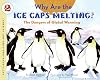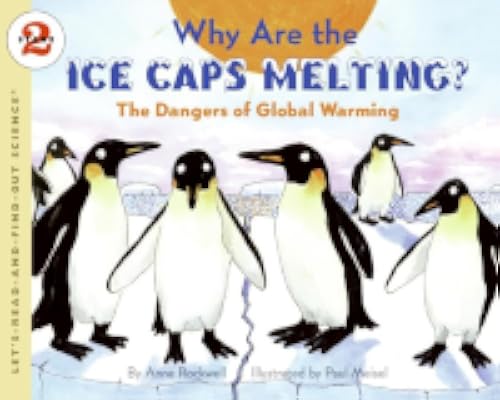
Why Are the Ice Caps Melting?
by Anne Rockwell
On This Page
Description
Tells about the greenhouse effect, recycling, and what you can do to help fight global warming.Tags
Recommendations
























Member Reviews
The climate is changing, sea levels are rising and the earth may be in trouble. If this sounds scary to you, you're not alone: many scientists are also worried about global warming. This book provides a gentle, but no-nonsense introduction to global warming for elementary school students. Concepts like the greenhouse effect and melting ice caps are explained clearly through simple but accurate language and appealing diagrams and illustrations. The argument that global warming may be a natural process is also presented and considered, though the author urges readers to err on the side of reducing carbon emissions regardless. The information is presented in an urgent, but not frightening manner, encouraging kids to do their part by show more recycling, writing letters and riding bicycles. I would have appreciated more information about larger scale efforts that adults are making to combat the situation, too -- after all, there is only so much one second grader can be expected to do! Also, a few of the solutions suggested seem dubious. On one page, for example, the text reads, "We can buy foods that aren't prepackaged, because all those paper packages are made from trees." The illustration shows a little boy helping his father bag up oranges at the grocery store while a snow storm rages outside. Even without packaging, transporting these fruits from thousands of miles south is hardly environmentally friendly. Nevertheless, this book provides a good, readable introduction to a very important and timely topic. I would recommend it for an elementary school audience. show less
The book Why Are the Ice Caps melting by Anne Rockwell delves into the process of global warming in a serious but not scary way. She uses illustrations and solid information to discuss important and adult feeling topics in a way that is appropriate for younger grades. I grabbed this book to connect with the NGSS science standard Earth's Systems which asks students to develop a model using an example to describe ways the geosphere, biosphere, hydrosphere and atmosphere connect. These more serious topics are great to start delving into in the 5th grade and I think my current students would be able to create discussion based on this book very well.
Hynes Library:
A little too wordy for a read aloud, but I really like the simplistic illusrtations and the text was very informative for older studnets or for a teacher to use as a lesson.
A little too wordy for a read aloud, but I really like the simplistic illusrtations and the text was very informative for older studnets or for a teacher to use as a lesson.
Lesson: How Do Family Members Take Care of Each Other?
Ratings
Members
- Recently Added By
Lists

Children's Books About Science and Math
461 works; 12 members
Author Information

218+ Works 21,932 Members
Anne Rockwell was born in Memphis, Tennessee on February 8, 1934. She moved to New York City at the age of 18 and found a job doing typing work for a textbook publisher. She studied at Pratt Graphic Arts Center and at the Sculpture Center. She became an author and illustrator. Her first children's book, Paul and Arthur Search for the Egg, was show more published in 1964. Her other books included Boats, Fire Engines, Things That Go, Our Earth, and Only Passing Through: The Story of Sojourner Truth. She collaborated on several books with her husband Harlow Rockwell including Sally's Caterpillar and The Toolbox. After her husband's death, she collaborated with her daughter Lizzy Rockwell. Their books included Career Day and Zoo Day. She died of natural causes on April 10, 2018 at the age of 85. (Bowker Author Biography) show less
Series
Belongs to Publisher Series
Let's-Read-and-Find-Out Science (Level 2)
Common Knowledge
- Canonical title
- Why Are the Ice Caps Melting?
Classifications
- Genres
- Nonfiction, Picture Books
- DDC/MDS
- 363.738 — Society, government, & culture Social problems and social services Public Safety - Police, Crime Investigation Environmental Issues - Pollution, Recycling, Global Warming Pollution Pollutants by source
- LCC
- QC981.8 .G56 .R63 — Science Physics Physics Meteorology. Climatology Climatology and weather
- BISAC
Statistics
- Members
- 213
- Popularity
- 153,758
- Reviews
- 4
- Rating
- (4.10)
- Languages
- English
- Media
- Paper
- ISBNs
- 8