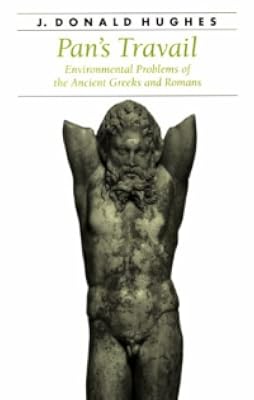
Pan's Travail: Environmental Problems of the Ancient Greeks and Romans (Ancient Society and History)
by J. Donald Hughes
On This Page
Description
"Many people express surprise," writes J. Donald Hughes, "when they are told that environmental problems existed in the ancient world; they are used to thinking of the environment as an exclusively modern concern. But an examination of the evidence shows that the Greeks and Romans not only suffered from some of the same predicaments that plague the present scene, but in many cases they were aware of them and commented on them." In Pan's Travail Hughes examines the environmental history of show more the classical period and argues that the decline of ancient civilizations resulted in part from exploitation of the natural world. Focusing on Greece and Rome, as well as on areas subject to their influences, Hughes offers a detailed look at the impact of humans and their technologies on the ecology of the Mediterranean basin. He explores the complex relationships of human culture and the environment with topics that include deforestation and overgrazing, soil erosion, depletion of wildlife and natural resources, pollution, and urban problems such as water supply and sewage disposal. He also compares the ancient world's environmental problems to those of other eras and discusses attitudes toward nature expressed in Greek and Latin literature. show lessTags
Recommendations


























Member Reviews
At first, this book was very disappointing. In the run-up to his main topic (the environmental problems of the Classical world), author Donald Hughes writes a chapter on environmental issues in pre-Classical societies that is pure New Age. We learn that Paleolithic hunter/gatherers understood the “balance of nature”, that the invention of agriculture was “the greatest mistake that ever occurred in the biosphere…” (interestingly, that statement is not from Dr. Hughes himself, but he quotes it with approval), and that “the practices of the Egyptians were rooted in a world that affirmed the sacred values of all nature”. It seems like the more literate people became, the less politically correct their views on “Nature” show more became. This suggests an approach to modern environmental problems, which appears to be in effect in some public-school systems.
However, things improve considerably once Dr. Hughes gets into his own specialty, classics. The depth of scholarship, both from primary and secondary sources, is impressive. Each chapter covers a different aspect of the classical “environment”; general attitude toward “nature”; deforestation; wildlife; technology; agriculture; urban life; and gardens. There’s great material here for anybody interested in the historic environment. The particular aspect that impressed me the most was the Roman world’s immense appetite for fuel wood. The Roman mints coined about 50 tons of silver a year. Each ton of metallic silver took 10000 tons of fuel wood to smelt. That’s just silver for coinage; it doesn’t count its use for other things: the smelting and processing of other metals, the use of wood for firing pottery and bricks, cooking, heating, and construction. (The famous statement of Augustus – “I found Rome a city of bricks and left it a city of marble” – takes on a different meaning; there wasn’t enough wood in the vicinity of Rome to fire bricks any more, sun-dried bricks won’t work in the climate, and if you’re going to haul heavy stuff a long distance it might as well be stone as bricks). The Romans did use small amounts of coal, from northern Italy and in Roman Britain; Hughes does not speculate on why it wasn’t more heavily used (my own take would be that coal won’t work for smelting; the fuel used in smelting is not only for heat, but also to provide a reducing environment. Charcoal and coke work fine for this, but wood and coal do not; they have too many volatiles and make an inferior product if anything at all. The Romans could make charcoal just fine, but did not make coke (and didn’t have the technology to do so even if they realized coke’s utility.)) Hughes notes that some mines were abandoned not because they were out of ore but because they ran out of fuel wood for smelting.
I was also interested in how many ancient authors commented on environmental problems. They were aware of deforestation, wildlife depletion, soil erosion, and air pollution (Rome was a city of 1.2 M people, all of whom used wood fires for heating and cooking); but nobody knew what to do about these things. They were even aware of climate change, although nobody attributed it to human activities. As usual, much of the environmental woe was government sponsored; by the Late Empire most State revenue was raised by an agricultural tax, which was independent of actual agricultural yield. Although farmers were aware that land had to lie fallow periodically, they couldn’t follow good agricultural practices and still pay their taxes, leading to a vicious cycle as the land became more and more depleted but taxes stayed constant.
Pretty interesting, once you get through the first couple of chapters. show less
However, things improve considerably once Dr. Hughes gets into his own specialty, classics. The depth of scholarship, both from primary and secondary sources, is impressive. Each chapter covers a different aspect of the classical “environment”; general attitude toward “nature”; deforestation; wildlife; technology; agriculture; urban life; and gardens. There’s great material here for anybody interested in the historic environment. The particular aspect that impressed me the most was the Roman world’s immense appetite for fuel wood. The Roman mints coined about 50 tons of silver a year. Each ton of metallic silver took 10000 tons of fuel wood to smelt. That’s just silver for coinage; it doesn’t count its use for other things: the smelting and processing of other metals, the use of wood for firing pottery and bricks, cooking, heating, and construction. (The famous statement of Augustus – “I found Rome a city of bricks and left it a city of marble” – takes on a different meaning; there wasn’t enough wood in the vicinity of Rome to fire bricks any more, sun-dried bricks won’t work in the climate, and if you’re going to haul heavy stuff a long distance it might as well be stone as bricks). The Romans did use small amounts of coal, from northern Italy and in Roman Britain; Hughes does not speculate on why it wasn’t more heavily used (my own take would be that coal won’t work for smelting; the fuel used in smelting is not only for heat, but also to provide a reducing environment. Charcoal and coke work fine for this, but wood and coal do not; they have too many volatiles and make an inferior product if anything at all. The Romans could make charcoal just fine, but did not make coke (and didn’t have the technology to do so even if they realized coke’s utility.)) Hughes notes that some mines were abandoned not because they were out of ore but because they ran out of fuel wood for smelting.
I was also interested in how many ancient authors commented on environmental problems. They were aware of deforestation, wildlife depletion, soil erosion, and air pollution (Rome was a city of 1.2 M people, all of whom used wood fires for heating and cooking); but nobody knew what to do about these things. They were even aware of climate change, although nobody attributed it to human activities. As usual, much of the environmental woe was government sponsored; by the Late Empire most State revenue was raised by an agricultural tax, which was independent of actual agricultural yield. Although farmers were aware that land had to lie fallow periodically, they couldn’t follow good agricultural practices and still pay their taxes, leading to a vicious cycle as the land became more and more depleted but taxes stayed constant.
Pretty interesting, once you get through the first couple of chapters. show less
Ratings
Members
- Recently Added By
Author Information
17+ Works 334 Members
J. Donald Hughes is John Evans Distinguished Professor of History at the University of Denver
Series
Belongs to Publisher Series
Ancient Society and History (1993)
Work Relationships
Classifications
- Genres
- Nonfiction, History, Science & Nature, General Nonfiction
- DDC/MDS
- 363.7 — Society, government, & culture Social problems and social services Public Safety - Police, Crime Investigation Environmental Issues - Pollution, Recycling, Global Warming
- LCC
- GE160 .G8 .H84 — Geography, Anthropology and Recreation Environmental Sciences Environmental sciences
- BISAC
Statistics
- Members
- 50
- Popularity
- 605,989
- Reviews
- 1
- Rating
- (3.57)
- Languages
- English
- Media
- Paper
- ISBNs
- 2