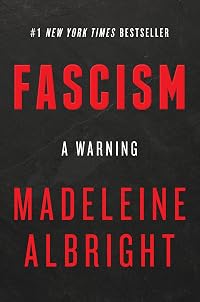
Fascism: A Warning
by Madeleine Albright
On This Page
Description
The former U.S. secretary of state presents a timely, considered, and personal look at the history and current resurgence of fascism and the virulent threat it poses to international freedom, prosperity, and peace.Tags
Recommendations






































Member Reviews
Are You Being Plucked?
Who better to help former Secretary of State Madeline Albright make her point than the first fascist, Il Duce, Benito Mussolini. He advised, pluck the chicken feather by feather so as to keep the squawking discrete; in this way, disappearing freedoms go unnoticed until too late. Sounds similar to what we are experiencing in the form of lie constantly, toss out outrageous statements regularly, do all to divert attention and confuse matters.
Using fascist leaders, dictators, and authoritarian rules from Mussolini’s and Hitler’s days, Albright describes and thereby alerts us to the pattern of how these people work. Wise people should pay attention.
Early on, Albright offers a checklist for defining a Fascist, and show more it’s worth quoting it here, for if you go no further than this, at least you will have a handy way for judging many of today’s strong men. “To my mind, a Fascist is someone who identifies strongly with and claims to speak for a whole nation or group, is unconcerned with the rights of others, and is willing to use whatever means are necessary—including violence—to achieve his or her goals. In that conception, a Fascist will likely be a tyrant, but a tyrant need not be a Fascist.”
Albright reinforces her point by taking readers through the circumstances allowing, the rise of, and the methods of control employed by a real rogues gallery of tough guys: Mussolini, Hitler, Franco (Spain), Sir Oswald Mosley (England), Stalin, Joe McCarthy, Milošević, Marcos and Duterte (Philippines), Chávez, Erdoğan, Orbán (Hungry), Putin, and the list, unfortunately, could be much longer. Learning about the motives and methods of these men, it won’t be lost on readers how Donald Trump seems to be drawing from these authoritarians’ playbooks. The message here is quite clear, forcefully laid out for all but the blind and addled to see: we like to believe that American democracy and our republican governmental checks and balances afford us protection against such strong men overwhelming our way of life, but we may be much to optimistic.
Back in the dim days of the Great Depression, when fascism rose in Italy and Germany, American author Sinclair Lewis saw clearly that we too could succumb to the siren song of order and national chauvinism. It’s well worth taking a look at his novelistic toppling of our government, It Can’t Happen Here (1936), both about fascist revolution and American populism manifested by Huey Long.
Again, with Albright’s book, we have yet another red flag volume that Americans should read, and that, alas, most, especially those who should, will not. show less
Who better to help former Secretary of State Madeline Albright make her point than the first fascist, Il Duce, Benito Mussolini. He advised, pluck the chicken feather by feather so as to keep the squawking discrete; in this way, disappearing freedoms go unnoticed until too late. Sounds similar to what we are experiencing in the form of lie constantly, toss out outrageous statements regularly, do all to divert attention and confuse matters.
Using fascist leaders, dictators, and authoritarian rules from Mussolini’s and Hitler’s days, Albright describes and thereby alerts us to the pattern of how these people work. Wise people should pay attention.
Early on, Albright offers a checklist for defining a Fascist, and show more it’s worth quoting it here, for if you go no further than this, at least you will have a handy way for judging many of today’s strong men. “To my mind, a Fascist is someone who identifies strongly with and claims to speak for a whole nation or group, is unconcerned with the rights of others, and is willing to use whatever means are necessary—including violence—to achieve his or her goals. In that conception, a Fascist will likely be a tyrant, but a tyrant need not be a Fascist.”
Albright reinforces her point by taking readers through the circumstances allowing, the rise of, and the methods of control employed by a real rogues gallery of tough guys: Mussolini, Hitler, Franco (Spain), Sir Oswald Mosley (England), Stalin, Joe McCarthy, Milošević, Marcos and Duterte (Philippines), Chávez, Erdoğan, Orbán (Hungry), Putin, and the list, unfortunately, could be much longer. Learning about the motives and methods of these men, it won’t be lost on readers how Donald Trump seems to be drawing from these authoritarians’ playbooks. The message here is quite clear, forcefully laid out for all but the blind and addled to see: we like to believe that American democracy and our republican governmental checks and balances afford us protection against such strong men overwhelming our way of life, but we may be much to optimistic.
Back in the dim days of the Great Depression, when fascism rose in Italy and Germany, American author Sinclair Lewis saw clearly that we too could succumb to the siren song of order and national chauvinism. It’s well worth taking a look at his novelistic toppling of our government, It Can’t Happen Here (1936), both about fascist revolution and American populism manifested by Huey Long.
Again, with Albright’s book, we have yet another red flag volume that Americans should read, and that, alas, most, especially those who should, will not. show less
Are You Being Plucked?
Who better to help former Secretary of State Madeline Albright make her point than the first fascist, Il Duce, Benito Mussolini. He advised, pluck the chicken feather by feather so as to keep the squawking discrete; in this way, disappearing freedoms go unnoticed until too late. Sounds similar to what we are experiencing in the form of lie constantly, toss out outrageous statements regularly, do all to divert attention and confuse matters.
Using fascist leaders, dictators, and authoritarian rules from Mussolini’s and Hitler’s days, Albright describes and thereby alerts us to the pattern of how these people work. Wise people should pay attention.
Early on, Albright offers a checklist for defining a Fascist, and show more it’s worth quoting it here, for if you go no further than this, at least you will have a handy way for judging many of today’s strong men. “To my mind, a Fascist is someone who identifies strongly with and claims to speak for a whole nation or group, is unconcerned with the rights of others, and is willing to use whatever means are necessary—including violence—to achieve his or her goals. In that conception, a Fascist will likely be a tyrant, but a tyrant need not be a Fascist.”
Albright reinforces her point by taking readers through the circumstances allowing, the rise of, and the methods of control employed by a real rogues gallery of tough guys: Mussolini, Hitler, Franco (Spain), Sir Oswald Mosley (England), Stalin, Joe McCarthy, Milošević, Marcos and Duterte (Philippines), Chávez, Erdoğan, Orbán (Hungry), Putin, and the list, unfortunately, could be much longer. Learning about the motives and methods of these men, it won’t be lost on readers how Donald Trump seems to be drawing from these authoritarians’ playbooks. The message here is quite clear, forcefully laid out for all but the blind and addled to see: we like to believe that American democracy and our republican governmental checks and balances afford us protection against such strong men overwhelming our way of life, but we may be much to optimistic.
Back in the dim days of the Great Depression, when fascism rose in Italy and Germany, American author Sinclair Lewis saw clearly that we too could succumb to the siren song of order and national chauvinism. It’s well worth taking a look at his novelistic toppling of our government, It Can’t Happen Here (1936), both about fascist revolution and American populism manifested by Huey Long.
Again, with Albright’s book, we have yet another red flag volume that Americans should read, and that, alas, most, especially those who should, will not. show less
Who better to help former Secretary of State Madeline Albright make her point than the first fascist, Il Duce, Benito Mussolini. He advised, pluck the chicken feather by feather so as to keep the squawking discrete; in this way, disappearing freedoms go unnoticed until too late. Sounds similar to what we are experiencing in the form of lie constantly, toss out outrageous statements regularly, do all to divert attention and confuse matters.
Using fascist leaders, dictators, and authoritarian rules from Mussolini’s and Hitler’s days, Albright describes and thereby alerts us to the pattern of how these people work. Wise people should pay attention.
Early on, Albright offers a checklist for defining a Fascist, and show more it’s worth quoting it here, for if you go no further than this, at least you will have a handy way for judging many of today’s strong men. “To my mind, a Fascist is someone who identifies strongly with and claims to speak for a whole nation or group, is unconcerned with the rights of others, and is willing to use whatever means are necessary—including violence—to achieve his or her goals. In that conception, a Fascist will likely be a tyrant, but a tyrant need not be a Fascist.”
Albright reinforces her point by taking readers through the circumstances allowing, the rise of, and the methods of control employed by a real rogues gallery of tough guys: Mussolini, Hitler, Franco (Spain), Sir Oswald Mosley (England), Stalin, Joe McCarthy, Milošević, Marcos and Duterte (Philippines), Chávez, Erdoğan, Orbán (Hungry), Putin, and the list, unfortunately, could be much longer. Learning about the motives and methods of these men, it won’t be lost on readers how Donald Trump seems to be drawing from these authoritarians’ playbooks. The message here is quite clear, forcefully laid out for all but the blind and addled to see: we like to believe that American democracy and our republican governmental checks and balances afford us protection against such strong men overwhelming our way of life, but we may be much to optimistic.
Back in the dim days of the Great Depression, when fascism rose in Italy and Germany, American author Sinclair Lewis saw clearly that we too could succumb to the siren song of order and national chauvinism. It’s well worth taking a look at his novelistic toppling of our government, It Can’t Happen Here (1936), both about fascist revolution and American populism manifested by Huey Long.
Again, with Albright’s book, we have yet another red flag volume that Americans should read, and that, alas, most, especially those who should, will not. show less
Albright takes us through the history of anti-democratic political movements in the twentieth century, trying to isolate the things they have in common, and then explores the ways in which those elements can and can't be mapped onto the rhetoric and actions of the current crop of (would-be) authoritarian leaders. Obviously, her main goal is to alert her US readers to the possible danger to democracy posed by Trump's rants against judges, legislators and journalists, but there's also a lot here that can help us understand some of the things going on in Europe and elsewhere.
The book is written for readers who are assumed to know nothing about world history outside the US, which is probably a good thing, but makes it a bit frustrating for show more the rest of us as we go at what often feels like a snail's pace through the familiar stories of how Mussolini, Hitler, Franco et al. came to power. It gets much more interesting as she advances to the late 20th century and to leaders she dealt with face to face in her own long career in international relations, including Milosevic, Putin, Chavez and Kim Jong-Il.
But we have to pay attention throughout, because she is picking up a lot of crucial points along the way: how most authoritarian leaders come to power in the first place by constitutional means (but often without majority support); how power is entrenched by "necessary reforms" to constitutions and by control of the media; the "Mussolini-model" where the leader refuses to delegate and increasingly overrates his own competence until everything collapses around him, versus the "Hitler-model" where the leader delegates as much as possible to competing subordinates and distances himself from unpopular decisions ("If the Führer only knew").
Albright — despite the title of this book — is very wary about how she uses words like nationalism, populism and fascism. She maintains that the first two are positive qualities, to be admired in liberal democracies. Politicians who don't have the interests of the nation at heart or who don't seek popular support for what they do are clearly going wrong somewhere. And fascism is a term she only wants to apply to leaders who claim to speak for the people without giving the people the chance to comment or contradict, who disregard the rights of minorities, and who impose their ideas inside and outside their country by violence without democratic or judicial controls. The only current fascist state, by her definition, is North Korea. On the other hand, she sees plenty of other leaders who appear to have some of the characteristics of fascism and give reason to fear that they might go further, especially with the examples of impunity Trump and Putin give them.
Obviously the chief interest of the book is that it is written by someone with exceptional practical and theoretical knowledge of how relations between countries work (and personal experience of being a refugee from first Hitler and then Stalin). And a communicator who is very good at making us feel that we can understand very complex questions, even whilst she warns us that the ability to reduce complex questions to simple answers is a strong indicator of anti-democratic rhetoric. Needless to say, there are no simple recipes provided for cooking up democracy at home, other than a warning to stay vigilant. show less
The book is written for readers who are assumed to know nothing about world history outside the US, which is probably a good thing, but makes it a bit frustrating for show more the rest of us as we go at what often feels like a snail's pace through the familiar stories of how Mussolini, Hitler, Franco et al. came to power. It gets much more interesting as she advances to the late 20th century and to leaders she dealt with face to face in her own long career in international relations, including Milosevic, Putin, Chavez and Kim Jong-Il.
But we have to pay attention throughout, because she is picking up a lot of crucial points along the way: how most authoritarian leaders come to power in the first place by constitutional means (but often without majority support); how power is entrenched by "necessary reforms" to constitutions and by control of the media; the "Mussolini-model" where the leader refuses to delegate and increasingly overrates his own competence until everything collapses around him, versus the "Hitler-model" where the leader delegates as much as possible to competing subordinates and distances himself from unpopular decisions ("If the Führer only knew").
Albright — despite the title of this book — is very wary about how she uses words like nationalism, populism and fascism. She maintains that the first two are positive qualities, to be admired in liberal democracies. Politicians who don't have the interests of the nation at heart or who don't seek popular support for what they do are clearly going wrong somewhere. And fascism is a term she only wants to apply to leaders who claim to speak for the people without giving the people the chance to comment or contradict, who disregard the rights of minorities, and who impose their ideas inside and outside their country by violence without democratic or judicial controls. The only current fascist state, by her definition, is North Korea. On the other hand, she sees plenty of other leaders who appear to have some of the characteristics of fascism and give reason to fear that they might go further, especially with the examples of impunity Trump and Putin give them.
Obviously the chief interest of the book is that it is written by someone with exceptional practical and theoretical knowledge of how relations between countries work (and personal experience of being a refugee from first Hitler and then Stalin). And a communicator who is very good at making us feel that we can understand very complex questions, even whilst she warns us that the ability to reduce complex questions to simple answers is a strong indicator of anti-democratic rhetoric. Needless to say, there are no simple recipes provided for cooking up democracy at home, other than a warning to stay vigilant. show less
At a time when the word "fascist" is blithely applied to political enemies of all ilks, it's useful to have someone as knowledgeable and experienced as Albright clarify what the term actually means. This history, from Mussolini's Italy and Nazi Germany to the many other nations who have struggled with wannabe dictators, is not only succinct and informative but alarming, as it becomes obvious that Trump is following the trail, little by little. That little by little, of course, is how such things happen to otherwise sane countries, and this brief overview (about 250 pages of text) is the perfect answer to those who can't imagine a dictatorship overwhelming our own society. Albright wrote this in 2018 and was, of course, oblivious to some show more of what Trump was to do, but it all fits in with her premise and makes it even more scary. As one of my doctors said to me last week, we're living in 1930s Germany. show less
Albright writes clearly and saliently on a topic she has seen grown and change through her lifetime in politics and political thought. She walks us through her definition of fascism and then takes us on a trip around the world to see it in action, from Duterte to Kim Jong Un, and then spends a lot of time discussing the developing political atmosphere in the United States. She laments the fall of the US as a world leader, the loss of trust in our government from other leaders around the world, the dubious position our democracy is currently occupying, and what it would take, in her eyes, to bring it back from the edge. She does not hold back on her opinions, but she is also very diplomatic. And she highlights exactly why she thinks show more America is in such a dubious position not based in our political leadership, but based in the way we interact with one another when it comes to politics. Contempt, she argues, is one of America's defining political attitudes, and that is largely what allows us to be so strongly divided by bad actors in our current political landscape. Well worth the read. show less
In the present political scenario, the word Fascist is thrown around like candy - a person whose views we disagree with is labelled as one (sometimes even used outside politics), and hence the impact of the word is reduced by a large amount. Albright, having lived through truly fascist regimes, examines in detail which people or governments should be assigned the label, and makes a strong case for democracy in the process.
The book deals with a brief introduction of the fascist regimes of the 20th century, such as Hitler's Germany and Mussolini's Italy - and then proceeds to examine how democracy was systemically undermined in today's fascist-like regimes in Russia, Hungary, Turkey, North Korea and Venezuela. The book's ending chapters show more deal with the US - as a case study in how supposed bastions of democracy are getting battered by relentless attacks on their institutions by their own leaders.
Albright comes across a true-blue diplomat - unlike her fellow Democrat colleagues, when asked to give a direct answer on whether Trump is a fascist, she answers along the lines of 'no, but...'. Although she accepts the fact that democracy has its own share of problems, and often gets undermined by red tape, accountability, and listening to fringe concerns - she asks the reader whether they have grown too impatient in demanding to be told 'where to march', and whether citizens have grown so cynical that they want their leaders to subvert democratic institutions altogether.
The author describes herself as an 'optimist, who worries a lot'. We have a lot to worry (and introspect about), true. Chauvinism and jingoism seem to be the torchbearers of the present age, what with the constant cries of '*insert your country here* first!', and Islamophobia, antisemitism, and racism on an unprecedented rise. The wearily optimistic tone of Albright's prose made me think, however, that maybe democracy is not completely on the wane after all - for that alone, this is an amazing read. If one is even slightly interested in politics, this is worth the time put in. show less
The book deals with a brief introduction of the fascist regimes of the 20th century, such as Hitler's Germany and Mussolini's Italy - and then proceeds to examine how democracy was systemically undermined in today's fascist-like regimes in Russia, Hungary, Turkey, North Korea and Venezuela. The book's ending chapters show more deal with the US - as a case study in how supposed bastions of democracy are getting battered by relentless attacks on their institutions by their own leaders.
Albright comes across a true-blue diplomat - unlike her fellow Democrat colleagues, when asked to give a direct answer on whether Trump is a fascist, she answers along the lines of 'no, but...'. Although she accepts the fact that democracy has its own share of problems, and often gets undermined by red tape, accountability, and listening to fringe concerns - she asks the reader whether they have grown too impatient in demanding to be told 'where to march', and whether citizens have grown so cynical that they want their leaders to subvert democratic institutions altogether.
The author describes herself as an 'optimist, who worries a lot'. We have a lot to worry (and introspect about), true. Chauvinism and jingoism seem to be the torchbearers of the present age, what with the constant cries of '*insert your country here* first!', and Islamophobia, antisemitism, and racism on an unprecedented rise. The wearily optimistic tone of Albright's prose made me think, however, that maybe democracy is not completely on the wane after all - for that alone, this is an amazing read. If one is even slightly interested in politics, this is worth the time put in. show less
In the context of the current political situation I keep asking myself how could this have happened? I do understand and accept that the political pendulum swings every decade or so, but what is it about the nation's psyche that resulted in the electoral success of a man of such low ethical and moral standards, one who blatantly lies, who is a braggart and a vicious bully and, quite likely, a white collar criminal? Quite clearly there is a such a significant magnitude of disaffection, and anger, among 60+ million voters to look beyond the grotesque character of President Trump. Was his victory the result of a poorly run campaign of his opponent? No, because among all the credible Republican candidates in the primaries, it was Trump who show more triumphed. Why is it that moderation is now so out of vogue?
Albright's highly readable analysis of the rise of authoritarian leaders gives us insights into today's situation. She uses the rise of Fascism, communism, and their right and left variants to explain the conditions that enable this to occur. Authoritarian leaders stoke grievances extant in society and cultures to leverage themselves to power. Perceived threats to economic well-being and cultural norms attract (angry) people to bold, if simplistic solutions, articulated by charismatic leaders. Such overtures involve creating enemies of the people and attacking institutions that once were considered legitimate and cohesive. It is important to understand that authoritarians do not initially rise by imposing their will upon people; their springboard is the disaffection of people. After gaining control they can dismantle institutional checks to achieve greater and greater power. Albright's concise overview of the means by which Mussolini, Hitler and the Bolsheviks rose is relevant to understanding what is happening around the world today in Europe, Russia, Latin American and the US. These leaders rode the waves of popular discontent among the people generated by external and internal factors they perceived as damaging to their lives. Around the world today people are threatened by forces and trends they see as affecting their economic security and cultural norms, e.g. income inequality, globalization, migration, the rise of calls for cultural diversity, secularism or religious extremism. The first tactic of those who would "save" the people is to identify and attack (often through demagoguery) the "culprits" who are responsible for the threats -- capitalists, socialists, the "elites", Muslims, the press, the judiciary, the right, the left, etc.
Albright notes that in places where there is not a history of democratic values and democratic institutions the susceptability of countries to the authoritarian "savior" is much greater. This fortunately is not the case in the United States where the strength and independence of various institutional players (and our inherent respect for the rule of law) is such that there are checks on a leader like Trump. She also points out with concern that the administration's disparagement of our traditional allies who share our values on democracy is exactly the wrong approach to take if we hope to preserve and advance the movement toward liberal and democratic governance around the world. Trump's admiration for "strong" leaders in Turkey, Russia, North Korea and the Philippines is sending the wrong message to the world.
This is a thought-provoking and worthwhile read. Another insightful analysis of "how did we get here" is Arlie Russell Hochshield's "Strangers in their Own Land: Anger and Mourning on the Right". show less
Albright's highly readable analysis of the rise of authoritarian leaders gives us insights into today's situation. She uses the rise of Fascism, communism, and their right and left variants to explain the conditions that enable this to occur. Authoritarian leaders stoke grievances extant in society and cultures to leverage themselves to power. Perceived threats to economic well-being and cultural norms attract (angry) people to bold, if simplistic solutions, articulated by charismatic leaders. Such overtures involve creating enemies of the people and attacking institutions that once were considered legitimate and cohesive. It is important to understand that authoritarians do not initially rise by imposing their will upon people; their springboard is the disaffection of people. After gaining control they can dismantle institutional checks to achieve greater and greater power. Albright's concise overview of the means by which Mussolini, Hitler and the Bolsheviks rose is relevant to understanding what is happening around the world today in Europe, Russia, Latin American and the US. These leaders rode the waves of popular discontent among the people generated by external and internal factors they perceived as damaging to their lives. Around the world today people are threatened by forces and trends they see as affecting their economic security and cultural norms, e.g. income inequality, globalization, migration, the rise of calls for cultural diversity, secularism or religious extremism. The first tactic of those who would "save" the people is to identify and attack (often through demagoguery) the "culprits" who are responsible for the threats -- capitalists, socialists, the "elites", Muslims, the press, the judiciary, the right, the left, etc.
Albright notes that in places where there is not a history of democratic values and democratic institutions the susceptability of countries to the authoritarian "savior" is much greater. This fortunately is not the case in the United States where the strength and independence of various institutional players (and our inherent respect for the rule of law) is such that there are checks on a leader like Trump. She also points out with concern that the administration's disparagement of our traditional allies who share our values on democracy is exactly the wrong approach to take if we hope to preserve and advance the movement toward liberal and democratic governance around the world. Trump's admiration for "strong" leaders in Turkey, Russia, North Korea and the Philippines is sending the wrong message to the world.
This is a thought-provoking and worthwhile read. Another insightful analysis of "how did we get here" is Arlie Russell Hochshield's "Strangers in their Own Land: Anger and Mourning on the Right". show less
Members
- Recently Added By
Lists

Huxley's Reading Log 2019
24 works; 1 member

Extremism
31 works; 1 member

Totalitarianism and Democratic Erosion: Essential Readings
45 works; 1 member
Author Information

17+ Works 5,537 Members
Madeleine Korbelová Albright was born May 15, 1937 in the Smíchov district of Prague, Czechoslovakia. She attended Wellesley College, in Wellesley, Massachusetts, on a full scholarship, majoring in political science and graduated in 1959. Her senior thesis was written on Czech Communist Zdenek Fierlinger Her PhD is from Columbia University. She show more holds honorary degrees from Brandeis University; the University of Washington; Smith College; University of Winnipeg; the University of North Carolina at Chapel Hill , and Knox College. Albright worked as an intern for The Denver Post and as a picture editor for Encyclopædia Britannica. She was invited to organize a fund-raising dinner for the 1972 presidential campaign of U.S. Senator Ed Muskie of Maine.This association with Muskie led to a position as his chief legislative assistant in 1976. However, after the 1976 U.S. presidential election of Jimmy Carter, Albright's former professor Brzezinski was named National Security Advisor, and recruited Albright from Muskie in 1978 to work in the West Wing as the National Security Council's congressional liaison. Albright joined the academic staff at Georgetown University in Washington, D.C., in 1982, specializing in Eastern European studies. In 1992, Bill Clinton returned the White House to the Democratic Party, and Albright was employed to handle the transition to a new administration at the National Security Council. In January 1993, Clinton nominated her to be U.S. Ambassador to the United Nations. Albright soon took office as the 64th U.S. Secretary of State on January 23, 1997 and she became the first female U.S. Secretary of State and the highest-ranking woman in the history of the U.S. government. Albright now serves as a Professor of International Relations at Georgetown University's Walsh School of Foreign Service. Her title Prague Winter: A Personal Story of Remembrance and War, 1937-1948 made The New York Times Best Seller list for 2012. Her most recent book is Fascism: A Warning. (Bowker Author Biography) show less
All Editions
Some Editions
Awards and Honors
Awards
Common Knowledge
- Canonical title*
- Fascism : en varning
- Original publication date
- 2018
- Epigraph
- Every age has its own fascism.
- Primo Levi - Dedication
- To the victims of Fascism
Then and now
And to all who fight Fascism
In others
And in themselves - First words
- On the day fascists first altered the direction of my life, I had barely mastered the art of walking.
- Quotations
- Whoever fights with monsters should see to it that in the process he does not himself become a monster.
- Nietzsche
A spoonful of sugar can be as helpful in dealing with foreign diplomats as it is in child psychology, for these are not unrelated fields. - Last words
- (Click to show. Warning: May contain spoilers.)For those who cherish freedom, the answers will provide grounds for reassurance or a warning we dare not ignore.
- Canonical DDC/MDS
- 320.53309
- Canonical LCC
- JC481
*Some information comes from Common Knowledge in other languages. Click "Edit" for more information.
Classifications
- Genres
- Politics and Government, General Nonfiction, Nonfiction, History
- DDC/MDS
- 320.53309 — Society, government, & culture Political science Types of Government Political ideologies Radicalism, collectivism, fascism Fascism Standard subdivisions History, geographic treatment, biography
- LCC
- JC481 — Political Science Political theory Political theory. The state. Theories of the state Forms of the state
- BISAC
Statistics
- Members
- 1,577
- Popularity
- 14,474
- Reviews
- 42
- Rating
- (4.15)
- Languages
- 13 — Czech, Danish, Dutch, English, Estonian, French, German, Italian, Polish, Romanian, Spanish, Swedish, Portuguese (Portugal)
- Media
- Paper, Audiobook, Ebook
- ISBNs
- 41
- ASINs
- 12