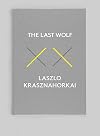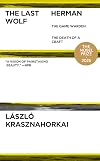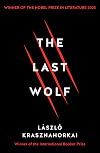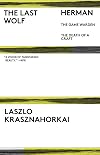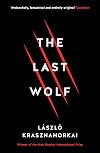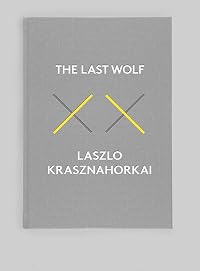
The Last Wolf & Herman
by Laszlo Krasznahorkai
On This Page
Description
The Last Wolf, translated by George Szirtes, features a classic, obsessed Krasznahorkai narrator, a man hired to write (by mistake, by a glitch of fate) the true tale of the last wolf of Extremadura, a barren stretch of Spain. This miserable experience (being mistaken for another, dragged about a cold foreign place, appalled by a species end) is narrated all in a single sentence as a sad looping tale, a howl more or less, in a dreary wintry Berlin bar to a patently bored bartender. The Last show more Wolf is Krasznahorkai in a maddening nutshell with the narrator trapped in his own experience (having internalized the extermination of the last creature of its kind and locked Extremadura in the depths of his own cold, empty, hollow heart ) enfolding the reader in the exact same sort of entrapment to and beyond the end, with its first full-stop period of the book. Herman, a peerless virtuoso of trapping who guards the splendid mysteries of an ancient craft gradually sinking into permanent oblivion, is asked to clear a forest s last noxious beasts. In Herman I: the Game Warden, he begins with great zeal, although in time he suspects that maybe he was on the wrong scent. Herman switches sides, deciding to track entirely new game... In Herman II: The Death of a Craft, the same situation is viewed by strange visitors to the region. Hyper-sexualized aristocratic officers on a very extended leave are enjoying a saturnalia with a bevy of beauties in the town nearest the forest. With a sense of effete irony, they interrupt their orgies to pitch in with the manhunt of poor Herman, and in the end, only we are left to relish the magic bouquet of this escapade... Translated by John Batki--Amazon.com show lessTags
Recommendations





Member Reviews
Me pone tan feliz haber leído a Laszlo. Es como descubrir una joya escondida: mientras se lee, uno tiene la impresión de haber encontrado a un nuevo clásico de la literatura universal.
"Herman" (un cuento contado desde dos diferentes perspectivas) y "El último lobo" (una novela corta) son dos historias muy distintas pero que se complementan a la perfección. En cualquier orden que se les lea (ya que, dada su forma de impresión, el libro te permite escoger qué relato vas a leer primero) ambas historias parecen ocurrir en el mismo universo: el de la feralidad sagrada, en una naturaleza tan hostil como bella, misma en la que ya no cabemos como seres humanos. Ambas historias tratan de lo mismo: gente que se encuentra de sopetón con la show more muerte, con esa parte inconsciente de su ser a la que sólo puede llegarse a través de la epifanía.
Lamentablemente, este libro no ha sido traducido al español (o al menos yo no he podido encontrar ningún rastro de una edición así), pero es relativamente barato si se compra por internet. Definitivamente voy a lanzarme en un futuro a leer más de este extraño autor. show less
"Herman" (un cuento contado desde dos diferentes perspectivas) y "El último lobo" (una novela corta) son dos historias muy distintas pero que se complementan a la perfección. En cualquier orden que se les lea (ya que, dada su forma de impresión, el libro te permite escoger qué relato vas a leer primero) ambas historias parecen ocurrir en el mismo universo: el de la feralidad sagrada, en una naturaleza tan hostil como bella, misma en la que ya no cabemos como seres humanos. Ambas historias tratan de lo mismo: gente que se encuentra de sopetón con la show more muerte, con esa parte inconsciente de su ser a la que sólo puede llegarse a través de la epifanía.
Lamentablemente, este libro no ha sido traducido al español (o al menos yo no he podido encontrar ningún rastro de una edición así), pero es relativamente barato si se compra por internet. Definitivamente voy a lanzarme en un futuro a leer más de este extraño autor. show less
A Lack of Ambition
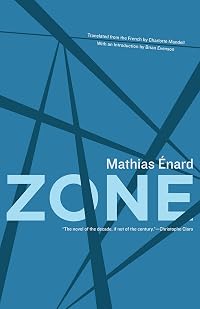
"The Last Wolf" is a novella, 76 pages in translation, written in what is usually described as one of Krasznahorkai's characteristic long sentences. Technically, that isn't right, because the novella is actually a string of run-on sentences, with ordinary sentences embedded in them. Grammatically correct long sentences are rare in fiction. (See the remarks on Enard's "The Zone.") This form is looser and, I think, less interesting than a single long sentence (as in Raymond Roussel's "New Impressions of Africa") or a genuine analocuthon (as in late Thomas Bernhard).
In the novella, a philosopher sits at a bar and recounts a trip he made to Extremadura, Spain, and to Alburquerque, the near-namesake of the city in New show more Mexico. The philosopher was invited to Spain in order to write about anything he might choose, and he ends up investigating the shootings of the last eight wolves in the region, in the 1980s and 1990s. He is given an unlimited budget and a translator, and he's driven around so he can interview people. All along he keeps saying, to the bartender, that he has said everything he can, that his thinking life is over, that even accepting the invitation was a sham, that he cannot write anything. In the end the killings of the last two wolves coincide with the end of his story, and -- as a reader will have surmised from the first couple of pages -- he ends up back in the bar, without having written anything.
It's all a common literary conceit: the unwritten text, the unspoken account, actually told, but not to an attentive hearer, or one who will retell the story, or write it down. (The bartender is represented, implausibly, as sometimes falling asleep.) The last of the wolves is the last of his thoughts; his wandering in Extremadura is his meandering mind made real, and so forth.
The story is simply not ambitious enough. If Krasznahorkai had more energy or commitment, he would have explained why it isn't a paradox that the philosopher actually has told a story, and in fact it's the story we're reading. The philosopher didn't write it down, but the author did. How, in the logic of the novella, does a person supposedly at the end of this thinking life manage to write -- really, to toss off -- a seventy-page novella? Of course there are thoughts in his head: we know, because we read them page after page. To make this more ambitious, more consistent, and more challenging, Krasznahorkai could have written out the philosopher's incapacity on the page, showing us what it was like for the to be unable to think.
The philosopher chooses to investigate the killing of the wolves because he remembers reading something about it, and in fact he made a note of it. That is interesting, but it isn't explained: but in a deeper version of this story, we could be told that he is perplexed by his choice of that article, and curious about his own interests and motives in finding it. That could be a sign of his ongoing inability to sort out his own motivations and thoughts. And while he is on the pursuit, he could do more than simply record what he sees and hears: he could wonder if he is being coherent in his intentions, or faithful to whatever remnants of intentions he may have.
By his own account, after all he can no longer think philosophically: but we're never told what that means, exactly, and what could it mean other than an incapacity for rational thought? And how could such an incapacity not vex or even torture the person who thinks he suffers from it? And how could he not wonder, at every moment, what he is understanding and what he isn't?
"The Last Wolf" is unambitious because it makes a very big claim about its narrator's incapacity: a claim that should not just exhaust him, as it does, but either perplex him -- given his apparent ability to continue to think and reason -- or paralyze him with doubt and fear -- given the apparently irrational nature of his investigation. A better model is Beckett's "Ill Seen Ill Said," where there's a claim about the narrator's incapacity, and it corrodes and infects the entire fabric of representation. Here it's just a claim, and the narrator goes on reasonably happily with his life, "incapacitated" only by an unaccountable inability to notice that by telling the bartender everything he has, in fact, written the story he claims he couldn't write. show less
"The Last Wolf" is a novella, 76 pages in translation, written in what is usually described as one of Krasznahorkai's characteristic long sentences. Technically, that isn't right, because the novella is actually a string of run-on sentences, with ordinary sentences embedded in them. Grammatically correct long sentences are rare in fiction. (See the remarks on Enard's "The Zone.") This form is looser and, I think, less interesting than a single long sentence (as in Raymond Roussel's "New Impressions of Africa") or a genuine analocuthon (as in late Thomas Bernhard).
In the novella, a philosopher sits at a bar and recounts a trip he made to Extremadura, Spain, and to Alburquerque, the near-namesake of the city in New show more Mexico. The philosopher was invited to Spain in order to write about anything he might choose, and he ends up investigating the shootings of the last eight wolves in the region, in the 1980s and 1990s. He is given an unlimited budget and a translator, and he's driven around so he can interview people. All along he keeps saying, to the bartender, that he has said everything he can, that his thinking life is over, that even accepting the invitation was a sham, that he cannot write anything. In the end the killings of the last two wolves coincide with the end of his story, and -- as a reader will have surmised from the first couple of pages -- he ends up back in the bar, without having written anything.
It's all a common literary conceit: the unwritten text, the unspoken account, actually told, but not to an attentive hearer, or one who will retell the story, or write it down. (The bartender is represented, implausibly, as sometimes falling asleep.) The last of the wolves is the last of his thoughts; his wandering in Extremadura is his meandering mind made real, and so forth.
The story is simply not ambitious enough. If Krasznahorkai had more energy or commitment, he would have explained why it isn't a paradox that the philosopher actually has told a story, and in fact it's the story we're reading. The philosopher didn't write it down, but the author did. How, in the logic of the novella, does a person supposedly at the end of this thinking life manage to write -- really, to toss off -- a seventy-page novella? Of course there are thoughts in his head: we know, because we read them page after page. To make this more ambitious, more consistent, and more challenging, Krasznahorkai could have written out the philosopher's incapacity on the page, showing us what it was like for the to be unable to think.
The philosopher chooses to investigate the killing of the wolves because he remembers reading something about it, and in fact he made a note of it. That is interesting, but it isn't explained: but in a deeper version of this story, we could be told that he is perplexed by his choice of that article, and curious about his own interests and motives in finding it. That could be a sign of his ongoing inability to sort out his own motivations and thoughts. And while he is on the pursuit, he could do more than simply record what he sees and hears: he could wonder if he is being coherent in his intentions, or faithful to whatever remnants of intentions he may have.
By his own account, after all he can no longer think philosophically: but we're never told what that means, exactly, and what could it mean other than an incapacity for rational thought? And how could such an incapacity not vex or even torture the person who thinks he suffers from it? And how could he not wonder, at every moment, what he is understanding and what he isn't?
"The Last Wolf" is unambitious because it makes a very big claim about its narrator's incapacity: a claim that should not just exhaust him, as it does, but either perplex him -- given his apparent ability to continue to think and reason -- or paralyze him with doubt and fear -- given the apparently irrational nature of his investigation. A better model is Beckett's "Ill Seen Ill Said," where there's a claim about the narrator's incapacity, and it corrodes and infects the entire fabric of representation. Here it's just a claim, and the narrator goes on reasonably happily with his life, "incapacitated" only by an unaccountable inability to notice that by telling the bartender everything he has, in fact, written the story he claims he couldn't write. show less
This is a quietly profound gem of a book. Two tales, one of which is told twice from differing perspectives. They are set up so that after reading one, the reader must flip the book over and read the second story starting at the opposite end of the physical book. Juxtaposition with intention?
The first tale, "The Last Wolf" is about a writer on a mysterious assignment and the baffling path he follows to meet his employers' expectations. He is faced with the existential dilemma of extinction, of humanity's cruelty, and comes to his own conclusions.
The second tale, "Herman" is told first from Herman's perspective, as he is hired to rid a public park of infestation of feral creatures who have overtaken the space. Herman goes through a show more transformational experience regarding his views on the role of aggression and compassion in life. The second version is told from the perspective of hedonistic young tourists visiting during Herman's "denouement".
Quite a read! show less
The first tale, "The Last Wolf" is about a writer on a mysterious assignment and the baffling path he follows to meet his employers' expectations. He is faced with the existential dilemma of extinction, of humanity's cruelty, and comes to his own conclusions.
The second tale, "Herman" is told first from Herman's perspective, as he is hired to rid a public park of infestation of feral creatures who have overtaken the space. Herman goes through a show more transformational experience regarding his views on the role of aggression and compassion in life. The second version is told from the perspective of hedonistic young tourists visiting during Herman's "denouement".
Quite a read! show less
Wild Thing
Review of the Loomingu Raamatukogu estonian language edition (2018) translated from the Hungarian language original "Az utolsó farkas" (2009)
I'm working my way up to the longer novels of Krasznohorkai and Viimne hunt is an excellent way to get started. It combines the use of the one-sentence, one paragraph format with a tale of an obsessive quest as told by the protagonist narrator to a not very attentive barman. The format of the Estonian LR series was also ideal for this as the very thorough afterword provides an excellent overview of Krasznohorkai's life and writing career.
The book has the standard disclaimer that its events and characters are not based on real life, but it is also interesting that Spain's Fundacion Ortega Munozi (named after Spanish painter Ortega Muñoz who was from Extremadura) is thanked for its support in helping in its writing. i.e. it seems very much in parallel with the protagonist in the book getting an unexpected commission from Spain.
In any case, I didn't think of this book as being strongly apocalyptic. It seemed more to me that the philosophy professor saw in the wolves a symbol of his own separation from society where his books are not respected and even his retelling of his tales to the Berlin barman are met with indifference.
Trivia and Links
The Loomingu Raamatukogu (The Creation Library) is a modestly priced Estonian literary journal which initially published weekly (from 1957 to 1994) and which now publishes 40 issues a year as of 1995. It is a great source for discovery as its relatively cheap prices (currently 3 to 5€ per issue) allow for access to a multitude of international writers in Estonian translation and of shorter works by Estonian authors themselves. These include poetry, theatre, essays, short stories, novellas and novels (the lengthier works are usually parcelled out over several issues).
For a complete listing of all works issued to date by Loomingu Raamatukogu see Estonian Wikipedia at: https://et.wikipedia.org/wiki/Loomingu_Raamatukogus_ilmunud_teoste_loend_aastak%... show less
Review of the Loomingu Raamatukogu estonian language edition (2018) translated from the Hungarian language original "Az utolsó farkas" (2009)
This story by the Hungarian master of the apocalypse, who won the International Man Booker Prize, is about a former German professor who spends his days in a Berlin tavern. He unexpectedly receives an invitation to Extremadura, an isolated and sparsely occupied part of Spain, to write about their potentially prosperous future. However, a strangely worded sentence in an ecological article that he reads in preparation for the trip triggers an unforeseen sequence of events, which leads him to dig further into a search for the last wolf in the countryside. - a translation of the Estonianshow more
language synopsis.
I'm working my way up to the longer novels of Krasznohorkai and Viimne hunt is an excellent way to get started. It combines the use of the one-sentence, one paragraph format with a tale of an obsessive quest as told by the protagonist narrator to a not very attentive barman. The format of the Estonian LR series was also ideal for this as the very thorough afterword provides an excellent overview of Krasznohorkai's life and writing career.
The book has the standard disclaimer that its events and characters are not based on real life, but it is also interesting that Spain's Fundacion Ortega Munozi (named after Spanish painter Ortega Muñoz who was from Extremadura) is thanked for its support in helping in its writing. i.e. it seems very much in parallel with the protagonist in the book getting an unexpected commission from Spain.
In any case, I didn't think of this book as being strongly apocalyptic. It seemed more to me that the philosophy professor saw in the wolves a symbol of his own separation from society where his books are not respected and even his retelling of his tales to the Berlin barman are met with indifference.
Trivia and Links
The Loomingu Raamatukogu (The Creation Library) is a modestly priced Estonian literary journal which initially published weekly (from 1957 to 1994) and which now publishes 40 issues a year as of 1995. It is a great source for discovery as its relatively cheap prices (currently 3 to 5€ per issue) allow for access to a multitude of international writers in Estonian translation and of shorter works by Estonian authors themselves. These include poetry, theatre, essays, short stories, novellas and novels (the lengthier works are usually parcelled out over several issues).
For a complete listing of all works issued to date by Loomingu Raamatukogu see Estonian Wikipedia at: https://et.wikipedia.org/wiki/Loomingu_Raamatukogus_ilmunud_teoste_loend_aastak%... show less
Kraznahrkai mesmerically and inexorably sucks you down into chaos and . The devil somehow writes supremely masterful and coherent work. Critics refer to Gogol, but I'm reminded of Cocteau somehow.
I think of portals to dimensions utterly unlike our blase day-to-day.
I think of portals to dimensions utterly unlike our blase day-to-day.
"...it was impossible for them to leave that which was theirs...."
The main thread running through all three stories is the contrast of nature (the old, the primitive, the familiar) and civilization (new, fake, unintelligent); the superiority of those closer to nature; and, in the end, pride before the fall.
"The Last Wolf" is a formal treat in that it is hypotaxis taken to the extreme--a single 70-page sentence with a single narrator describing another narrator and his lethargic interlocutor, alternating time sequences and speakers within speakers to the point where a conventional rendering would be something to the effect of: " ' " ' ' " '."
The main thread running through all three stories is the contrast of nature (the old, the primitive, the familiar) and civilization (new, fake, unintelligent); the superiority of those closer to nature; and, in the end, pride before the fall.
"The Last Wolf" is a formal treat in that it is hypotaxis taken to the extreme--a single 70-page sentence with a single narrator describing another narrator and his lethargic interlocutor, alternating time sequences and speakers within speakers to the point where a conventional rendering would be something to the effect of: " ' " ' ' " '."
This translated work by postmodern Hungarian author László Krasznahorkai contains two novellas or short stories. The Last Wolf is the story of a man telling a story in a bar about hunting the last wolf in Spain. It's written entirely in one loooooong sentence. Herman is a story in two parts about a game warden tasked with trapping predators in the woods near a city who ends up going feral himself, trapping animals of all types, including domesticated animals. "The Game Warden" portion is told from his perspective while "The Death of Craft" focuses on a group of young men and women traveling to the town and hearing the stories of Herman's madness going on around them. Both books focus on hunting and the animal nature within humanity. show more This is a challenging book to read, especially as an Around the World for a Good Book selection, because of it's sparse narrative and experimental prose. show less
Members
- Recently Added By
Lists

Books Read in 2025
4,128 works; 98 members
Author Information

42+ Works 6,677 Members
László Krasznahorkai is an Hungarian Author who has won the 2015 Man Booker International Prize. The $117,600 biennial prize is awarded to a living author, whose body of work is available in English or English translation, in recognition of his or her contribution to fiction 'on the world stage'. (Bowker Author Biography)
Some Editions
Awards and Honors
Awards
Distinctions
The Guardian Book of the Day (2017-02-04)
Series
Belongs to Publisher Series
Work Relationships
Common Knowledge
- Canonical title*
- Den sista vargen
- Original title
- Az utolsó farkas
- Alternate titles
- The last wolf; Herman; Az utolsó farkas; Kegyelmi visonyok
- Original publication date
- 2016 (English translations) (English translations); 2009 (The last wolf) (The last wolf); 1986 (Herman) (Herman)
*Some information comes from Common Knowledge in other languages. Click "Edit" for more information.
Classifications
- Genres
- Fiction and Literature, General Fiction
- DDC/MDS
- 894.51134 — Literature & rhetoric Literatures of other languages Literatures of Altaic, Uralic, Hyperborean, Dravidian languages; literatures of miscellaneous languages of south Asia Finno-Ugric languages Ugric languages Hungarian Hungarian fiction 2000–
- LCC
- PH3281 .K8866 .A2 — Language and Literature Uralic languages. Basque language Uralic. Basque Hungarian
- BISAC
Statistics
- Members
- 301
- Popularity
- 106,799
- Reviews
- 11
- Rating
- (3.95)
- Languages
- English, Estonian, Swedish
- Media
- Paper, Ebook
- ISBNs
- 9
- ASINs
- 2