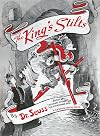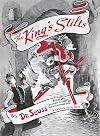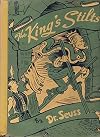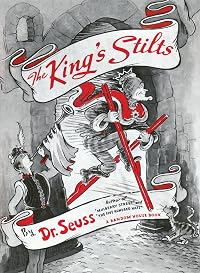
The King's Stilts
by Dr. Seuss
On This Page
Description
When the King's stilts are stolen and hidden, and he can no longer enjoy his play hour, the whole kingdom is threatened with destruction until a page boy bravely saves the day.Tags
Recommendations



Member Reviews
King Birtram of Binn got more work done by seven o'clock in the morning than most rulers got done in a month. He worked hard keeping his kingdom safe from the ever-threatening sea, caring for the Patrol Cats who battled the Nizzards - birds who continually ate away at the roots of the Dike Trees protecting the land. But as hard as the king worked, he played just as hard, flashing about on his bright red stilts every day at five in the evening. No one begrudged him his amusement, save for sour Lord Droon, who conspired to hide the king's stilts, and to keep the king's pageboy, Eric, from disclosing this piece of villainy. Unable to play, the king stopped working as well, the cats stopped patrolling, and the Dike Trees became ever weaker. show more Eric knew he had to do something, or the Kingdom of Binn would soon disappear beneath the waves...
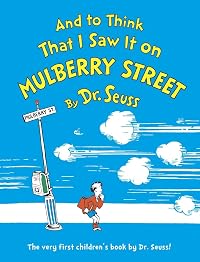
Originally published in 1939, The King's Stilts was Dr. Seuss' third picture-book, following upon And To Think That I Saw It on Mulberry Street (1937) and The 500 Hats of Bartholomew Cubbins (1938). Although it was never one of my favorites, when it comes to Dr. Seuss' many books, I do recall reading and enjoying it, when a girl, and have a vivid memory of the image of the king on his stilts. I picked it up for this reread as part of a Seuss retrospective I have recently undertaken as an act of personal protest against the suppression of six of the author/artist's titles - And to Think That I Saw It on Mulberry Street, McElligot's Pool, If I Ran the Zoo, Scrambled Eggs Super!, On Beyond Zebra! and The Cat's Quizzer - by Dr. Seuss Enterprises. See my review of And to Think That I Saw It on Mulberry Street, to be found HERE, for a fuller exploration of my thoughts on that matter.
In any case, I found this an entertaining and thought-provoking original fairy-tale, and appreciated both the story and the artwork. Unlike many of Dr. Seuss' books aimed at younger children, or written later in his career, The King's Stilts presents its story in prose. I have seen it described as an exploration of balance - the need for both hard work and hard play, in a fulfilled life - and I think that makes sense. After all, King Birtram is described as the most productive of royals, until his pleasure is taken away, and he sinks into a depression, suggesting that without the release provided by his chosen leisure activity, his work performance will suffer. This seems a commonly accepted idea today, but I'm not sure how widespread it was in 1939. It occurs to me that the story could also be read as an exploration of the idea of convention and respectability politics, as Lord Droon's actions are driven by what he thinks is proper for a king to do - something that does not involve dashing about on stilts - and by his sense of embarrassment at what he perceives as a silly activity.
However one interprets the story, it is engaging, offering an entertaining and suspenseful tale with plenty of fairy-tale elements - the royal kingdom, the threat from non-human forces, the magical animals - and a satisfactorily happy ending. The accompanying artwork is done in black and white, with the occasional red accent, and captures the absurd humor of the whole tale. The depiction of the both the cats and the Nizzards recalled other creatures of the kind, in subsequent Seuss books, and was very appealing, in that rather snarky, humorous Seussian way. In sum: an appealing, entertaining and satisfying fairy-tale from Seuss, well worth the time of any picture-book reader with a taste for such stories. It's a little text-heavy, so I'd advise its use with slightly older audiences, perhaps six and above. show less
Originally published in 1939, The King's Stilts was Dr. Seuss' third picture-book, following upon And To Think That I Saw It on Mulberry Street (1937) and The 500 Hats of Bartholomew Cubbins (1938). Although it was never one of my favorites, when it comes to Dr. Seuss' many books, I do recall reading and enjoying it, when a girl, and have a vivid memory of the image of the king on his stilts. I picked it up for this reread as part of a Seuss retrospective I have recently undertaken as an act of personal protest against the suppression of six of the author/artist's titles - And to Think That I Saw It on Mulberry Street, McElligot's Pool, If I Ran the Zoo, Scrambled Eggs Super!, On Beyond Zebra! and The Cat's Quizzer - by Dr. Seuss Enterprises. See my review of And to Think That I Saw It on Mulberry Street, to be found HERE, for a fuller exploration of my thoughts on that matter.
In any case, I found this an entertaining and thought-provoking original fairy-tale, and appreciated both the story and the artwork. Unlike many of Dr. Seuss' books aimed at younger children, or written later in his career, The King's Stilts presents its story in prose. I have seen it described as an exploration of balance - the need for both hard work and hard play, in a fulfilled life - and I think that makes sense. After all, King Birtram is described as the most productive of royals, until his pleasure is taken away, and he sinks into a depression, suggesting that without the release provided by his chosen leisure activity, his work performance will suffer. This seems a commonly accepted idea today, but I'm not sure how widespread it was in 1939. It occurs to me that the story could also be read as an exploration of the idea of convention and respectability politics, as Lord Droon's actions are driven by what he thinks is proper for a king to do - something that does not involve dashing about on stilts - and by his sense of embarrassment at what he perceives as a silly activity.
However one interprets the story, it is engaging, offering an entertaining and suspenseful tale with plenty of fairy-tale elements - the royal kingdom, the threat from non-human forces, the magical animals - and a satisfactorily happy ending. The accompanying artwork is done in black and white, with the occasional red accent, and captures the absurd humor of the whole tale. The depiction of the both the cats and the Nizzards recalled other creatures of the kind, in subsequent Seuss books, and was very appealing, in that rather snarky, humorous Seussian way. In sum: an appealing, entertaining and satisfying fairy-tale from Seuss, well worth the time of any picture-book reader with a taste for such stories. It's a little text-heavy, so I'd advise its use with slightly older audiences, perhaps six and above. show less
Every day King Birtram works really hard, after which he really plays by going about town on his pair of red stilts. Lord Droon thinks it's unbecoming for a king to have fun, so he plots to steal the stilts away, forcing the king's page boy Eric to become a player in his theft. Without his stilts, King Birtram has no fun and his work suffers as a result, with impending doom threatening the kingdom because of this.
This is only the third children's book written by Dr. Seuss and it more resembles his second book (The 500 Hats of Bartholomew Cubbins) than his later and arguably more famous books (The Cat in the Hat and so on). The book does not feature typical Seussical elements such as rhyming, tongue twisters, alliteration, and so forth. show more The illustrations do have his later style at heart but are perhaps slightly more realistic. However, we do see here the beginnings of the later Seuss emerging - there are imaginary creatures called Nizzards introduced here, reminding me of the many, many bizarre animals Dr. Seuss would create over time.
Still, none of that is to say this is not a good book. Indeed, it's a magnificent book with a fairy tale like story of fantastical magic. It's rather funny and the story hints at a moral without being overly preachy - work is important, but so is fun; indeed, the former will suffer without the latter. This is an important message for kids - and adults - to be reminded of from time to time. I also enjoyed how the illustrations were all black in white except with a hint of red here and there for things like the king's stilts.
Do be aware, however, that this book is rather lengthy compared to other Dr. Seuss titles. This is not a beginner reader book that an emergent reader will sit down with on their own, and it will take some time to read aloud. However, I think it's worth that effort and found that my 6-year-old babysitting charge was enraptured throughout the entire reading. show less
This is only the third children's book written by Dr. Seuss and it more resembles his second book (The 500 Hats of Bartholomew Cubbins) than his later and arguably more famous books (The Cat in the Hat and so on). The book does not feature typical Seussical elements such as rhyming, tongue twisters, alliteration, and so forth. show more The illustrations do have his later style at heart but are perhaps slightly more realistic. However, we do see here the beginnings of the later Seuss emerging - there are imaginary creatures called Nizzards introduced here, reminding me of the many, many bizarre animals Dr. Seuss would create over time.
Still, none of that is to say this is not a good book. Indeed, it's a magnificent book with a fairy tale like story of fantastical magic. It's rather funny and the story hints at a moral without being overly preachy - work is important, but so is fun; indeed, the former will suffer without the latter. This is an important message for kids - and adults - to be reminded of from time to time. I also enjoyed how the illustrations were all black in white except with a hint of red here and there for things like the king's stilts.
Do be aware, however, that this book is rather lengthy compared to other Dr. Seuss titles. This is not a beginner reader book that an emergent reader will sit down with on their own, and it will take some time to read aloud. However, I think it's worth that effort and found that my 6-year-old babysitting charge was enraptured throughout the entire reading. show less
My sweet four year old is begging for books with more adventure (and more bad guys) and this one fits the bill perfectly. The bad guy is just nasty enough, Eric the page saves the day through cleverness and a little trickery. This is the book he insists must now be read every day. We might not be able to return it to the library.
For one of the non-colourful, non-rhyming early Seuss books, I found this one rather charming. It may lack the amusement of Seuss's made-up lingo and bouncing rhythm, but it loses none of its whimsy due to the carefully depicted character of the hardworking king who takes afternoon jaunts around the palace grounds via stilts. Only Seuss would be able to successfully depart the important message of having fun alongside the importance of working hard through a seemingly silly story - a theme that he would continue throughout his career as a writer and illustrator.
This one stands out among the other Suess works.... as it is one of only a few not written in the typical zaney rhyming style Suess is known for. Also missing is the imaginative language Suess created for his whimisical universe. But, this story does suffer from lacking either.....it's still a fun romp through the imagination of a literary icon!
This is one of Dr. Seuss's early books (1939) and like the Bartholomew books, it's for a somewhat more mature audience than Seuss usually attracts: there's a lot of words on the page and some real peril.
But it's still wonderfully engaging nonsense, and with Seuss's illustrations and wordplay, a loyal army of cats, and an ever-more-relevant plot that centers around the problem of rising sea level, the dangers of letting P.C. get out of control, (and of course a pair of royal stilts.)
But it's still wonderfully engaging nonsense, and with Seuss's illustrations and wordplay, a loyal army of cats, and an ever-more-relevant plot that centers around the problem of rising sea level, the dangers of letting P.C. get out of control, (and of course a pair of royal stilts.)
I'm sure all the other positive reviews say everything essential about this. If you don't recall it, read it. It's one of his longer prose stories, with real people and less fantasy, but still wonderful. I'll only add that there's a subtler message in here, one that children are more likely to pick up on than adults: delegate!
Members
- Recently Added By
Lists

Favorite Childhood Books
1,651 works; 519 members

1970s
657 works; 23 members

Written and Illustrated By
805 works; 1 member
Author Information

802+ Works 360,933 Members
Theodor Seuss Geisel was born in Springfield, Massachusetts on March 2, 1904. He wrote and illustrated more than 45 picture books under the pseudonym Dr. Seuss. His first picture book, And to Think That I Saw It on Mulberry Street, was published in 1937. His other books included The Cat in the Hat, The Butter-Battle Book, The Lorax, The Bippolo show more Seed and Other Lost Stories, Fox in Socks: Dr. Seuss's Book of Tongue Tanglers, What Pet Should I Get?, and Oh, the Places You'll Go. In 1984, he received a Pulitzer Prize for his contributions to children's literature. He died of oral cancer on September 24, 1991 at the age of 87. (Bowker Author Biography) show less
Series
Belongs to Publisher Series
Common Knowledge
- Canonical title
- The King's Stilts
- Alternate titles
- The King's Stilts
- Original publication date
- 1939
- People/Characters
- King Birtram; Lord Droon; Eric the Page; Nizzards; Patrol Cats
- Important places
- The Kingdom of Binn
- Dedication
- For Alison Margaret Budd and Deirdre Clodagh Budd
- First words
- Naturally, the King never wore his stilts during business hours.
- Last words
- (Click to show. Warning: May contain spoilers.)And the Dike Trees kept the water back out of the land.
Classifications
Statistics
- Members
- 918
- Popularity
- 29,312
- Reviews
- 19
- Rating
- (4.10)
- Languages
- English, Hebrew, Japanese
- Media
- Paper, Ebook
- ISBNs
- 9
- ASINs
- 9