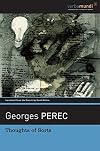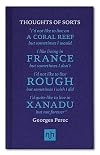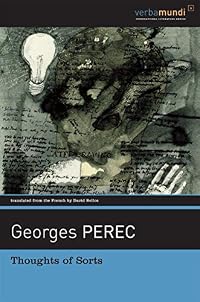
Thoughts of Sorts
by Georges Perec
On This Page
Description
Thoughts of Sorts, one of Georges Perec's final works, was published posthumously in France in 1985. With this translation, David Bellos, Perec's preeminent translator, has completed the Godine list of Perec's great works translated into English and has provided an introduction to this master of "systematic versatility." Thoughts of Sorts is a compilation of musings and essays attempting to circumscribe, in Perec's words, "my experience of the world not in terms of the reflections it casts show more in distant places, but at its actual point of breaking surface." Perec investigates the ways by which we define our place in the world, reveling in listmaking, orientating, classifying. This book employs all of the modes of questioning explored by his previous books, and at the same time breaks new ground of its own, ending with a question mark in typical/atypical Perec fashion. show lessTags
Recommendations















Member Reviews
I have always enjoyed making lists, especially list involving books and reading: lists of books I've read, lists of books I've listened to on audio CD, lists of my favorite authors, lists of books I intend reading, lists of books I've reviewed and posted on amazon.com, lists of books I've discussed in book groups, lists of books I've studied in detail, etc. I also have enjoyed the way words look and sound by themselves and in combination with other words, especially words that start with the same letter, words that are synonyms, words that are antonyms, simple monosyllabic words, compound words, obscure words, colorful words, etc. Is it any wonder I have fallen in love with the writing of Georges Perec?
Here is my favorite sentence from show more the back cover of this book, Thoughts of Sorts, translated by David Bellos and published by David R. Godine: "This playful and inventive master of classification and wordplay investigates the ways in which we define our place in the world, reveling in list-making, orientating and classifying." I couldn't imagine a more apt one-sentence description of this collection of essays.
Playful and Inventive - Here is a quote from the essay `Reading' under the section on public transport: "The place for reading is the metro. That could almost be a definition. I continue to be amazed that neither the Minister of Culture nor the Secretary of State for Higher Education has ever exclaimed: "Honourable members should cease forthwith their demands for more money for libraries. The people's true library is the underground!""
Master of classification and wordplay - When speaking on the alphabet in `Thoughts of Sorts/Sorts of Thoughts', we read, "The quality code of alphabetical order is not very rich; in fact, it has only three elements: A for excellent, B for less good and Z for rock bottom (in French, really rotten films can be called "Z movies)."
The ways in which we define our place in the world - From `Notes on the Objects to Be Found on My Desk', we find, "I do still work now quite often in cafes; but at home it is only once in a blue moon that I work (write) anywhere else than at my desk (for instance, I don't ever really write in bed), and my desk is never used for anything other than my work (once again, as I write these words down I realize that they are not quite correct: two or three times a year; when I give a party, I clear my desk completely, cover it with a paper tablecloth and - like the plank on which I pile my dictionaries - turn it into a serving table)."
Reveling in list-making, orientating and classifying - In the section `On Order' in the essay `Brief Notes on the Art and Craft of Sorting Books' the author has four sub-sections: `Ways of sorting books', `Books which are very easy to sort', `Books which are not too hard to sort', and `Books which are well-night unsortable'.
I included the above quotes and snips as a way of a small taste of what the reader will find in this enlightening and entertaining collection of short essays. If you wish to explore the writings of Georges Perec, Thoughts of Sorts is a perfect place to start before moving on to his longer books: `A Void', `Life: A User's Manual', `Species of Spaces and Other Pieces', etc.. show less
Here is my favorite sentence from show more the back cover of this book, Thoughts of Sorts, translated by David Bellos and published by David R. Godine: "This playful and inventive master of classification and wordplay investigates the ways in which we define our place in the world, reveling in list-making, orientating and classifying." I couldn't imagine a more apt one-sentence description of this collection of essays.
Playful and Inventive - Here is a quote from the essay `Reading' under the section on public transport: "The place for reading is the metro. That could almost be a definition. I continue to be amazed that neither the Minister of Culture nor the Secretary of State for Higher Education has ever exclaimed: "Honourable members should cease forthwith their demands for more money for libraries. The people's true library is the underground!""
Master of classification and wordplay - When speaking on the alphabet in `Thoughts of Sorts/Sorts of Thoughts', we read, "The quality code of alphabetical order is not very rich; in fact, it has only three elements: A for excellent, B for less good and Z for rock bottom (in French, really rotten films can be called "Z movies)."
The ways in which we define our place in the world - From `Notes on the Objects to Be Found on My Desk', we find, "I do still work now quite often in cafes; but at home it is only once in a blue moon that I work (write) anywhere else than at my desk (for instance, I don't ever really write in bed), and my desk is never used for anything other than my work (once again, as I write these words down I realize that they are not quite correct: two or three times a year; when I give a party, I clear my desk completely, cover it with a paper tablecloth and - like the plank on which I pile my dictionaries - turn it into a serving table)."
Reveling in list-making, orientating and classifying - In the section `On Order' in the essay `Brief Notes on the Art and Craft of Sorting Books' the author has four sub-sections: `Ways of sorting books', `Books which are very easy to sort', `Books which are not too hard to sort', and `Books which are well-night unsortable'.
I included the above quotes and snips as a way of a small taste of what the reader will find in this enlightening and entertaining collection of short essays. If you wish to explore the writings of Georges Perec, Thoughts of Sorts is a perfect place to start before moving on to his longer books: `A Void', `Life: A User's Manual', `Species of Spaces and Other Pieces', etc.. show less
Do you enjoy making lists? Perhaps lists on books and reading - lists of books you've read, lists of books you want to read, lists of your favorite authors, lists of books you intend reading, lists of books you've reviewed, lists of books you've discussed in book groups or with friends, lists of books you've studied in detail?
Do you enjoyed the way words look and sound by themselves and in combination with other words? Do you like to see words that start with the same letter, words that are synonyms, words that are antonyms, monosyllabic words, compound words (among my personal favorite), obscure words or colorful words?
If your answer is "yes" to more than one of the above, you just might be a prime candidate to fall in love with the show more writing of Georges Perec, ink slinger in the widest sense of the sentence.
And speaking of sentences, here is my favorite sentence from the back cover of this book, Thoughts of Sorts: "This playful and inventive master of classification and wordplay investigates the ways in which we define our place in the world, reveling in list-making, orientating and classifying."
One couldn't come up with a more apt one-sentence amplification or description, exact explication or pithy portrayal of this splendiferous batch of nifty essays.
Playful and Inventive - Here's a quote from the essay Reading under the section on public transport: "The place for reading is the metro. That could almost be a definition. I continue to be amazed that neither the Minister of Culture nor the Secretary of State for Higher Education has ever exclaimed: "Honourable members should cease forthwith their demands for more money for libraries. The people's true library is the underground!""
Master of classification and wordplay - When speaking on the alphabet in Thoughts of Sorts/Sorts of Thoughts, we read, "The quality code of alphabetical order is not very rich; in fact, it has only three elements: A for excellent, B for less good and Z for rock bottom (in French, really rotten films can be called "Z movies)."
The ways in which we define our place in the world - From Notes on the Objects to Be Found on My Desk: "I do still work now quite often in cafes; but at home it is only once in a blue moon that I work (write) anywhere else than at my desk (for instance, I don't ever really write in bed), and my desk is never used for anything other than my work (once again, as I write these words down I realize that they are not quite correct: two or three times a year; when I give a party, I clear my desk completely, cover it with a paper tablecloth and - like the plank on which I pile my dictionaries - turn it into a serving table)."
Reveling in list-making, orientating and classifying - In Brief Notes on the Art and Craft of Sorting Books, the author has four sub-sections: Ways of sorting books, Books which are very easy to sort, Books which are not too hard to sort and Books which are well-night unsortable.
I included the above quotes and snips as a way highlighting several Georges gumdrops. If you wish to explore the writings of Georges Perec, Thoughts of Sorts is a perfect place to start before moving on to his longer books such as A Void (an entire novel without using the letter "e"), Life: A User's Manual or Species of Spaces. show less
Reading my way through Perec, because how is it possible to stop? This collection of short pieces has some models for prose experiments:
1. "Thoughts of Sorts / Sorts of Thoughts" is fragmentary in an uninteresting way: it could be much more intensively executed, more fictionally complete, more obsessively classificatory. But it makes up for that unaccountable lightness (it seems that it's the product of a waning interest, or a lack of energy) by some wonderful passages, like this:
"THOUGHTS / SORTS
What does the forward slash mean?
What exactly is the question? Whether I think before I sort? Whether I sort before I think?"
And so on. The problem is that there isn't much so on, and there is no clear reason why there isn't.
2. "I Remember show more Malet & Isaac" is an inventory of one of Perec's school books, a history of France. He inventories the table of contents, then all the words in italics, then just one picture's caption, then everything in boldface. It's also incomplete in a strangely unaccountable way, but it has a great cumulative effect: it makes me share in Perec's impatience with the old cobwebby history texts that we've all had to read.
3. "Backtracking" is a prose piece about his years in analysis, which manages to sound almost completely decathected by avoiding all talk about substance. Almost.
The problem with these pieces, for me, is that knowing "A Void," "W," and "Life: A User's Guide," I know he was capable of much more protracted concentration, which is not at all to say real exhaustiveness or actual classificatory rigor, but rather to say that I know he was capable of more interesting irrationalism. show less
1. "Thoughts of Sorts / Sorts of Thoughts" is fragmentary in an uninteresting way: it could be much more intensively executed, more fictionally complete, more obsessively classificatory. But it makes up for that unaccountable lightness (it seems that it's the product of a waning interest, or a lack of energy) by some wonderful passages, like this:
"THOUGHTS / SORTS
What does the forward slash mean?
What exactly is the question? Whether I think before I sort? Whether I sort before I think?"
And so on. The problem is that there isn't much so on, and there is no clear reason why there isn't.
2. "I Remember show more Malet & Isaac" is an inventory of one of Perec's school books, a history of France. He inventories the table of contents, then all the words in italics, then just one picture's caption, then everything in boldface. It's also incomplete in a strangely unaccountable way, but it has a great cumulative effect: it makes me share in Perec's impatience with the old cobwebby history texts that we've all had to read.
3. "Backtracking" is a prose piece about his years in analysis, which manages to sound almost completely decathected by avoiding all talk about substance. Almost.
The problem with these pieces, for me, is that knowing "A Void," "W," and "Life: A User's Guide," I know he was capable of much more protracted concentration, which is not at all to say real exhaustiveness or actual classificatory rigor, but rather to say that I know he was capable of more interesting irrationalism. show less
This was an enjoyable little book of essays on, well, "Thoughts of Sorts/Sorts of Thoughts". Worthwhile for the essay on his desk alone, but the rest of it is also enjoyable and thought-provoking. They're all nice reflections on the things we do without reflection - the things we leave on our desks (except when we have parties), the gestures that only the bespectacled possess, the way we arrange our reading materials and the ways we read.
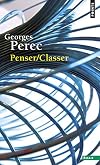
C'est une relecture de cette petite compilation des textes de Perec sur le classement et quelques sujets connexes.
J'ai bien aimé ses « Notes brèves sur l'art de ranger les livres » car cela me confronte à des problèmes qui me hantent chaque fois qu'un nouveau livre dont la lecture vient de se terminer doit s'aménager une place dans l'une de mes étagères. C'est l'esprit de Perec même , le classement et les listes qui m'ont probablement porté vers l'écriture de ces courts textes regroupés dans de petits cahiers [ou ce blogue] dédiés à mes lectures.
À retenir : « Lire : une esquisse socio-physiologique », « Considérations sur les lunettes » et « Penser / classer ».
L'art de la liste, la maîtrise de l'énumération, show more la maestria de l'inventaire, la virtuosité du recensement, la précision du catalogue, la science du dénombrement, du Perec rien de moins que perecquien et un raton-laveur.
[http://rivesderives.blogspot.ca/2016/05/penser-classer-georges-perec.html] show less
J'ai bien aimé ses « Notes brèves sur l'art de ranger les livres » car cela me confronte à des problèmes qui me hantent chaque fois qu'un nouveau livre dont la lecture vient de se terminer doit s'aménager une place dans l'une de mes étagères. C'est l'esprit de Perec même , le classement et les listes qui m'ont probablement porté vers l'écriture de ces courts textes regroupés dans de petits cahiers [ou ce blogue] dédiés à mes lectures.
À retenir : « Lire : une esquisse socio-physiologique », « Considérations sur les lunettes » et « Penser / classer ».
L'art de la liste, la maîtrise de l'énumération, show more la maestria de l'inventaire, la virtuosité du recensement, la précision du catalogue, la science du dénombrement, du Perec rien de moins que perecquien et un raton-laveur.
[http://rivesderives.blogspot.ca/2016/05/penser-classer-georges-perec.html] show less
Jun 22, 2016French
El libro recoge una serie de artículos sobre temática diversa: el idioma, el pensamiento, el arte de ordenar los libros, las recetas de cocina, la ciudad ideal, las gafas, los aforismos, etc.
--
Perec, Georges (1936-1982). Pensar-clasificar / por Georges Perec ; [traducción, Carlos Gardini]. -- 1ª ed. -- Barcelona : Gedisa, 1986. -- 128 p. ; 23 cm. -- Traducción de: Penser / Classer. -- Bibliografía: p. 127-128. -- ISBN 84-7432-255-3
I. Gardini, Carlos, trad. II. Título. 1. Pensamiento-Psicología.
821.133.1-43"19"
821.133.1-92"19"
025
159.955
--
Perec, Georges (1936-1982). Pensar-clasificar / por Georges Perec ; [traducción, Carlos Gardini]. -- 1ª ed. -- Barcelona : Gedisa, 1986. -- 128 p. ; 23 cm. -- Traducción de: Penser / Classer. -- Bibliografía: p. 127-128. -- ISBN 84-7432-255-3
I. Gardini, Carlos, trad. II. Título. 1. Pensamiento-Psicología.
821.133.1-43"19"
821.133.1-92"19"
025
159.955
Jan 2, 2014Spanish
Members
- Recently Added By
Author Information

149+ Works 13,525 Members
Georges Perec was born in Paris on March 7, 1936 and was educated in Claude-Bernard and Geoffroy-Saint-Hilaire. Perec was a parachutist in the French Military before he began publishing his writing in magazines like Partisans. Perec also wrote the book, Life: A Users Manual. Perec is noted for his constrained writing: his 300-page novel La show more disparition (1969) is a lipogram, written without ever using the letter "e". Perec won the Prix Renaudot in 1965, the Prix Jean Vigo in 1974, the Prix Médicis in 1978. Georges Perec died on March 3, 1982. (Bowker Author Biography) show less
Some Editions
Series
Belongs to Publisher Series
Common Knowledge
- Canonical title
- Thoughts of Sorts
- Original title
- Penser / Classer
- Original publication date
- 1985
- Original language
- French
Classifications
Statistics
- Members
- 261
- Popularity
- 124,155
- Reviews
- 7
- Rating
- (3.87)
- Languages
- 7 — English, French, German, Greek, Italian, Japanese, Spanish
- Media
- Paper, Ebook
- ISBNs
- 19
- ASINs
- 2