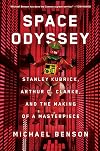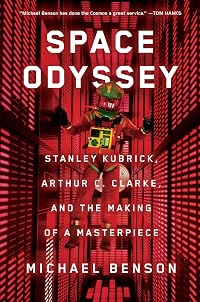
Space Odyssey: Stanley Kubrick, Arthur C. Clarke, and the Making of a Masterpiece
by Michael Benson
On This Page
Description
"Celebrating the fiftieth anniversary of the film's release, this is the definitive story of the making of 2001: A Space Odyssey, acclaimed today as one of the greatest films ever made, including the inside account of how director Stanley Kubrick and writer Arthur C. Clarke created this cinematic masterpiece. Regarded as a masterpiece today, 2001: A Space Odyssey received mixed reviews on its 1968 release. Despite the success of Dr. Strangelove, director Stanley Kubrick wasn't yet recognized show more as a great filmmaker, and 2001 was radically innovative, with little dialogue and no strong central character. Although some leading critics slammed the film as incomprehensible and self-indulgent, the public lined up to see it. 2001's resounding commercial success launched the genre of big-budget science fiction spectaculars. Such directors as George Lucas, Steven Spielberg, Ridley Scott, and James Cameron have acknowledged its profound influence. Author Michael Benson explains how 2001 was made, telling the story primarily through the two people most responsible for the film, Kubrick and science fiction legend Arthur C. Clarke. Benson interviewed Clarke many times, and has also spoken at length with Kubrick's widow, Christiane; with visual effects supervisor Doug Trumbull; with Dan Richter, who played 2001's leading man-ape; and many others. A colorful nonfiction narrative packed with memorable characters and remarkable incidents, Space Odyssey provides a 360-degree view of this extraordinary work, tracking the film from Kubrick and Clarke's first meeting in New York in 1964 through its UK production from 1965-1968, during which some of the most complex sets ever made were merged with visual effects so innovative that they scarcely seem dated today. A concluding chapter examines the film's legacy as it grew into it current justifiably exalted status"-- show lessTags
Recommendations



Member Reviews
Firstly, ‘2001: A Space Odyssey’ is one of the all time great films, groundbreaking in so many ways (and if you disagree I shall have to ask you to step outside...). So this will clearly colour my review.
Benson’s book covers the whole production of the movie from the initial pondering of Kubrick in 1964 and first contact with Arthur C. Clarke through to the eventual release in late 1968. There is some discussion of the film’s impact, mainly concerned with early audience reaction, and a fairly cursory follow through to the eventual passing of both Kubrick and Clarke. The meat of the book concerns the development of the ideas and what was to pass for a script and a detailed look at how those ideas were translated into actual show more filmed scenes.
The technical parts of the book are pretty good and there is lots of incidental detail that was new to me - the Young Generation dancers as apes? The focus is very much on the (very) young team of technicians that Kubrick hired to achieve his vision and the input they had in refining what that vision ultimately was. Surprisingly, Kubrick himself remains a quite distant figure in all this, floating in and out with a thumbs up or down (and we see that it was mostly down, pour encourager les autres) and handling lots of filmic admin that we never really see.
A really good book that lifts the lid on exactly how such a great piece of art was made. show less
Benson’s book covers the whole production of the movie from the initial pondering of Kubrick in 1964 and first contact with Arthur C. Clarke through to the eventual release in late 1968. There is some discussion of the film’s impact, mainly concerned with early audience reaction, and a fairly cursory follow through to the eventual passing of both Kubrick and Clarke. The meat of the book concerns the development of the ideas and what was to pass for a script and a detailed look at how those ideas were translated into actual show more filmed scenes.
The technical parts of the book are pretty good and there is lots of incidental detail that was new to me - the Young Generation dancers as apes? The focus is very much on the (very) young team of technicians that Kubrick hired to achieve his vision and the input they had in refining what that vision ultimately was. Surprisingly, Kubrick himself remains a quite distant figure in all this, floating in and out with a thumbs up or down (and we see that it was mostly down, pour encourager les autres) and handling lots of filmic admin that we never really see.
A really good book that lifts the lid on exactly how such a great piece of art was made. show less
I’m a big fan of 2001: A Space Odyssey, so this book, published around the time of the 50th anniversary of the movie’s release, was a natural for me. I wanted to get some view inside the thinking that went into the plot and, especially the decisions about how much to explain and how much to leave mysterious.
The thing I most love about the movie is that Kubrick and Clarke didn’t explain everything to us — how the monolith works, where it came from, how it got there, what really happened to Dave Bowman, what exactly a “Star Child” is, and what produced the problem with HAL. As the book’s chapter on the movie’s release shows, it was questions like those that mystified initial reviewers and left them panning the movie as show more incomprehensible. I think there is a challenge in the movie, one that Kubrick especially worked single-mindedly to pose, to make the movie’s watcher think, even to accept that there are unknowns and to experience awe at what we don’t know.
As Benson tells the story, Kubrick had very little by way of a substantive idea for the movie when he and Clarke began to talk about it — he only wanted to make the proverbial “good science fiction movie.” Both he and Clarke agreed that it hadn’t been done yet, that there were some close calls but no winners (e.g., Forbidden Planet, The Day the Earth Stood Still).
And Kubrick was very interested in the idea of aliens, and alien intelligence.
Clarke of course was a veteran of such ideas, at least in print media. His book, Childhood’s End, was already a classic. And his experience steered Kubrick away from dead-ends and clichés. They started almost from scratch. Kubrick, at Clarke’s and others’ recommendations, read classics of science fiction, and ended up choosing as potential starting points a number of stories by Clarke. Through their discussions, those potentials winnowed themselves down to Clarke’s short story, The Sentinel.
When they got started, even as production on the movie geared up, there were lots of blanks in the story. So much of the story was created as they went along — HAL’s “malfunction”, the fate of the crew members, the real role of the monolith (the idea of the monolith extended the original “crystal” of The Sentinel), the Star Child.
As the story developed, and especially as Kubrick directed the movie itself, he and Clarke diverged. From Benson’s account, I’m convinced that Kubrick is almost solely responsible for the enigmatic character of the movie. Benson talks about the collaboration in left-brain/right-brain terms, with Clarke the rational, analytic left brain and Kubrick the feeling-centered, intuition-led right brain. The right brain won.
The original plan for the movie included a narration, to be written by Clarke, that would have explained to the viewers much of what they were seeing. In fact, Clarke worked to almost the very end of production on this narration before Kubrick finally told him they would not use it at all. Kubrick wanted to appeal to the viewer’s senses and emotions more so than his intellect. Not everything would be explained, and so much more would be experienced than even could be explained.
We learn a lot about Kubrick, and Clarke too, from Benson’s account. Kubrick was famously difficult to work with, and his deference to Clarke’s experience and achievements had strong, if not always well defined, limits. It was his movie, and the story it told was his story. In fact, Clarke’s contract did not include any share in the movie’s earnings, and Kubrick had seen to it that he would have final say not only on the movie’s content, but even on the book that would be published at the same time, written primarily (or even exclusively) by Clarke.
Clarke turns out to be a different person than I thought he was. I always pictured him as a self-assured master of his realm, not as the somewhat hapless man Benson presents. Despite his success as one of the “big three” of science fiction, along with Asimov and Heinlein, he was not financially set. His personal relationships sapped his finances and skewed his judgment. Both he and his agent, Scott Meredith, were poorly equipped to negotiate with someone of Kubrick’s drive and ego. Clarke spent a substantial time during the movie’s generation and production in debt, partly as a result of the arrangements he made with Kubrick.
Kubrick himself was a polite dictator, with an ego to match the ambitions of 2001. Benson describes the work of the special effects creators and crew, the actors, . . . all of whom had creative input to the story and its realization onscreen. Kubrick drove them all past their artistic and physical limits (with little public credit in the end). He was never satisfied when a shot met his expectations — the very experience of the shot would always inspire him to go farther, with a new idea or a new technical requirement. Benson’s account of the Dawn of Man sequence from the beginning of the movie (actually shot last) is a great story of escalating expectations and an almost crazed drive toward a goal that only became clear at the end of the process, if even then.
At the same time, Kubrick was privately less supremely secure and confident than he appeared. His private remarks, recounted by his wife Christiane in Benson’s book, echo some of the same dramatic self-doubt you hear in Eleanor Coppola’s documentary about her husband’s making of Apocalypse Now. Kubrick would confesss, “I don’t know what I’m doing, I have no idea!” “Does that sound right? No. It sounds really pompous! Stupid!”
Maybe like all of us, Kubrick was driven as much by self-doubt as self-confidence.
There’s much more to Benson’s book — accounts of how special effects were technically created, the ingenious contributions of people like Doug Trumbull and Dan Richter (the lead man-ape, Moonwatcher), and many others. After reading the book, I’m now anxious to watch the movie and see all the things I didn’t appreciate before, even some plot elements I hadn’t picked up.
Maybe that’s the best thing I can say about the book, that it deepens my appreciation of what I already liked about the movie, and I think it’s going to make me see even more than I saw before.
If I have any criticism, it’s that the book isn’t a smooth story. It bumps and rattles around — maybe that’s as much a reflection of Kubrick’s way of making a movie as it is of Benson’s talent as a storyteller. show less
The thing I most love about the movie is that Kubrick and Clarke didn’t explain everything to us — how the monolith works, where it came from, how it got there, what really happened to Dave Bowman, what exactly a “Star Child” is, and what produced the problem with HAL. As the book’s chapter on the movie’s release shows, it was questions like those that mystified initial reviewers and left them panning the movie as show more incomprehensible. I think there is a challenge in the movie, one that Kubrick especially worked single-mindedly to pose, to make the movie’s watcher think, even to accept that there are unknowns and to experience awe at what we don’t know.
As Benson tells the story, Kubrick had very little by way of a substantive idea for the movie when he and Clarke began to talk about it — he only wanted to make the proverbial “good science fiction movie.” Both he and Clarke agreed that it hadn’t been done yet, that there were some close calls but no winners (e.g., Forbidden Planet, The Day the Earth Stood Still).
And Kubrick was very interested in the idea of aliens, and alien intelligence.
Clarke of course was a veteran of such ideas, at least in print media. His book, Childhood’s End, was already a classic. And his experience steered Kubrick away from dead-ends and clichés. They started almost from scratch. Kubrick, at Clarke’s and others’ recommendations, read classics of science fiction, and ended up choosing as potential starting points a number of stories by Clarke. Through their discussions, those potentials winnowed themselves down to Clarke’s short story, The Sentinel.
When they got started, even as production on the movie geared up, there were lots of blanks in the story. So much of the story was created as they went along — HAL’s “malfunction”, the fate of the crew members, the real role of the monolith (the idea of the monolith extended the original “crystal” of The Sentinel), the Star Child.
As the story developed, and especially as Kubrick directed the movie itself, he and Clarke diverged. From Benson’s account, I’m convinced that Kubrick is almost solely responsible for the enigmatic character of the movie. Benson talks about the collaboration in left-brain/right-brain terms, with Clarke the rational, analytic left brain and Kubrick the feeling-centered, intuition-led right brain. The right brain won.
The original plan for the movie included a narration, to be written by Clarke, that would have explained to the viewers much of what they were seeing. In fact, Clarke worked to almost the very end of production on this narration before Kubrick finally told him they would not use it at all. Kubrick wanted to appeal to the viewer’s senses and emotions more so than his intellect. Not everything would be explained, and so much more would be experienced than even could be explained.
We learn a lot about Kubrick, and Clarke too, from Benson’s account. Kubrick was famously difficult to work with, and his deference to Clarke’s experience and achievements had strong, if not always well defined, limits. It was his movie, and the story it told was his story. In fact, Clarke’s contract did not include any share in the movie’s earnings, and Kubrick had seen to it that he would have final say not only on the movie’s content, but even on the book that would be published at the same time, written primarily (or even exclusively) by Clarke.
Clarke turns out to be a different person than I thought he was. I always pictured him as a self-assured master of his realm, not as the somewhat hapless man Benson presents. Despite his success as one of the “big three” of science fiction, along with Asimov and Heinlein, he was not financially set. His personal relationships sapped his finances and skewed his judgment. Both he and his agent, Scott Meredith, were poorly equipped to negotiate with someone of Kubrick’s drive and ego. Clarke spent a substantial time during the movie’s generation and production in debt, partly as a result of the arrangements he made with Kubrick.
Kubrick himself was a polite dictator, with an ego to match the ambitions of 2001. Benson describes the work of the special effects creators and crew, the actors, . . . all of whom had creative input to the story and its realization onscreen. Kubrick drove them all past their artistic and physical limits (with little public credit in the end). He was never satisfied when a shot met his expectations — the very experience of the shot would always inspire him to go farther, with a new idea or a new technical requirement. Benson’s account of the Dawn of Man sequence from the beginning of the movie (actually shot last) is a great story of escalating expectations and an almost crazed drive toward a goal that only became clear at the end of the process, if even then.
At the same time, Kubrick was privately less supremely secure and confident than he appeared. His private remarks, recounted by his wife Christiane in Benson’s book, echo some of the same dramatic self-doubt you hear in Eleanor Coppola’s documentary about her husband’s making of Apocalypse Now. Kubrick would confesss, “I don’t know what I’m doing, I have no idea!” “Does that sound right? No. It sounds really pompous! Stupid!”
Maybe like all of us, Kubrick was driven as much by self-doubt as self-confidence.
There’s much more to Benson’s book — accounts of how special effects were technically created, the ingenious contributions of people like Doug Trumbull and Dan Richter (the lead man-ape, Moonwatcher), and many others. After reading the book, I’m now anxious to watch the movie and see all the things I didn’t appreciate before, even some plot elements I hadn’t picked up.
Maybe that’s the best thing I can say about the book, that it deepens my appreciation of what I already liked about the movie, and I think it’s going to make me see even more than I saw before.
If I have any criticism, it’s that the book isn’t a smooth story. It bumps and rattles around — maybe that’s as much a reflection of Kubrick’s way of making a movie as it is of Benson’s talent as a storyteller. show less
When's the last time you finished a book and said, This is one of the best books I've ever read? This is one of them: one of the best books about artistic creation ever written and I'm including A Portrait of the Artist as a Young Man in that list. In 450 pages, there's not a single extraneous sentence and I've never read anything that suggests Kubrick's method and character in as balanced and believable a fashion. He's always portrayed as the Obsessed Maniac or the Reclusive Genius or the Big Jerk--but here, he's an incredibly intelligent person struggling to articulate an idea. Benson is great on everything: Kubrick and Clarke's relationship, special effects, the story, the release, the impact--there's not a single aspect that Benson show more has overlooked. I learned so much from this--and I'm a 2001 know-it-all. If you love 2001, buy this book and begin reading it immediately. I wish Congress could compel Benson to write another one on any other of Kubrick's films. I know I'm being hyperbolic, but the book is that good. show less
... dah ... dah ... dah ... DAH DAH!! ... [return][return]There, now that I've got that out of my system, we can talk about the book. Once he hits his stride, Michael Benson does an excellent job of telling all you need to know (and some things you probably never realized that you needed to know) about the making of Stanley Kubrick's 2001: A Space Odyssey. [return][return]Like the movie, the book has its flaws and (hmmmm) its longeurs. Benson's attention to detail can occasionally become self-parodic; sometimes his word choice and phrasing can seem ... odd. But Benson has done a fantastic job of gathering together the people, where they are still with us, and the information, and has rendered it into a genuinely fascinating, and at show more times genuinely moving chronicle of the creative process, the making of a movie that is never anything less than challenging and ground-breaking -- and the genius of Stanley Kubrick. [return][return]Benson teases out all sorts of fascinating factoids -- and creates the ghostly image of an alternate-reality version of a 2001 that might have been. The iconic use of classical music was a last minute decision by Kubrick, much to the distress of MGM, which had commissioned a composer for an original score. Right up the last minute, Arthur C. Clarke thought he was writing a voice-over explication of what was going on -- which Kubrick decided not to use. Actor Martin Balsam recorded HAL's lines, but Kubrick thought he made the rogue AI sound "too emotional."[return][return]And there are wonderful soundbites -- some of Benson's own I have already transcribed into the quotes here on Goodreads. This one, from Colin Cantwell, who joined the production late on as special photographic effects supervisor, really captures some of the insights into Kubrick's techniques -- and his inspiration.[return][return] He was dedicated to what he was creating, he was listening for it, finding where it was, continually trying to build it to this complete thing. That film is what Stanley is. And the great thing was, the "is-ing" of it -- the verb of doing it-- we all got sucked into that. How can this be done, and he excellence that had to be there. Everything had to have that excellence, or it couldn't happen at all. show less
Stubb said it better, but I just am so stoked about this book I need to add my two cents: I saw 2001: A Space Odyssey when it came out in 1968. I was 12 years old. I fell in love with it, and have always counted it as my favorite movie. I've read many books about it but this is the best one by far - by far! It is one of the most interesting, informative, best written books I've ever read -- not just about 2001 -- period. I thought (like Stubb) I knew a lot about 2001, but this book was a revelation. I even read the "Acknowledgements" with interest. How often do you do that?
An exhaustive, and sometimes exhausting, examination of what it took to make the film that set the bar for all future space adventures; besides creating a lot of the tricks and technology that went into making those films. What you read this for is to learn about how Kubrick and Clarke came to have a working relationship, Kubrick's creation of the armature on which to build his film, and the painstaking problem solving that went into making each scene work. It's all very impressive stuff. As for how it makes me feel about Kubrick, you can almost overlook the processes by which he edged contributors out of the lime light, so that the movie was his personal achievement; that no one worked harder on this film almost makes it seem just.
More than 50 years ago, at the start of a fateful 4-year collaboration, film director Kubrick and futurist / SF writer Clarke agreed that an imagined extraterrestrial influence on the origin and destiny of humankind was a subject worthy of epic dramatization. The result, of course, was one of the most astonishing, iconic, and culturally enduring movies of all time. With its 444 pages of main text, I can't imagine that there will ever be a more complete account of the creation of _2001: A Space Odyssey_ than this book. If you have seen the film, you should find Benson's account absorbing; if you haven't seen it, you should be ashamed of yourself.
Members
- Recently Added By
Lists

2019 Hugo Eligible Related Works
9 works; 3 members

Top Five Books of 2025
954 works; 303 members
Author Information

7+ Works 757 Members
Awards and Honors
Awards
Distinctions
Common Knowledge
- Original publication date
- 2018
Classifications
- Genres
- Nonfiction, Biography & Memoir, General Nonfiction
- DDC/MDS
- 791.43 — Arts & recreation Recreation, sports, and performing arts Public performances Motion pictures, radio, television, podcasting Motion pictures
- LCC
- PN1997 .T86 .B46 — Language and Literature Literature (General) Literature (General) Drama Motion pictures Plays, scenarios, etc.
- BISAC
Statistics
- Members
- 310
- Popularity
- 102,841
- Reviews
- 16
- Rating
- (4.43)
- Languages
- English, Portuguese (Portugal)
- Media
- Paper, Audiobook, Ebook
- ISBNs
- 7
- ASINs
- 3