On This Page
Description
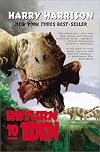
Fantasy. Fiction. HTML:In West of Eden and Winter in Eden, master novelist Harry Harrison broke new ground with his most ambitious project ever. He brought to vivid life the world as it might have been, where dinosaurs survived, where their intelligent descendents, the Yilane, challenged humans for mastery of the Earth, and where the human Kerrick, a young hunter of the Tanu tribe, grew among the dinosaurs and rose to become their most feared enemy. Now, in Return to Eden, Harrison brings show more the epic trilogy to a stunning conclusion. After Kerrick rescues his people from the warlike Yilane, they find a safe haven on an island and there begin to rebuild their shattered lives. But with fierce predators stalking the forests, how long can these unarmed human outcasts hope to survive? And, of course, Kerrick cannot forget Vainte, his implacable Yilane enemy. She's been cast out from her kind, under sentence of death, but how long will her banishment last? For her strange attraction to Kerrick has turned into a hatred even more powerful than her instincts - an obsession that compels her to hunt down Kerrick and kill him... show lessTags
Recommendations



















Member Reviews
In the third, melancholy book of Harrison’s alternate history trilogy where the intelligent descendants of dinosaurs, the Yilanè, uneasily coexist with humans, the theme is succession.
Series hero Kerrick wants his son to learn the Yilanè language so there will be more than one human who can communicate between the mutually hostile races. The war between the races threatens to resume again when the humans raid Yilanè cities for hèsotsan, lizards engineered to fire poisonous darts. Things escalate further when the series villain, the unusually ambitious and crafty Vaintè, leaves her torpid, mindless exile on the beaches of Africa, to resume her genocide against humanity.
Enge, the leader of the Daughters of Life, tries to ensure the show more religious order’s survival. They are the first such in Yilan history but despised and feared and termed the Daughters of Death for their refusal to drop dead as is the custom when ordered by the leader of a Yilanè city. Founded on something like Buddhist principles and the first to exhibit to others of their kind, they are threatened not only by some members’ too rigid adherence to monastic contemplation but an inability to procreate with the intelligent, but not Yilanè-enough race inhabiting the area around their city.
And the greater question is which race will end up with the Earth – the sophisticated bioengineers -- but caste-bound -- Yilanè or tool using humans who, unlike the Yilanè, universally use language.
Kerrick, the only person in this world with intimate knowledge of both races, is the classic caught-between-two-worlds figure. Even at the story’s end, his ambivalence is never entirely vanquished. Harrison ends his series on a complete enough resolution even though the final climactic scenes are a bit too reliant on coincidence in order for Harrison to end this fast paced volume, the shortest of the series.
Again, this novel’s original hardcover version features interesting and integral line drawings by Bill Sanderson. And, again, while an introduction makes it possible to read just this volume, I’d recommend reading the series from the beginning to get the full nuance, grandeur, and emotion of Kerrick’s life from small boy to wise old man. show less
Series hero Kerrick wants his son to learn the Yilanè language so there will be more than one human who can communicate between the mutually hostile races. The war between the races threatens to resume again when the humans raid Yilanè cities for hèsotsan, lizards engineered to fire poisonous darts. Things escalate further when the series villain, the unusually ambitious and crafty Vaintè, leaves her torpid, mindless exile on the beaches of Africa, to resume her genocide against humanity.
Enge, the leader of the Daughters of Life, tries to ensure the show more religious order’s survival. They are the first such in Yilan history but despised and feared and termed the Daughters of Death for their refusal to drop dead as is the custom when ordered by the leader of a Yilanè city. Founded on something like Buddhist principles and the first to exhibit to others of their kind, they are threatened not only by some members’ too rigid adherence to monastic contemplation but an inability to procreate with the intelligent, but not Yilanè-enough race inhabiting the area around their city.
And the greater question is which race will end up with the Earth – the sophisticated bioengineers -- but caste-bound -- Yilanè or tool using humans who, unlike the Yilanè, universally use language.
Kerrick, the only person in this world with intimate knowledge of both races, is the classic caught-between-two-worlds figure. Even at the story’s end, his ambivalence is never entirely vanquished. Harrison ends his series on a complete enough resolution even though the final climactic scenes are a bit too reliant on coincidence in order for Harrison to end this fast paced volume, the shortest of the series.
Again, this novel’s original hardcover version features interesting and integral line drawings by Bill Sanderson. And, again, while an introduction makes it possible to read just this volume, I’d recommend reading the series from the beginning to get the full nuance, grandeur, and emotion of Kerrick’s life from small boy to wise old man. show less
In the last volume of the trilogy we can follow the lives of the human and jilanè characters known from the previous books. Unfortunately less action-packed than the first two, sometimes even tends to be boring a bit and the main plot threads converging only at the last pages a nit meaninglessly. The world itself still interesting and amusing although.
The West of Eden series is the best Harry Harrison gets, in my opinion. The world is not fully fleshed out, we know nothing about the ecology, but the lizards are well-rounded , the people...not so much. Passable entertainment
This is the last of the trilogy. In some respects it was a interesting story but not much drama except for the last 100 pages and then it is somewhat predictable.
I am glad I read it but I just wish there was more meat to the story when it comes to the human side. I also wish there was not a repeat (about 100 pages) on the life/history of all groups and language dictionary of the margu.. what was the point? Reading it once (ok skimming it once) was enough.
I am glad I read it but I just wish there was more meat to the story when it comes to the human side. I also wish there was not a repeat (about 100 pages) on the life/history of all groups and language dictionary of the margu.. what was the point? Reading it once (ok skimming it once) was enough.
In de fantastische prehistorie van meesterverteller Harry Harrison heeft de kosmische catastrofe, die een eind maakte aan het tijdperk van de dinosaurussen nooit plaatsgevonden. De evolutie van de grote reptielen zette voort en culmineerde zelfs in het ontstaan van de Yilanè, het intelligentste en meest ontwikkelde ras op aarde. De veroveringsdrang van deze superieure sauriërs lijkt niet te stuiten, tot ze in contact komen met een onbekende zoogdierensoort... de mens.
In Ten westen van Eden maken de Yilanè voor het eerst kennis met de mens, bij gevangenneming van een jongeling van deze soort. Ze beseffen echter niet dat daardoor de op handen zijnde krijg tussen de beide soorten een andere wending zal nemen. Want het is deze jongen, show more Kerrick, die zijn soort aanvoert in de strijd die onvermijdelijk is.
In Winter in Eden is het opnieuw Kerrick die de verdedigingslinie van de mensheid bepaald. Gedreven door zorg voor vrouw en kind zoekt hij de toevlucht bij de walvisjagers in het zuiden.
Als Terugkeer naar Eden opent, doen de Yilanè een laatste poging zich van de wereldheerschappij te verzekeren. Maar Kerrick, nu een volwassen man en gerijpt en gelouterd in de listen en lagen van het oorlogsbedrijf, bereidt een meesterplan voor. Dan begint de laatste titanenslag tussen mens en sauriër. show less
In Ten westen van Eden maken de Yilanè voor het eerst kennis met de mens, bij gevangenneming van een jongeling van deze soort. Ze beseffen echter niet dat daardoor de op handen zijnde krijg tussen de beide soorten een andere wending zal nemen. Want het is deze jongen, show more Kerrick, die zijn soort aanvoert in de strijd die onvermijdelijk is.
In Winter in Eden is het opnieuw Kerrick die de verdedigingslinie van de mensheid bepaald. Gedreven door zorg voor vrouw en kind zoekt hij de toevlucht bij de walvisjagers in het zuiden.
Als Terugkeer naar Eden opent, doen de Yilanè een laatste poging zich van de wereldheerschappij te verzekeren. Maar Kerrick, nu een volwassen man en gerijpt en gelouterd in de listen en lagen van het oorlogsbedrijf, bereidt een meesterplan voor. Dan begint de laatste titanenslag tussen mens en sauriër. show less
Ratings
Members
- Recently Added By
Lists

Best Alternate History
111 works; 60 members

Best Fantasy Novels
821 works; 358 members
Author Information

439+ Works 44,316 Members
Harry Harrison was born Henry Maxwell Dempsey on March 12, 1925 in Stamford, Connecticut. He was drafted into the U. S. Air Corps in 1943 and became a sharpshooter, a military policeman, a gunnery instructor, and a specialist in the prototypes of computer-guided bomb-sights and gun turrets. After being discharged, he graduated from Hunter College show more with a degree in art. By the end of the 1940s, he was running a small studio that specialized in selling illustrations to comics and science-fiction magazines. He then moved on to editing some of the magazines. As the market for comics began to shrink, he started writing for science-fiction magazines. He wrote short science fiction stories and novels including Deathworld, Captive Universe, Montezuma's Revenge, Star Smashers of the Galaxy Rangers, Stonehenge, West of Eden, Stars and Stripes Forever. He also wrote the Stainless Steel Rat series and the Bill, the Galactic Hero series. His novel Make Room! Make Room! Was the inspiration for the movie Soylent Green. He also wrote under the pseudonyms Hank Dempsey, Felix Boyd, Wade Kaempfert, Cameron Hall, Philip St. John, and Leslie Charteris. He died on August 15, 2012 at the age of 87. (Bowker Author Biography) show less
Some Editions
Series

Belongs to Publisher Series
Common Knowledge
- Canonical title*
- Terugkeer naar Eden
- Original title
- Return to Eden
- Original publication date
- 1988-08
- People/Characters*
- Kerrick
- Epigraph
- Uveigil as lok at mennet, homennet
thorpar ey wat marta ok etin.
MARBAK PROVERB
**********
No matter how clear the river,
there is always some darkness
upstream drifting down towards you. - First words
- PROLOGUE: KERRICK
Life is no longer easy.
ONE
There was silence and peace. - Last words
- (Click to show. Warning: May contain spoilers.)The sculpture in one hand, his son's knife in the other, he turned his back on the Yilane and trudged off the join the Tanu.
(Click to show. Warning: May contain spoilers.)The telling is over now.
*Some information comes from Common Knowledge in other languages. Click "Edit" for more information.
Classifications
Statistics
- Members
- 791
- Popularity
- 35,008
- Reviews
- 6
- Rating
- (3.78)
- Languages
- 11 — Czech, Dutch, English, Finnish, German, Hungarian, Italian, Lithuanian, Polish, Russian, Spanish
- Media
- Paper, Audiobook, Ebook
- ISBNs
- 20
- ASINs
- 8