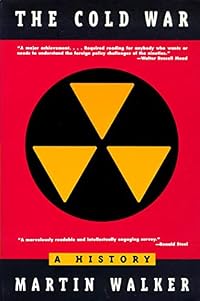
The Cold War: A History
by Martin Walker
On This Page
Description
The history of the Cold War is the history of the world since 1945. Now that we think it is over, we have to make sense of what the Cold War was, how it shaped us, and the uncertain new world that lies ahead. In [this book, the author] explains how the United States became the "security state."Tags
Recommendations














Member Reviews
In The Cold War: A History, Martin Walker argues, “In purely ideological terms, the confrontation of the Cold War was an extreme version of the continuing political debate between conservative and social democratic parties across Europe. It was a fatally exaggerated form of the ongoing choice between organizing societies on a collective or on an individual basis, which is part of the common political vocabulary of North America as well as Europe” (pg. 5). To this end, while he examines the events of the Cold War while drawing upon both U.S. and then-recently declassified Russian, Chinese, and other documents, he also focuses largely on economic forces.
Of the Cold War’s origins, Walker writes, “The Soviet Union had an ideology show more which gave the capitalist West ample cause to be nervous, and Russia had a history which mandated a suspicion of its neighbours. The implicit tensions in their relations might have been eased, as President Roosevelt had believed, by American goodwill. But Roosevelt died, and Truman had to prove himself fit to fill those giant shoes” (pg. 27). He continues, “Once the United States and the Soviet Union began to perceive one another through the prism of the Cold War in Europe, they saw that jaundiced image of the other wherever they looked. The irony was that Europe, the crucible, remained edgily at peace; the vast bulk of the Cold War’s fighting and dying took part in Asia, the Middle East, Africa and Latin America” (pg. 60).
By the early 1960s and with the effects of the Marshall Plan and Bretton Woods taking shape, economics became even more apparent. Walker writes, “[UK Prime Minister Harold] Macmillan made clear his conviction that economics lay at the very heart of the confrontation with Communism. It was not simply that wealth was essential to buy weapons and military research, but that the Cold War itself was a form of economic competition” (pg. 137). When de Gaulle wanted to put pressure on the U.S. government, he returned U.S. dollars and insisted on gold in payment, prompting the U.S. to end the gold standard in order to maintain economic superiority (pgs. 210-211). According to Walker, “The motive of Nixon, and his Treasury Secretary… was largely political: to free the U.S. economy from balance-of-payments restraints and open the way for reflation to ensure the economy was growing comfortably in time for Nixon’s re-election campaign the following year” (pgs. 222-223).
Discussing the impact of Reagan’s acceleration of the Cold War after détente, Walker writes, “In 1980, when Reagan was elected, the USA was the world’s largest creditor, and its national debt was just over $1 trillion. By 1992, after two terms of President Reagan and one of President Bush, the United States was the world’s largest debtor and the national debt had reached $4 trillion. The difference – $3 trillion, or $3,000 billion – is roughly equivalent to the accumulated defence budgets of those years” (pg. 266). Meanwhile, in the Soviet Union, “Gorbachev talked of the need to use modern economic mechanisms, like profit and credit, and for the first time talked of the need for a wholesale restructuring, a perestroika” (pg. 283).
Walker concludes, “The objective may have been to contain the Soviet Union. The achievement was to build up the West, the global economy which was greater than the sum of its American, European and Japanese parts, and whose creative economic energies were the true victory of the Cold War” (pg. 332). Further, “The costs of the Cold War, and the distortions it inflicted upon the social systems of what had been the world’s two most powerful economies, suggested that the superpowers had become superlosers during the Cold War’s final decade. The USSR had broken, and the USA had bent under the strain” (pg. 343). Walker’s analysis expertly combines political and economic history, though some of his predictions from 1993 now seem naïve with the benefit of hindsight, but that does not detract from his analysis. show less
Of the Cold War’s origins, Walker writes, “The Soviet Union had an ideology show more which gave the capitalist West ample cause to be nervous, and Russia had a history which mandated a suspicion of its neighbours. The implicit tensions in their relations might have been eased, as President Roosevelt had believed, by American goodwill. But Roosevelt died, and Truman had to prove himself fit to fill those giant shoes” (pg. 27). He continues, “Once the United States and the Soviet Union began to perceive one another through the prism of the Cold War in Europe, they saw that jaundiced image of the other wherever they looked. The irony was that Europe, the crucible, remained edgily at peace; the vast bulk of the Cold War’s fighting and dying took part in Asia, the Middle East, Africa and Latin America” (pg. 60).
By the early 1960s and with the effects of the Marshall Plan and Bretton Woods taking shape, economics became even more apparent. Walker writes, “[UK Prime Minister Harold] Macmillan made clear his conviction that economics lay at the very heart of the confrontation with Communism. It was not simply that wealth was essential to buy weapons and military research, but that the Cold War itself was a form of economic competition” (pg. 137). When de Gaulle wanted to put pressure on the U.S. government, he returned U.S. dollars and insisted on gold in payment, prompting the U.S. to end the gold standard in order to maintain economic superiority (pgs. 210-211). According to Walker, “The motive of Nixon, and his Treasury Secretary… was largely political: to free the U.S. economy from balance-of-payments restraints and open the way for reflation to ensure the economy was growing comfortably in time for Nixon’s re-election campaign the following year” (pgs. 222-223).
Discussing the impact of Reagan’s acceleration of the Cold War after détente, Walker writes, “In 1980, when Reagan was elected, the USA was the world’s largest creditor, and its national debt was just over $1 trillion. By 1992, after two terms of President Reagan and one of President Bush, the United States was the world’s largest debtor and the national debt had reached $4 trillion. The difference – $3 trillion, or $3,000 billion – is roughly equivalent to the accumulated defence budgets of those years” (pg. 266). Meanwhile, in the Soviet Union, “Gorbachev talked of the need to use modern economic mechanisms, like profit and credit, and for the first time talked of the need for a wholesale restructuring, a perestroika” (pg. 283).
Walker concludes, “The objective may have been to contain the Soviet Union. The achievement was to build up the West, the global economy which was greater than the sum of its American, European and Japanese parts, and whose creative economic energies were the true victory of the Cold War” (pg. 332). Further, “The costs of the Cold War, and the distortions it inflicted upon the social systems of what had been the world’s two most powerful economies, suggested that the superpowers had become superlosers during the Cold War’s final decade. The USSR had broken, and the USA had bent under the strain” (pg. 343). Walker’s analysis expertly combines political and economic history, though some of his predictions from 1993 now seem naïve with the benefit of hindsight, but that does not detract from his analysis. show less
Ratings
Members
- Recently Added By
Author Information

52+ Works 10,060 Members
Martin Walker is a senior fellow of the Global Business Policy Council, a private think tank for CEOs of major corporations, based in Washington, D.C. Walker is also editor in chief emeritus and international affairs columnist at United Press International and the author of the Bruno series. (Bowker Author Biography)
Common Knowledge
- Important events
- Cold War; Berlin Crisis of 1961
Classifications
Statistics
- Members
- 276
- Popularity
- 116,762
- Reviews
- 1
- Rating
- (3.66)
- Languages
- English
- Media
- Paper
- ISBNs
- 5
- ASINs
- 1