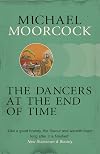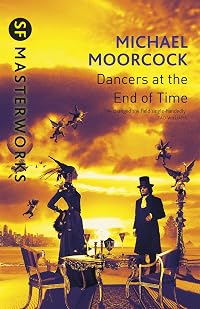
The Dancers at the End of Time
by Michael Moorcock
The Dancers at the End of Time (Collections and Selections — 1-3), The End of Time (Collections and Selections — Omnibus 1-3), The Eternal Champion (Collections and Selections — The End of Time books 1-3)
On This Page
Description
Enter a decaying far, far future society, a time when anything and everything is possible, where words like ¿conscience¿ and ¿morality¿ are meaningless, and where heartfelt love blossoms mysteriously between Mrs Amelia Underwood, an unwilling time traveller, and Jherek Carnelian, a bemused denizen of the End of Time. The Dancers at the End of Time, containing the novels An Alien Heat, The Hollow Lands and The End of All Songs, is a brilliant homage to the 1890s of Wilde, Beardsley and show more the fin de siècle decadents, satire at its sharpest and most colourful. show lessTags
Recommendations












Member Reviews
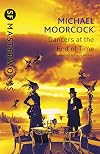
The Dancers at the End of Time combines Michael Moorcock's three novels An Alien Heat, The Hollow Lands and The End of All Songs, and is reprinted here as number 53 in the SF Masterworks series.
The titular dancers are the inhabitants of Earth in the centuries prior to the destruction of the Universe. Their powers--granted to them by their ancestors' technology, which they no longer truly understand--are god-like, and the Earth of the distant future is their plaything. They are amoral aesthetes whose lives are carefully constructed pieces of performance art, or a series of complex games.
Jherek Carnelian is the last human conceived and born on Earth in the old-fashioned way. At a party, he glimpses unwilling nineteenth century time show more traveller Mrs Amelia Underwood, and decides upon a new affectation: he will fall in love with her and win her heart. His new game thrills his friends, and everyone wants to play. Jherek's attempts to track down and seduce Mrs Underwood--as the Universe edges ever closer to destruction--are the heart of three quite funny novels.
An Alien Heat, the first volume, is by far the best of the three. The weird omnipotent innocence of Jherek and his friends and rivals is beautifully introduced and developed, then made marvellous by Jherek's pursuit of Mrs Underwood back to the nineteenth century--where he is powerless, but still innocent, and barely understands a single thing that happens to him.
The Hollow Lands is arguably the funniest of the three. Jherek's return to the nineteenth century culminates in the farcical set-piece chapter entitled, A Particularly Memorable Night at the Cafe Royal.
The End of All Songs suffers slightly from its need to deal with the previous book's cliff-hanger and then to resolve the various plots, but Moorcock is a skilled writer, and he does what he needs to do with panache. show less
The titular dancers are the inhabitants of Earth in the centuries prior to the destruction of the Universe. Their powers--granted to them by their ancestors' technology, which they no longer truly understand--are god-like, and the Earth of the distant future is their plaything. They are amoral aesthetes whose lives are carefully constructed pieces of performance art, or a series of complex games.
Jherek Carnelian is the last human conceived and born on Earth in the old-fashioned way. At a party, he glimpses unwilling nineteenth century time show more traveller Mrs Amelia Underwood, and decides upon a new affectation: he will fall in love with her and win her heart. His new game thrills his friends, and everyone wants to play. Jherek's attempts to track down and seduce Mrs Underwood--as the Universe edges ever closer to destruction--are the heart of three quite funny novels.
An Alien Heat, the first volume, is by far the best of the three. The weird omnipotent innocence of Jherek and his friends and rivals is beautifully introduced and developed, then made marvellous by Jherek's pursuit of Mrs Underwood back to the nineteenth century--where he is powerless, but still innocent, and barely understands a single thing that happens to him.
The Hollow Lands is arguably the funniest of the three. Jherek's return to the nineteenth century culminates in the farcical set-piece chapter entitled, A Particularly Memorable Night at the Cafe Royal.
The End of All Songs suffers slightly from its need to deal with the previous book's cliff-hanger and then to resolve the various plots, but Moorcock is a skilled writer, and he does what he needs to do with panache. show less
Poor hedonist Jherek Carnelian, forced to travel back and forth in time to woo his beloved and prim Mrs. Underwood. All this as a backdrop to allow Michael Moorcock's characters to philosophize about everything from architecture to parenting. I wanted to like this book so much more than I actually did. An Alien Heat and The Hollow Lands were marvelous, great characters, nice paradox. But then the End of All Songs was about 100 pages too long. Once the sexual tension between Amelia and Jherek was released, the book sort of "jumped the shark" for me. It turned into a way too goofy Hitchhikers Guide to the Galaxy. Although it did manage to have a nice end tacked on.
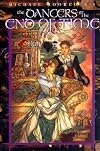
It did have a lovely dust jacket by Thomas Canty.
I can't believe others show more would place this before Hawkmoon, Elric, the Steampunk novels, or my personal favorite, Von Bek. show less
It did have a lovely dust jacket by Thomas Canty.
I can't believe others show more would place this before Hawkmoon, Elric, the Steampunk novels, or my personal favorite, Von Bek. show less
Have you ever wondered who came up with the idea of Second Life? It's basically a world in which you can make what you want or do what you like. Your only limits are those of your imagination.
I'm sure that the creators of this virtual world may have found a copy of Michael Moorcock's End of Time books, in which the inhabitants live in a world that is entirely their own. Clothes are made with the twist of a ring. Homes are put together with the wave of a hand. Life is as they make it, complete with parties, servants, and elaborate meals.
Jherek Carnelian is an odd sort of character dancing at the end of time. He is one of two inhabitants there (other than the occasional time traveler who gets stuck there) who was born. His mother, the show more Iron Orchid, thought it would be amusing to have a child the natural way. Those who were not born were either created by others (as was Sweet Orb Mace) or just came into being.
It is at a party at the Duke of Queen's home that Jherek discovers a time traveler quite different than the others. This traveler, Mrs. Amelia Underwood, a woman from the Victorian age, catches Jherek's heart in a way that no other creature was able to in the past. Distracted by a doomsaying alien, Jherek loses sight of Mrs. Underwood, and embarks on a quest to find her and win her love.
Jherek travels across time and space to win the heart of Mrs. Underwood, and gets help from very unlikely places along the way. Additionally, some Moorcock favorites make cameo appearances both and the End and Beginning of Time.
If you're a fan of Moorcock's Eternal Champion series (essentially, his entire corpus), then this volume of the tales of Carnelian are a must-have. Highly recommended! show less
I'm sure that the creators of this virtual world may have found a copy of Michael Moorcock's End of Time books, in which the inhabitants live in a world that is entirely their own. Clothes are made with the twist of a ring. Homes are put together with the wave of a hand. Life is as they make it, complete with parties, servants, and elaborate meals.
Jherek Carnelian is an odd sort of character dancing at the end of time. He is one of two inhabitants there (other than the occasional time traveler who gets stuck there) who was born. His mother, the show more Iron Orchid, thought it would be amusing to have a child the natural way. Those who were not born were either created by others (as was Sweet Orb Mace) or just came into being.
It is at a party at the Duke of Queen's home that Jherek discovers a time traveler quite different than the others. This traveler, Mrs. Amelia Underwood, a woman from the Victorian age, catches Jherek's heart in a way that no other creature was able to in the past. Distracted by a doomsaying alien, Jherek loses sight of Mrs. Underwood, and embarks on a quest to find her and win her love.
Jherek travels across time and space to win the heart of Mrs. Underwood, and gets help from very unlikely places along the way. Additionally, some Moorcock favorites make cameo appearances both and the End and Beginning of Time.
If you're a fan of Moorcock's Eternal Champion series (essentially, his entire corpus), then this volume of the tales of Carnelian are a must-have. Highly recommended! show less
In the end I liked Dancers at the End of Time more than I thought I would around half-way through. It is essentially a debate contrasting the values of the protestant moral world view and work ethic against an entirely free and "innocent" society. It suffered I felt from both a rather uneven structure across its three parts and a desire to add external threats and incidents which weren't really necessary. It wasn't as funny as the comedies of manners of Oscar Wilde, either, on which it was, I believe modelled. In the end I thought it succeeded as an exploration of its themes and was able to explore them in ways only possible in an SF novel of this kind but it failed as a homage to Wilde and Beardsley and as a more traditional style show more SF-based adventure which it seemed, in places, to wish to be.
The story revolves around the love affair of Amelia Underwood, a married woman from Bromley 1896, and Jherek Carnelian from the End of Time. They provide the central constrast of course but one criticism I have is that Moorcock seemed to find it difficult to portray Jherek's freedom and innocence without frequently making him look rather stupid. For instance, in 1896, he meets HG Wells an a train and concludes through a misunderstanding that bicycles are time machines. Amelia corrects him but he refuses to believe the fact despite knowing that Amelia is a native of this time and place about which he acknowledges that he is largely ignorant.
Structurally the first book works best, a story in two halves in which Amelia first visits the End of Time and Jherek then visits 1896. The second book then appears to retread much the same ground without advancing the plot a great deal, beyond driving a wedge between Amelia and her husband, and it works mostly as an extended farce. It is probably attempting to be Wildean, but Wilde succeeds by making fun of a society we understand and, in fact, many of his epithets are as aposite today as they were when written. Whereas the humour here is driven by the inability of the Victorians and the denizens at the End of Time to remotely comprehend each other without really critiquing either, let alone our own, which isn't really the same thing.
The third book (just read) is rather top heavy and a bit rambling, bearing the burden of resolving the secondary plot about the end of the Universe without seeming particularly interested in it and also dealing with most of the substance of the love story. Where the books suceed though is in portraying this central love affair without mindlessly condemning either Victorian morality or the excesses of the End of Time - or perhaps it condemns both equally and having constructed a society with unlimited resources, no death and therefore an absense of sin finds it can not actually condone it. At the end Jherek and Amelia leave this symbolic Garden of Eden of their own free will to go "forwards" to the beginning of time as a new Adam and Eve.
Bill is a huge fan of the portrayal of time within this book, but its portrayal, as I understand it, is not as Bill described it to me and I wonder if he was remembering another book. Time is cyclic and resists paradox. Any time-traveller in danger of creating a paradox is forcibly ejected by Time and sent, generally, forwards to somewhere they can do no harm. If they go too far forwards they cycle round into an alternative Universe. Bill seemed to think the books portrayed a kind of flexible time in which, even in the face of paradox, Time tended to mend itself so that it continued along much the same lines as it had before the intervention. The nature of time itself didn't seem to me to be particularly integral to the story line. It explained why there were comparatively few time travellers and added a certain danger into the characters various temporal voyages while at the same time providing a comedy scientist character who is wrong about things and petulant when his theories are challenged. Said scientist briefly shapes up for some sort of villainous role towards the end but Moorcock seems to grow bored of this and he is swiftly hoist by his own petard. Science gets fairly short shrift at the End of Time which is just about explained away towards the end when Amelia points out that since the residents of the End of Time can change the laws of Physics to suit themselves there is little point in trying to study or understand them but ultimately you get the sense that Moorcock believes humanity, left to its own devices in a state of innocence, is fundamentally more interested in aesthetics than understanding. Only Amelia and Jherek escape into a world in which man has to strive and in which, therefore, life has meaning. Ultimately this seems rather depressing. show less
The story revolves around the love affair of Amelia Underwood, a married woman from Bromley 1896, and Jherek Carnelian from the End of Time. They provide the central constrast of course but one criticism I have is that Moorcock seemed to find it difficult to portray Jherek's freedom and innocence without frequently making him look rather stupid. For instance, in 1896, he meets HG Wells an a train and concludes through a misunderstanding that bicycles are time machines. Amelia corrects him but he refuses to believe the fact despite knowing that Amelia is a native of this time and place about which he acknowledges that he is largely ignorant.
Structurally the first book works best, a story in two halves in which Amelia first visits the End of Time and Jherek then visits 1896. The second book then appears to retread much the same ground without advancing the plot a great deal, beyond driving a wedge between Amelia and her husband, and it works mostly as an extended farce. It is probably attempting to be Wildean, but Wilde succeeds by making fun of a society we understand and, in fact, many of his epithets are as aposite today as they were when written. Whereas the humour here is driven by the inability of the Victorians and the denizens at the End of Time to remotely comprehend each other without really critiquing either, let alone our own, which isn't really the same thing.
The third book (just read) is rather top heavy and a bit rambling, bearing the burden of resolving the secondary plot about the end of the Universe without seeming particularly interested in it and also dealing with most of the substance of the love story. Where the books suceed though is in portraying this central love affair without mindlessly condemning either Victorian morality or the excesses of the End of Time - or perhaps it condemns both equally and having constructed a society with unlimited resources, no death and therefore an absense of sin finds it can not actually condone it. At the end Jherek and Amelia leave this symbolic Garden of Eden of their own free will to go "forwards" to the beginning of time as a new Adam and Eve.
Bill is a huge fan of the portrayal of time within this book, but its portrayal, as I understand it, is not as Bill described it to me and I wonder if he was remembering another book. Time is cyclic and resists paradox. Any time-traveller in danger of creating a paradox is forcibly ejected by Time and sent, generally, forwards to somewhere they can do no harm. If they go too far forwards they cycle round into an alternative Universe. Bill seemed to think the books portrayed a kind of flexible time in which, even in the face of paradox, Time tended to mend itself so that it continued along much the same lines as it had before the intervention. The nature of time itself didn't seem to me to be particularly integral to the story line. It explained why there were comparatively few time travellers and added a certain danger into the characters various temporal voyages while at the same time providing a comedy scientist character who is wrong about things and petulant when his theories are challenged. Said scientist briefly shapes up for some sort of villainous role towards the end but Moorcock seems to grow bored of this and he is swiftly hoist by his own petard. Science gets fairly short shrift at the End of Time which is just about explained away towards the end when Amelia points out that since the residents of the End of Time can change the laws of Physics to suit themselves there is little point in trying to study or understand them but ultimately you get the sense that Moorcock believes humanity, left to its own devices in a state of innocence, is fundamentally more interested in aesthetics than understanding. Only Amelia and Jherek escape into a world in which man has to strive and in which, therefore, life has meaning. Ultimately this seems rather depressing. show less
Story: 7 / 10
Characters: 8
Setting: 10
Prose: 8
An absolutely fantastic adventure during the last few years of Earth's life. Thus, probably the book that looks furthest into the future of all science-fiction (on par with Stapledon's Star Maker). The world at that time is a veritable paradise and technology enables the few people left to live as gods. While not as hilarious as The Hitchhiker's Guide, the story is hilarious.
Highly recommended, even the time travel sections (for their genre innovations).
Characters: 8
Setting: 10
Prose: 8
An absolutely fantastic adventure during the last few years of Earth's life. Thus, probably the book that looks furthest into the future of all science-fiction (on par with Stapledon's Star Maker). The world at that time is a veritable paradise and technology enables the few people left to live as gods. While not as hilarious as The Hitchhiker's Guide, the story is hilarious.
Highly recommended, even the time travel sections (for their genre innovations).
My reaction to reading this omnibus in 1999. Spoilers follow.
“Introduction” -- An interesting introduction in which Moorcock talks about the fin-de-siècle writers that influenced him and how this series is different from others in the Eternal Champion canon. It is a comedy (though Moorcock takes pain to emphasize it is not a satirization of the other, tragic and romantic, Eternal Champion stories). The fight here tends to be against Law rather than Chaos, and the plot features Jherek Carnelian who is not in any way, physical, mental, or emotional, maimed. He has no grand obsessions. He just wants to be around a woman.
An Alien Heat -- I wasn’t looking forward to reading this series, but I was very pleasantly surprised. This, next show more to the Elric series, is the best Moorcock I’ve read. It was witty and funny and very engrossing. The society at the End of Time is one ruled solely by aesthetics. Conventional morality has appallingly fallen away in a society where the humans have god-like powers of life and resurrection, body sculpting of the most extreme sort, menageries of time travelers (not so much captured as too befuddled to explore this world on their own), casual rearrangement of the sun’s position and the land itself (including producing miniature solar systems just to recreate historical battles in miniature), and casual and sometimes bizarre sexual unions in various permutations. Fashion and politeness are the guiding mores as befits a series influenced by fiń-dé-siecle 19th century novels. Emotions are comically affected (all emotions, even the ones we consider undesirable) and some people have dourness and grimness and despair as their emotional trademark. It’s a decadent world (and time traveler Li Pao wastes no opportunity to tell its inhabitants this) but a pleasant one. As the Prologue notes, the world has “rivalry without jealousy, affection without lust, malice without rage, kindness without pity.” The hero Jherak Carnelian has, like some of his cohorts, a fascination for historical recreation. (His classic misunderstandings of Victorian society provide much of the humor of the book along with his naiveté and ingeniousness which Amelia Underwood eventually finds charming. This type of humor is the sort usually found in humorous time travel stories, and it is very well done here, and Moorcock proves surprisingly adept at wit and humor. Jherak eventually develops a fascination for Amelia Underwood, an unwitting time traveler of mysterious means of transport. Carnelian eventually becomes fascinated with the Victorian Underwood (the 19th Century fascinates him) and resolves to develop the affection of love. He shocks her in funny ways like his slow realization that she actually requires a bathroom or when he tries to put her at ease by appearing to her in what he thinks are period clothes but really garish drag. After more humor during a trip back to 19th Century England in pursuit of his love, Underwood hints that she has sincerely grown to care for the charmingly sincere and naïve Carnelian just before he’s hung and transported back to his world. (Carnelian also has the distinction of being one of only two End of the Worlders naturally conceived.)
The Hollow Lands -- This novel, the second part of the charming trilogy, continues some of the ideas and comical themes of An Alien Heat. Jherek Carnelian is again reunited with Mrs. Underwood. And it is Mrs. Underwood. No matter her attraction to Carnelian, she will not give into it or give Jherek any encouragement despite the fact that Mr. Underwood will have nothing more to do with her after Carnelian shows up at their house. He, as in the first book, is totally baffled by many of the concepts of Victorian England – for instance the idea of virtues (as the still lecturing Li Pao notes) and “self-denial and hopes that Amelia will educate him. There is a great deal of humor involving garbled notions of history as in the first book and a comedy of manners when Carnelian meets the Underwoods and a bit of slapstick when the phlegmatic Inspector Springer and Captain Mubbers and his annoying fellow alien “brigand musicians” and Mrs. Underwood and Jherek all meet at the Café Royale. Of course, as it is to be expected in a science fiction novel set partly during late Victorian times, H. G. Wells puts in an appearance and is a bit miffed that Carnelian finds the ideas in The Time Machine pretty ordinary. I liked the bit set in the nursery of perennially arrested children (they live in a time loop maintained by a somewhat senile nanny robot). Here, in one of his splendid snatches of a future history, Moorcock talks about Peking Pa and the age of the Tryant Producers who marshaled entire societies to film their epics. It’s also in this novel we begin to suspect Lord Jagged is more than he seems. There is something very charming about a science fiction novel set in the distant future (and near past and distant past, at novel’s end) where the main plot conflict centers around Carnelian’s desire to marry (though he certainly has a different understanding of the word than does Amelia) and the very old fashioned question as to whether Carnelian and Amelia will kiss.
The End of All Songs -- This was a charming ending to a charming series. It’s also much more serious than the preceding books. Not only are details of the multiverse and Carnelian's position as Champion Eternal revealed, but the book is does a realistic job of delving into the psychological difficulties of Amelia Underwood’s adjustment to the world at the End of Time (and, as Moorcock intended, these troubles serve as commentaries on our society and Amelia’s). She eventually comes to realize how cramped in space, time, and morality that her world in Bromley was. It is not so much that she suffers future shock at the End of Time. In fact, trying to fit in, she throws a splendid party talked about by all and learns how to use the instrumentality at the End of Time. But, rather like a person leaving an old religion they intellectually know to be wrong, she feels guilty about her attachment to Carnelian and refuses to have sex with him until she is divorced. When, after a meeting with Mr. Underwood, she considers her marriage bond dissolved, she still has trouble resolving her old morality with the society at the End of Time with its casual sex in many forms, luxury, immortality, and lack of struggle even if she knows she is irrational. Her party does not truly satisfy her and makes Jherek uneasy and he comes to realize that it is – he tells her that he does not wish to destroy her “old-fashioned notions”, that they are part, essential, to the character he loves. Yet Amelia says she irrationally feels Carnelian’s world is a “travesty, artificially maintained, denying mortality.” In discussion with Lord Jagged and Li Pao, she (and Li Pao) confess that they are used, unlike Jherek and his peers, of living in a world where destruction is possible, always feared, and life is a race with death. Li Pao admits his talk of decadence may be the product of trying to persuade others to have a sense of urgency and that only conflict and misery lead to truth. Underwood feels similarly. Jherek and his cohorts regard the prophecies of cosmic doom by the alien Yusharisp with aplomb. They will not side with those who hate the thought of possible destruction so much that they want the certainty. Still, Amelia desires a purpose and gets it at novel’s end. When Lord Jagged reveals his scheme to push them forward in time to the beginning of the cycle where, in prehistory, mortal and without their very advanced tech, Amelia and Jherek can repopulate the Earth. At novel’s end, Lord Jagged reveals himself to be the arch mover and schemer of the book. Originally, a time traveler from the 21st century, he found a way of avoiding the Morphail Effect which states that, because of paradox generation, a time traveler can not return to the past or, once going into the future, can not return. He spends a great deal of time in the 19th Century where he is careful to avoid paradoxes by living a low key life that does not affect his future. He also develops the knack of traveling in time without a time machine and kidnaps Amelia as part of a program to breed her with Jherek (his son), and he is the first to put the idea of pursing a romance with Amelia in Jherek’s head. (He also speculates their children may establish a world where time is redefined.) He also saves the world at the End of Time by putting it into a permanent time loop which is fine for most of its citizens like the Iron Orchid though Jagged, after marrying her, (the novel ends with a whole raft of marriages, many absurd, and concludes with Amelia and Jherek’s announced marriage and their kiss – not the first), decides he won’t stay at the End of Time but will travel history while Jherek and Amelia will also leave. Oswald Bastable and Una Persson, from Moorcock’s A Nomad of the Time Streams, show up in the distant past (a time centre the Paleozoic where time and “time vessels” are monitored. They help Amelia and Jherek return to the End of Time (more talk is also made of the Guild of Temporal Adventures), and they also show up to watch Jagged save the End of Time with his time loop. The comedy is still here like the first two books. The comically annoying Lat (the strange, sentient cities may have been influenced by Philip K. Dick’s sometimes berserk automata) and Inspector Spinger are here. . show less
“Introduction” -- An interesting introduction in which Moorcock talks about the fin-de-siècle writers that influenced him and how this series is different from others in the Eternal Champion canon. It is a comedy (though Moorcock takes pain to emphasize it is not a satirization of the other, tragic and romantic, Eternal Champion stories). The fight here tends to be against Law rather than Chaos, and the plot features Jherek Carnelian who is not in any way, physical, mental, or emotional, maimed. He has no grand obsessions. He just wants to be around a woman.
An Alien Heat -- I wasn’t looking forward to reading this series, but I was very pleasantly surprised. This, next show more to the Elric series, is the best Moorcock I’ve read. It was witty and funny and very engrossing. The society at the End of Time is one ruled solely by aesthetics. Conventional morality has appallingly fallen away in a society where the humans have god-like powers of life and resurrection, body sculpting of the most extreme sort, menageries of time travelers (not so much captured as too befuddled to explore this world on their own), casual rearrangement of the sun’s position and the land itself (including producing miniature solar systems just to recreate historical battles in miniature), and casual and sometimes bizarre sexual unions in various permutations. Fashion and politeness are the guiding mores as befits a series influenced by fiń-dé-siecle 19th century novels. Emotions are comically affected (all emotions, even the ones we consider undesirable) and some people have dourness and grimness and despair as their emotional trademark. It’s a decadent world (and time traveler Li Pao wastes no opportunity to tell its inhabitants this) but a pleasant one. As the Prologue notes, the world has “rivalry without jealousy, affection without lust, malice without rage, kindness without pity.” The hero Jherak Carnelian has, like some of his cohorts, a fascination for historical recreation. (His classic misunderstandings of Victorian society provide much of the humor of the book along with his naiveté and ingeniousness which Amelia Underwood eventually finds charming. This type of humor is the sort usually found in humorous time travel stories, and it is very well done here, and Moorcock proves surprisingly adept at wit and humor. Jherak eventually develops a fascination for Amelia Underwood, an unwitting time traveler of mysterious means of transport. Carnelian eventually becomes fascinated with the Victorian Underwood (the 19th Century fascinates him) and resolves to develop the affection of love. He shocks her in funny ways like his slow realization that she actually requires a bathroom or when he tries to put her at ease by appearing to her in what he thinks are period clothes but really garish drag. After more humor during a trip back to 19th Century England in pursuit of his love, Underwood hints that she has sincerely grown to care for the charmingly sincere and naïve Carnelian just before he’s hung and transported back to his world. (Carnelian also has the distinction of being one of only two End of the Worlders naturally conceived.)
The Hollow Lands -- This novel, the second part of the charming trilogy, continues some of the ideas and comical themes of An Alien Heat. Jherek Carnelian is again reunited with Mrs. Underwood. And it is Mrs. Underwood. No matter her attraction to Carnelian, she will not give into it or give Jherek any encouragement despite the fact that Mr. Underwood will have nothing more to do with her after Carnelian shows up at their house. He, as in the first book, is totally baffled by many of the concepts of Victorian England – for instance the idea of virtues (as the still lecturing Li Pao notes) and “self-denial and hopes that Amelia will educate him. There is a great deal of humor involving garbled notions of history as in the first book and a comedy of manners when Carnelian meets the Underwoods and a bit of slapstick when the phlegmatic Inspector Springer and Captain Mubbers and his annoying fellow alien “brigand musicians” and Mrs. Underwood and Jherek all meet at the Café Royale. Of course, as it is to be expected in a science fiction novel set partly during late Victorian times, H. G. Wells puts in an appearance and is a bit miffed that Carnelian finds the ideas in The Time Machine pretty ordinary. I liked the bit set in the nursery of perennially arrested children (they live in a time loop maintained by a somewhat senile nanny robot). Here, in one of his splendid snatches of a future history, Moorcock talks about Peking Pa and the age of the Tryant Producers who marshaled entire societies to film their epics. It’s also in this novel we begin to suspect Lord Jagged is more than he seems. There is something very charming about a science fiction novel set in the distant future (and near past and distant past, at novel’s end) where the main plot conflict centers around Carnelian’s desire to marry (though he certainly has a different understanding of the word than does Amelia) and the very old fashioned question as to whether Carnelian and Amelia will kiss.
The End of All Songs -- This was a charming ending to a charming series. It’s also much more serious than the preceding books. Not only are details of the multiverse and Carnelian's position as Champion Eternal revealed, but the book is does a realistic job of delving into the psychological difficulties of Amelia Underwood’s adjustment to the world at the End of Time (and, as Moorcock intended, these troubles serve as commentaries on our society and Amelia’s). She eventually comes to realize how cramped in space, time, and morality that her world in Bromley was. It is not so much that she suffers future shock at the End of Time. In fact, trying to fit in, she throws a splendid party talked about by all and learns how to use the instrumentality at the End of Time. But, rather like a person leaving an old religion they intellectually know to be wrong, she feels guilty about her attachment to Carnelian and refuses to have sex with him until she is divorced. When, after a meeting with Mr. Underwood, she considers her marriage bond dissolved, she still has trouble resolving her old morality with the society at the End of Time with its casual sex in many forms, luxury, immortality, and lack of struggle even if she knows she is irrational. Her party does not truly satisfy her and makes Jherek uneasy and he comes to realize that it is – he tells her that he does not wish to destroy her “old-fashioned notions”, that they are part, essential, to the character he loves. Yet Amelia says she irrationally feels Carnelian’s world is a “travesty, artificially maintained, denying mortality.” In discussion with Lord Jagged and Li Pao, she (and Li Pao) confess that they are used, unlike Jherek and his peers, of living in a world where destruction is possible, always feared, and life is a race with death. Li Pao admits his talk of decadence may be the product of trying to persuade others to have a sense of urgency and that only conflict and misery lead to truth. Underwood feels similarly. Jherek and his cohorts regard the prophecies of cosmic doom by the alien Yusharisp with aplomb. They will not side with those who hate the thought of possible destruction so much that they want the certainty. Still, Amelia desires a purpose and gets it at novel’s end. When Lord Jagged reveals his scheme to push them forward in time to the beginning of the cycle where, in prehistory, mortal and without their very advanced tech, Amelia and Jherek can repopulate the Earth. At novel’s end, Lord Jagged reveals himself to be the arch mover and schemer of the book. Originally, a time traveler from the 21st century, he found a way of avoiding the Morphail Effect which states that, because of paradox generation, a time traveler can not return to the past or, once going into the future, can not return. He spends a great deal of time in the 19th Century where he is careful to avoid paradoxes by living a low key life that does not affect his future. He also develops the knack of traveling in time without a time machine and kidnaps Amelia as part of a program to breed her with Jherek (his son), and he is the first to put the idea of pursing a romance with Amelia in Jherek’s head. (He also speculates their children may establish a world where time is redefined.) He also saves the world at the End of Time by putting it into a permanent time loop which is fine for most of its citizens like the Iron Orchid though Jagged, after marrying her, (the novel ends with a whole raft of marriages, many absurd, and concludes with Amelia and Jherek’s announced marriage and their kiss – not the first), decides he won’t stay at the End of Time but will travel history while Jherek and Amelia will also leave. Oswald Bastable and Una Persson, from Moorcock’s A Nomad of the Time Streams, show up in the distant past (a time centre the Paleozoic where time and “time vessels” are monitored. They help Amelia and Jherek return to the End of Time (more talk is also made of the Guild of Temporal Adventures), and they also show up to watch Jagged save the End of Time with his time loop. The comedy is still here like the first two books. The comically annoying Lat (the strange, sentient cities may have been influenced by Philip K. Dick’s sometimes berserk automata) and Inspector Spinger are here. . show less
This and its companion volume 'legends at the end of time' of which i had a copy in my library, are my all time favourite books. I have borrowed this one to re read because i dont have a copy. SF masterworks is reissueing all michael moorcocks books and it is great this one is back in print. Do others like it as much as I do? the world at the end of time which it describes is so seductive. i wish i live there. I have read the others reviews and am rather surprised because their comments did not seem to be about the book of the same title that i read long ago. I dont remember the edition of the book that I read long ago concentrate a lot on mrs underwood or jherek. Or perhaps when i read the book i was very young and just did not show more register that there was any love interest between them, nor was i interested. Maybe i skipped or sped through those parts haha. i was more interested in the world at the end of time and the inhabitants there. I find all the scenes that involve that universe at the end of time so enthralling that I dont remember much of mrs underwood and jherek's adventures in the past. So perhaps I am glad I got the 'legends at the End of time' after all, because it concentrated a lot on the wild things the people there got up to. I am unable to find a copy of that in the library. I wonder whether no one else is interested in it as I am? Pity that.
added 23.2.08
Now I have finished the book I can see that the first time i read it did not get the full nuances. the world is ending, and so it needs a new adam and eve to start the cycle again.
it also made me wonder whether I wouldlike to be at the world at the end of time in an endless loop, or be free to timetravel. it also featured a week long time loop, where children were placed there to keep them safe. within that time loop people can do whatever they wish, so it is not like a groundhog day scenario, where they repeat exactly each day. It makes me wonder whether the 9-5 weekly threadmill that workers do is not a time loop.
but let me come back to asking whether I would like to be stuck in a place that constantly repeats itself. (Though the inhabitants are not aware of it, and so like one of the characters said, if u are not aware of the bars, you wont know if u r a prisoner. And you will have unlimited powers to create anyting u like.) Or would I like to be a timetraveller.
It reminded me of the present day, where I live in London. I have all the modern freedom of speech and movement, and freedom of thought, and then I go to malaysia where people cannot express freely their thoughts. This is not only because the govt censors it, but also because the people who live there are very aware that what they say may cause others to be offended.(people there are easily offended) so they curb their utterances by choice. It is not a nice place to stay for long when you have to guard ur speech and so I am glad I dont live there. The analogy is similar to the one given at the end of the book. The best outcome is to be able to live at the end of time, enjoying the unlimited powers to create anyting at all, whilst being able to time travel to all the ages and briefly sample the experience knowing it is not going tobe permanent. That is the situation now with my life, and that is why this book is rather alive for me, for it s analogy with my life is very close. However I split from the book in the final ending. My life is still open to outside influence, it is not a close loop. show less
added 23.2.08
Now I have finished the book I can see that the first time i read it did not get the full nuances. the world is ending, and so it needs a new adam and eve to start the cycle again.
it also made me wonder whether I wouldlike to be at the world at the end of time in an endless loop, or be free to timetravel. it also featured a week long time loop, where children were placed there to keep them safe. within that time loop people can do whatever they wish, so it is not like a groundhog day scenario, where they repeat exactly each day. It makes me wonder whether the 9-5 weekly threadmill that workers do is not a time loop.
but let me come back to asking whether I would like to be stuck in a place that constantly repeats itself. (Though the inhabitants are not aware of it, and so like one of the characters said, if u are not aware of the bars, you wont know if u r a prisoner. And you will have unlimited powers to create anyting u like.) Or would I like to be a timetraveller.
It reminded me of the present day, where I live in London. I have all the modern freedom of speech and movement, and freedom of thought, and then I go to malaysia where people cannot express freely their thoughts. This is not only because the govt censors it, but also because the people who live there are very aware that what they say may cause others to be offended.(people there are easily offended) so they curb their utterances by choice. It is not a nice place to stay for long when you have to guard ur speech and so I am glad I dont live there. The analogy is similar to the one given at the end of the book. The best outcome is to be able to live at the end of time, enjoying the unlimited powers to create anyting at all, whilst being able to time travel to all the ages and briefly sample the experience knowing it is not going tobe permanent. That is the situation now with my life, and that is why this book is rather alive for me, for it s analogy with my life is very close. However I split from the book in the final ending. My life is still open to outside influence, it is not a close loop. show less
Members
- Recently Added By
Lists

S.F. Masterworks (Complete)
229 works; 15 members

David Pringle's Science Fiction: The 100 Best Novels
101 works; 9 members

SF Masterworks
193 works; 8 members

Dying Earth Stories
8 works; 2 members

Books Read in 2003
261 works; 7 members

Books Read in 2009
464 works; 11 members
Author Information

661+ Works 65,378 Members
Michael Moorcock, 1939 - Writer Michael Moorcock was born December 18, 1939 in Mitcham, Surrey, England. Moorcock was the editor of the juvenile magazine Tarzan Adventures from 1956-58, an editor and writer for the Sexton Blake Library and for comic strips and children's annuals from 1959-61, an editor and pamphleteer for Liberal Party in 1962, show more and became editor and publisher for the science fiction magazine New Worlds in 1964. He has worked as a singer-guitarist, has worked with the rock bands Hawkwind and Blue Oyster Cult and is a member of the rock band Michael Moorcock and the Deep Fix. Moorcock's writing covers a wide range of science fiction and fantasy genres. "The Chronicles of Castle Brass" was a sword and sorcery novel, and "Breakfast in the Ruins: A Novel of Inhumanity" uses the character Karl Glogauer as a different person in different times. Karl participates in the political violence of the French Revolution, the Paris Commune, and a Nazi concentration camp. Moorcock also wrote books and stories that featured the character Jerry Cornelius, who had no consistent character or appearance. "The Condition of Muzak" completed the initial Jerry Cornelius tetralogy and won Guardian Literary Prize in 1977. "Byzantium Endures" and "The Laughter of Carthage" are two autobiographical novels of the Russian emigre Colonel Pyat and were the closest Moorcock came to conventional literary fiction. "Byzantium Endures" focuses on the first twenty years of Pyat's life and tells of his role in the Russian revolution. Pyat survives the revolution and the subsequent civil war by working first for one side and then another. "The Laughter of Carthage" covers Pyat's life from 1920-1924 telling of his escape from Communist Russia and his travels in Europe and America. It's a sweeping picture of the world during the 1920's because it takes the character from living in Constantinople to Hollywood. Moorcock returned to the New Wave style in "Blood: A Southern Fantasy" (1994) and combined mainstream fiction with fantasy in "The Brothel of Rosenstrasse," which is set in the imaginary city of Mirenburg. MoorCock won the 1967 Nebula Award for Behold the Man and the 1979 World Fantasy Award for his novel, Gloriana. (Bowker Author Biography) show less
Some Editions
Awards and Honors
Notable Lists
Series

The Dancers at the End of Time
3 works (Collections and Selections — 1-3)

The End of Time
9 works (Collections and Selections — Omnibus 1-3)

The Eternal Champion
63 works (Collections and Selections — The End of Time books 1-3)
Belongs to Publisher Series
Work Relationships
Common Knowledge
- Canonical title*
- The Dancers at the End of Time
- Original publication date
- 1981
- People/Characters
- Jherek Carnelian; Amelia Underwood; Lord Jagged; Iron Orchid; Werther de Goethe; Duke of Queens (show all 15); Oswald Bastable; Una Persson; Li Pao; Captain Mubbers; Yusharisp; Karl Glogauer; Professor Faustaff; Ernest Wheldrake; H.G. Wells
- Important places
- Queens, New York, New York, USA; Bromley, UK
- Important events
- End of Time
- Epigraph
- The silver lips of lilies virginal,
The full deep bosom of the enchanted rose
Please less than flowers glass-hid from frosts and snows
For whom an alien heat makes festival.
Theodore Wratislaw
<... (show all)br>Hothouse Flowers
1896
Let us go hence—the night is now at hand;
The day is overworn, the birds all flow;
And we have reaped the crops the gods have sown,
Despair and death; deep darkness o'er the land,
<... (show all)br>Broods like and owl; we cannot understand
Laughter or tears, for we have only known
Surpassing vanity: vain things alone
Have drive our perverse and aimless band.
Ket us go hence, somewhither strange and cold,
To Hollow Lands where just ment and unjust
Find end of labour, where's rest for the old,
Freedom to all from love and fear and lust.
Twin our torn hands! O pray the earth unfold
Our life-sick hearts and turn them into dust
Ernest Dowson
A Last Word
1899
The fire is out, and spent the warmth thereof,
(This is the end of every song man sings!)
The golden win is drunk, the dregs remain,
Bitter as wormwood and as salt as pain;
And health and hope have... (show all) gone the way of love
Into the drear oblivion of lost things.
Ghosts go along with us until the end;
This was a mistress, this, perhaps, a friend.
With pale, indifferent eyes, we sit and wait
For the dropt curtain and the closing gate:
This is the end of all the songs man sings.
Ernest Dowson
Dregs
1899 - Dedication
- For Nik Turner, Dave Brock, Bob Calvert, DikMik, Del Dettmar, Terry Ollis, Simon King, Lemmy and Ronald Firbank
For Mike Harrison, Diane Boardman and A.C. Swineburne
For John Clute, Tom Disch and Barry Pain - First words
- The cycle of our Earth (indeed, our universe, if the truth had been known) was nearing its end and the human race had at last ceased to take itself seriously.
- Last words
- (Click to show. Warning: May contain spoilers.)They kissed.
- Blurbers
- Carter, Angela; Williams, Tad
*Some information comes from Common Knowledge in other languages. Click "Edit" for more information.
Classifications
Statistics
- Members
- 935
- Popularity
- 28,687
- Reviews
- 12
- Rating
- (3.86)
- Languages
- English, Finnish, French
- Media
- Paper, Ebook
- ISBNs
- 12
- ASINs
- 8