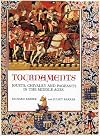
Tournaments: Jousts, Chivalry and Pageants in the Middle Ages
by Richard W. Barber
On This Page
Description
Illustrations and text describe medieval tournaments in detail.Tags
Recommendations















Member Reviews
"Tournaments were at the heart of much medieval pageantry...They combined the spectacular with all the excitement of a dangerous skillful sport, and the attendant hero-worship of its stars."
The "tournament" is a result of an evolving cultural exchange throughout the Middle Ages, originally meaning an open battlefield melee of teamed combatants. Starting in the 11th c. in Northern France with the introduction of the "couched" lance, mounted combat was called a "hastilude," whether in unified teams or joust.
In the early years, a bloody hastilude could be hosted by any number of lords, foreign or otherwise, on any public land they wished. To control disorder and utilize propaganda, tournaments were eventually royally licensed. Tournaments show more were banned or encouraged at a whim, with disobedience paid for in title or land. But a battle won, a coronation, or a royal marriage could mean a celebratory tournament. With poets and troubadours singing the praises of victorious knights and their gracious hosts, the tournament became intimately intertwined with chivalry.
The coffee-table size of this book is misleading because it isn't just a broad overview. Gorgeous illustrations accompany a detailed examination of the origin, terminology, and variations of tournaments with examples both famous and obscure. The authors explore the politics behind it all and how economy vs extravagance could make or break a host's reputation. The reader might be surprised to learn that a joust at their local Renaissance Faire or "festival," is quite similar to one in the 15th c. But Barber and Barker also explore the dangers behind the colorful banners. The effectiveness of armour meant life or death for the rider. This chapter in particular was fascinating as each region offers their own designs, alterations and improvements. A beautiful book and an excellent read! show less
The "tournament" is a result of an evolving cultural exchange throughout the Middle Ages, originally meaning an open battlefield melee of teamed combatants. Starting in the 11th c. in Northern France with the introduction of the "couched" lance, mounted combat was called a "hastilude," whether in unified teams or joust.
In the early years, a bloody hastilude could be hosted by any number of lords, foreign or otherwise, on any public land they wished. To control disorder and utilize propaganda, tournaments were eventually royally licensed. Tournaments show more were banned or encouraged at a whim, with disobedience paid for in title or land. But a battle won, a coronation, or a royal marriage could mean a celebratory tournament. With poets and troubadours singing the praises of victorious knights and their gracious hosts, the tournament became intimately intertwined with chivalry.
The coffee-table size of this book is misleading because it isn't just a broad overview. Gorgeous illustrations accompany a detailed examination of the origin, terminology, and variations of tournaments with examples both famous and obscure. The authors explore the politics behind it all and how economy vs extravagance could make or break a host's reputation. The reader might be surprised to learn that a joust at their local Renaissance Faire or "festival," is quite similar to one in the 15th c. But Barber and Barker also explore the dangers behind the colorful banners. The effectiveness of armour meant life or death for the rider. This chapter in particular was fascinating as each region offers their own designs, alterations and improvements. A beautiful book and an excellent read! show less
A scholarly study of all things tournament-related - that nevertheless manages to be an unputdownable read. It looks at the history and development of the tournament, from its thuggish beginnings to the delicate refinements of its later years, and is illustrated with magnificent contemprary images. The interplay between medieval romances, and their re-enactment as spectacle provided by the great and the good of Europe; the unsubtle economics behind some of the participants' presence, tournament wives - all are covered here. I love it!
5FTQPIBH
Ratings
Members
- Recently Added By
Author Information

67+ Works 5,587 Members
Common Knowledge
- Original publication date
- 1989
- People/Characters
- Philip the Good, Duke of Burgundy; Galbert of Bruges; Count Charles the Good of Flanders; William of Newburgh; Henry I, King of England; Henry II, King of England (show all 8); William Marshal, 1st Earl of Pembroke; Richard I, King of England
- Important events
- Lateran Council (1139); Council of Rheims (1148); Lateran Council (1179); Statute of Arms (1292)
- First words
- In the grey world of everyday life, the light and colour of pageantry has always offered an escape from mundane reality.
- Last words
- (Click to show. Warning: May contain spoilers.)The joust and its ideals belong to the glories of the past, to the pages of medieval manuscripts, and above all to the imagination, which alone can recreate these extraordinary festivals.
Classifications
- Genres
- History, Nonfiction, General Nonfiction, Art & Design
- DDC/MDS
- 394.7 — Society, government, & culture Customs, etiquette & folklore General customs Chivalry; Tournaments
- LCC
- CR4553 .B37 — Auxiliary Sciences of History Heraldry Heraldry Chivalry and knighthood (Orders, decorations, etc.) Ceremonials, pageants, tournaments, etc.
- BISAC
Statistics
- Members
- 222
- Popularity
- 147,772
- Reviews
- 3
- Rating
- (4.09)
- Languages
- English, German
- Media
- Paper
- ISBNs
- 6