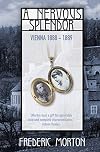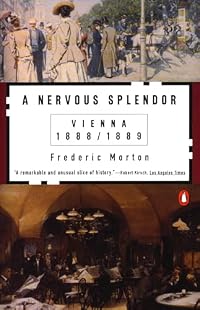
A Nervous Splendor: Vienna 1888-1889
by Frederic Morton
On This Page
Description
On January 30, 1889, at the champagne-splashed height of the Viennese Carnival, the handsome and charming Crown Prince Rudolf shot and killed his teenage mistress and then himself in a suicide pact. The two shots that rang out at Mayerling in the Vienna Woods echo still. Frederic Morton, author of the bestselling THE ROTHSCHILDS, deftly tells the haunting story of the Prince and his city, where, in the span of only ten months, "the Western dream started to go wrong." Other young men with show more striking intellectual and artistic talents--and all as frustrated as the Prince--moved through his Vienna. Among them were a young Sigmund Freud, Gustav Mahler, Theodor Herzl, Gustav Klimt, and the playwright Arthur Schnitzler, whose La Ronde was the great erotic drama of the fin de siecle. show lessTags
Recommendations















Member Reviews
Having little personal knowledge regarding the history of Austria, my first thought after finishing the book was “those poor, poor Austrians.” Their impending doom just oozed from the pages of "A Nervous Splendor."
"A Nervous Splendor" follows the lives of Brahms, Bruckner, Freud, Wolf, Klimt, Herzl, Mahler and the royal Austrian family. The book features portraits of those mentioned and illustrations of significant locations. It also includes excerpts from written correspondence and diary entries. Covering just ten months of Austrian history, this segment of time gives the reader a pretty clear picture of what made Austria great, and by the end of the book, it’s obvious where the country is headed.
Frederic Morton cleverly show more juxtaposed the drama and splendor of the arts: theater, opera, and the opulent nightly costume balls of the carnival season to the rotting decay of the archaic, inaccessible, staunchly militant government. Even the Crown Prince Rudolf could not penetrate the hierarchy to communicate effectively with his father King Franz Joseph.
It was pathetic to read about the general public - either poor starving laborers, or the small population of successful working class people. They knew their station in society and unlike other more progressive nations during that time (Great Britain and the United States), no matter how much wealth individuals accumulated, there was no middle-class. To quote Morton (Pg. 68) “Austrian nobility was ancient, exclusive, rigorously pedigreed. It treated the mushrooming burgherdom (bourgeois) like a fungus.”
With a sense of unavoidable doom bordering on hysteria, the working man had to pin his hopes on Prince Rudolf - the common man’s Prince. He was a weak, unreliable, mentally unstable, drug addict and possibly an alcoholic... but nevertheless he was their savior. Upon Rudolf’s suicidal death, the famed music critic Eduard Hanslick spoke for the Austrian people, “I have lived through revolutions, the loss of lands, murderous devastations by flood and fire - nothing of all this is comparable to the horror of January 30th” (the day Prince Rudolf died). (Pg. 267)
Morton goes so far as to imply that Crown Prince Rudolf’s suicide may have influenced the course of history. Surely it cast a black cloud over the city of Vienna and it was an omen of bad things to come. But it is hard to imagine that even if Prince Rudolf would had lived, he could have made a substantial contribution to the empire. As the story closes, Austria is suffering from rising prices, increasing anti-semitism, diminishing control over outlying territories, and overall discontent. The final page of the book is April 20th, 1889 - the birth date of Adolf Hitler.
If you are a history buff already familiar with the historical events of Austria during 1888 - 1889, you may think the story is superfluous. But the fresh observation of Austrian society and the cultural norms in that time period combined with Morton’s personal compilation of events and how those events affected Austria’s populace is both original and thoroughly captivating. show less
"A Nervous Splendor" follows the lives of Brahms, Bruckner, Freud, Wolf, Klimt, Herzl, Mahler and the royal Austrian family. The book features portraits of those mentioned and illustrations of significant locations. It also includes excerpts from written correspondence and diary entries. Covering just ten months of Austrian history, this segment of time gives the reader a pretty clear picture of what made Austria great, and by the end of the book, it’s obvious where the country is headed.
Frederic Morton cleverly show more juxtaposed the drama and splendor of the arts: theater, opera, and the opulent nightly costume balls of the carnival season to the rotting decay of the archaic, inaccessible, staunchly militant government. Even the Crown Prince Rudolf could not penetrate the hierarchy to communicate effectively with his father King Franz Joseph.
It was pathetic to read about the general public - either poor starving laborers, or the small population of successful working class people. They knew their station in society and unlike other more progressive nations during that time (Great Britain and the United States), no matter how much wealth individuals accumulated, there was no middle-class. To quote Morton (Pg. 68) “Austrian nobility was ancient, exclusive, rigorously pedigreed. It treated the mushrooming burgherdom (bourgeois) like a fungus.”
With a sense of unavoidable doom bordering on hysteria, the working man had to pin his hopes on Prince Rudolf - the common man’s Prince. He was a weak, unreliable, mentally unstable, drug addict and possibly an alcoholic... but nevertheless he was their savior. Upon Rudolf’s suicidal death, the famed music critic Eduard Hanslick spoke for the Austrian people, “I have lived through revolutions, the loss of lands, murderous devastations by flood and fire - nothing of all this is comparable to the horror of January 30th” (the day Prince Rudolf died). (Pg. 267)
Morton goes so far as to imply that Crown Prince Rudolf’s suicide may have influenced the course of history. Surely it cast a black cloud over the city of Vienna and it was an omen of bad things to come. But it is hard to imagine that even if Prince Rudolf would had lived, he could have made a substantial contribution to the empire. As the story closes, Austria is suffering from rising prices, increasing anti-semitism, diminishing control over outlying territories, and overall discontent. The final page of the book is April 20th, 1889 - the birth date of Adolf Hitler.
If you are a history buff already familiar with the historical events of Austria during 1888 - 1889, you may think the story is superfluous. But the fresh observation of Austrian society and the cultural norms in that time period combined with Morton’s personal compilation of events and how those events affected Austria’s populace is both original and thoroughly captivating. show less
A portrait of Hapsburg Vienna about a generation before its dissolution. The monarchy is a class-driven machine producing much punctilio but apparently little in the way of strategic planning. The growth of nationalism among its polyglot population is viewed by Emperor Franz Joseph with trepidation, but ultimately the official attitude is wait and see. We as readers know these nationalist pressures will tear the Empire apart in 1914 when, in Sarajevo, Serb Gavrilo Princep blows a hole in Archduke Franz Ferdinand's neck. But in 1888 the monarchy seems either oblivious or in denial, perhaps a little of both. Only Crown Prince Rudolph and those of his immediate circle possess insight into the unsustainable imperial trajectory.
The Crown show more Prince is a fascinating paradox. He's well educated and liberal, a noble who's at heart a republican. His fondest wish is to see his kind expunged from state affairs. He knows the government is in desperate need of reform. Yet despite his lofty rank, his legions of admirers, he possesses no real power to effect change. The emperor employs his intelligence apparatus to spy on him. Agents follow him about and monitor his telegrams. The burden of protocol is overwhelming, but Rudolph seems to bear up well until the visit of Kaiser Wilhelm II of Germany. The occasion is Emperor Franz Joseph's fifty-sixth birthday. Rudolph, who prefers the company of the so-called commoners to the moribund aristocracy, despises Wilhelm for his empty pan-German rhetoric. Yet he must toast him, must follow him about like a puppy, so the Kaiser won't grandstand at this or that reception about the virtues of the Greater Reich. He's stuck in this empty diplomatic role, smiling and toasting a man he despises. He's good at it. His manners are Old World. Understandably, he grows depressed.
There can be no question of Rudolph taking a mistress from among the nobility. His marriage to a cipher was a function of politics, not love. The noble ladies set their sights on him but he is emphatically not interested. Things look bleak indeed. Then he sees Mary Vetsera at one of the few social events where commoners and nobles can intermingle. At the new Court Theater they observe each other with opera glasses. Mary is 18 and Rudolph is 30. He's heard of her, of course. Mary's mother is a skillful social climber who's handed her gifts on to her daughter. Mary's a "lady of fashion" whose every new ensemble makes the society pages. Their liaisons are complex, arranged by a Vetsera family friend. There is much scuttling about labyrinthine corridors, much zigzagging about town to shake persistent tails.
Soon they are both dead from a suicide pact. Mary's corpse is spirited away by family members and buried without ceremony. Rudolph is given a funeral the likes of which are perhaps no longer seen in our day. His death rocks the empire. Of his final messages for others, he leaves not one word, not a syllable, addressed to his father.
The book is a portrait of a vanished era as much as it is a tale of star-crossed lovers. Along with Rudolph and Mary's story we're given a look at the cultural life of Vienna. The artist bios are beautifully compressed. We peek into the young lives of Arthur Schnitzler, Hugo Wolf, and Sigmund Freud--all in their twenties--as well as older established artists like Aaron Bruckner and Johannes Brahms. Vienna is a vast overwrought Baroque wedding cake. Morton brilliantly transforms the boulevard of braggadocio, the new Ringstrasse, into a fitting central metaphor for the posturing and decorum of a vast, fragmenting empire oblivious of the ticking clock. Wonderfully vivid and highly recommended. show less
The Crown show more Prince is a fascinating paradox. He's well educated and liberal, a noble who's at heart a republican. His fondest wish is to see his kind expunged from state affairs. He knows the government is in desperate need of reform. Yet despite his lofty rank, his legions of admirers, he possesses no real power to effect change. The emperor employs his intelligence apparatus to spy on him. Agents follow him about and monitor his telegrams. The burden of protocol is overwhelming, but Rudolph seems to bear up well until the visit of Kaiser Wilhelm II of Germany. The occasion is Emperor Franz Joseph's fifty-sixth birthday. Rudolph, who prefers the company of the so-called commoners to the moribund aristocracy, despises Wilhelm for his empty pan-German rhetoric. Yet he must toast him, must follow him about like a puppy, so the Kaiser won't grandstand at this or that reception about the virtues of the Greater Reich. He's stuck in this empty diplomatic role, smiling and toasting a man he despises. He's good at it. His manners are Old World. Understandably, he grows depressed.
There can be no question of Rudolph taking a mistress from among the nobility. His marriage to a cipher was a function of politics, not love. The noble ladies set their sights on him but he is emphatically not interested. Things look bleak indeed. Then he sees Mary Vetsera at one of the few social events where commoners and nobles can intermingle. At the new Court Theater they observe each other with opera glasses. Mary is 18 and Rudolph is 30. He's heard of her, of course. Mary's mother is a skillful social climber who's handed her gifts on to her daughter. Mary's a "lady of fashion" whose every new ensemble makes the society pages. Their liaisons are complex, arranged by a Vetsera family friend. There is much scuttling about labyrinthine corridors, much zigzagging about town to shake persistent tails.
Soon they are both dead from a suicide pact. Mary's corpse is spirited away by family members and buried without ceremony. Rudolph is given a funeral the likes of which are perhaps no longer seen in our day. His death rocks the empire. Of his final messages for others, he leaves not one word, not a syllable, addressed to his father.
The book is a portrait of a vanished era as much as it is a tale of star-crossed lovers. Along with Rudolph and Mary's story we're given a look at the cultural life of Vienna. The artist bios are beautifully compressed. We peek into the young lives of Arthur Schnitzler, Hugo Wolf, and Sigmund Freud--all in their twenties--as well as older established artists like Aaron Bruckner and Johannes Brahms. Vienna is a vast overwrought Baroque wedding cake. Morton brilliantly transforms the boulevard of braggadocio, the new Ringstrasse, into a fitting central metaphor for the posturing and decorum of a vast, fragmenting empire oblivious of the ticking clock. Wonderfully vivid and highly recommended. show less
"In the first July week of 1888 Mahler sat down in his childhood room at his father's house in Iglau and worked out great sound-metaphors of perdition, the first movement of his Second Symphony. He would call it Totenfeier or Death Celebration. And to [his] friend he would confess: 'It is the hero of my First Symphony I carry to the grave here. Immediately arise the great questions: Why hast thou lived? . . . Why hast thou suffered? . . . Is it all nothing but a huge, terrible joke?'"
This is a cultural history of a moment in time, less than two years, when the Hapsburg Empire was about to expire. The story of Crown Prince Rudolph and his world during the years of 1888 and 1889 touched upon the lives of many of the most famous people in show more nineteenth century history; people who would change both our parents' lives and our own in the twentieth century. Young men are part of this story and they include Sigmund Freud, Gustav Mahler, Theodore Herzl, Hugo Wolf, and Arthur Schnitzler whose La Ronde was the great erotic drama of the fin de siecle. Their cultural elders were present also and Frederic Morton, whose own grandfather lived on the periphery of the story, narrates many cultural events including the feud between Bruckner (obsessed with Wagner) and Brahms (one of whose followers was a young Arnold Schoenberg). The history reads like a novel that is both exciting and pathetic, for an era and a century and a world were coming to an end--the great war that would destroy much of what little culture survived into the new century was lurking in the relative near-mist of future history. show less
This is a cultural history of a moment in time, less than two years, when the Hapsburg Empire was about to expire. The story of Crown Prince Rudolph and his world during the years of 1888 and 1889 touched upon the lives of many of the most famous people in show more nineteenth century history; people who would change both our parents' lives and our own in the twentieth century. Young men are part of this story and they include Sigmund Freud, Gustav Mahler, Theodore Herzl, Hugo Wolf, and Arthur Schnitzler whose La Ronde was the great erotic drama of the fin de siecle. Their cultural elders were present also and Frederic Morton, whose own grandfather lived on the periphery of the story, narrates many cultural events including the feud between Bruckner (obsessed with Wagner) and Brahms (one of whose followers was a young Arnold Schoenberg). The history reads like a novel that is both exciting and pathetic, for an era and a century and a world were coming to an end--the great war that would destroy much of what little culture survived into the new century was lurking in the relative near-mist of future history. show less
A Nervous Splendour is a history book written mainly in the present tense as a snapshot of the actions and activities of a select few aristocrats and intellectuals in 1888-89 around the height of the Habsburg Empire. The central figure is Crown Prince Rudolf, beloved throughout the Empire and in particular by the female population and his story is told as the crux around which Morton's assessment of Vienna in this period unfolds. Morton also introduces musicians such as Strauss and Brahms, academics including Freud, artists like Klimt and a host of other great men who have had an impact on the wider world in the time since. Ultimately Morton's snapshot aims to portray this period in time as the death of the future in the Habsburg world show more that fell apart entirely 25 years later.
Crown Prince Rudolf is the central piece of the splendour as Morton describes the unfolding of the Ringstrasse. Morton through Rudolf's voice criticises the decadence and romanticising of history that the Ringstrasse represents set against the liberalising modernising taking place in places like the UK and the US. I can't really agree with this as the Habsburg approach to provide a sense of stability and focus to build unity around in a particularly fractious Empire was a good idea and the Ringstrasse itself remains a magnificent draw to this day. Rudolf himself is the liberal progressive who supports modernising as a means to keep the Empire intact. In reality though he is a suicidal womaniser and it is this distinction that Morton pulls out most vividly - the great hope is in fact a weak and self-destructive presence. Morton glosses over his opium and alcohol addictions but drops those in as asides just to remind the reader that this man who seems to be everything an Empire could want is fatally flawed.
The gossip style presentation of emphatuations such as Baroness Mary Vetsera are particularly well written. I am not a fan either of the subject matter or the style but Morton is an expert writer and breaks up the vocabulary and sentence structure to outstanding effect in that the history book reads close to a contemporanious novel in the present tense. What it does mean though and why I do not rate the book more highly is that there is a breathless devotion to artistic and intellectual greatness. The struggles of hard working intellectuals such as Freud are detailed as a paean to their eventual revelatory genius. I read the stories of most of these characters as being fame obsessed and do not perhaps share Morton's appreciation for their greatnesses.
The noble Emporer Franz Josef is given short shrift in the narrative. Crown Prince Rudolf's dislike of being shut out when he has so much to add is repeatedly described as a terrible blight but Rudolf's suicide is an indication that Josef was right all along. The attention drawn to the high suicide rate in Vienna is very interesting though the cases of mental illness dropped in throughout are not all that remarkable. Drawing a small snapshot of people over a small period of time can easily lead to hastily jumped conclusions. Vienna's high suicide rate at the time is characterised as a product of the enclosed intellectual space under which aspirational genius strove - the absence of a functioning and effective middle class is posited as a key reason for the collapse of Austrian power. These claims are seductive in the confines of a small snapshot but as the capital city of one of the world's major powers there is bound to have been a high allocation of brilliance.
What is impressive about this work though is the attention to detail. The study of newspapers, speeches, and correspondence must have been painstaking to reveal such focussed intimacies. To weave these into a strong narrative is a serious labour and Morton has provided an insight into the characters in existence at the time and the place in a way that most works never will. The conflict between Brahms and Bruckner is hilarious, the social climbing of the Vetsera family audacious but the extras that flow by are perhaps more fascinating than anyone - the King of the Birds being my personal favourite.
A Nervous Splendour is an excellent exposition of the people of Vienna in 1888 who went on to make a world impression but it is also a thorough and impressive description of the character of Vienna itself. The pomp and ceremony, the rising anti-Semitism, and the incredible wealth gaps help to form a view of a city and an Empire at it's height before the spectacular decline a couple of decades later. The romanticising though is at times grating and at one point Morton puts a What If on the Crown Prince Rudolf's possible role in shaping the future had he not died. I respectfully disagree and suggest the What If would have been better applied on the Crown Prince himself - it was not that Rudolf was a great loss to the world but that he was never the man he could and should have been. show less
Crown Prince Rudolf is the central piece of the splendour as Morton describes the unfolding of the Ringstrasse. Morton through Rudolf's voice criticises the decadence and romanticising of history that the Ringstrasse represents set against the liberalising modernising taking place in places like the UK and the US. I can't really agree with this as the Habsburg approach to provide a sense of stability and focus to build unity around in a particularly fractious Empire was a good idea and the Ringstrasse itself remains a magnificent draw to this day. Rudolf himself is the liberal progressive who supports modernising as a means to keep the Empire intact. In reality though he is a suicidal womaniser and it is this distinction that Morton pulls out most vividly - the great hope is in fact a weak and self-destructive presence. Morton glosses over his opium and alcohol addictions but drops those in as asides just to remind the reader that this man who seems to be everything an Empire could want is fatally flawed.
The gossip style presentation of emphatuations such as Baroness Mary Vetsera are particularly well written. I am not a fan either of the subject matter or the style but Morton is an expert writer and breaks up the vocabulary and sentence structure to outstanding effect in that the history book reads close to a contemporanious novel in the present tense. What it does mean though and why I do not rate the book more highly is that there is a breathless devotion to artistic and intellectual greatness. The struggles of hard working intellectuals such as Freud are detailed as a paean to their eventual revelatory genius. I read the stories of most of these characters as being fame obsessed and do not perhaps share Morton's appreciation for their greatnesses.
The noble Emporer Franz Josef is given short shrift in the narrative. Crown Prince Rudolf's dislike of being shut out when he has so much to add is repeatedly described as a terrible blight but Rudolf's suicide is an indication that Josef was right all along. The attention drawn to the high suicide rate in Vienna is very interesting though the cases of mental illness dropped in throughout are not all that remarkable. Drawing a small snapshot of people over a small period of time can easily lead to hastily jumped conclusions. Vienna's high suicide rate at the time is characterised as a product of the enclosed intellectual space under which aspirational genius strove - the absence of a functioning and effective middle class is posited as a key reason for the collapse of Austrian power. These claims are seductive in the confines of a small snapshot but as the capital city of one of the world's major powers there is bound to have been a high allocation of brilliance.
What is impressive about this work though is the attention to detail. The study of newspapers, speeches, and correspondence must have been painstaking to reveal such focussed intimacies. To weave these into a strong narrative is a serious labour and Morton has provided an insight into the characters in existence at the time and the place in a way that most works never will. The conflict between Brahms and Bruckner is hilarious, the social climbing of the Vetsera family audacious but the extras that flow by are perhaps more fascinating than anyone - the King of the Birds being my personal favourite.
A Nervous Splendour is an excellent exposition of the people of Vienna in 1888 who went on to make a world impression but it is also a thorough and impressive description of the character of Vienna itself. The pomp and ceremony, the rising anti-Semitism, and the incredible wealth gaps help to form a view of a city and an Empire at it's height before the spectacular decline a couple of decades later. The romanticising though is at times grating and at one point Morton puts a What If on the Crown Prince Rudolf's possible role in shaping the future had he not died. I respectfully disagree and suggest the What If would have been better applied on the Crown Prince himself - it was not that Rudolf was a great loss to the world but that he was never the man he could and should have been. show less
I'm think I probably wouldn't wholly agree with the sweeping conclusions and metaphors in this book, but they are exquisitely rendered. Overall, an enthralling (and fast-paced) work, I would recommend it to anyone who enjoys narrative nonfiction.
Fascinating account of a small period of time in Vienna's history. Memebers of the Habsburg dynasty are the main players but all sorts of other characters, each worthy of a seperate biography, are drawn into the tale; from Freud to Hitler.
Made me want to read more about the Habsburgs and their tragic lives which have shaped the destinies of Europe and, strangely, Mexico.
Made me want to read more about the Habsburgs and their tragic lives which have shaped the destinies of Europe and, strangely, Mexico.
This one reminded me of Solomon Volkov's cultural history of St. Petersburg: that isn't a compliment.
I think two stars in closer to an estimation. As the narrative shed its filler in the second half, fewer peeks into the diaries of Freud and Mahler, their was a whsiper of verve. The figure of Crown Prince Rudolf is a curious one, but one they maintains the enigma.
I think two stars in closer to an estimation. As the narrative shed its filler in the second half, fewer peeks into the diaries of Freud and Mahler, their was a whsiper of verve. The figure of Crown Prince Rudolf is a curious one, but one they maintains the enigma.
Members
- Recently Added By
Author Information

21+ Works 1,926 Members
Frederic Morton was born Fritz Mandelbaum on October 5, 1924 in Vienna, Austria. He fled with his family to Britain in 1939 and immigrated to New York City the following year. The senior Mandelbaum changed the family name in order to join an anti-Semitic labor union. Morton went to a trade school and became a baker. He later attended City College show more of New York and Columbia University, where he studied literature. His best-known work was The Rothschilds, about the banking family, which became a Broadway show. His other nonfiction works included A Nervous Splendor: Vienna, 1888-1889, Thunder at Twilight: Vienna 1913-1914, and a memoir, Runaway Waltz. He wrote several novels during his lifetime including The Hound, The Schatten Affair, Snow Gods, An Unknown Woman, and The Forever Street. In 2002, the city of Vienna distributed 100,000 copies of The Forever Street to residents for free. He received the Cross of Honor for Arts and Sciences in 2003. He died on April 20, 2015 at the age of 90. (Bowker Author Biography) show less
Awards and Honors
Common Knowledge
- Canonical title*
- Schicksalsjahr Wien 1888/89
- Alternate titles*
- Ein letzter Walzer. Wien 1888/89
- Original publication date
- 1979
- People/Characters
- Franz Joseph, Emperor of Austria; Elisabeth, Empress of Austria; Rudolf, Crown Prince of Austria; Mary Vetsera; Princess Stéphanie of Belgium; Gustav Klimt (show all 22); Gustav Mahler; Sigmund Freud; Sarah Bernhardt; Johannes Brahms; Josef Bratfisch; Anton Bruckner; Franz Ferdinand, Archduke of Austria; Theodor Herzl; Maurice de Hirsch; Nathaniel Rothschild; Franz Salvator; Arthur Schnitzler; Katharina Schratt; Johann Strauss; Moritz Szeps; Hugo Wolf
- Important places
- Vienna, Austria; Austro-Hungarian Empire; Austria-Hungary; Mayerling, Austria-Hungary; Ottakring, Vienna, Austria; Budapest, Hungary
- Important events
- Mayerling Incident (1889)
- Dedication
- to M. C. M.
to Felicia and Lester Coleman, for so much
and to my parents, my two dearest Viennese - First words
- On Friday, July 6, 1888, the price of sugar went up from forty to forty-two kreuzers a kilo in Imperial Vienna.
- Last words
- (Click to show. Warning: May contain spoilers.)They named their little one Adolf.
*Some information comes from Common Knowledge in other languages. Click "Edit" for more information.
Classifications
- Genres
- History, Nonfiction, General Nonfiction, Biography & Memoir
- DDC/MDS
- 943.613 — History & geography History of Europe Central Europe: Germany, Austria, Switzerland, Czech, Poland, Hungary Austria and Liechtenstein Vienna, Lower Austria, Burgenland Vienna
- LCC
- DB851 .M6 — History of Europe, Asia, Africa and Oceania Austria – Liechtenstein – Hungary – Czechoslovakia History of Austria. Liechtenstein. Hungary. Czechoslovakia Local history and description Vienna
- BISAC
Statistics
- Members
- 786
- Popularity
- 35,308
- Reviews
- 15
- Rating
- (3.92)
- Languages
- English, German, Hungarian
- Media
- Paper, Ebook
- ISBNs
- 8
- ASINs
- 20