On This Page
Description
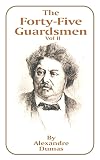
Fans of historical fiction will delight in this action-packed account of Henri III's court and the secretive plot to exact revenge upon the murderer of the leader of the royal guards. From the romantic intrigue and entanglements among the aristocrats to the painstakingly executed ambush plan, every detail is brought fully to life in this engrossing novel..
Tags
Recommendations





























Member Reviews
Phew! I’m done with the Valois trilogy and am feeling a little disappointed, the first time with a Dumas book. The ending was very rushed and so much additional drama and intrigue was ignored and all I got was a few sentences in an epilogue. Bah. I’ve been told that Dumas had a framework for his story and whatever didn’t fit didn’t get in regardless of how great or useful it could have been.
This book follows more closely in time to Chicot than Chicot did with Queen Margot and the action takes a while to get to. There are set ups to be constructed as well as some true identities to come to light. I figured out both of them and so I don’t think they were meant to be mysterious to the reader. Which reminds me, the reader is show more addressed directly many times throughout the story and I kind of like that. No one does it today that I know of. The whole thing opens with an execution scene which introduces some new players, but goes unexplained for 200 pages. Crazy.
Basically we’ve got the same factions fighting over King Henri III’s throne. He has no heirs and everyone considers him a fool so of course he should be gotten rid of and someone more suitable put in place. We’ve got the de Guise faction (cousins), the Duc d’Angou (brother) and the Navarre faction (King Henri, married to Margot, Henri III’s sister). Prudent heads have recruited 45 bourgeoisie to reinforce the king’s already large security detail. Within these 45 some rivalries and factions arise and those are fun. Some of them just stay within the 45, but others get pulled into rival factions to infiltrate the king’s inner circle. Gorenflot makes some memorable appearances, as does Chicot and the beleaguered Diana.
Her situation was the most frustrating for me to endure and I put the book down for a day or so because I was just so sick of men treating her, at best, like some prize to be won, and at worst, their rightful property to be possessed entirely at their whim. Now Bussy is dead, she feels her life is over and she wants to die, but since it will doom her to hell, she wants to retire to a convent. Not before she takes her revenge on the Duc d’Angou, however. It was touch and go that she’d actually have the agency to do so, she’s that much a passive creature to be sent for, imprisoned, insulted or cast aside as some man may wish. She is forever the untouchable, noble virgin of the piece and boy it was tiring.
There’s a lot more, as is usual with Dumas’s books. I’m happy to have read these even if the whole Diana thing did make me a bit sick. Given our current president, things really haven’t changed and I don’t know why men have to continue to behave as if I have no humanity, no identity and no agency. It’s stupid, destructive, unnecessary and deeply insulting. Why, men, why? show less
This book follows more closely in time to Chicot than Chicot did with Queen Margot and the action takes a while to get to. There are set ups to be constructed as well as some true identities to come to light. I figured out both of them and so I don’t think they were meant to be mysterious to the reader. Which reminds me, the reader is show more addressed directly many times throughout the story and I kind of like that. No one does it today that I know of. The whole thing opens with an execution scene which introduces some new players, but goes unexplained for 200 pages. Crazy.
Basically we’ve got the same factions fighting over King Henri III’s throne. He has no heirs and everyone considers him a fool so of course he should be gotten rid of and someone more suitable put in place. We’ve got the de Guise faction (cousins), the Duc d’Angou (brother) and the Navarre faction (King Henri, married to Margot, Henri III’s sister). Prudent heads have recruited 45 bourgeoisie to reinforce the king’s already large security detail. Within these 45 some rivalries and factions arise and those are fun. Some of them just stay within the 45, but others get pulled into rival factions to infiltrate the king’s inner circle. Gorenflot makes some memorable appearances, as does Chicot and the beleaguered Diana.
Her situation was the most frustrating for me to endure and I put the book down for a day or so because I was just so sick of men treating her, at best, like some prize to be won, and at worst, their rightful property to be possessed entirely at their whim. Now Bussy is dead, she feels her life is over and she wants to die, but since it will doom her to hell, she wants to retire to a convent. Not before she takes her revenge on the Duc d’Angou, however. It was touch and go that she’d actually have the agency to do so, she’s that much a passive creature to be sent for, imprisoned, insulted or cast aside as some man may wish. She is forever the untouchable, noble virgin of the piece and boy it was tiring.
There’s a lot more, as is usual with Dumas’s books. I’m happy to have read these even if the whole Diana thing did make me a bit sick. Given our current president, things really haven’t changed and I don’t know why men have to continue to behave as if I have no humanity, no identity and no agency. It’s stupid, destructive, unnecessary and deeply insulting. Why, men, why? show less
Después del tomo anterior, esta novela decae un poco. La trama sigue siendo entretenida aunque los protagonistas (Salvo Chicot) no tienen el mismo interés pero sufre el lastre de que, a diferencia de las anteriores, esta entrega da la sensación de ser una novela incompleta. Tanto La reina Margot como La dama de Monsoreau se tienen tramas que se prolongan a otros libros, pero son claramente novelas autónomas que se pueden leer independientemente mientras que en esta casi todo queda abierto en espera de una posible continuación que Dumas nunca realizó.
A continuation of the story started in Queen Margot and Chicot the Jester. It basically deals with Diana de Meridor and her servant Remy who find a way to take revenge. The story ends with their vengence taken - but it leaves much to be desired in the story of Henry III's battle against the Duc de Guise and the events that lead up to the reign of Henry IV of Navarre and the founding of the Caput dynasty of the house of Bourbon. Still a good yarn, it perhaps was juicier in French than the Victorian translation that I read.
This is a sequel to La Dame de Monsoreau (aka Chicot the Jester), wherein Henri III and Francois d'Anjou and the de Guises amuse themselves with politics, Henri du Bouchage seeks love, Diane de Monsoreau seeks vengeance, and Henri de Navarre begins to collect his wife's dowry. Throughout this, Chicot, in one guise or another, interweaves his observations and connects the plots.
illustration has tissue guard printed with caption. Very attractive binding in black cloth with floral decoration on covers and spines in light green and orange. Spine titles are gold, most very bright, a few slightly rubbed.
age wear - cover separating, otherwise in good cond. - Publisher: THOMAS NELSON & SON, NY,
Members
- Recently Added By
Lists

Books Read in 2017
4,249 works; 130 members

French Fiction of the 18th and 19th Centuries in English Translation
169 works; 3 members

Books in The Club Dumas
72 works; 1 member
Author Information

1,609+ Works 98,567 Members
Some Editions
Awards and Honors
Series

Belongs to Publisher Series
Work Relationships
Is contained in
Contains
Has the adaptation
Common Knowledge
- Canonical title
- The Forty-Five Guardsmen
- Original title
- Les Quarante-cinq
- Original publication date
- 1847
- People/Characters
- Henri III, King of France; Chicot; Brother Gorenflot; Francois d'Anjou; Henri IV, King of France (Henri de Navarre); Diane de Monsoreau (show all 7); Henri du Bouchage
- Important places
- Paris, France; Antwerp, Antwerp, Belgium; Cahors, Occitanie, France
- Original language*
- Français
*Some information comes from Common Knowledge in other languages. Click "Edit" for more information.
Classifications
Statistics
- Members
- 313
- Popularity
- 102,066
- Reviews
- 11
- Rating
- (3.76)
- Languages
- 10 — Danish, Dutch, English, French, German, Italian, Latvian, Russian, Spanish, Swedish
- Media
- Paper, Ebook
- ISBNs
- 61
- ASINs
- 40